
Stay up to date with all Nonwovens Industry content by subscribing to our newsletter.
.mobile-only {
display: none;
}
.scroll_to_continue:after {
content: ‘F282’;
position: absolute;
content: ‘F282’;
top: 21px;
transform: translateY(-50%);
right: 16px;
width: 10px;
height: 15px;
background-repeat: no-repeat;
background-size: 10px 15px;
background-position: center center;
font-family: “Bootstrap-icons”;
opacity: 1;
font-size: 16px;
right: 100px;
}
@media only screen and (max-width: 768px) {
.mobile-only {
display: block;
}
}
var labelText = “SCROLL TO CONTINUE”; //set custom “advertisment” awareness text label
var clickMacro = “/users/signupnewsletter/5” //set clickURL destination
var linkTarget = “_blank” //set link target attribute, by default “blank”
var hei = document.documentElement.clientHeight * 0.65;
/* == generator code == */
var container = document.getElementById(“inscroll-banner”);
//container.setAttribute(“style”,”height: 121vh; position: relative; margin: 55px 0;”);
var adlabel = document.createElement(“div”);
adlabel.classList.add(“scroll_to_continue”);
var lt = document.createTextNode(labelText)
adlabel.appendChild(lt);
//adlabel.setAttribute(“style”,”position:absolute; z-index:9; margin-top:-26px; color:#FFFFFF; background-color:#603577; text-align:center; width:100%; left:0;font-size:14px; padding:3px 0; height:26px”);
adlabel.setAttribute(“style”,”position: relative; z-index: 9; top: 21px; color: #FFFFFF; background-color: #603577; text-align: center; width: 200px; left: 0;font-size: 14px; padding: 0;line-height: 50px; margin: 0 auto;”);
var inner = document.getElementById(“banner-core”);
//inner.setAttribute(“id”,”banner-core”);
//inner.setAttribute(“style”,”width: 100%; top:49px; left: 0; clip: rect(0,100vw,100vh,0); overflow-x: hidden; overflow-y: auto; position: fixed; -webkit-transform: translateZ(0); -moz-transform: translateZ(0); transform: translateZ(0);”);
//var art = document.createElement(“img”);
//art.setAttribute(“src”,imagePath);
//art.setAttribute(“style”,”width:100%”);
//inner.appendChild(art);
//inner.appendChild(cm);
container.appendChild(adlabel);
//container.appendChild(inner);
window.onscroll = function(){
var pos = container.getBoundingClientRect();
inner.style.clip = “rect(“+pos.top+”px,100vw,”+pos.bottom+”px,0)”;
}
window.onscroll();
A.Celli Nonwovens
A.Celli Nonwovens, a market-leading Italian manufacturer with over 80 years of experience, specializes in advanced machinery for the nonwovens industry.
Under the E-Wind brand, it provides a complete range of Master Roll Winders and Slitter Rewinders for spunbond, spunmelt, spunlace and airlaid reels, all tailored to meet diverse production needs.
Its product portfolio also includes:
- F-Line turnkey solutions for lamination, medical treatment, spooling and 3D embossing/aperturing
- Iridium flexographic printers for PP/PE film, nonwovens and tissue
- Cloud-based Industry 4.0 applications for real-time monitoring, production optimization and anomaly detection
- R-Way systems for automatic packaging, material handling and warehousing
Focusing heavily on intralogistics, A.Celli acquired key companies and launched Smartlogistix, a brand new company dedicated to plant intralogistics. This enables the supply of:
- Modular automated packaging lines
- AGVs and AMRs for handling materials and reels of any size
- ASRS solutions with WCS/WMS software for internal management
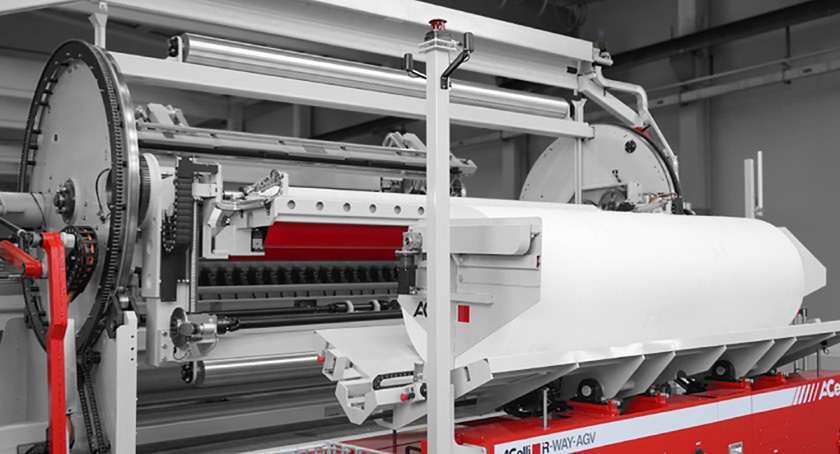
Supported by 2-Care Customer, A.Celli delivers complete, integrated solutions for maximum performance.
Andritz
Natural fibers such as hemp and flax are increasingly used in nonwovens and textiles due to their renewable nature, low environmental footprint and excellent performance characteristics.

Andritz provides integrated solutions covering the entire natural fiber value chain—from decortication, refining and cottonizing to airlay, carding, hydroentanglement and needlepunch technologies. These solutions ensure efficient fiber preparation, consistent product quality, and reliable processing of natural and recycled fibers.
To support product development and reduce investment risks, Andritz offers customer trials at its technical centers in France. Under production-like conditions, customers can test fibers, optimize processes and validate new product concepts before industrial implementation. This “first test, then invest” approach helps accelerate innovation and ensure project success.
Autefa Solutions
As a leading supplier of turnkey nonwoven production lines and machinery, Autefa Solutions provides complete solutions for carded-crosslapped needlepunch lines as well as airlay, spunlace, thermobonding and ATB processes. Drawing on decades of experience from Autefa Solutions and its predecessor companies, Autefa, Fehrer, For, Octir and Strahm Hi-Tex, machines and production lines from these brands continue to operate reliably worldwide. Comprehensive engineering services cover start-up and production support as well as quality and capacity guarantees.
The LineONE series offers advanced, cost-efficient solutions tailored to diverse industry requirements. A key product within this portfolio is the StylusONE Needle Loom—smart performance and smart investment – manufactured by Autefa Solutions in China.
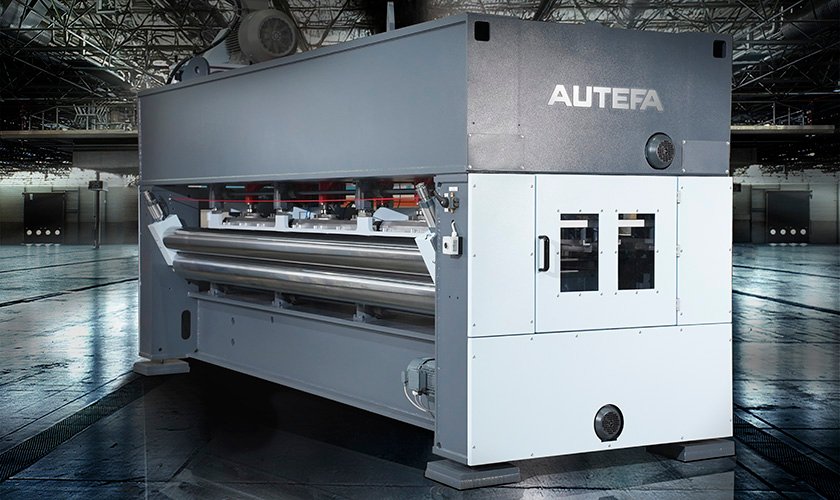
In addition to new machinery and production lines, tailor-made upgrade and modernization solutions help manufacturers improve performance, process reliability and product quality while extending the service life of existing equipment. Services range from electrical and software updates to the refurbishment of individual machines and complete production lines, enabling manufacturers to remain technologically current and position their operations for future growth.
V-Slot Flex technology can reduce energy consumption by an average of 27% on spunlace lines.
For thermobonding and ATB processes, Autefa Solutions offers assessment and engineering services aimed at reducing specific energy consumption, increasing production capacity and improving product quality. Existing processes are evaluated and, where appropriate, modified to achieve measurable improvements with manageable investments. For spunlace lines, regardless of brand, Autefa Solutions delivers significant energy-saving potential through its V-Slot Flex leakage-free suction technology. The system achieves high performance at equivalent vacuum pressure with reduced airflow and improved dewatering efficiency, resulting in average energy savings of 27%. Through the continuous modernization and upgrading of existing nonwovens plants, Autefa Solutions supports manufacturers in reducing operating costs, improving production efficiency and substantially lowering the environmental footprint of their operations.
Balemaster
A market leader in the baler industry since 1946, Balemaster provides innovative solutions based upon solid engineering, expertise and experience.
As nonwoven baling needs have changed over the years, Balemaster has continually responded by offering products capable of cost-effectively meeting any automatic waste handling challenge. Whether a customer bales diaper trim or personal care products, airlaid, drylaid, or wetlaid, a baler from Balemaster can be outfitted to best suit a customer’s specific requirements. Its goal is to make customers’ baling processes more profitable.
Balemaster’s E-Series balers are a perfect match for this industry. The E-Series is the flagship of the Balemaster auto-tie baler line. These balers are fully automated, so man-hours are kept to a minimum, allowing workers to concentrate on other things. The heavy-duty automatic wire-tier completes the tie-off cycle in less than 30 seconds. Balemaster’s unique bale density control system automatically and continuously regulates the tensioning pressure and creates the proper squeezing force to achieve the highest bale density possible. No adjustments are required.
Add to all of this, energy-efficient hydraulic power packs available up to 225 horsepower that meet any capacity demand, along with a comprehensive touch screen controller, and customers have a baler equipped with the features and benefits to keep up with any demand the industry has to offer.
Beta
Beta has been in love with Equipressure since the early 1960s, when Beta technicians first developed a new roll that could remain perfectly parallel when pressure was applied on it. Its team was successful in creating the first version of the Beta-Roll. Since then, several improvements have been added, and today the new Beta-Roll-HS tops 120 N/mm, a max speed of 300 m/min, and a length of 7,000 for large geotextile webs.
Equipressure does all the tricks: when a pressure is applied to the roll, the internal shaft bends, while the outer rubber-coated sleeve remains perfectly flat. The working pressure is evenly distributed along the surface of the roll. This is its major strength: the web is squeezed with a uniform pressure, thus giving a perfect finishing result.
The advantages of Equipressure are many: no more chemical stains or puddles on the web; reduced water and chemicals use; water reuse; limited sewage; and drastically lowered use of energy during the drying phase. But the most important aspect is that the web gets the highest possible quality. With these benefits, Equipressure becomes the new trend in sustainability.
A best-selling application of Equipressure is the Beta Differentiated Equipressure Padder used for impregnation on wet. It features two impregnations (the first with water and the second a chemical) and two squeezes: the first is between the two lower rolls, and the second is between the two upper rolls. These two squeezes can be both independently set between zero and the maximum pressure. It’s like having two two-roll padders in one. For this machine, Beta has 2000 references in the world since the mid 1960s.
BTSR
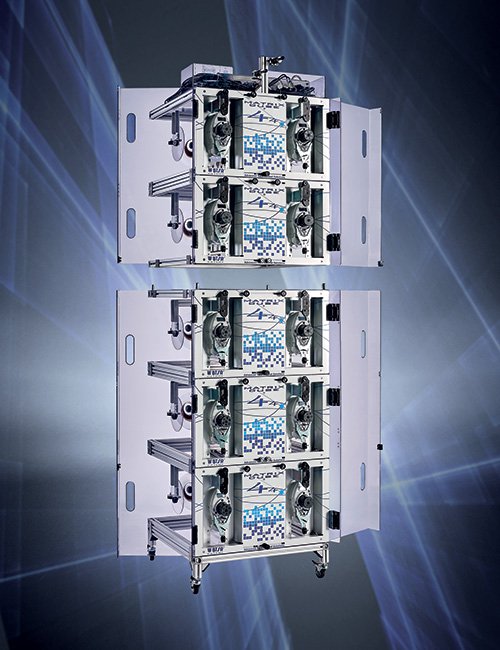
Over the past decades, BTSR has consistently introduced innovative tension-controlled unwinding systems (MCC, MCC2, MCC3, and Trio-Loop). Now, the company is introducing MCC44, the next-generation BTSR Creel specifically designed for Low Dtex yarns, by setting a new benchmark in compactness and performance.
Specifically designed for thinner and Low Dtex spandex yarns, MCC44 is focused on space reduction, usage simplicity and cost-per-position reduction.
Keeping modularity as a unique feature of BTSR system configurations, MCC44 represents a concrete response to the growing market demand for Low Dtex applications in the hygiene industry.
Thanks to an optimized internal layout, MCC44 comes equipped with n. 2 devices for each creel cube, by accommodating two ‘DIAPERFEEDER’ feeders and two ‘TFS’ Tension and Metering Sensors in the same compact space, thus ensuring improved productivity without increasing the creel size.
This brings a ‘High-Density Column’ Layout (up to 12 devices per column), making it the most space-efficient creel in the BTSR portfolio and a unique solution in the market.
Easy-to-extract drawers allow seamless elastic bobbin replacement, thus reducing machine downtime and simplifying maintenance.
A dedicated new pulley version has been developed for MCC44, featuring color-coded super low-friction materials to ensure gentle, precise yarn handling for very fine denier.
Further key updates in the MCC44 version:
- New design offering double possibility to extract the spool
- Each pull out drawer has its own spool change sensor HTHS
- The rounded and bevelled shape of the new reel holder has been specifically optimized to prevent the spandex from getting caught during unwinding, by ensuring a smoother and safer yarn path
- A new compact circular anti-balloon device is available for both left and right positions, each equipped with a pair of self-threading rollers and a modular ceramic guide to avoid static and improve yarn flow
Bucci Industries Group
Vire and Zeta, both part of Bucci Industries Group, combine their expertise in a unified synergy that covers the entire packaging process for single-use hygiene products, from bagging to case-packing.
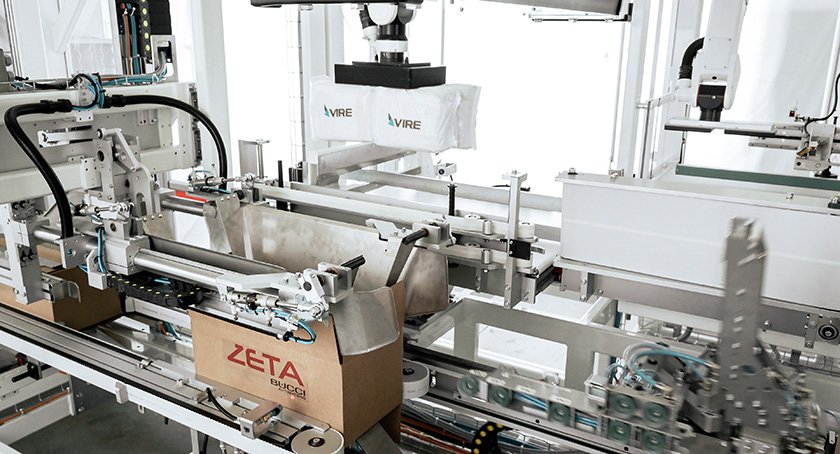
The two brands operate as one coordinated technological partner, integrating primary and secondary packaging technologies with complex, fully engineered conveyor systems, shared line configuration and controls, and product inspection at both the infeed and outfeed of each machine, supported by comprehensive customer service.
Within the production line, Vire manages the stacking and bagging stages, while Zeta handles secondary packaging. Mechanical interfaces and control systems are developed to support communication between the machines and maintain a stable product flow throughout the different packaging stages.
For manufacturers, working with Vire and Zeta means managing the packaging project through a single industrial partner. Line layout, machine interfaces and commissioning can be coordinated from the initial engineering phase, reducing the complexity that often arises when equipment from separate suppliers must operate together.
This integration is also reflected in the operator experience. Vire and Zeta machines share a common web-based HMI platform, providing a consistent user interface, operating philosophy and navigation across the entire packaging line. Beyond creating a familiar environment for operators, the web architecture enhances scalability, simplifies software lifecycle management and facilitates continuous evolution of the system. The result is faster operator onboarding, reduced system complexity and a more efficient production environment.
The same coordinated approach applies to after-sales activities: shared technical knowledge allows the service team to identify issues across the complete packaging line and coordinate interventions without dividing responsibilities between unrelated suppliers.
Common mechanical and software principles also make maintenance and spare-parts management easier for plant personnel.
The Vire and Zeta synergy combines two specialized areas of packaging technology while preserving the specific expertise of each brand. Customers receive a line developed around the complete process and supported by a single technical team covering both Vire and Zeta solutions.
www.vire.it / www.zetamachines.com
Chase Machine and Engineering
Since 1954, Chase Machine and Engineering has been designing and building custom converting equipment to process films, foils and woven/nonwoven/knit fabrics, while controlling speed, tension and guidance. It specializes in integrating technologies such as ultrasonics, impulse welding, hot air welding, adhesive dispensing, RF welding, band sealing, extruders and CO2 lasers.
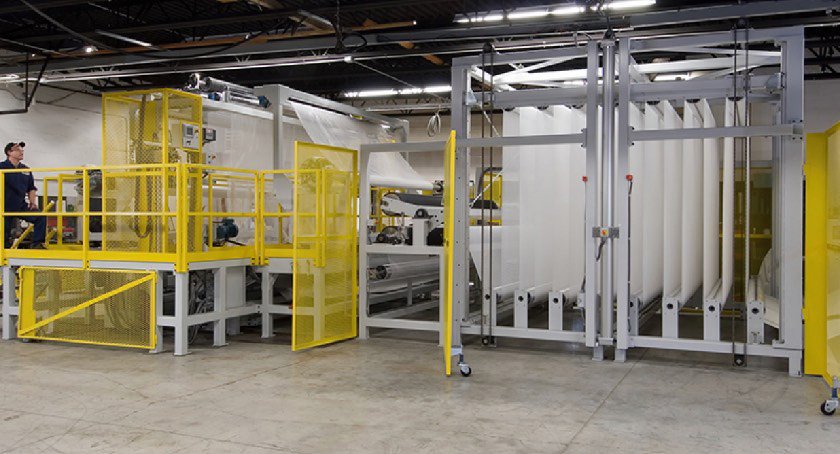
Chase Machine manufactures unwinds, rewinds, slitters, laminators, traverse winders, cut-to-length machines, festooners, accumulators, ultrasonic sewing machines as well as custom machines. Its equipment is utilized in the manufacturing of consumer products such as face masks, wipes, safety vests, air/liquid filters, medical devices and hygiene products. Chase Machine uses its 70 years of web handling experience to benefit customers in the filtration, medical, packaging, automotive, textile and geotextile market segments
Dilo Group
Needled nonwovens for the carpeting and home furnishing sector, including automotive interior components, have been relying on the Dilo developments of the 60s, 70s, and 80s: DI-LOOP, DI-LOFT, and DI-LOUR. Using these needling technologies, it became possible to give flat carpet surfaces a new structure through pile formation in the thickness direction using fork needles, lamella tables, brush aprons and disk rollers. Even today, this sector is interesting with particular emphasis on supplies to offices, contract space in general, and to some extent, home flooring.
Particularly in the car, the light material made on DI-LOUR machines, including patterning capabilities, is playing an important role when moldability and light weights build a good match, offering many advantageous features, including cost reductions.
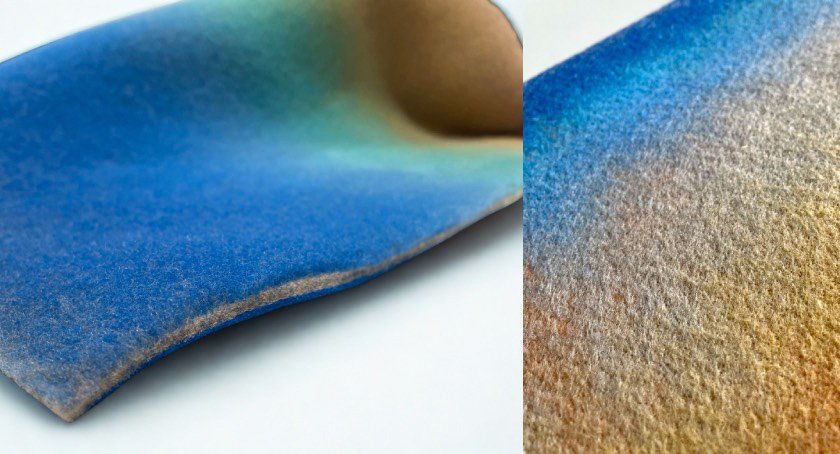
Recently, Dilo presented a new concept within the principle of additive manufacturing by applying colored sliver out of the spinning to be fed into individual segmented opening and small airlay devices arranged across the width of the material before entering a needle loom. Needling consolidates and fixes the colored fibrous material onto a flat substrate of felt in various amounts in MD and CD direction.
This application process is electronically controlled by a program. The software offers a very flexible way to add floral, geometric patterns, or other designs with a resolution of e.g. one inch by one inch when placing the fibrous additions onto a flat needled substrate. Higher resolutions within smaller segments are within reach.
The additive manufacturing process, as an underlaying principle of the 3D-Lofter process, provides an endless array of programmed patterns and even illustrations. One example of this is named “Sliding Colours” where shades of colors are applied in a transient changing amount, which offers many modern possibilities to deviate from geometric or floral designs. Even individualized designs for floor and wall coverings or automotive interiors are envisaged.
The 3D-Lofter device can be easily attached to existing needling lines in a rather simple manner. The sliver is sourced from spinning mills in a cost-efficient way and can be considered a commodity item.
More recently, room partitions are made available in thick fibrous structures stiff enough as flat stand-alone panels where the 3D-Lofter can add individual and attractive colored designs on these surfaces. The amount of additional fiber can be easily adjusted and adapted to create a very cost-effective and inexpensive design feature.
Elsner Engineering Works
For nearly 90 years, Elsner Engineering Works has helped manufacturers increase productivity through innovative automation, custom machinery and complete converting line solutions.
More than a machine builder, Elsner is a full-service engineering and manufacturing partner. The company designs, builds, integrates and supports complete production systems tailored to each customer’s products, processes and manufacturing objectives.
Whether a project requires a single machine, a fully integrated converting line, or an entirely new manufacturing process, its engineering team works alongside customers to develop solutions that improve throughput, enhance quality, reduce labor and maximize long-term reliability.
Elsner’s capabilities include:
- Complete converting production lines
- Custom machine design and development
- Automation and controls engineering
- Material handling and product transfer systems
- Precision machining and fabrication
- Machine assembly and factory acceptance testing
- Equipment modernization and controls upgrades
- Spare parts, field service, training and lifecycle support
Elsner serves manufacturers across the paper, nonwovens, filtration, medical, packaging, film, foil and specialty converting industries, delivering purpose-built solutions designed around each customer’s unique application—not forcing their process into a standard machine.
Every project is backed by decades of engineering expertise and a commitment to craftsmanship, innovation and responsive customer support.
Whether a customer is expanding capacity, launching a new product, replacing aging equipment, or developing a process that has never been automated before, Elsner has the engineering experience to turn any vision into production reality.
Emmebi Impianti
In 1989, Emmebi Impianti started operating in aerotextile filtration and air conditioning, distinguishing itself for high-quality solutions designed for Italian fashion brands.
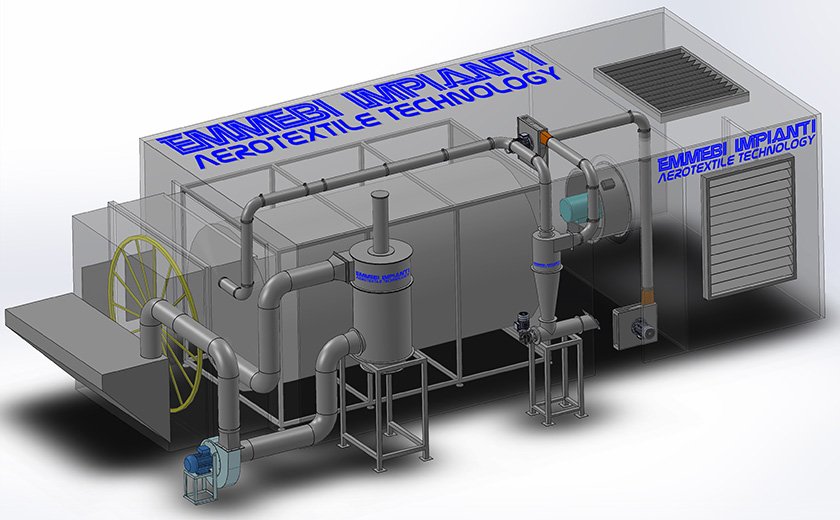
In 2000, starting from its great experience in the textile sector, Emmebi shifted its focus to nonwovens, and it created specific solutions for first medical and hydroentangled products.
Emmebi has grown steadily, becoming a solid reality in filtration, conditioning and waste recovery for all types of nonwovens, wipes and disposables, as well as a quality and efficiency benchmark for all medical and spunlace applications, installing more than 1000 systems for the largest manufacturers in the world.
The company offers solutions for every type of production process using synthetic and natural fibers, cellulose powder, SAP, extruded and man-made fibers, and it can offer a project-leading service for engineering and complete turnkey plant realizations.
In the last year of the pandemic, the company has confirmed itself in the nonwoven sector, and it will carry out an expansion of its production plant with the integration of industry 4.0 and 5.0 technologies, in order to improve competitiveness and flexibility. With the automation and robotization of its key processes, Emmebi aims to create the most automated production plant in Italy for the production of aerotextile systems.
Goldenrod Corporation
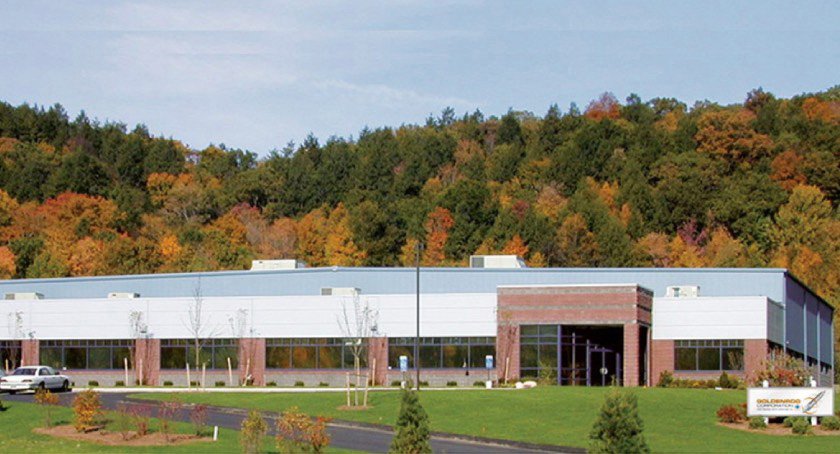
Goldenrod Corporation (USA) and Svecom (Italy) combine to be a world leader in core holding technology. They supply air shafts, expanding chucks, safety chucks and a full line of shaft handling/roll handling options for the nonwovens industry. Their easy to maintain, light weight, multi-bladder air shafts come standard on many OEM supplied machines from Europe and North America. Goldenrod has a large manufacturing facility in Beacon Falls, CT, and can supply lightweight, cost-effective aluminum extrusions for 3″, 4″, 5″, 6″, 6.75″ and 8″ ID cores. They can also make custom shafts in diameters ranging from 0.5″ to 36″ and above. Goldenrod engineers take pride in asking all the right questions and coming up with the best, long-term solutions for customers.
Herrmann Ultrasonics
With the latest advancement in ultrasonic machines from Herrmann Ultrasonics, producers of hygiene products gain more time and flexibility. Through Herrmann’s newly released Microbond System G4, customers can now be supported virtually in downtime situations while minimizing the service cost through fast response time and reduction in travel.
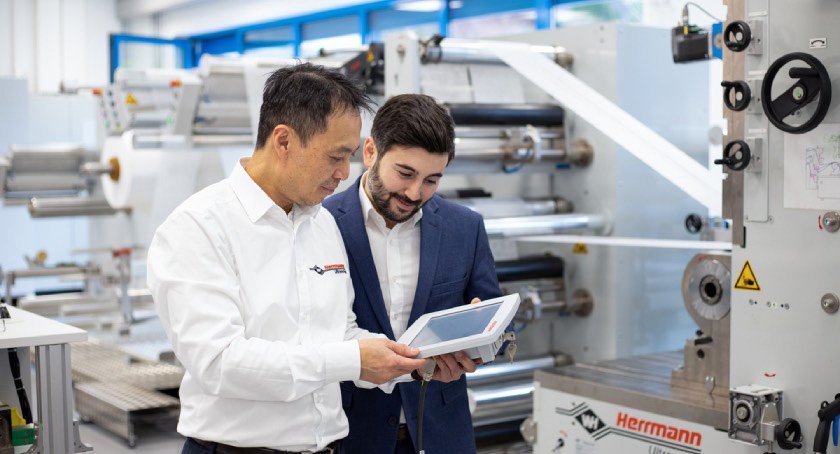
When a customer encounters a system issue, they can contact a Herrmann service technician via the Remote App. The technician can then access the system virtually, providing support as if they were on-site through a secure connection. Additionally, this feature enables secure uploads of backups, updates and configuration files to ensure the customer’s production remains uninterrupted.
Herrmann guarantees reliability, safety and immediate support when a customer is in need. Its service technicians act as trusted advisors throughout the production process and are available to assist at any stage, whether that be the best equipment selection for an application or production support. With over 60 years of ultrasonic experience, customers can rely on Herrmann’s safe and efficient joining technology. Embodying the motto, “Bonding – More than materials,” Herrmann works closely with their partners worldwide to ensure the highest quality product is produced while continuously improving relationships globally.
Hills, Inc.
Since 1971, Hills, Inc. continues to be a world leader in the development and commercialization of fiber extrusion equipment for high-value specialty fibers and nonwovens. Hills equipment is in operation throughout North America, Europe and Asia. Customers may work in Hills’ and various partners’ laboratories to develop multicomponent and nanofiber meltspun products.
Hills’ core technology is its proprietary method of creating precision polymer flow passages to extrude exquisitely complex fiber cross sections containing multiple polymers. Hills offers R&D support, extrusion equipment (for spunbond, meltblown, staple, filament and monofilaments), upgrades of existing extrusion machines, and small-scale, high-value fiber and fabric contract manufacturing. Hills is also a world leader in supplying lab-scale fiber extrusion equipment for customers’ use in their own laboratories.
Hills is working on several programs in the field of sustainability. Hills was a pioneer in the supply of extrusion equipment for customers using recycled PET in fibers. Other sustainability programs that Hills is working on include:
- Joint development programs that are developing starch additives that create PP biodegradability.
- Development of easy split spunbond fibers. This process will limit energy required to produce micro fibers.
- Micro and nano fibers in filtration. This process has higher filtration with less fabric weight and lower pressure drop.
- Hills’ patented lofty spunbond process that produces lofty nonwovens in one step and can optionally be made to loft at site of use which reduces shipping and storage resources in insulation, filtration, etc.
- Hills patented self-set carpet fibers (no heat setting required of cable/twisted yarns).
- Self crimping fibers that make fabrics with less fabric weight.
- Patented instant color change technology to reduce waste when changing melt colors.
- Hills is also working on numerous other continuous developments in Hills In-House fiber labs with customers developing various biologic, recycle and other sustainability technologies.
Isra Vision
Isra Vision, a global leader in surface inspection solutions, has launched NoWo.Inspect, a next-generation inspection system designed exclusively for the nonwovens industry. This innovative solution addresses the sector’s growing demand for higher quality standards, transparent reporting and streamlined production processes.
The nonwovens market faces increasing pressure from brand owners for zero-defect products and unified quality documentation. At the same time, manufacturers are challenged by skills shortages and the complexity of traditional inspection systems. Isra Vision NoWo.Inspect meets these needs with a user-friendly, highly automated platform that simplifies operation while delivering uncompromising precision.
Key features of NoWo.Inspect include dedicated defect classification, which tracks defects by type, severity and origin, enabling systematic root cause analysis and targeted corrective actions. GSM monitoring detects deviations from target GSM in real time, allowing immediate adjustments to production parameters and reducing material waste.
Additionally, standardized settings ensure consistent inspection results across shifts and production runs, minimizing human error and variability. NoWo.Inspect also features lifecycle services and digital tools including predictive maintenance, remote support and continuous software upgrades to secure long-term reliability and performance.
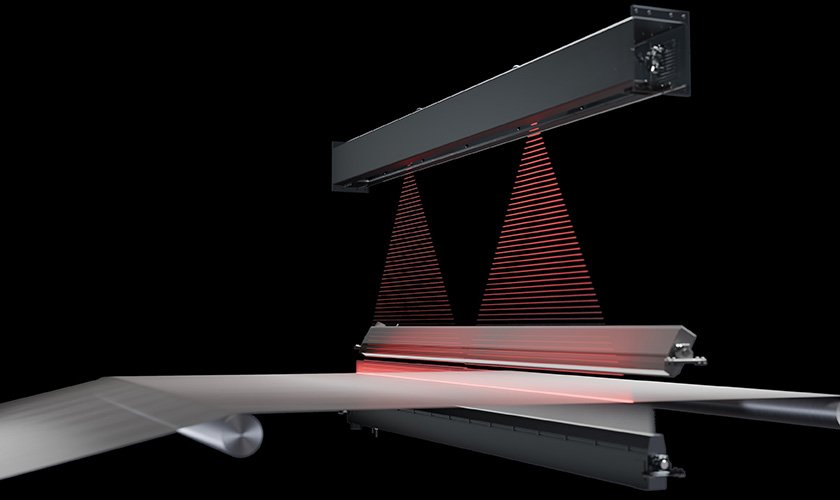
NoWo.Inspect empowers producers to achieve improved quality and consistency, process optimization, waste reduction and cost savings and competitive advantage.
Isra Vision works closely with line builders and machine manufacturers to ensure seamless integration of NoWo.Inspect into existing production environments. The system can be customized to fit specific machine designs and operational requirements, creating a perfect synergy between inspection technology and production equipment. This collaborative approach guarantees optimal performance and simplifies implementation for OEM partners.
By combining cutting-edge machine vision with intuitive operation, NoWo.Inspect delivers a future-proof solution that adapts to evolving industry demands. Manufacturers gain a powerful tool to reduce complexity, maximize productivity and secure long-term success in a rapidly changing environment.
Maxcess
Maxcess designs, engineers and manufactures many innovative solutions for the nonwovens industry. From end-to-end, Fife, Tidland, RotoMetrics, International Cutting Die (ICD), MAGPOWR, Componex, WEBEX and Valley Roller products are designed to run better together so customers run better, faster and smarter. Nonwoven highlights include:
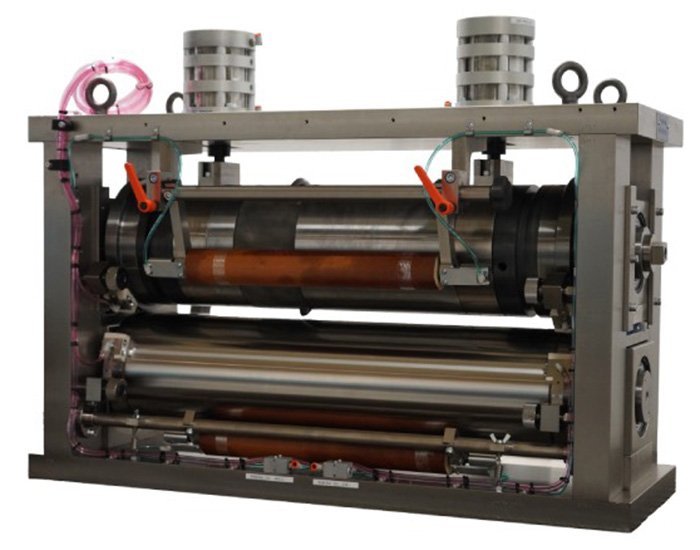
International Cutting Die (ICD) AntiBounce Technology – Patented die station move the pressure cylinders from the outer side frames inward, adjacent to the cut – eliminating bounce and transforming the application from wide web to narrow web performance, delivering greater yield and less die damage. (US Patent—US.11.292.148 B2)
Fife-500 MAX Web Guiding System—Fife-500 Max Web Guiding System: The next-generation of advanced web-guiding technology from Fife, the Fife-500 Max features an intuitive five-inch color touchscreen interface with multiple languages, newly designed sensors for enhanced resolution and accuracy, a smoother 8-pole motor for better guiding at slow speeds and an all-new modern design. The Fife-500 Max represents the future of guiding from Fife, the company that invented the first web guide back in 1939. The Fife-500 Max can accommodate web widths up to 1200 mm, with maximum tension up to 800 N.
Componex Plasma Rolls—Componex Plasma Idler Rolls provide exceptional wear resistance and consistent coefficient of friction, preventing material damage, slippage, adhesive build-up or static issues during nonwoven converting applications, even at high speeds.
Fife DSE-17 Digital Sensor—Fife DSE-17 Sensor is a digital wideband infrared sensor designed to address the challenges of web guiding in industries where materials exhibit variations in opacity or density, including the production of personal hygiene products.
Megadyne
As manufacturers in the hygiene and nonwovens sector continue to push for higher production speeds, greater product consistency and stricter hygiene standards, reliable belting technology has become increasingly important across every stage of production.
To address these challenges, Megadyne, a power transmission manufacturer since 1957, has developed a dedicated range of high-performance belts and complete belt systems for personal care and hygiene applications.
Designed for continuous operation in high-speed manufacturing environments, Megadyne solutions support precise product handling, reliable synchronization and consistent performance across complex production lines.
The portfolio covers the entire manufacturing process – from raw material handling and web forming to stacking and end-of-line packaging – helping manufacturers maintain smooth operations, reduce unplanned downtime, and achieve stable product quality.
Engineered for disposable hygiene applications such as diapers, sanitary pads, tissues, towels and wet wipes, Megadyne belts combine durability with application-specific engineering to meet the demanding operational and hygiene requirements of modern nonwovens production.
“Meeting strict FDA requirements in personal care applications is a challenge we embrace. Every belting solution we develop is engineered to deliver the right balance of efficiency, reliability and hygiene performance – whatever the application,” says Shaun Pretorius, Megadyne’s global industry segment manager for Personal Care and Hygiene.
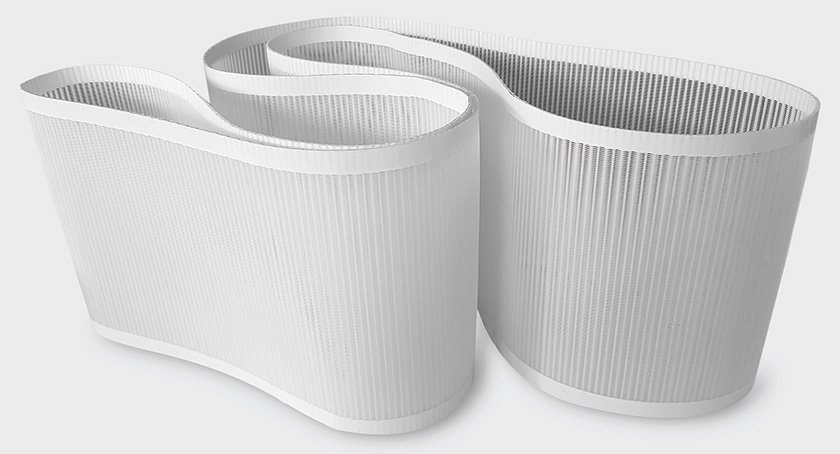
Whether supporting web forming, core assembly, product transfer, or final packaging, Megadyne belts are designed to deliver reliable performance in some of the most demanding production environments.
- Precise handling across high-speed production lines
- High wear resistance for extended service life
- Compliance with FDA and ISO hygiene standards
- Production speeds up to 550 m/min and 1,200 ppm
- Lower total cost of ownership (TCO)
Megadyne’s hygiene solutions portfolio includes a range of standard and special reworked belts developed to support efficiency, cleanliness, and reliable operation across demanding production environments:
- MEGALINEAR family– Polyurethane timing belts offering dimensional stability, chemical resistance, and customizable coatings for hygiene applications.
- MEGASYNC family – Rubber endless timing belts engineered for high-performance synchronization.
- MEGAFLAT – Truly endless flat belts designed for smooth product handling, flexibility and energy efficiency.
- HYBRID Vacuum Belts – Combining the advantages of timing and flat belts for synchronized and efficient vacuum handling, even at high production speeds.
- SPIRAFLEX – Screen conveyor belts with sealed edges designed to help prevent contamination and ensure safe product transport.
In the personal care and hygiene industry, every production line has unique requirements. That is why Megadyne combines advanced belt technology with application expertise to develop solutions tailored to specific operational needs.
From customized metal drive components to specialized belt solutions, Megadyne brings together engineering knowledge, innovation and close collaboration to help customers achieve their production goals.
Megadyne is part of AMMEGA, a global group uniting leading brands in power transmission and conveyor belting – including Ammeraal Beltech, a leader in conveyor belting manufacturing.
Mezger Inc.
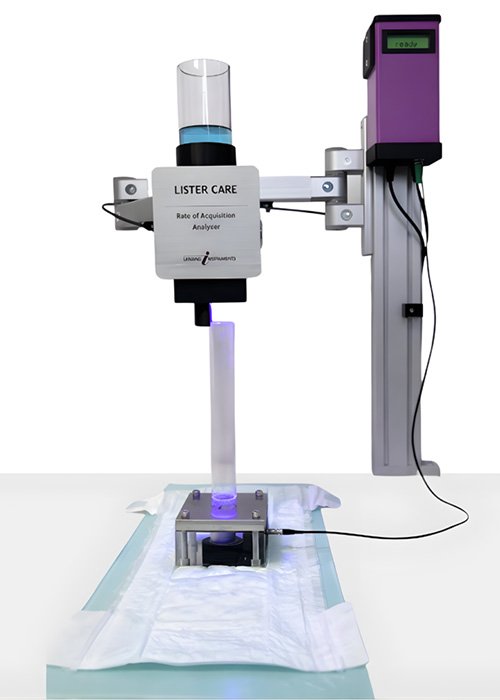
Mezger is the exclusive North America and Mexico distributor of Lister Care, a Rate of Acquisition (ROA) tester manufactured by Austria-based Lenzing Instruments.
ROA measures how quickly an absorbent hygiene product (baby diapers, adult briefs, underpads, fem care) pulls liquid from the surface into its core, a critical factor in leakage prevention and consumer comfort. Lister Care automates this traditionally manual, operator-sensitive test, delivering precise, repeatable results aligned with global protocols including EDANA NWSP 070.9.R1 (23) and NAFC Rewet and ROA.
The instrument delivers test fluid at a controlled rate using standardized funnels or calibrated pumps, then records acquisition time from fluid contact to the disappearance of surface wet sheen. Adjustable dosing positions, selectable load and configurable volumes and flow rates let labs adapt testing to different product designs, core constructions and development stages.
By replacing manual timing and judgment with controlled dosing and exact measurement, Lister Care delivers objective, reproducible and comparable fluid-intake data. Therefore, reducing errors, improving consistency and supporting standards-compliant product development and optimization.
Sonobond
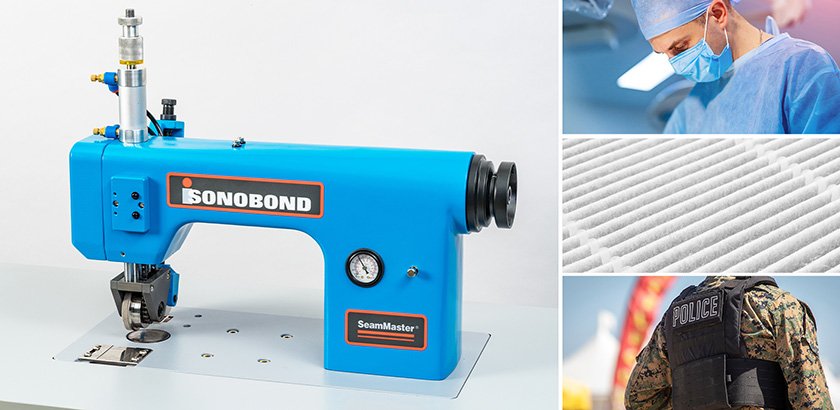
Ultrasonic bonding is a fast, efficient method of joining synthetic textiles using high-frequency vibrations and pressure. Sonobond offers advanced ultrasonic systems that can quickly assemble products including PPE, filters and automotive components. Ultrasonics outperform sewing and adhesive joining methods, creating secure barrier seams and bonded edges without stitch holes, glue gaps, fraying or unraveling. Since there are no perforations, these systems are ideal for producing safe, compliant medical garments and disposable nonwovens.
Performance benefits:
- Bonds up to 4x faster than traditional sewing.
- Bonds up to 10x faster than adhesive methods.
- Seams and trims in one efficient step.
- Ultrasonic bonding is ideal for products where speed, precision and hygienic processing are essential. The materials must be composed of at least 60% synthetic properties.
- Medical & PPE: Face masks, surgical gowns, wound dressings and sterilization pouches.
- Protective Gear: Ballistic-resistant materials without stitch holes that meet NIJ standards.
- Automotive: Headliners, seat covers, door panels, acoustic insulation and cabin air filters.
- Sonobond provides a range of equipment to meet many assembly needs. Each machine is user-friendly and requires minimal training to operate efficiently.
- SeamMaster Ultrasonic bonding machine: seal, trim and bond synthetic fabrics in a single pass without thread or adhesives.
- LaceMaster Ultrasonic bonding machine: produce customizable seams up to two inches wide.
- PlungeBonder Ultrasonic bonder: join large, thick or multi-layered materials; commonly used for assembling box-style filters and sealing filter bag ends.
- RingMaster Ultrasonic bonder: attach heavy felted filter bags to rigid plastic collars in under 10 seconds without the need for adhesives or thread.
- Sonobond’s ultrasonic bonding systems are ideal for many nonwoven applications.
Thwing-Albert
Nonwoven producers face a unique testing challenge: a single roll of material may need to perform completely differently depending on its end use—soft and absorbent for a hygiene product, rigid and puncture-resistant for a filtration medium, tear-resistant for protective apparel. That range calls for specialized instruments. Thwing-Albert’s ProGage Touch thickness gauge (NWSP 120.1/120.6) catches loft and density variation that affects both feel and function. Its ProTear Elmendorf tear tester (NWSP 100.1) flags weak points in bonding or fiber orientation before they become field failures. Its Handle-O-Meter (NWSP 090.3) puts a number on the subjective “hand” that hygiene and personal care customers judge a nonwoven by.
Where a lab can consolidate is tensile, tear, burst and puncture testing—properties a single universal testing machine (UTM) can cover when configured with the right fixtures and software. Thwing-Albert’s VantageNX runs grab and strip tensile, ball burst and puncture resistance to NWSP 110.1, 110.4 and 110.5, ISO 9073 and ASTM D5034/D5035, so R&D developing a new nonwoven and QC validating daily production work from the same platform and the same data.
That combination—dedicated instruments where specialization matters, a shared UTM where it doesn’t—is what Thwing-Albert, an ISO 9001-certified and ISO/IEC 17025-accredited manufacturer, builds its nonwovens testing line around: catching drift in raw material or process before it becomes a customer complaint.
Toscotec
Founded in Italy in 1948, Toscotec specializes in the design and manufacturing of turnkey projects, complete machines, rebuilds and stand-alone systems for the tissue, paper & board, and nonwovens industries.
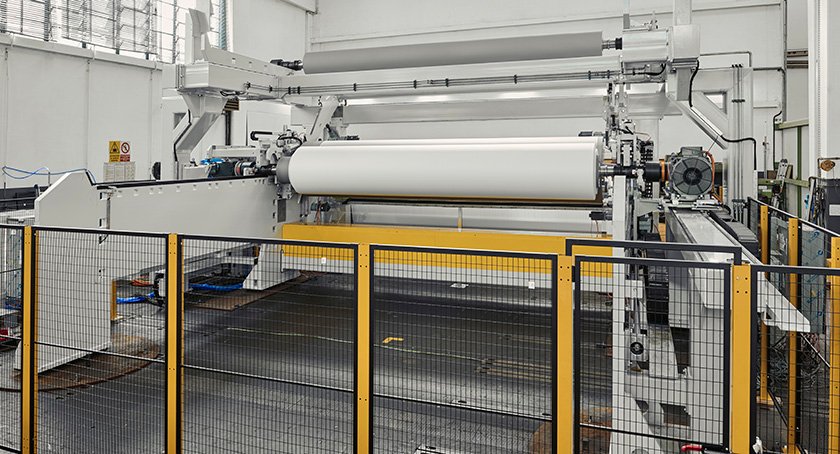
Toscotec’s Nonwovens End Line is a new generation of winding, rewinding and packaging systems for all types of nonwovens production, focusing on maximum control, product care and high efficiency. The core objective is to deliver advanced solutions that preserve the initial nonwovens properties—from the winding of the parent reel to the final product and transportation.
The company’s tailor-made approach allows the design of systems for medium and high-performance plants, including electromechanical and pneumatic winders, rewinders and automatic handling systems.
Winders:
The Optima Winders NW are electromechanically actuated and equipped with nip control for the roll and an efficient tension control system. The automation through a high-level mechanical construction allows efficient operations which preserve the web characteristics.
Key features:
- Tension control
- Nip control
- Roll changing system (saw, scissor, and paper strip)
- Empty shafts storage for reels changing
- Automatic bridge crane for empty shafts
- Slow rotation of the master roll during storage
- Mother reel carriage (lateral exit) 180°-reel rotation
Rewinders:
Toscotec has developed a closed-loop tension and nip control system using load cells. This enables the rewinder to perform and maintain the product characteristics and high operational efficiency, specifically preserving thickness and finished reel density.
Key features:
- Shorter unwind stand path
- Short path between slitting and winding
- Manual or automatic slitting positioning
- Tension control
- Nip control (closed loop) in the 1200 and 1800 types
- Automatic shaft handling, core cutting, and positioning
- Finished reel kick out made by pushing instead of kicking
Packaging systems:
A fully automated packaging solution designed to streamline reel handing, wrapping, and data integration.
Key features:
- Reel transferring from rewinder to packaging
- Preparation of finished reel into bundles
- Reel (core and external) and bundle weighing and labelling
- Reel wrapping, pallet application and second wrapping
- Robotized operation
- Customer ERP integration
- Defect management
WEIMA
For more than 40 years, WEIMA has been a world leader in size reduction technology. WEIMA’s machinery line for the nonwovens industry aims to maximize an operation’s profits and safety while decreasing mess and excess waste.
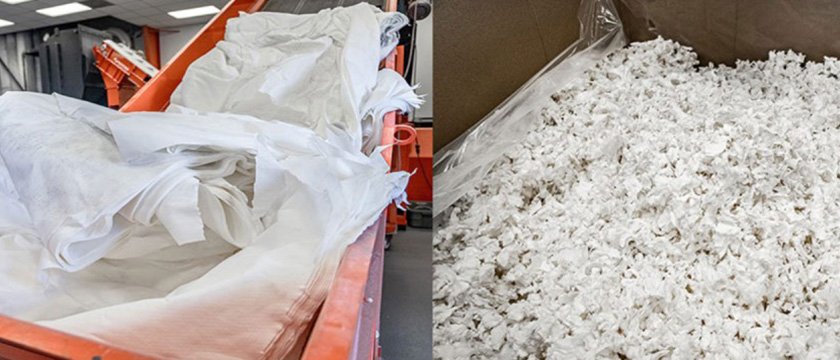
Shredding is often the first step in recycling for many materials, including nonwovens. The WEIMA WLK singleshaft shredder series offers many custom options for the recycling and reintegration of nonwoven materials. The F+ Rotor is most often used for the initial destruction of nonwoven products. It can be outfitted with bolted or welded knife holders and is ideal for shredding filament-based materials (the “F” in “F+ Rotor” stands for “filaments”). WEIMA also offers a chilled rotor option for those materials that have lower melting points.
Up to 9:1 compaction ratio with WEIMA’s briquette presses, reducing disposal costs.
The dust that is created when nonwoven material is cut can be both messy and extremely dangerous in production environments. Installing a briquette press at the discharge of the dust collection system can help eliminate dusting in the plant and increase overall safety. A dust collection system can pneumatically convey any residual dust into a covered briquette press. This eliminates the need for an employee to spend time cleaning up and transporting the dust and keeps the nearby machinery functioning in a dust-free environment. WEIMA briquette presses use pressure (not adhesives) to compress dust into small, hockey-puck-shaped briquettes. With a compaction ratio of up to 9:1, briquetting can save a company money in dumpster haul-away costs alone. Fewer dumpsters being hauled away means a bigger bottom line and a smaller environmental footprint.
The post 2026 Machinery & Equipment Review appeared first on Nonwovens Industry.


