
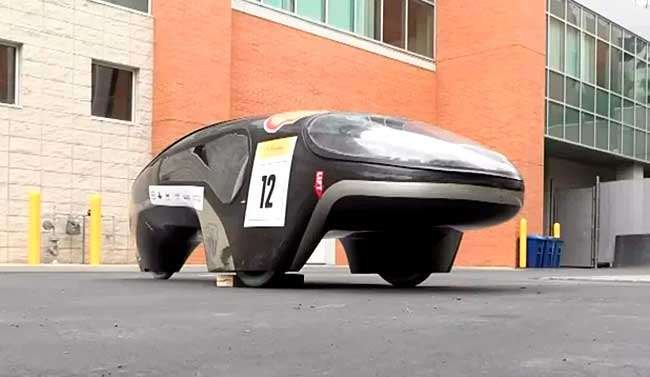
In an era dominated by discussions of kilowatt-hours and range anxiety, a group of engineering students from Brigham Young University (BYU) has reminded the world that the internal combustion engine is far from a dead technology. Their creation, a lightweight vehicle simply named “Supermileage,” has achieved a fuel economy figure that sounds like a misprint: 2,145 miles per gallon.
To put that into perspective, that is approximately 0.11 liters of fuel per 100 kilometers—enough energy to theoretically drive from Provo, Utah, to New York City on a single gallon of ethanol . This isn’t a theoretical exercise; it is a championship-winning demonstration of engineering prowess that pushes the boundaries of physics and efficiency.
The Science of “Super”
The Supermileage vehicle, which won the Shell Eco-marathon Americas for the third time in four years, is not a production car; it is a purpose-built prototype designed to solve a single equation: how to extract the maximum possible distance from a minimum amount of energy .
The formula for its success is rooted in three core principles: extreme weight reduction, obsessive aerodynamics, and powertrain optimization.
The Weight of Efficiency
The most astonishing statistic regarding the BYU vehicle is its weight. The car tips the scales at just 108 pounds (approximately 49 kilograms) . To achieve this featherweight status, the team stripped the vehicle of all “creature comforts.” There is no air conditioning, no radio, and no heavy suspension components. The chassis and body are constructed from ultra-light carbon fiber, a material commonly found in Formula 1 cars and high-end aerospace applications .
This weight reduction is critical. In automotive engineering, every pound saved reduces the energy required to accelerate and maintain speed. The vehicle is so small that it has strict driver requirements: the pilot must be no taller than 5-foot-4 and weigh no more than 120 pounds .
The Aerodynamic Teardrop
To complement its low mass, the Supermileage vehicle boasts a teardrop-like aerodynamic profile designed to slice through the air with minimal resistance. At the vehicle’s optimal speed of just 23 mph, aerodynamic drag is the primary force the engine must overcome. By designing a body that minimizes the coefficient of drag, the students ensure that the small amount of energy produced by the engine is used for forward motion rather than fighting the wind .
Fuel and Finesse
Interestingly, the engine does not run on standard pump gasoline. The team utilizes ethanol, which, while containing less energy per gallon than gasoline, allows for a higher compression ratio, leading to greater thermal efficiency . The fuel tank itself is a testament to the vehicle’s efficiency—a tiny 30-milliliter container, roughly equivalent to a single shot glass, holds the fuel for the competition run .
However, achieving the 2,145 mpg figure requires more than just engineering; it demands driver finesse. “If you drove your car so that you never used the brake, so that you were just rolling to a stop at every stop sign, every stoplight, you would get a much higher miles per gallon out of your car,” explained Dr. Dale Tree, the team’s advisor . The driver must maintain a steady throttle, avoid braking, and manage momentum to maximize the vehicle’s potential.
A Blueprint for the Future
While the BYU Supermileage vehicle is impractical for daily use—it’s essentially a three-wheeled cocoon on wheels—its implications are profound. As the global automotive industry pivots toward electrification, the lessons learned from extreme efficiency projects like this are invaluable.
The engineering challenges faced by the BYU students—weight reduction, aerodynamic optimization, and energy management—are the very same challenges facing manufacturers of electric vehicles. As seen with the University of Michigan’s Supermileage team, which is transitioning to a battery-electric vehicle aiming for the equivalent of 4,000-5,000 mpg, the competition continues to drive innovation .
The Supermileage team’s success proves that even with a technology as mature as the internal combustion engine, there is still room for radical improvement . It serves as a powerful reminder that “efficiency” is not just about the fuel source, but about the intelligent, rigorous application of engineering principles to reduce waste.
The post 2,145 MPG Car Puts the Super in Supermileage first appeared on Green Tech Gazette.


