
Carl Brubacher’s swine operation produces about 1.5 million gallons of manure, and short springs and wet falls make field application a challenge.
Enter the newest addition to his farm arsenal, 360 Rain, an autonomous irrigation system for manure, nutrients and water.
“It’s just a game changer in how to take manure to a growing crop, getting it on the crop when it needs it,” said Brubacher, Carlotte Ag owner, during the Grand River Robotics 360 Rain demonstration day his family hosted near Arthur.
“It just simply made sense in many ways.”
Why It Matters
Ontario farmers are increasingly looking for solutions to offset potential drought stressors and maximize inputs for increased yields.
“It’s slow and steady growth,” said Henry Hutton, of Grand River Robotics, adding there are currently 15 systems running in Ontario, five on dairy operations, nine on hog operations and one in potatoes.
“Probably 60 per cent of our machines are applying some kind of manure or digestate,” confirmed Loren Weaver, 360 Yield Center regional manager, from Morton, Illinois.
“The most important (benefit) is the manure application in season on growing crops, the irrigation part and being able to mix water with those nutrients to get it down into the soil correctly.”
The system is so effective, Brubacher is already supplementing it with digestate and coloured water, adding the latter offsets well-water use, which is another bonus.
360 Rain system basics
A well, lagoon or reservoir delivering 200 to 250 GPM with 115 psi at the well or hydrant is needed.
The field-edge base station requires 110v AC and includes an electric panel pre-wired to power the machine’s GPS and cellular network, inputs for up to four pressure or flow sensors, and up to eight relays for wells, booster pumps and injector pumps.
The optional 360 Rain Liquid Station injection system provides an integrated variable-rate speed pump for water, fertilizer and manure application needs.
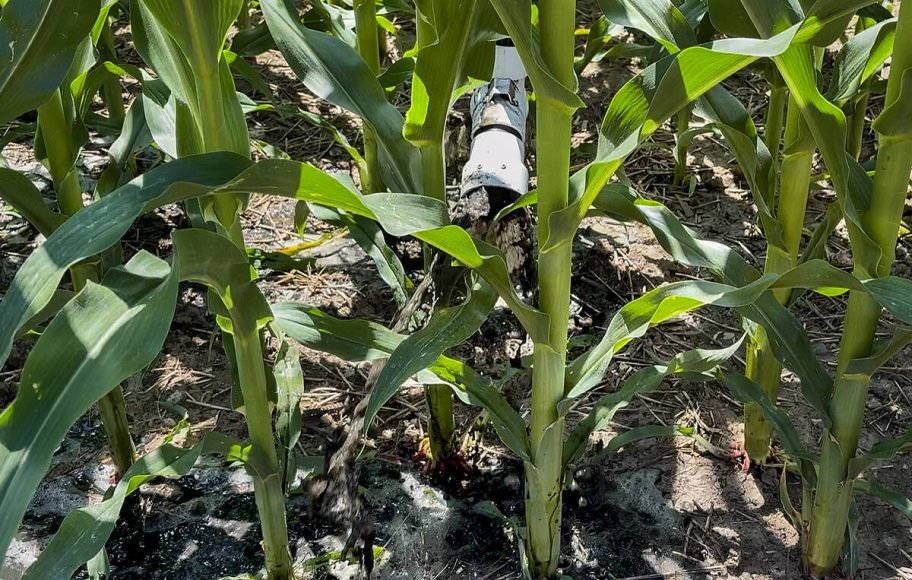
Y-DROP or flat-fan style drop hoses deliver water and nutrients in a 15-inch band at the plant’s root zone, reducing evaporation.
The 24-horsepower diesel engine burns 1.89 litres of fuel per hour, with a run-time of up to 600 hours on a single fill, travelling at 4.2 inches per second.
It can cover a 200-acre field in a week with a 10,000-gallon application rate.
No edge of field turns
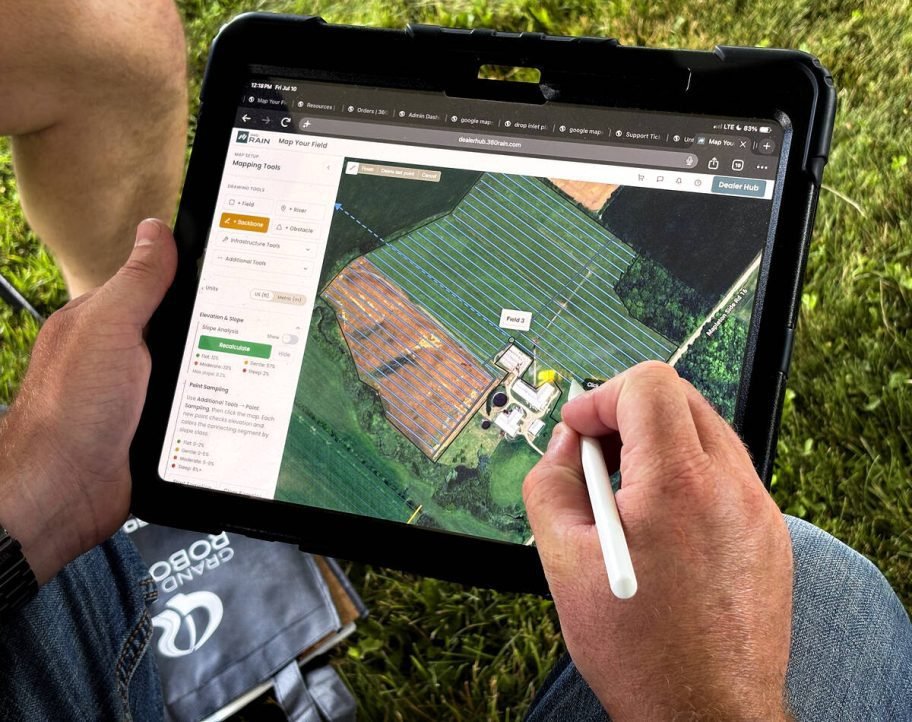
The machine is tethered to a field riser that provides a “backbone” delivering inputs or water to the 3,000 feet of three-inch hose that it unfurls and rolls up through its travels.
One riser provides coverage for 160 to 200 acres.
Available in a 60- and 80-foot boom, the machine’s GPS syncs with the planter to stay inside the 30-inch rows, and can work in corn, wheat, alfalfa and potatoes, said Weaver.
Matching the machine to the planter helps ensure easy alignment, he explained.
For example, a 30- or 60-foot planter would be matched with a 60-foot machine, and a 40-foot planter would be matched with an 80-foot machine, he said.
The 360 Rain follows the pre-made path using geo-fencing and sensors to avoid damaging the crop, while outside hoses apply inputs or water while moving away from the riser and the interior ones are used on the return to reduce compaction.
Pivot versus 360 Rain
When compared against the traditional pivot circular pathway, the 360 Rain shines with its ability to negotiate obstacles, run square or irregular patterns and non-traditional field shapes.
It uses approximately 40 per cent less water but delivers twice the benefit, and wind has little to no effect on drift and evaporation due to its banded drops.
For example, the company stated that if 69 per cent of a 205-acre farm were irrigated with a pivot applying 0.8 inches per acre per week with a 700 GPM water flow consumption rate, it would use 4.06 million gallons per week.
On the same field, 360 Rain could provide 100 per cent coverage at 0.35 inches per acre per week at 200 GPM and use only 1.47 million gallons per week, providing the equivalent of 0.7 inches per acre per week benefit because it’s banded at the base of the plant.
Field and yield benefits
When asked what his yield expectations are during the 360 Rain’s inaugural season, Brubacher estimated 260 bushels an acre.
“If we keep getting heat, we should be able to get there,” he hedged, adding that a recent update to the 360 Rain system allows for a prescription option for variable-rate application across the field.
Brubacher said field application into a closed canopy reduces volatilization while delivering nutrients for immediate and easy uptake.
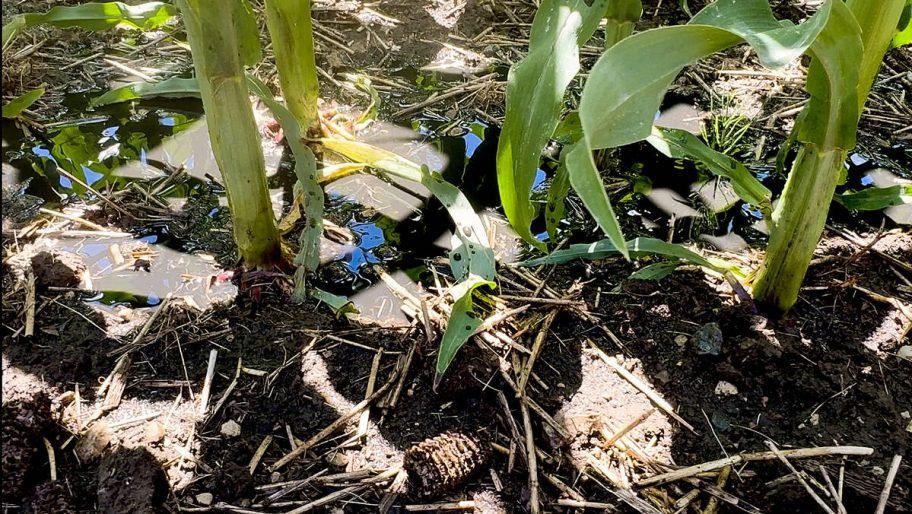
For him, there’s an added benefit of the heat plus moisture equation: earthworms, increased soil connectivity and resilience.
“People ask what the payback is, and it’s unknown,” he admitted, saying weather over the next decade or two is a factor.
“There’s benefits we can’t measure initially — benefits to the soil and the environment, which will only improve over time.”
The post 360 Rain cuts evaporation and expands field irrigation coverage appeared first on Farmtario.


