
Bringing it Together
In the first three parts of this series, we explored what nutrients plants need, where they come from, and how living organisms use them. In Part 4, we’ll examine how those nutrients move through the ecosystem.
Nutrient cycling is the continuous exchange of elements between soil, plants, microbes, animals, and the environment. By exploring processes like mineralization and immobilization, you’ll see that soil is far more than a nutrient reservoir. It’s a living, dynamic system, and understanding these natural cycles can help producers improve nutrient efficiency, reduce input costs, and build more resilient agricultural systems by working with nature rather than against it.
Natural Nutrient Cycling in the Soil
The term “nutrients” will be used moving forward, but remember they are simply atoms giving and taking electrons, and they’re all very important. Now, the Nutrient Cycle is the wildly complex collective movement of every single shape-shifting nutrient throughout the environment. Our understanding of the natural cycling of nutrients has increased dramatically as our scientific tools have improved. We now know that many nutrients cycle together, while others antagonize each other. We know that some nutrients like to become solids, while others prefer to be liquid or gaseous. We also know that water, wind, and other abiotic forces of nature move nutrients throughout the landscape, while living organisms consume and excrete others. Abiotic forces of nature tend to move the Nutrient Cycle along very, very slowly, while living biological entities move nutrients at light speed, comparatively.
Organic vs Inorganic
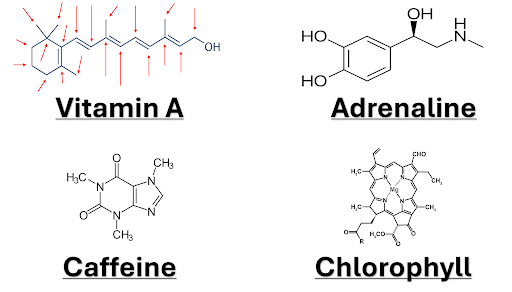
To really understand the Nutrient Cycle and be able to manage it properly, there are a few foundational points to understand. In nature, nutrients can be part of the living or dead bodies of organisms, such as the ones that make up your body right now or the ones that make up dead plant residue in a field. These are called “organic nutrients” because they are part of Carbon-based molecules associated with organisms. In the science world, the term “organic” means it is only produced by living organisms and has carbon-hydrogen bonds, the hallmark bond shared by all living organisms. Methane (CH4) is an organic compound because it fits both criteria.
Alternatively, “inorganic” nutrients are those not associated with organisms. These include the nutrients in rocks, soil and air that aren’t part of a carbon-based molecule, such as water (H2O), dinitrogen gas (N2), potassium (K+) and nitrate (NO3–). Even though it has a carbon atom, carbon dioxide gas (CO2) is considered inorganic because it can be produced by non-living entities, such as volcanoes, and it doesn’t have any carbon-hydrogen bonds. The carbon inside the carbon dioxide molecule transforms from an inorganic nutrient into an organic nutrient when a plant vacuums it in its leaf and fuses it with other carbon atoms to make glucose. The carbon goes from organic to inorganic again when molecules of glucose decompose.
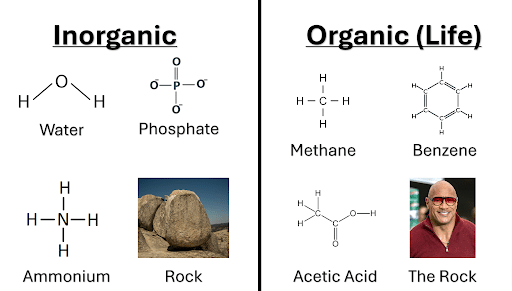
This is the case for all nutrients. For example, the nitrogen used for proteins inside of a bacteria is in an organic form. When a predator consumes the bacteria and decomposes it in its digestive tract, the nitrogen may be stripped away from the larger carbon-based protein it was attached to. One option is for the nitrogen to end up attached to four hydrogen atoms, in which case it is part of an ammonium molecule (NH4+). The nitrogen has thus transformed from being in an organic form to being in an inorganic form. The predator may then excrete this inorganic ammonium near the root, where the root can say “thank you very much” and slurp it up. This inorganic nitrogen in ammonium could very well end up fusing to a larger carbon-based molecule and become organic nitrogen once again while inside the plant. This incessant shifting back and forth between organic and inorganic forms is happening all around us, as well as in our own bodies. It’s a natural part of what makes organisms and ecosystems alive. In contrast, nutrients on the Moon and Mars, and to a lesser extent in deserts, are stuck in one form or the other with little to no way to transform without living biological activity.
Immobilization vs Mineralization
Two other terms that you will probably come across when studying nutrients are “immobilization” and “mineralization”. Immobilization refers to the process by which nutrients are taken in by organisms and made unavailable for other organisms to utilize. A common example is when soil microbes consume a lot of nitrogen in the soil, which “ties up nitrogen”, making it immediately unavailable to plant roots. This can lead to nitrogen-deprived crops and one unhappy farmer. We immobilize nutrients when we eat food and make its contents part of our body. The same goes with plants or any other organism. It’s all immobilization. On the flip side, mineralization is the process by which nutrients are made available for other organisms to utilize them, such as the ammonium excreted from the predator in the previous paragraph. Natural systems do an excellent job of balancing these two processes. Immobilization keeps adequate nutrients in the system, while mineralization releases nutrients for new growth.

Challenging Paradigms
For the past 100+ years, conventional agronomy has taught that plant roots could only absorb nutrients in an inorganic and mineralized form. Search the web for “plant available forms of nutrients” today, and you will find numerous resources that have a list of “plant-available forms of nutrients”. Before or after the list, most resources state, “For a plant to absorb an element, it must be in a chemical form used by the plant and dissolved in the soil water (a.k.a. water-soluble).”16 This is the foundation for modern synthetic (a.k.a. man-made) fertilizer use. Synthetic fertilizer application is designed to place the inorganic, water-soluble, “plant-available form” of a nutrient in the soil where the plant root can absorb it. Simple enough… but that’s not what happens in reality.
First, it’s not true that plants can only absorb nutrients in an inorganic, water-soluble form. If that was the case,herbicides wouldn’t work. Observe the chemical structure of glyphosate below:
Let’s look at nitrogen, as another example. Plants (and mycorrhizal fungi) contain transport proteins in their cell membranes whose job it is to absorb amino acids, the organic building block of proteins.17 This saves the plant time and energy because plants have to fix absorbed nitrogen in nitrate (NO3–) and ammonium (NH4+) forms into an amino acid before it can be forged into a protein. Plants also absorb intact proteins, likely through endocytosis.18 If they don’t want to consume the whole protein, they can break up proteins in the soil by exuding proteolytic (proteo- protein; lytic- breaking apart) enzymes. These enzymes break apart proteins into smaller chains of amino acids or individual amino acids that the plant can then choose to absorb.
Endocytosis and proteolytic enzymes are very important because nitrogen primarily occurs as protein in natural soil ecosystems.18 This is a huge reservoir of nitrogen, so you can imagine why plants have methods of utilizing it! (Side Note: None of the nitrogen in this huge reservoir will be counted in a standard soil test because it’s not in an inorganic, water-soluble form. However, we just learned that organic nitrogen can and will be utilized by the plant, so this inevitably leads to overestimates of fertilizer need.)
We also know that plants absorb nutrients in organic form because organic compounds like citric acid are utilized in projects that clean up dangerous heavy metals from a contaminated soil.19 Nutrients like lead, arsenic, and cadmium bind to the citric acid compound and plants take up the Heavy Metal/Citric Acid organic complex, thus reducing the amount of heavy metal contamination in the soil. This would not be possible if plants could not absorb nutrients in an organic form.
Lastly, plant absorption of whole microbes (a.k.a. Rhizophagy, more on this later) are further proof that they absorb larger, carbon-based organic compounds.
The second paradigm-shifting idea to ponder is that nutrients from synthetic fertilizers don’t feed plants, at least statistically speaking. Most nutrients that plants take up are actually acquired from the natural Nutrient Cycle, even after fertilizer applications are made. The 15th edition of The Nature and Properties of Soil textbook writes, “A common myth about fertilizers suggests that inorganic fertilizers applied to soil directly feed the plant, and that therefore the biological cycling of nutrients are of little consequence where inorganic fertilizers are used. The reality is that nutrients added by normal application of fertilizers, whether organic or inorganic, are incorporated into the complex soil nutrient cycles, and that relatively little of the fertilizer nutrient (from 10 to 60%) actually winds up in the plant being fertilized during the year of application. Even when the application of fertilizer greatly increases both plant growth and nutrient uptake, the fertilizer stimulates increased cycling of the nutrients, and the nutrient ions taken up by the plant come largely from various pools in the soil and not directly from the fertilizer. For example, some of the added N may go to satisfy the needs of microorganisms, preventing them from competing with plants for other pools of N.”
Phosphorus absorption from fertilizers is particularly woeful as more than 80% of applied P is immediately made unavailable after application.20 How many farmers and ranchers are told by their fertilizer salespeople or advisers that 40-90% of the fertilizer they purchase won’t end up in their plants? That’s a hefty chunk of change!
This isn’t to say fertilizers don’t work and they should be ditched, especially on a farm or ranch where natural nutrient cycling is inefficient. The image below shows a pretty close relationship between fertilizer use and wheat yield in Oklahoma from 1890-2004.
Of course, fertilizers aren’t the only factor in this rise in yield over time, but they certainly play a role. In any case, it’s important to understand that the majority of nutrients absorbed by a plant run through the natural Nutrient Cycle before reaching the plant. GOLDEN RULE: Microbes eat first.
Data from the third longest-running agricultural research project in the United States corroborates this claim. The Magruder plots in Columbus, Ohio at the Ohio State University found that around 40% of wheat yields from 1930-2000 were attributable to fertilizer nutrients.
40% is a big boost and that’s great, but a few questions should come to mind:
- Where exactly does the other 60% of nutrients absorbed by plants come from?
- Can this number be higher so we have to purchase less fertilizer?
- Do unused nutrients build up in the soil over time and can producers tap into this bank?
- How do plants in the wild grow so well without synthetic fertilizers?
Your homework assignment until the next installment of this series is to turn off the TV, pause the Spotify and put up the phone for 5-10 minutes and really ponder these questions. Challenge your understanding of these processes to learn where there is a gap in your knowledge. Filling in these knowledge gaps is the key to making informed management decisions that could save you tens of thousands of dollars over the next few years. Sounds like a good use of time to me.
Next time
Part 5 of this series will introduce the stars of the show in this fascinating story of nutrient transformation. We will discuss the “Soil Food Web” and explain how regenerative agriculture harnesses biology to unlock the vast reserves of nutrients already present in soil, air and water. From mycorrhizal fungi that extend plant root systems to the newly discovered rhizophagy cycle where plants “farm” microbes for nutrients, you’ll learn how living roots and thriving soil biology can dramatically improve fertility, reduce input costs, and transform the way producers think about nutrient management.
Understanding nutrient cycling is one thing. Applying it successfully on your farm or ranch is another. If you’d like help identifying opportunities to improve nutrient efficiency, reduce input costs, and strengthen the biological function of your soils, reach out to an Understanding Ag consultant. Our team can help you translate these principles into practical management strategies tailored to your operation.
References
16https://content.ces.ncsu.edu/extension-gardener-handbook/1-soils-and-plant-nutrients
17https://nph.onlinelibrary.wiley.com/doi/pdfdirect/10.1111/j.1469-8137.2008.02751.x
18https://www.pnas.org/doi/full/10.1073/pnas.0712078105
20https://academic.oup.com/plphys/article/116/2/447/6085629?login=false

The post 4 Ecosystem Processes: Nutrient Cycle Part 4 appeared first on Understanding Ag.


