5 Ways Technology is Making Mining Safer
Key Takeaways
- Mining safety tech uses connected systems rather than standalone tools for real-time operational monitoring.
- Data-driven insights and automation enable continuous safety improvements, helping prevent incidents before they occur.
Mining is one of the most complex and demanding industries in the world. Operations often take place deep underground or in remote regions, where extreme conditions and heavy machinery create a constantly shifting environment.
Though mining provides the raw materials for much of modern life and supports the global energy transition, it also carries significant safety risks. As a result, operators are turning to mining safety tech to better manage these challenges and protect workers on site.
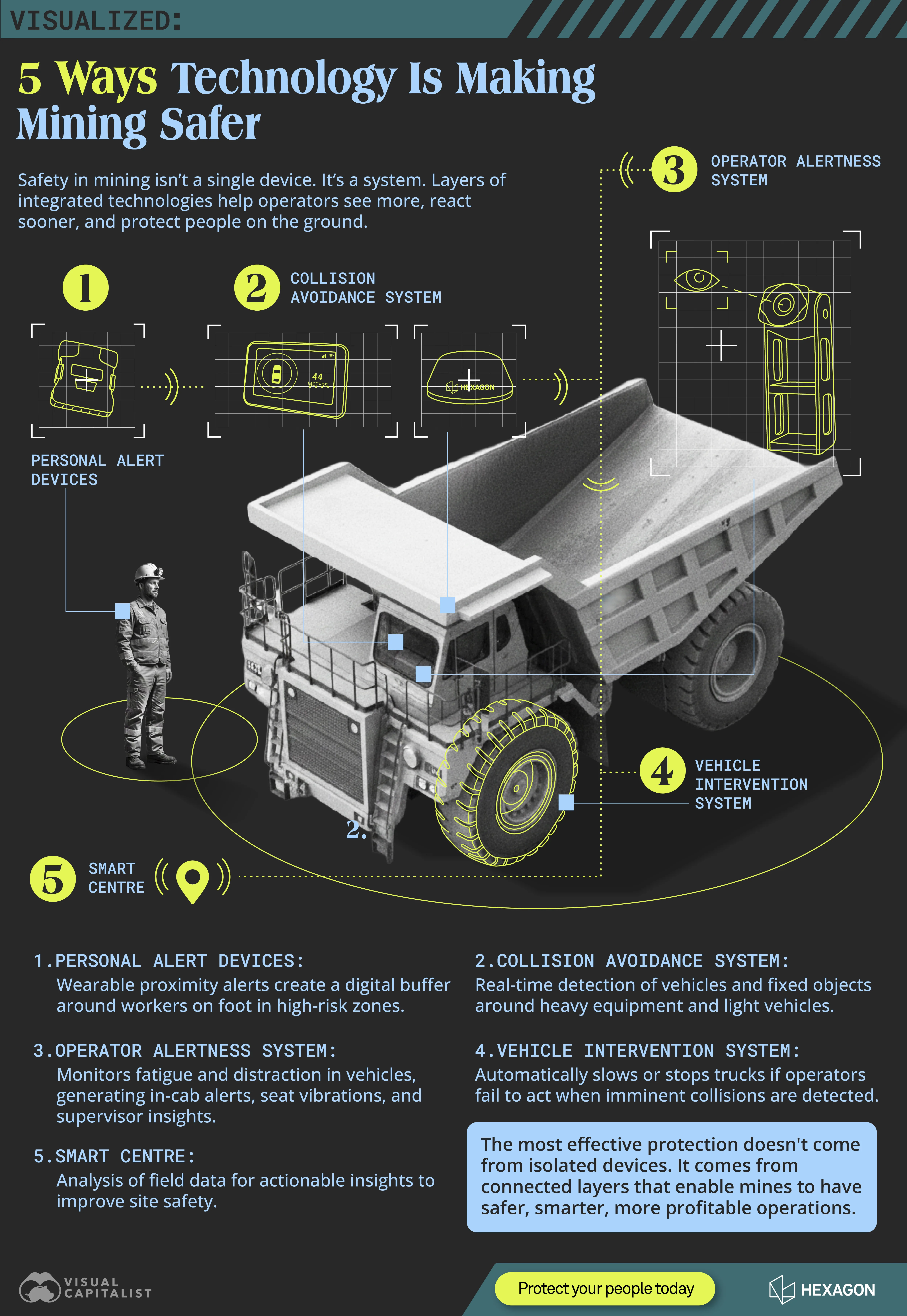
This graphic, in partnership with Hexagon, shows five ways technology is making mining safer through connected systems.
The Evolution of Mining Safety
In the past, mine safety relied on reacting to incidents after they occurred. Systems operated in silos, with limited visibility across equipment, people, and site conditions.
However, that approach no longer works for today’s fast-moving operations. Many industries are shifting toward connected ecosystems that combine data across multiple inputs.
In mining this evolution enables a more proactive safety model. Operators can detect risks earlier, respond faster, and make better data-informed decisions.
As a result, this shift lays the foundation for a new generation of mining safety tech designed to work together rather than alone.
How Mining Safety Tech Works
Each layer of modern mining safety plays a specific role, from monitoring worker proximity to analyzing site-wide data in real time.
Here is a table that shows the core technologies improving safety across today’s mining operations:
| Technology | Description |
|---|---|
| Personal Alert Devices | Wearable proximity alerts create a digital buffer around workers on foot in high-risk zones. |
| Collision Avoidance System | Real-time detection of vehicles and fixed objects around heavy equipment and light vehicles. |
| Operator Alertness System | Monitors fatigue and distraction in vehicles, generating in-cab alerts, seat vibrations, and supervisor insights. |
| Vehicle Intervention System | Automatically slows or stops trucks if operators fail to act when imminent collisions are detected. |
| Smart Centre | Analysis of field data for actionable insights to improve site safety. |
Source: Hexagon.
Together, these systems create a continuous loop of awareness, alerting, and intervention. Data flows between devices, vehicles, and control centres to provide a clearer picture of on-site conditions.
A Closer Look: Collision Avoidance Systems
One of the most critical safety layers is collision avoidance. These systems use real-time positioning and detection to identify nearby vehicles, equipment, and fixed objects.
As a result, operators receive immediate alerts when hazards enter their vicinity. This added visibility helps reduce blind spots and gives workers more time to react in high-risk environments.
How It All Comes Together: The Safety Centre
The full impact of mining safety tech emerges when these systems connect through a centralized safety centre.
By aggregating data from vehicles, wearable devices, and site infrastructure, the safety centre provides a holistic view of operations. This visibility allows teams to identify patterns, anticipate risks, and coordinate responses more effectively.
In mining, real-time operational data and centralized insights are becoming essential. Solutions like those from Hexagon are designed to connect these layers, helping operations become safer, smarter, and more productive.

See how Hexagon can help protect your people today.
-

 Mining1 week ago
These Countries Hold Most of the World’s Copper
Global copper reserves approach 980 million tonnes, led by Chile.
-

 Central Banks2 weeks ago
Ranked: Central Banks Buying and Selling Gold in 2026
Central banks gold buying in 2026 shows rising demand from emerging markets amid geopolitical uncertainty.
-
 Mining2 months ago
Ranked: U.S. Import Reliance for 37 Critical Minerals
This chart shows U.S. import reliance on critical minerals in 2025, with China dominating key supplies.
-
 Technology2 months ago
Visualizing the Critical Minerals Powering the AI Boom
This chart breaks down the critical minerals used in AI data centers, and how reliant the U.S. is on imports for each.
-
 Strategic Metals3 months ago
Ranked: The Critical Minerals Lost to U.S. Mining Waste, by Tonnage
The U.S. discards massive quantities of critical minerals each year through mining waste.
-

 Money3 months ago
Ranked: The Countries Buying (and Selling) the Most Gold Since 2020
China, Poland, and Türkiye led global gold buying among central banks.