
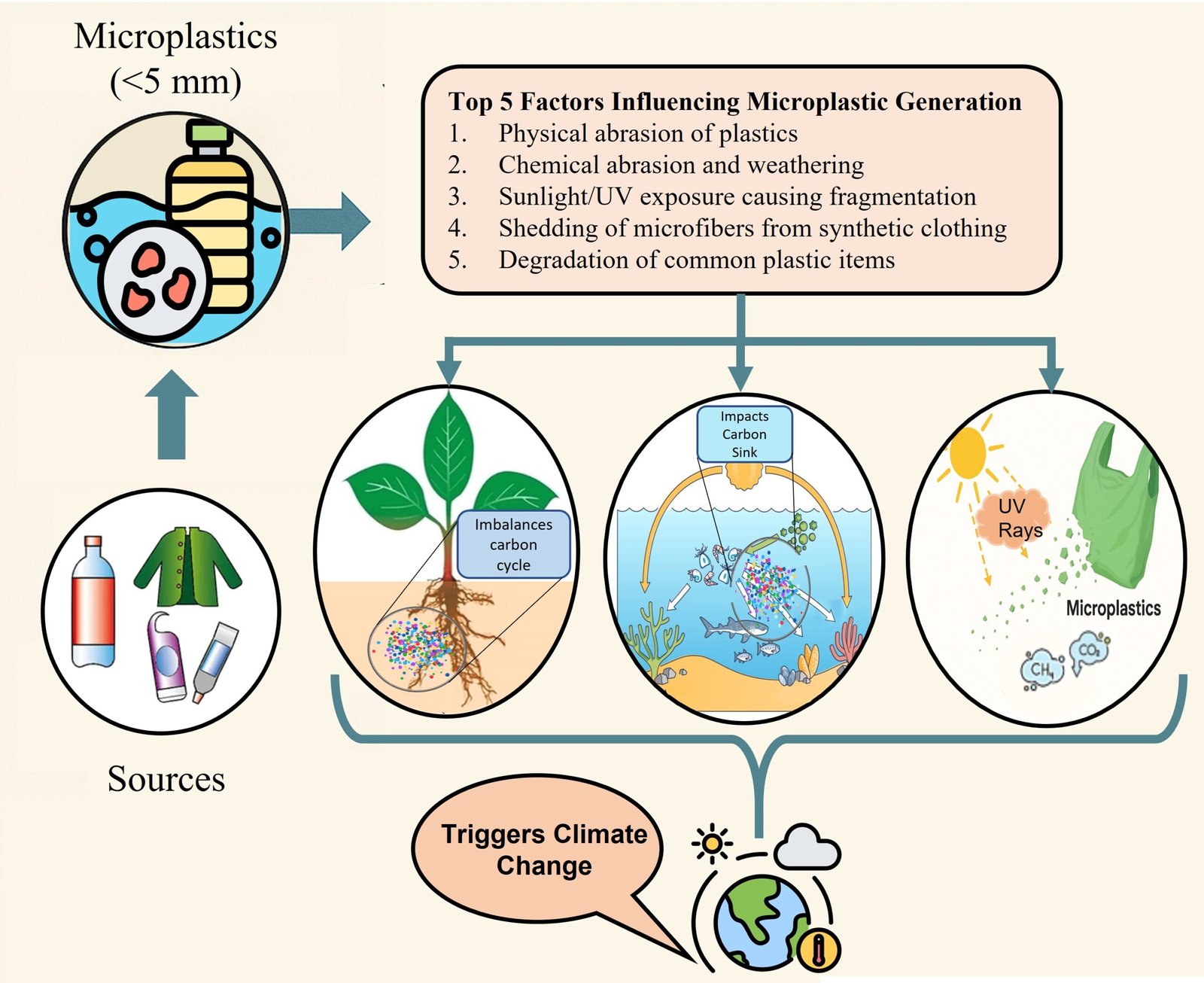
Microplastics, which are tiny members of the regular plastic polymer family smaller than 5 mm, are among the most persistent pollutants in the environment. Once released, these environmental enemies degrade extremely slowly, fragmenting further through physical and chemical abrasion and exposure to sunlight. As a result, they are difficult to trace, remove, or manage. Today, microplastics are found almost everywhere: in surface waters, soil, the atmosphere, and even in food and drinking water (Ghosh et al., 2023).
Their broad classification includes primary and secondary types. Primary microplastics are intentionally manufactured at small sizes for specific uses, such as microbeads in cosmetics including face wash, creams, and scrubs. (Osman et al., 2023). Secondary microplastics form when larger plastic items break down unintentionally over time. . Common sources include fibers shed from synthetic clothing, plastic bags and bottles, paint chips, fishing nets, and agricultural waste. (Kukkola et al., 2024).
Disrupting Soils and Carbon Storage
Microplastic accumulation in soil impacts its fertility, interferes with water retention, ultimately hindering root growth. Over time, microplastics can disrupt soil microbial activities, leading to changes in biogeochemical cycles such as carbon and nitrogen cycles.
Soil typically stores more carbon than the atmosphere and plant biomass combined. However, microplastics can reduce the soil’s capacity to store carbon and may even accelerate CO₂ release by interfering with nutrient cycling, soil structure, decay rates, microbial composition and enzymatic activity, aeration, etc. (Zhao et al., 2021).
Threats to Aquatic Life and Human Health
In aquatic environments, microplastics disrupt local ecosystems and impact water quality. Aquatic animals and organisms often mistake these materials for food, leading to digestive blockages, hampering growth and reproduction, and increased disease risk. Toxins such as Bisphenol A, phthalates, drugs, toxic metals, flame retardants and harmful pathogens adsorb on the surface of microplastics, which act as vector for these contaminants in the environment, aggravating the risk of biomagnification through the food chain.
Aside from ingestion, humans are exposed to microplastics through inhalation. Emerging evidence links microplastic exposure to respiratory and cardiovascular issues, endocrine disruption, gastrointestinal disorders, and cancer through multiple biological pathways (Alimba et al., 2021; Du et al., 2021).
A Hidden Climate Feedback
Microplastics are increasingly recognized as a driver of climate change. Their degradation releases greenhouse gases such as methane and ethylene. Even very small particles contribute to these emissions. Microplastic degradation can emit approximately 1–10 kg CO₂e/tonne-year (Kida et al., 2023), depending on plastic type, age, surface area, solar exposure, temperature, UV intensity, and biofouling. Under certain conditions, emissions may reach as high as ~102 kg CO₂e/tonne (Zubair et al., 2023; Kukkola et al., 2024).
Microplastics also hinder CO₂ absorption in marine ecosystems by impacting phytoplankton and zooplankton and weaken the ocean’s capacity to serve as a carbon sink. Oceans absorb nearly 30% of global CO₂ emissions through microbial activities, including photosynthesis by phytoplankton. Microplastics block light and hinder nutrient uptake in phytoplankton by obstructing their surface area. When ingested by zooplankton, microplastics suppress feeding and reduce the density of fecal pellets, weakening the biological carbon pump mechanism, ultimately diminishing carbon sequestration (Shen et al., 2020).
In addition, microplastics make water and wastewater treatment more energy-intensive due to the requirement of high-end screening and dredging, thereby increasing the carbon footprint.
An Urgent Call for Systemic Action
Greenhouse gases such as CO₂ and methane can remain in the atmosphere for decades to centuries, meaning today’s emissions lock in long-term warning and ecosystem loss (Qaiser et al., 2023). Microplastics evolution, as an emergent contaminant of high priority, is fast impacting environmental, human and wildlife health degradation. Addressing microplastic pollution requires a combination of upstream redesign, such as biodegradable polymers, reduced packaging, and textile reforms, and downstream solutions like advanced filtration and improved wastewater treatment infrastructure.
Without systemic interventions, microplastics will continue to silently accumulate, outpacing the ability of natural systems to absorb or recover from their impacts. Confronting this invisible threat is critical for protecting ecosystems, human health, and for safeguarding the planet’s climate resilience.
References
Alimba, C.G., Faggio, C., Sivanesan, S., Ogunkanmi, A.L., & Krishnamurthi, K. (2021). Micro(nano)-plastics in the environment and risk of carcinogenesis: Insight into possible mechanisms. Journal of Hazardous Material, 416:126413. https://doi.org/10.1016/j.jhazmat.2021.126143
Du, S., Zhu, R., Cai, Y., Xu, N., Yap, P. S., Zhang, Y., He, Y., & Zhang, Y. (2021). Environmental fate and impacts of microplastics in aquatic ecosystems: a review. RSC advances, 11(26), 15762–15784. https://doi.org/10.1039/d1ra00880c
Ghosh, S., Sinha, J. K., Ghosh, S., Vashisth, K., Han, S., & Bhaskar, R. (2023). Microplastics as an Emerging Threat to the Global Environment and Human Health. Sustainability, 15(14), 10821. https://doi.org/10.3390/su151410821
Kida, M., Ziembowicz, S., & Koszelnik, P. (2023). Decomposition of microplastics: emission of harmful substances and greenhouse gases in the environment. Journal of Environmental Chemical Engineering, 11(1), 109047. https://doi.org/10.1016/j.jece.2022.109047
Kukkola, A., Chetwynd, A. J., Krause, S., & Lynch, I. (2024). Beyond microbeads: Examining the role of cosmetics in microplastic pollution and spotlighting unanswered questions. Journal of hazardous materials, 476, 135053. https://doi.org/10.1016/j.jhazmat.2024.135053
Osman, A. I., Hosny, M., Eltaweil, A. S., Omar, S., Elgarahy, A. M., Farghali, M., Yap, P. S., Wu, Y. S., Nagandran, S., Batumalaie, K., Gopinath, S. C. B., John, O. D., Sekar, M., Saikia, T., Karunanithi, P., Hatta, M. H. M., & Akinyede, K. A. (2023). Microplastic sources, formation, toxicity and remediation: a review. Environmental chemistry letters, 1–41. Advance online publication. https://doi.org/10.1007/s10311-023-01593-3
Qaiser, Z., Aqeel, M., Sarfraz, W., Rizvi, Z. F., Noman, A., Naeem, S., & Khalid, N. (2023). Microplastics in wastewaters and their potential effects on aquatic and terrestrial biota. Case Studies in Chemical and Environmental Engineering, 8, 100536. https://doi.org/10.1016/j.cscee.2023.100536
Shen, M., Ye, S., Zeng, G., Zhang, Y., Xing, L., Tang, W., Wen, X., & Liu, S. (2020). Can microplastics pose a threat to ocean carbon sequestration?. Marine pollution bulletin, 150, 110712. https://doi.org/10.1016/j.marpolbul.2019.110712
Zhao, T., Lozano, Y. M., & Rillig, M. C. (2021). Microplastics increase soil pH and decrease microbial activities as a function of microplastic shape, polymer type, and exposure time. Frontiers in Environmental Science, 9, 675803. https://doi.org/10.3389/fenvs.2021.675803
Zubair, M., Chen, S., Ma, Y., & Hu, X. (2023). A Systematic Review on Carbon Dioxide (CO2) Emission Measurement Methods under PRISMA Guidelines: Transportation Sustainability and Development Programs. Sustainability, 15(6), 4817. https://doi.org/10.3390/su15064817

Dr. Atun Roy Choudhury is the Technical Head at Unison i3x Pvt. Ltd. He specializes in waste management, air pollution, water, and sanitation. He has authored over 60 publications in reputed international outlets. He serves as an Editor and Reviewer for major publishers and is frequently featured in leading magazines and national newspapers. A TEDx and global forum speaker, he has mentored numerous researchers. His achievements include several national accolades and certifications in environmental auditing, and his patented waste-valorization technologies have received top recognitions from the UN and the Government of India.

Dr. Chibuisi Gideon Alimba is a Scientist at the Leibniz Research Centre for Working Environment and Human Factors (IfADo), Germany. His research focuses on the toxicological mechanisms of xenobiotics. He previously served as a Senior Lecturer in Genetics, Cell Biology, and Molecular Toxicology at the University of Ibadan, Nigeria. He is a recipient of several honors, including The World Academy of Science Award and the Alexander von Humboldt Foundation Postdoctoral Fellowship, along with multiple international grants and scholarships. Dr. Alimba has authored over 100 publications in reputed peer-reviewed journals and serves as an experienced editor and reviewer in toxicology, environmental science, and public health.

Dr. Musa Manga is a Water and Sanitation Engineer and Assistant Professor in the Department of Environmental Sciences and Engineering at the Gillings School of Global Public Health, University of North Carolina at Chapel Hill. His research group, The Manga Lab, focuses on planning, monitoring, and optimizing biological treatment of high-strength wastewater and biosolids, along with advancing sanitation technologies to improve pathogen inactivation, pollutant removal, and resource recovery. His work addresses nutrients, pathogens, PFAS, antibiotics, antimicrobial resistance, and broader environmental health concerns. Over the past decade, he has secured major research grants and led projects on anaerobic digestion, biosolids valorization, and engineering treatment materials in both the Global South and the U.S.


