
.
.
RSB’s Preliminary Certification Framework gives early-stage sustainable aviation fuel projects a way to resolve any potential supply chain risk before they are operational. That capability matters everywhere, but its value is sharpest in a market building capacity quickly from an early base, which describes India’s SAF sector closely.
.
The problem the framework addresses
.
Early-stage biofuel and SAF project certification rarely gets settled at the right time. Projects reach front-end engineering design (FEED) and their final investment decision (FID) with certification risk still open, particularly around three questions: how renewable electricity sourcing will be proven, how lifecycle greenhouse gas emissions will be accounted for, and how traceability and mass balance will hold across the supply chain.
Left unresolved, supply chain risks not mitigated through third party certification carries a credibility cost at each project stage.
It slows offtake contracting, because a buyer cannot commit to a fuel whose eventual certification compliance remains unconfirmed. It raises financing costs, since a financier prices unresolved risk into the terms. And it increases the risks at a later stage in the full certification audit process, once the plant is operational, when problems that could have been mitigated at the design stage are found too late to fix without costly rework. In a scaling market, where a pipeline of projects moves through development at the same time, that pattern does not stay contained to one plant. It repeats across the sector.
.
What the framework introduces
.
The Preliminary Certification Framework establishes a route for early-stage developers to have their documented systems assessed against RSB preliminary certification requirements before the plant is fully commercially operational, at Pre-FEED, FEED, Pre-FID or later. It does this without compromising the independence of the certification process that follows.
The Preliminary Certification Assessment is a third-party assessment, conducted by an RSB-approved certification body against defined RSB standards, for projects not yet ready for a full audit.
Full certification remains entirely separate and applies at a later stage, when the plant is operating at commercial scale and already is producing sustainable fuel that is auditable against RSB Standards. Full RSB certification is binding, based on verified operational data, and available only once a plant is running.
That distinction is what gives the Preliminary Certification Assessment its value. Though non-binding, and not a substitute for certification, it identifies non-conformities and mitigates risks across the supply chain. Those constraints are what let the Assessment mean something to a financier: it is produced by an independent auditor with no stake in flattering the result, held to the same standards the eventual certification will apply.
.
What the Preliminary Certification Assessment examines
Because the Assessment of compliance with the Preliminary Certification framework works from design documentation rather than a fully operational plant, its scope is deliberately bounded. It reviews documented plans, management systems, design-stage greenhouse gas calculations and available evidence, and because it is document-based it can be conducted remotely. It does not yet verify performance, because there is no operational performance yet to verify. What it does is establish whether a project’s design and systems are aligned with RSB certification requirements, across six areas.
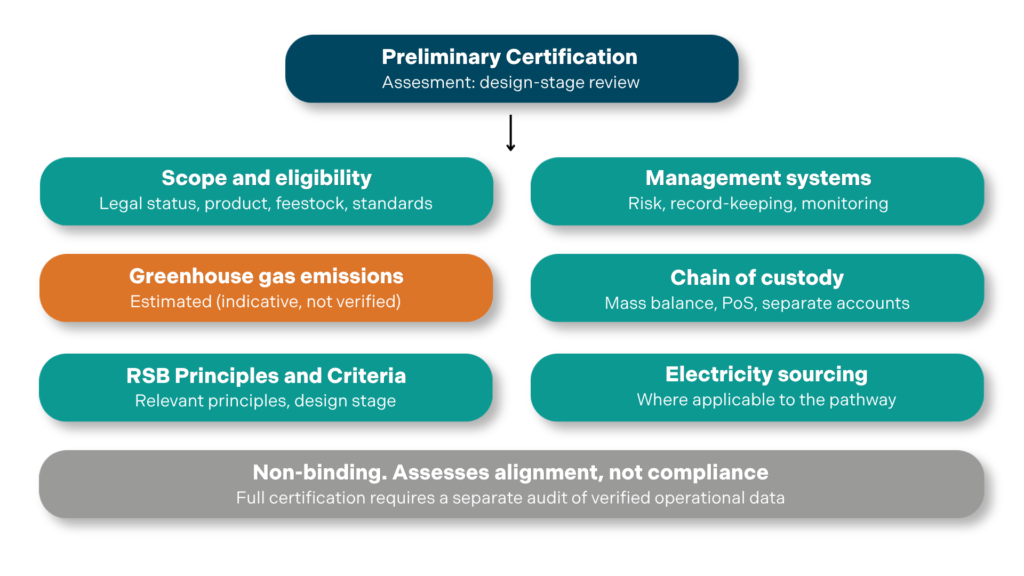
Scope and eligibility. The Assessment first confirms the basics of what is being assessed: the project’s legal status, and its declared scope of product, feedstock and the applicable RSB standards. This sets the boundary for everything that follows.
Management systems. It reviews whether the project has a documented approach to risk assessment and management, and procedures for record-keeping and internal monitoring. These are the systems that will later have to produce auditable evidence, so their design is assessed early.
Greenhouse gas emissions. It examines the project’s greenhouse gas estimation, using design data or default values where available. At this stage the figures are indicative, not verified for compliance, which the document is explicit about: a design-stage estimate is not a certified lifecycle number, and cannot be presented as one.
Chain of custody. It reviews the documented systems a project has designed for controlling mass balance transactions, for issuing and handling Proof of Sustainability documents, and for keeping separate accounts where materials carry separate claims. For a market where traceability is the recognised constraint, this is often the area where design-stage scrutiny is most valuable.
RSB Principles and Criteria. The Assessment examines the principles that can be assessed at design stage, which is a subset of the full set rather than all twelve. It reviews procedures for legal compliance, the Environmental and Social Management Plan and stakeholder mapping, human and labour rights policies and a grievance mechanism, evidence that the planned site is not in a legally protected area, an assessment of water needs and impacts, identification of air pollution sources, and hazardous technology and waste management plans. Several principles, including those covering rural development, food security, soil and land rights, are not assessed at this stage, because they depend on operational context that does not yet exist.
Electricity sourcing, where applicable. Where a project’s pathway depends on it, the Assessment reviews the described electricity source and how it is intended to meet the applicable standard’s requirements. This is one of the recurring sticking points the Framework was built to surface early.
Across all six, the output is the same in kind: a documented view of design-stage alignment, not a compliance decision. The gap between the two is the point. It is what keeps the Assessment honest, and what makes the eventual full certification worth holding.
.
Why a scaling market feels this most
.
A mature market absorbs early-stage supply chain risk quietly, because it has a deep bench of financed, operating precedents to price against. A scaling market does not. When a sector is building its first wave of capacity at once, every project is closer to the frontier, and the financing conversation for each one carries more unresolved risk than it would in an established market.
India’s SAF build-out sits precisely there. Refineries are moving co-processing and dedicated SAF capacity through engineering and investment decisions now, against blending requirements signalled for international flights that are not yet binding. That combination, real capital moving towards plants that do not yet exist, against demand that is directional rather than contracted, is the exact condition in which unaddressed supply chain and project risks at FID is most expensive.
A developer who can show a financier an independent, design-stage assessment against CORSIA requirements is resolving one of the larger unknowns in the financing conversation before it hardens into a sticking point.
.
Which markets, which schemes
.
The Framework covers the schemes that matter for an export-facing SAF sector: CORSIA for international aviation, EU RED for fuel entering the European Union and RSB Global for voluntary and corporate buyers. Which of these a project needs is determined by where its fuel is going and who is buying it, and most Indian developers with export ambitions will need more than one.
Building that readiness in early does more than prepare a project for RSB certification specifically. RSB’s standards are benchmarked to the ISEAL codes of good practice and sit at the demanding end of the recognised certification schemes, so the traceability, greenhouse gas accounting and management systems a project puts in place to meet them are well positioned against the requirements of other schemes too. For a developer, the work of achieving pre-certification readiness holds its value as a project moves towards operation, whichever markets it ultimately serves.
.
Certification as an early investment, not a late cost
.
The instinct on many projects is to treat certification as a final step, something to resolve once the plant is running. In a scaling market, that sequence is the expensive one, because it leaves the largest commercial unknowns open at exactly the point where capital is being committed.
Engaging at the design stage inverts that. A project designed against certification requirements from the outset carries that discipline forward, whether in stronger long-term returns or in risk identified and managed early, well before the certificate itself is in place. The third-party assessment turns unresolved supply chain and project risk into a documented position a financier or offtaker can assess with more confidence. It surfaces design-stage gaps while they can still be engineered out rather than remediated at an operational audit. And it moves a project from uncertain compliance to documented pre-certification readiness before the capital is committed, which is when that certainty is worth the most.
This is why the Framework works best in a market like India’s, engaging from the earliest stage does not just prepare a single project. It helps shape how certification readiness is built into a sector’s implementation as it scales, rather than retrofitted onto it afterwards.
.
Call for local adopters
.
RSB invites developers of SAF and advanced biofuel projects in India, and elsewhere, to engage with the Preliminary Certification Framework at the design and investment stage, where its findings can still shape a project. A developer that engages at Pre-FEED or FEED has the room to act on what an assessment surfaces. One that waits until commissioning has already lost the advantage the Framework exists to provide.
.
Call for local adopters
.
To understand how the Preliminary Certification Framework applies to a specific project, and which RSB scheme fits its intended markets, get in touch with RSB’s Certification team via the Preliminary Certification Framework page.
.
.
.
.
.
.
.
The post Preliminary certification for SAF projects under development: why it matters most in a scaling market like India appeared first on RSB.


