

We share evidence-based sustainability guidance for business leaders thinking ahead.
Wed, 18 Dec 2024 18:57:58 +0000
en-US
hourly
1
https://wordpress.org/?v=6.7.1
https://nbs.net/wp-content/uploads/2021/12/cropped-NBS_logo_trefoil-32×32.jpeg
32
32
Tue, 17 Dec 2024 04:15:30 +0000
<![CDATA[
NBS’s monthly compilation of the latest business sustainability research prioritizes in-press articles, in order to highlight cutting-edge knowledge. The list draws from Financial Times Top 50 journals and other publications.
The post Table of Contents: November 2024 appeared first on Network for Business Sustainability (NBS).
]]>
<![CDATA[
The post Table of Contents: November 2024 appeared first on Network for Business Sustainability (NBS).
]]>
https://nbs.net/table-of-contents-november-2024/feed/
0
Tue, 17 Dec 2024 01:19:24 +0000
<![CDATA[
Impact Bonds & Climate Action Resources
The post December 2024: Network News appeared first on Network for Business Sustainability (NBS).
]]>
<![CDATA[
96
p{
margin:10px 0;
padding:0;
}
table{
border-collapse:collapse;
}
h1,h2,h3,h4,h5,h6{
display:block;
margin:0;
padding:0;
}
img,a img{
border:0;
height:auto;
outline:none;
text-decoration:none;
}
body,#bodyTable,#bodyCell{
height:100%;
margin:0;
padding:0;
width:100%;
}
.mcnPreviewText{
display:none !important;
}
#outlook a{
padding:0;
}
img{
-ms-interpolation-mode:bicubic;
}
table{
mso-table-lspace:0pt;
mso-table-rspace:0pt;
}
.ReadMsgBody{
width:100%;
}
.ExternalClass{
width:100%;
}
p,a,li,td,blockquote{
mso-line-height-rule:exactly;
}
a[href^=tel],a[href^=sms]{
color:inherit;
cursor:default;
text-decoration:none;
}
p,a,li,td,body,table,blockquote{
-ms-text-size-adjust:100%;
-webkit-text-size-adjust:100%;
}
.ExternalClass,.ExternalClass p,.ExternalClass td,.ExternalClass div,.ExternalClass span,.ExternalClass font{
line-height:100%;
}
a[x-apple-data-detectors]{
color:inherit !important;
text-decoration:none !important;
font-size:inherit !important;
font-family:inherit !important;
font-weight:inherit !important;
line-height:inherit !important;
}
table[align=left]{
float:left;
}
table[align=right]{
float:right;
}
#bodyCell{
padding:10px;
}
.templateContainer{
max-width:600px !important;
}
a.mcnButton{
display:block;
}
.mcnImage,.mcnRetinaImage{
vertical-align:bottom;
}
.mcnTextContent{
word-break:break-word;
}
.mcnTextContent img{
height:auto !important;
}
.mcnDividerBlock{
table-layout:fixed !important;
}
body,#bodyTable{
background-color:#f1f1f1;
}
#bodyCell{
border-top:0;
}
.templateContainer{
border:0;
}
h1{
color:#817a75;
font-family:’Helvetica Neue’, Helvetica, Arial, Verdana, sans-serif;
font-size:24px;
font-style:normal;
font-weight:normal;
line-height:200%;
letter-spacing:normal;
text-align:center;
}
h2{
color:#817a75;
font-family:’Helvetica Neue’, Helvetica, Arial, Verdana, sans-serif;
font-size:18px;
font-style:normal;
font-weight:normal;
line-height:125%;
letter-spacing:normal;
text-align:center;
}
h3{
color:#817a75;
font-family:’Helvetica Neue’, Helvetica, Arial, Verdana, sans-serif;
font-size:18px;
font-style:normal;
font-weight:bold;
line-height:125%;
letter-spacing:normal;
text-align:center;
}
h4{
color:#817a75;
font-family:’Helvetica Neue’, Helvetica, Arial, Verdana, sans-serif;
font-size:18px;
font-style:normal;
font-weight:bold;
line-height:125%;
letter-spacing:normal;
text-align:left;
}
#templatePreheader{
background-color:#f1f1f1;
background-image:none;
background-repeat:no-repeat;
background-position:center;
background-size:contain;
border-top:10px none ;
border-bottom:10px none ;
padding-top:10px;
padding-bottom:10px;
}
#templatePreheader .mcnTextContent,#templatePreheader .mcnTextContent p{
color:#656565;
font-family:’Helvetica Neue’, Helvetica, Arial, Verdana, sans-serif;
font-size:12px;
line-height:150%;
text-align:center;
}
#templatePreheader .mcnTextContent a,#templatePreheader .mcnTextContent p a{
color:#5e81ca;
font-weight:normal;
text-decoration:underline;
}
#templateHeader{
background-color:#ffffff;
background-image:none;
background-repeat:no-repeat;
background-position:center;
background-size:cover;
border-top:0;
border-bottom:0;
padding-top:0px;
padding-bottom:0px;
}
#templateHeader .mcnTextContent,#templateHeader .mcnTextContent p{
color:#666666;
font-family:’Helvetica Neue’, Helvetica, Arial, Verdana, sans-serif;
font-size:16px;
line-height:150%;
text-align:center;
}
#templateHeader .mcnTextContent a,#templateHeader .mcnTextContent p a{
color:#5e81ca;
font-weight:normal;
text-decoration:underline;
}
#templateBody{
background-color:#ffffff;
background-image:none;
background-repeat:no-repeat;
background-position:center;
background-size:cover;
border-top:0;
border-bottom:2px solid #EAEAEA;
padding-top:0;
padding-bottom:0px;
}
#templateBody .mcnTextContent,#templateBody .mcnTextContent p{
color:#666666;
font-family:’Helvetica Neue’, Helvetica, Arial, Verdana, sans-serif;
font-size:16px;
line-height:150%;
text-align:center;
}
#templateBody .mcnTextContent a,#templateBody .mcnTextContent p a{
color:#5e81ca;
font-weight:normal;
text-decoration:underline;
}
#templateFooter{
background-color:#f1f1f1;
background-image:none;
background-repeat:no-repeat;
background-position:center;
background-size:cover;
border-top:0;
border-bottom:0;
padding-top:10px;
padding-bottom:10px;
}
#templateFooter .mcnTextContent,#templateFooter .mcnTextContent p{
color:#666666;
font-family:’Helvetica Neue’, Helvetica, Arial, Verdana, sans-serif;
font-size:12px;
line-height:150%;
text-align:center;
}
#templateFooter .mcnTextContent a,#templateFooter .mcnTextContent p a{
color:#5e81ca;
font-weight:normal;
text-decoration:underline;
}
@media only screen and (min-width:768px){
.templateContainer{
width:600px !important;
}
} @media only screen and (max-width: 480px){
body,table,td,p,a,li,blockquote{
-webkit-text-size-adjust:none !important;
}
} @media only screen and (max-width: 480px){
body{
width:100% !important;
min-width:100% !important;
}
} @media only screen and (max-width: 480px){
.mcnRetinaImage{
max-width:100% !important;
}
} @media only screen and (max-width: 480px){
.mcnImage{
width:100% !important;
}
} @media only screen and (max-width: 480px){
.mcnCartContainer,.mcnCaptionTopContent,.mcnRecContentContainer,.mcnCaptionBottomContent,.mcnTextContentContainer,.mcnBoxedTextContentContainer,.mcnImageGroupContentContainer,.mcnCaptionLeftTextContentContainer,.mcnCaptionRightTextContentContainer,.mcnCaptionLeftImageContentContainer,.mcnCaptionRightImageContentContainer,.mcnImageCardLeftTextContentContainer,.mcnImageCardRightTextContentContainer,.mcnImageCardLeftImageContentContainer,.mcnImageCardRightImageContentContainer{
max-width:100% !important;
width:100% !important;
}
} @media only screen and (max-width: 480px){
.mcnBoxedTextContentContainer{
min-width:100% !important;
}
} @media only screen and (max-width: 480px){
.mcnImageGroupContent{
padding:9px !important;
}
} @media only screen and (max-width: 480px){
.mcnCaptionLeftContentOuter .mcnTextContent,.mcnCaptionRightContentOuter .mcnTextContent{
padding-top:9px !important;
}
} @media only screen and (max-width: 480px){
.mcnImageCardTopImageContent,.mcnCaptionBottomContent:last-child .mcnCaptionBottomImageContent,.mcnCaptionBlockInner .mcnCaptionTopContent:last-child .mcnTextContent{
padding-top:18px !important;
}
} @media only screen and (max-width: 480px){
.mcnImageCardBottomImageContent{
padding-bottom:9px !important;
}
} @media only screen and (max-width: 480px){
.mcnImageGroupBlockInner{
padding-top:0 !important;
padding-bottom:0 !important;
}
} @media only screen and (max-width: 480px){
.mcnImageGroupBlockOuter{
padding-top:9px !important;
padding-bottom:9px !important;
}
} @media only screen and (max-width: 480px){
.mcnTextContent,.mcnBoxedTextContentColumn{
padding-right:18px !important;
padding-left:18px !important;
}
} @media only screen and (max-width: 480px){
.mcnImageCardLeftImageContent,.mcnImageCardRightImageContent{
padding-right:18px !important;
padding-bottom:0 !important;
padding-left:18px !important;
}
} @media only screen and (max-width: 480px){
.mcpreview-image-uploader{
display:none !important;
width:100% !important;
}
} @media only screen and (max-width: 480px){
h1{
font-size:22px !important;
line-height:125% !important;
}
} @media only screen and (max-width: 480px){
h2{
font-size:20px !important;
line-height:125% !important;
}
} @media only screen and (max-width: 480px){
h3{
font-size:18px !important;
line-height:125% !important;
}
} @media only screen and (max-width: 480px){
h4{
font-size:16px !important;
line-height:150% !important;
}
} @media only screen and (max-width: 480px){
.mcnBoxedTextContentContainer .mcnTextContent,.mcnBoxedTextContentContainer .mcnTextContent p{
font-size:14px !important;
line-height:150% !important;
}
} @media only screen and (max-width: 480px){
#templatePreheader{
display:block !important;
}
} @media only screen and (max-width: 480px){
#templatePreheader .mcnTextContent,#templatePreheader .mcnTextContent p{
font-size:14px !important;
line-height:150% !important;
}
} @media only screen and (max-width: 480px){
#templateHeader .mcnTextContent,#templateHeader .mcnTextContent p{
font-size:16px !important;
line-height:150% !important;
}
} @media only screen and (max-width: 480px){
#templateBody .mcnTextContent,#templateBody .mcnTextContent p{
font-size:16px !important;
line-height:150% !important;
}
} @media only screen and (max-width: 480px){
#templateFooter .mcnTextContent,#templateFooter .mcnTextContent p{
font-size:14px !important;
line-height:150% !important;
}
}
<!–
|




The post December 2024: Network News appeared first on Network for Business Sustainability (NBS).
]]>
https://nbs.net/december-2024-network-news/feed/
0
Thu, 05 Dec 2024 22:55:15 +0000
<![CDATA[
A new impact bond improved local biodiversity and supported Indigenous rights. However, for impact at scale, the financial system needs serious reform.
The post Impact Bonds and the Possibilities of Regenerative Finance appeared first on Network for Business Sustainability (NBS).
]]>
<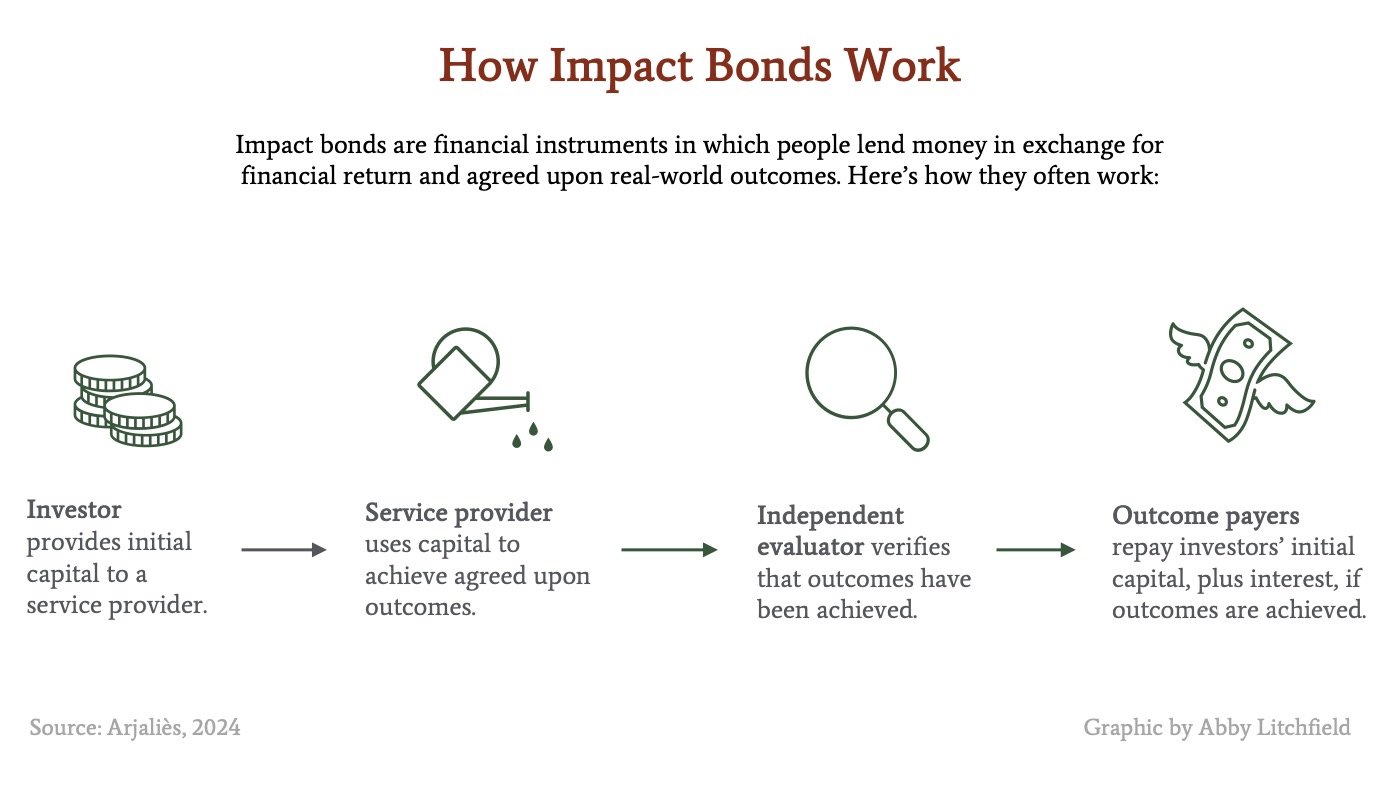
Impact bonds are also known as pay-for-performance products. When the “outcomes” are achieved, investors are repaid their capital plus interest by outcome payers. However, if the outcomes are not met, the investor will not receive any interest on their initial capital and may forgo repayment of some or all of the principle. Investors take the financial risk in exchange for potential financial returns.
Outcome payers are only interested in the project’s outcomes. They agree to pay interest on the project’s cost, but in exchange, they only pay if their intended outcome is achieved.
Case Study: The Deshkan Ziibi Conservation Impact Bond (DZCIB)
Our research focused on a particular impact bond—the Deshkan Ziibi Conservation Impact Bond (DZCIB). The project was created using Community-Based Participatory Research, whereby my research team and I worked closely with Deshkan Ziibiing, also known as the Chippewas of the Thames First Nation, and Carolinian Canada. With the support of other partners, we created a bond to support habitat restoration and biodiversity conservation in a biodiversity hotspot—the Carolinian zone of Southwestern Ontario, Canada.
This bond pursued the Mi’kmaw principles of Two-Eyed Seeing/Etuaptmumk. Proposed by Mi’kmaw Elder Albert Marshall, Two-Eyed Seeing/Etuaptmumk advocates for a synergistic blend of two perspectives or ‘eyes:’ one Indigenous and one Western, each embedded in their ways of knowing. The Two-Eyed Seeing approach was critical to the bond’s ability to achieve its conservation goals. 80% of the planet’s remaining biodiversity is located on Indigenous lands, indicating that Indigenous land management practices have much to offer conservation efforts.
Historically, colonial governments globally have removed Indigenous communities from their land and stripped them of their culture. Centring Indigenous people and their knowledges in conservation not only supports cultural restoration, but also encourages reconnection to land and land stewardship. No regeneration can be achieved with reconciliation with Indigenous peoples.
How the Deshkan Ziibi Conservation Bond Worked
The Deshkan Ziibi Conservation Bond followed the four traditional steps of an Impact Bond:
-
Investor provided upfront capital: Verge Capital, an impact investing company, provided a $300,000 grant as seed funding for the project.
-
Funds were used for habitat restoration: The funds were allocated to partners like the Thames Talbot Land Trust and Deshkan Ziibiing to carry out restoration activities. Activities included planting native trees and plants, restoring wetlands, and managing invasive species.
-
Outcome payer repaid the investor: 3M, a technology company, agreed to act as the first outcome payer. They committed to repay Verge Capital their initial investment plus a 3-5% return (the exact amount would be determined primarily by the average rate of return on the bond market). Other outcome payers eventually joined, including a non-profit and the government.
-
Impact was assessed: The project’s outcomes were verified using metrics that reflect Indigenous and Western perspectives on land conservation.
Assessing Outcomes of the Deshkan Ziibi Conservation Bond
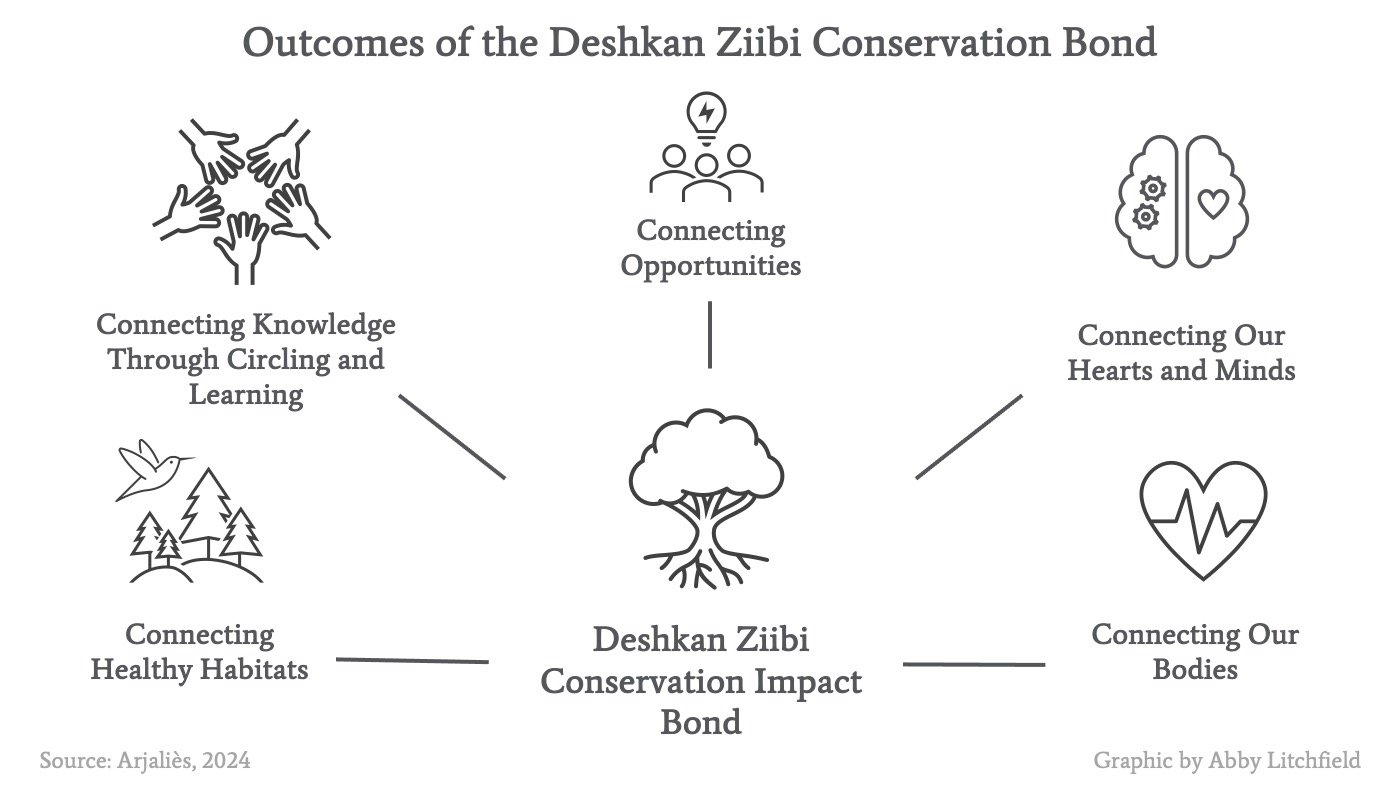
DCZIB outcomes were assessed across five metrics. In this case, the word “metric” is not a single quantitative measure. Rather, a metric describes a collection of related measures, each looking at relationships between Indigenous and non-Indigenous peoples and relationships between people and the land. The five metrics were:
-
Connecting Healthy Habitats: This metric assessed the project’s direct environmental impact. For example, it measured how many hectares of habitat were improved and how many native plants were planted.
-
Connecting Knowledge Through Circling and Learning: This metric focused on how successfully the project integrated traditional ecological knowledge with Western conservation science.
-
Connecting Opportunities: This metric assessed the socio-economic benefits created by the project, particularly for Indigenous communities. That included job creation, economic development, and Indigenous peoples’ participation in and benefits from conservation efforts.
-
Connecting Our Hearts and Minds: This metric captured the project’s impact on people’s attitudes and perceptions. For instance, it investigated whether participants had a deeper understanding and appreciation for the interconnectedness of human and non-human communities and a sense of responsibility for the well-being of the land.
-
Connecting Our Bodies: This metric explored the project’s impact on human health and well-being. That included assessing opportunities for people to spend time in nature, which has physical and mental health benefits.
To learn more about the Deshkan Ziiibi Conservation Impact bond, you can look at the academic paper, report, and story map.
Regenerative Finance: The Path Forward
While the DZCIB has had very positive local impacts, impact bonds alone cannot address the fundamental problems in the current financial system, which is not set up to enable positive impact at scale.
The financial system has an extractive and exploitative relationship with land. Land—including plants, animals, water, and minerals—is seen as a natural resource to be exploited for people’s short-term financial gain. Pursuing only profit results in practices like deforestation, mining, and industrial agriculture, which damage ecosystems and threaten biodiversity.
In addition to innovative financial instruments, like the DZCIB, we also need changes to the global financial system. We need policy that requires us to pay the financial cost of the harm caused by pollution and climate change. We need policy that gives intentional financial value to biodiversity, ecosystem services, and Indigenous cultural restoration. Only when the larger financial system begins to value these things will we move more seamlessly toward them.
More About Sustainable Finance at Ivey
I lead Ivey’s Sustainable Finance Lab, where we use different forms of regenerative capital to protect biodiversity and pursue truth and reconciliation with Indigenous communities. We are currently developing a region-wide impact bond, like the DZCIB. We are also investigating the role capital markets can play in economic reconciliation with First Nations and developing new financial products targeting regenerative agriculture.
If you want to know more about the Ivey Sustainable Finance Lab, visit our website or contact me: Dr. Diane-Laure Arjaliès (darjalies@ivey.ca).
The post Impact Bonds and the Possibilities of Regenerative Finance appeared first on Network for Business Sustainability (NBS).
]]>
https://nbs.net/impact-bonds-and-the-possibilities-of-regenerative-finance/feed/
0
Sun, 01 Dec 2024 01:18:03 +0000
<![CDATA[
Researcher Update: Indigenous Management and October Table of Contents
The post November 2024: Researcher Update appeared first on Network for Business Sustainability (NBS).
]]>
<![CDATA[
96
p{
margin:10px 0;
padding:0;
}
table{
border-collapse:collapse;
}
h1,h2,h3,h4,h5,h6{
display:block;
margin:0;
padding:0;
}
img,a img{
border:0;
height:auto;
outline:none;
text-decoration:none;
}
body,#bodyTable,#bodyCell{
height:100%;
margin:0;
padding:0;
width:100%;
}
.mcnPreviewText{
display:none !important;
}
#outlook a{
padding:0;
}
img{
-ms-interpolation-mode:bicubic;
}
table{
mso-table-lspace:0pt;
mso-table-rspace:0pt;
}
.ReadMsgBody{
width:100%;
}
.ExternalClass{
width:100%;
}
p,a,li,td,blockquote{
mso-line-height-rule:exactly;
}
a[href^=tel],a[href^=sms]{
color:inherit;
cursor:default;
text-decoration:none;
}
p,a,li,td,body,table,blockquote{
-ms-text-size-adjust:100%;
-webkit-text-size-adjust:100%;
}
.ExternalClass,.ExternalClass p,.ExternalClass td,.ExternalClass div,.ExternalClass span,.ExternalClass font{
line-height:100%;
}
a[x-apple-data-detectors]{
color:inherit !important;
text-decoration:none !important;
font-size:inherit !important;
font-family:inherit !important;
font-weight:inherit !important;
line-height:inherit !important;
}
table[align=left]{
float:left;
}
table[align=right]{
float:right;
}
#bodyCell{
padding:10px;
}
.templateContainer{
max-width:600px !important;
}
a.mcnButton{
display:block;
}
.mcnImage,.mcnRetinaImage{
vertical-align:bottom;
}
.mcnTextContent{
word-break:break-word;
}
.mcnTextContent img{
height:auto !important;
}
.mcnDividerBlock{
table-layout:fixed !important;
}
body,#bodyTable{
background-color:#f1f1f1;
}
#bodyCell{
border-top:0;
}
.templateContainer{
border:0;
}
h1{
color:#817a75;
font-family:’Helvetica Neue’, Helvetica, Arial, Verdana, sans-serif;
font-size:24px;
font-style:normal;
font-weight:normal;
line-height:125%;
letter-spacing:normal;
text-align:center;
}
h2{
color:#817a75;
font-family:’Helvetica Neue’, Helvetica, Arial, Verdana, sans-serif;
font-size:18px;
font-style:normal;
font-weight:bold;
line-height:125%;
letter-spacing:normal;
text-align:center;
}
h3{
color:#817a75;
font-family:’Helvetica Neue’, Helvetica, Arial, Verdana, sans-serif;
font-size:18px;
font-style:normal;
font-weight:bold;
line-height:125%;
letter-spacing:normal;
text-align:center;
}
h4{
color:#817a75;
font-family:’Helvetica Neue’, Helvetica, Arial, Verdana, sans-serif;
font-size:18px;
font-style:normal;
font-weight:bold;
line-height:125%;
letter-spacing:normal;
text-align:left;
}
#templatePreheader{
background-color:#f1f1f1;
background-image:none;
background-repeat:no-repeat;
background-position:center;
background-size:contain;
border-top:10px none ;
border-bottom:10px none ;
padding-top:10px;
padding-bottom:10px;
}
#templatePreheader .mcnTextContent,#templatePreheader .mcnTextContent p{
color:#656565;
font-family:’Helvetica Neue’, Helvetica, Arial, Verdana, sans-serif;
font-size:12px;
line-height:150%;
text-align:center;
}
#templatePreheader .mcnTextContent a,#templatePreheader .mcnTextContent p a{
color:#5e81ca;
font-weight:normal;
text-decoration:underline;
}
#templateHeader{
background-color:#ffffff;
background-image:none;
background-repeat:no-repeat;
background-position:center;
background-size:cover;
border-top:0;
border-bottom:0;
padding-top:0px;
padding-bottom:0px;
}
#templateHeader .mcnTextContent,#templateHeader .mcnTextContent p{
color:#666666;
font-family:’Helvetica Neue’, Helvetica, Arial, Verdana, sans-serif;
font-size:16px;
line-height:150%;
text-align:center;
}
#templateHeader .mcnTextContent a,#templateHeader .mcnTextContent p a{
color:#5e81ca;
font-weight:normal;
text-decoration:underline;
}
#templateBody{
background-color:#ffffff;
background-image:none;
background-repeat:no-repeat;
background-position:center;
background-size:cover;
border-top:0;
border-bottom:2px solid #EAEAEA;
padding-top:0;
padding-bottom:0px;
}
#templateBody .mcnTextContent,#templateBody .mcnTextContent p{
color:#666666;
font-family:’Helvetica Neue’, Helvetica, Arial, Verdana, sans-serif;
font-size:16px;
line-height:150%;
text-align:center;
}
#templateBody .mcnTextContent a,#templateBody .mcnTextContent p a{
color:#5e81ca;
font-weight:normal;
text-decoration:underline;
}
#templateFooter{
background-color:#f1f1f1;
background-image:none;
background-repeat:no-repeat;
background-position:center;
background-size:cover;
border-top:0;
border-bottom:0;
padding-top:10px;
padding-bottom:10px;
}
#templateFooter .mcnTextContent,#templateFooter .mcnTextContent p{
color:#666666;
font-family:’Helvetica Neue’, Helvetica, Arial, Verdana, sans-serif;
font-size:12px;
line-height:150%;
text-align:center;
}
#templateFooter .mcnTextContent a,#templateFooter .mcnTextContent p a{
color:#5e81ca;
font-weight:normal;
text-decoration:underline;
}
@media only screen and (min-width:768px){
.templateContainer{
width:600px !important;
}
} @media only screen and (max-width: 480px){
body,table,td,p,a,li,blockquote{
-webkit-text-size-adjust:none !important;
}
} @media only screen and (max-width: 480px){
body{
width:100% !important;
min-width:100% !important;
}
} @media only screen and (max-width: 480px){
.mcnRetinaImage{
max-width:100% !important;
}
} @media only screen and (max-width: 480px){
.mcnImage{
width:100% !important;
}
} @media only screen and (max-width: 480px){
.mcnCartContainer,.mcnCaptionTopContent,.mcnRecContentContainer,.mcnCaptionBottomContent,.mcnTextContentContainer,.mcnBoxedTextContentContainer,.mcnImageGroupContentContainer,.mcnCaptionLeftTextContentContainer,.mcnCaptionRightTextContentContainer,.mcnCaptionLeftImageContentContainer,.mcnCaptionRightImageContentContainer,.mcnImageCardLeftTextContentContainer,.mcnImageCardRightTextContentContainer,.mcnImageCardLeftImageContentContainer,.mcnImageCardRightImageContentContainer{
max-width:100% !important;
width:100% !important;
}
} @media only screen and (max-width: 480px){
.mcnBoxedTextContentContainer{
min-width:100% !important;
}
} @media only screen and (max-width: 480px){
.mcnImageGroupContent{
padding:9px !important;
}
} @media only screen and (max-width: 480px){
.mcnCaptionLeftContentOuter .mcnTextContent,.mcnCaptionRightContentOuter .mcnTextContent{
padding-top:9px !important;
}
} @media only screen and (max-width: 480px){
.mcnImageCardTopImageContent,.mcnCaptionBottomContent:last-child .mcnCaptionBottomImageContent,.mcnCaptionBlockInner .mcnCaptionTopContent:last-child .mcnTextContent{
padding-top:18px !important;
}
} @media only screen and (max-width: 480px){
.mcnImageCardBottomImageContent{
padding-bottom:9px !important;
}
} @media only screen and (max-width: 480px){
.mcnImageGroupBlockInner{
padding-top:0 !important;
padding-bottom:0 !important;
}
} @media only screen and (max-width: 480px){
.mcnImageGroupBlockOuter{
padding-top:9px !important;
padding-bottom:9px !important;
}
} @media only screen and (max-width: 480px){
.mcnTextContent,.mcnBoxedTextContentColumn{
padding-right:18px !important;
padding-left:18px !important;
}
} @media only screen and (max-width: 480px){
.mcnImageCardLeftImageContent,.mcnImageCardRightImageContent{
padding-right:18px !important;
padding-bottom:0 !important;
padding-left:18px !important;
}
} @media only screen and (max-width: 480px){
.mcpreview-image-uploader{
display:none !important;
width:100% !important;
}
} @media only screen and (max-width: 480px){
h1{
font-size:22px !important;
line-height:125% !important;
}
} @media only screen and (max-width: 480px){
h2{
font-size:20px !important;
line-height:125% !important;
}
} @media only screen and (max-width: 480px){
h3{
font-size:18px !important;
line-height:125% !important;
}
} @media only screen and (max-width: 480px){
h4{
font-size:16px !important;
line-height:150% !important;
}
} @media only screen and (max-width: 480px){
.mcnBoxedTextContentContainer .mcnTextContent,.mcnBoxedTextContentContainer .mcnTextContent p{
font-size:14px !important;
line-height:150% !important;
}
} @media only screen and (max-width: 480px){
#templatePreheader{
display:block !important;
}
} @media only screen and (max-width: 480px){
#templatePreheader .mcnTextContent,#templatePreheader .mcnTextContent p{
font-size:14px !important;
line-height:150% !important;
}
} @media only screen and (max-width: 480px){
#templateHeader .mcnTextContent,#templateHeader .mcnTextContent p{
font-size:16px !important;
line-height:150% !important;
}
} @media only screen and (max-width: 480px){
#templateBody .mcnTextContent,#templateBody .mcnTextContent p{
font-size:16px !important;
line-height:150% !important;
}
} @media only screen and (max-width: 480px){
#templateFooter .mcnTextContent,#templateFooter .mcnTextContent p{
font-size:14px !important;
line-height:150% !important;
}
}
<!–
|




The post November 2024: Researcher Update appeared first on Network for Business Sustainability (NBS).
]]>
https://nbs.net/november-2024-researcher-update/feed/
0
Weaving Indigenous Approaches into Management and Organization
Weaving Indigenous Approaches into Management and Organization
Wed, 27 Nov 2024 17:28:29 +0000
Weaving Indigenous Approaches into Management and Organization
<![CDATA[
After decades of marginalization, a new movement is nurturing Indigenous scholars and research in Business Schools.
The post Weaving Indigenous Approaches into Management and Organization appeared first on Network for Business Sustainability (NBS).
]]>
<
Emphasising Relationships
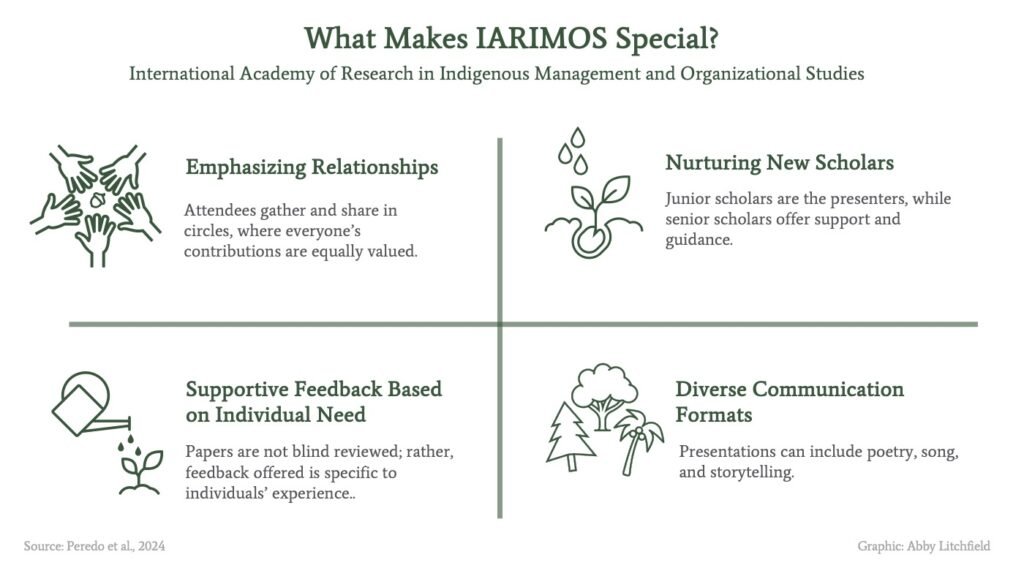
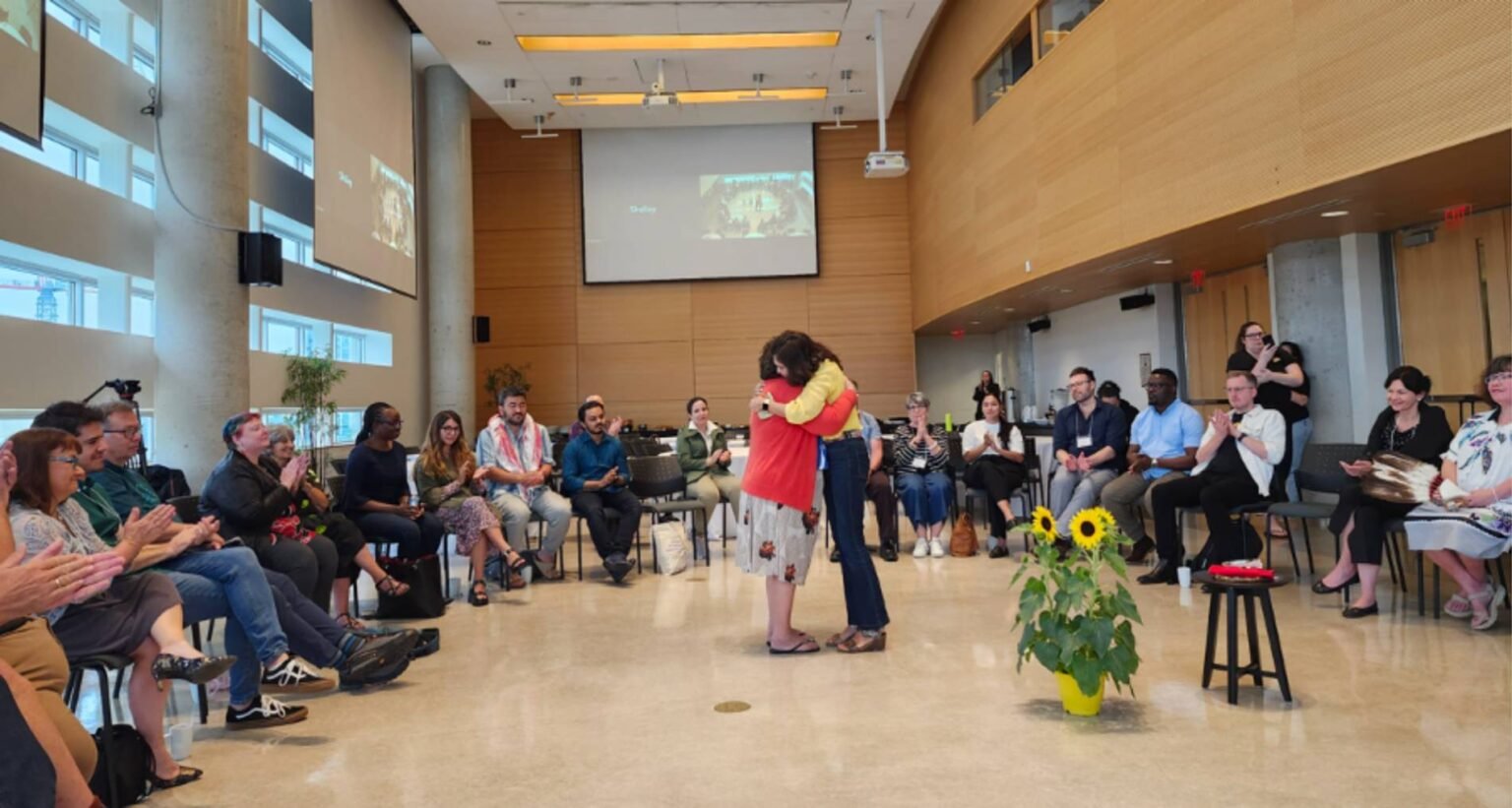
IARIMOS is designed to enable connection and relationship building among attendees. Attendance numbers are kept small enough to enable everybody to get to know everybody else on a personal level. The meeting begins and ends with attendees seated in a circle, where they are guided by elders in a ceremony. Every participant introduces themselves to the circle as a person, including their heritage, or other aspects of their background, and what they hope to share and gain from the experience. Everyone’s perspective is of equal status in the circle. There is no top table, and no ‘cheap seats’ in the back.
Supportive Feedback Based on Individual Need
Papers submitted to IARIMOS are not blind-reviewed. They are assessed by a committee made up of Indigenous and non-Indigenous ally scholars from different geographies, ages, and backgrounds. The committee carefully considers the scholars’ development, personal, academic and financial needs, and what the best way to review their paper would be given ‘where they are at.’
For example, if a non-Indigenous scholar new to the field of Indigenous research joins IARIMOS, the assigned mentor and the supportive research circle help guide the selection of appropriate methodologies – here, an important consideration is a benefit to the community. For scholars who are further into their research, mentor feedback could address more nuanced elements of research, such as the cultural relevance of a specific methodology.
A paper presented at IARIMOS by John Huria, a researcher from Aotearoa (New Zealand), looked at how blind reviewing can be a poor fit for Indigenous knowledge development (and other knowledge development, too). The pretence of disconnected anonymity comes at a cost, particularly for young scholars. They often get cold, unempathetic and dispiriting advice, in unhelpful ways, at the wrong time, and delivered in ways that are not necessarily suited to their or the field’s development.
Diverse Communication Formats
Attendees are encouraged to present knowledge in many different ways. At IARIMOS, the medium depends upon the best relationship with the nature of the knowledge and the message it conveys. For example, a particularly insightful presentation at IARIMOS 2024 was offered in the form of a poem, and an introductory address by an elder was responded to in song. Stories, symbolism and metaphors connected to the land were also invoked frequently.
Benefits of IARIMOS
IARIMOS unites Indigenous Peoples from around the globe and their allies. It aims to foster an environment where participants collectively learn about and celebrate the diversity of Indigenous knowledges with care and mutual respect. There are no registration fees, and presenters, especially those who are Indigenous or from the Global South, are provided with a small stipend to assist with travel costs. Spaces and budget are limited, and the committee does its best to accommodate as many presenters as possible. If you’re wondering if you and your research will find your place at IARIMOS, organizers invite you to email them. Their contact details are below.
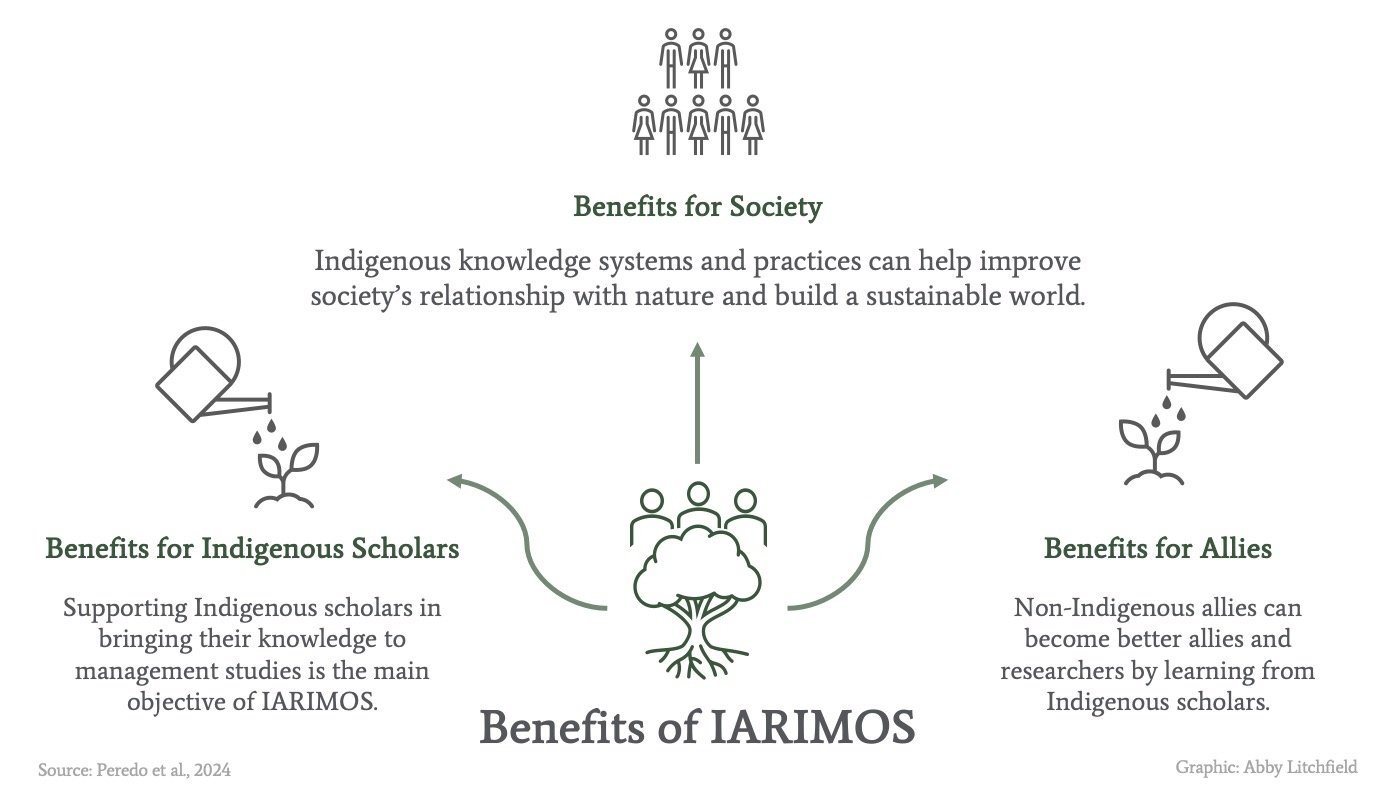
The conference offers many benefits for Indigenous scholars, allies, and society.
Benefits for Indigenous Scholars
IARIMOS’s main objective is to support Indigenous scholars, especially those just beginning their journey as academics, encouraging them to bring their knowledge into management and organization studies. Most Indigenous scholars have experienced invalidation in the workplace or at conferences when their views don’t align with colonial ways of thinking. For example, Dr. Robin Wall Kimmerer often tells the story of her first day at forestry school. Her advisor asked why she wanted to study botany. She shared that she “wanted to learn why asters and goldenrod look so beautiful together,” but she was told that her question was not science. IARIMOS respects, embraces, and supports all Indigenous approaches to knowledge development.
The post Weaving Indigenous Approaches into Management and Organization appeared first on Network for Business Sustainability (NBS).
]]>
https://nbs.net/weaving-indigenous-approaches-into-management-and-organization/feed/
0
Fri, 15 Nov 2024 23:49:17 +0000
<![CDATA[
NBS’s monthly compilation of the latest business sustainability research prioritizes in-press articles, in order to highlight cutting-edge knowledge. The list draws from Financial Times Top 50 journals and other publications.
The post Table of Contents: October 2024 appeared first on Network for Business Sustainability (NBS).
]]>
<![CDATA[
The post Table of Contents: October 2024 appeared first on Network for Business Sustainability (NBS).
]]>
https://nbs.net/table-of-contents-october-2024/feed/
0
Fri, 01 Nov 2024 01:17:58 +0000
<![CDATA[
Researcher Update: August Table of Contents
The post October 2024: Researcher Update appeared first on Network for Business Sustainability (NBS).
]]>
<![CDATA[
96
p{
margin:10px 0;
padding:0;
}
table{
border-collapse:collapse;
}
h1,h2,h3,h4,h5,h6{
display:block;
margin:0;
padding:0;
}
img,a img{
border:0;
height:auto;
outline:none;
text-decoration:none;
}
body,#bodyTable,#bodyCell{
height:100%;
margin:0;
padding:0;
width:100%;
}
.mcnPreviewText{
display:none !important;
}
#outlook a{
padding:0;
}
img{
-ms-interpolation-mode:bicubic;
}
table{
mso-table-lspace:0pt;
mso-table-rspace:0pt;
}
.ReadMsgBody{
width:100%;
}
.ExternalClass{
width:100%;
}
p,a,li,td,blockquote{
mso-line-height-rule:exactly;
}
a[href^=tel],a[href^=sms]{
color:inherit;
cursor:default;
text-decoration:none;
}
p,a,li,td,body,table,blockquote{
-ms-text-size-adjust:100%;
-webkit-text-size-adjust:100%;
}
.ExternalClass,.ExternalClass p,.ExternalClass td,.ExternalClass div,.ExternalClass span,.ExternalClass font{
line-height:100%;
}
a[x-apple-data-detectors]{
color:inherit !important;
text-decoration:none !important;
font-size:inherit !important;
font-family:inherit !important;
font-weight:inherit !important;
line-height:inherit !important;
}
table[align=left]{
float:left;
}
table[align=right]{
float:right;
}
#bodyCell{
padding:10px;
}
.templateContainer{
max-width:600px !important;
}
a.mcnButton{
display:block;
}
.mcnImage,.mcnRetinaImage{
vertical-align:bottom;
}
.mcnTextContent{
word-break:break-word;
}
.mcnTextContent img{
height:auto !important;
}
.mcnDividerBlock{
table-layout:fixed !important;
}
body,#bodyTable{
background-color:#f1f1f1;
}
#bodyCell{
border-top:0;
}
.templateContainer{
border:0;
}
h1{
color:#817a75;
font-family:’Helvetica Neue’, Helvetica, Arial, Verdana, sans-serif;
font-size:24px;
font-style:normal;
font-weight:normal;
line-height:125%;
letter-spacing:normal;
text-align:center;
}
h2{
color:#817a75;
font-family:’Helvetica Neue’, Helvetica, Arial, Verdana, sans-serif;
font-size:18px;
font-style:normal;
font-weight:bold;
line-height:125%;
letter-spacing:normal;
text-align:center;
}
h3{
color:#817a75;
font-family:’Helvetica Neue’, Helvetica, Arial, Verdana, sans-serif;
font-size:18px;
font-style:normal;
font-weight:bold;
line-height:125%;
letter-spacing:normal;
text-align:center;
}
h4{
color:#817a75;
font-family:’Helvetica Neue’, Helvetica, Arial, Verdana, sans-serif;
font-size:18px;
font-style:normal;
font-weight:bold;
line-height:125%;
letter-spacing:normal;
text-align:left;
}
#templatePreheader{
background-color:#f1f1f1;
background-image:none;
background-repeat:no-repeat;
background-position:center;
background-size:contain;
border-top:10px none ;
border-bottom:10px none ;
padding-top:10px;
padding-bottom:10px;
}
#templatePreheader .mcnTextContent,#templatePreheader .mcnTextContent p{
color:#656565;
font-family:’Helvetica Neue’, Helvetica, Arial, Verdana, sans-serif;
font-size:12px;
line-height:150%;
text-align:center;
}
#templatePreheader .mcnTextContent a,#templatePreheader .mcnTextContent p a{
color:#5e81ca;
font-weight:normal;
text-decoration:underline;
}
#templateHeader{
background-color:#ffffff;
background-image:none;
background-repeat:no-repeat;
background-position:center;
background-size:cover;
border-top:0;
border-bottom:0;
padding-top:0px;
padding-bottom:0px;
}
#templateHeader .mcnTextContent,#templateHeader .mcnTextContent p{
color:#666666;
font-family:’Helvetica Neue’, Helvetica, Arial, Verdana, sans-serif;
font-size:16px;
line-height:150%;
text-align:center;
}
#templateHeader .mcnTextContent a,#templateHeader .mcnTextContent p a{
color:#5e81ca;
font-weight:normal;
text-decoration:underline;
}
#templateBody{
background-color:#ffffff;
background-image:none;
background-repeat:no-repeat;
background-position:center;
background-size:cover;
border-top:0;
border-bottom:2px solid #EAEAEA;
padding-top:0;
padding-bottom:0px;
}
#templateBody .mcnTextContent,#templateBody .mcnTextContent p{
color:#666666;
font-family:’Helvetica Neue’, Helvetica, Arial, Verdana, sans-serif;
font-size:16px;
line-height:150%;
text-align:center;
}
#templateBody .mcnTextContent a,#templateBody .mcnTextContent p a{
color:#5e81ca;
font-weight:normal;
text-decoration:underline;
}
#templateFooter{
background-color:#f1f1f1;
background-image:none;
background-repeat:no-repeat;
background-position:center;
background-size:cover;
border-top:0;
border-bottom:0;
padding-top:10px;
padding-bottom:10px;
}
#templateFooter .mcnTextContent,#templateFooter .mcnTextContent p{
color:#666666;
font-family:’Helvetica Neue’, Helvetica, Arial, Verdana, sans-serif;
font-size:12px;
line-height:150%;
text-align:center;
}
#templateFooter .mcnTextContent a,#templateFooter .mcnTextContent p a{
color:#5e81ca;
font-weight:normal;
text-decoration:underline;
}
@media only screen and (min-width:768px){
.templateContainer{
width:600px !important;
}
} @media only screen and (max-width: 480px){
body,table,td,p,a,li,blockquote{
-webkit-text-size-adjust:none !important;
}
} @media only screen and (max-width: 480px){
body{
width:100% !important;
min-width:100% !important;
}
} @media only screen and (max-width: 480px){
.mcnRetinaImage{
max-width:100% !important;
}
} @media only screen and (max-width: 480px){
.mcnImage{
width:100% !important;
}
} @media only screen and (max-width: 480px){
.mcnCartContainer,.mcnCaptionTopContent,.mcnRecContentContainer,.mcnCaptionBottomContent,.mcnTextContentContainer,.mcnBoxedTextContentContainer,.mcnImageGroupContentContainer,.mcnCaptionLeftTextContentContainer,.mcnCaptionRightTextContentContainer,.mcnCaptionLeftImageContentContainer,.mcnCaptionRightImageContentContainer,.mcnImageCardLeftTextContentContainer,.mcnImageCardRightTextContentContainer,.mcnImageCardLeftImageContentContainer,.mcnImageCardRightImageContentContainer{
max-width:100% !important;
width:100% !important;
}
} @media only screen and (max-width: 480px){
.mcnBoxedTextContentContainer{
min-width:100% !important;
}
} @media only screen and (max-width: 480px){
.mcnImageGroupContent{
padding:9px !important;
}
} @media only screen and (max-width: 480px){
.mcnCaptionLeftContentOuter .mcnTextContent,.mcnCaptionRightContentOuter .mcnTextContent{
padding-top:9px !important;
}
} @media only screen and (max-width: 480px){
.mcnImageCardTopImageContent,.mcnCaptionBottomContent:last-child .mcnCaptionBottomImageContent,.mcnCaptionBlockInner .mcnCaptionTopContent:last-child .mcnTextContent{
padding-top:18px !important;
}
} @media only screen and (max-width: 480px){
.mcnImageCardBottomImageContent{
padding-bottom:9px !important;
}
} @media only screen and (max-width: 480px){
.mcnImageGroupBlockInner{
padding-top:0 !important;
padding-bottom:0 !important;
}
} @media only screen and (max-width: 480px){
.mcnImageGroupBlockOuter{
padding-top:9px !important;
padding-bottom:9px !important;
}
} @media only screen and (max-width: 480px){
.mcnTextContent,.mcnBoxedTextContentColumn{
padding-right:18px !important;
padding-left:18px !important;
}
} @media only screen and (max-width: 480px){
.mcnImageCardLeftImageContent,.mcnImageCardRightImageContent{
padding-right:18px !important;
padding-bottom:0 !important;
padding-left:18px !important;
}
} @media only screen and (max-width: 480px){
.mcpreview-image-uploader{
display:none !important;
width:100% !important;
}
} @media only screen and (max-width: 480px){
h1{
font-size:22px !important;
line-height:125% !important;
}
} @media only screen and (max-width: 480px){
h2{
font-size:20px !important;
line-height:125% !important;
}
} @media only screen and (max-width: 480px){
h3{
font-size:18px !important;
line-height:125% !important;
}
} @media only screen and (max-width: 480px){
h4{
font-size:16px !important;
line-height:150% !important;
}
} @media only screen and (max-width: 480px){
.mcnBoxedTextContentContainer .mcnTextContent,.mcnBoxedTextContentContainer .mcnTextContent p{
font-size:14px !important;
line-height:150% !important;
}
} @media only screen and (max-width: 480px){
#templatePreheader{
display:block !important;
}
} @media only screen and (max-width: 480px){
#templatePreheader .mcnTextContent,#templatePreheader .mcnTextContent p{
font-size:14px !important;
line-height:150% !important;
}
} @media only screen and (max-width: 480px){
#templateHeader .mcnTextContent,#templateHeader .mcnTextContent p{
font-size:16px !important;
line-height:150% !important;
}
} @media only screen and (max-width: 480px){
#templateBody .mcnTextContent,#templateBody .mcnTextContent p{
font-size:16px !important;
line-height:150% !important;
}
} @media only screen and (max-width: 480px){
#templateFooter .mcnTextContent,#templateFooter .mcnTextContent p{
font-size:14px !important;
line-height:150% !important;
}
}
<!–
|
The post October 2024: Researcher Update appeared first on Network for Business Sustainability (NBS).
]]>
https://nbs.net/october-2024-researcher-update/feed/
0
Sun, 20 Oct 2024 22:57:36 +0000
<![CDATA[
New Ways to Learn
The post October 2024: Network News appeared first on Network for Business Sustainability (NBS).
]]>
<![CDATA[
96
p{
margin:10px 0;
padding:0;
}
table{
border-collapse:collapse;
}
h1,h2,h3,h4,h5,h6{
display:block;
margin:0;
padding:0;
}
img,a img{
border:0;
height:auto;
outline:none;
text-decoration:none;
}
body,#bodyTable,#bodyCell{
height:100%;
margin:0;
padding:0;
width:100%;
}
.mcnPreviewText{
display:none !important;
}
#outlook a{
padding:0;
}
img{
-ms-interpolation-mode:bicubic;
}
table{
mso-table-lspace:0pt;
mso-table-rspace:0pt;
}
.ReadMsgBody{
width:100%;
}
.ExternalClass{
width:100%;
}
p,a,li,td,blockquote{
mso-line-height-rule:exactly;
}
a[href^=tel],a[href^=sms]{
color:inherit;
cursor:default;
text-decoration:none;
}
p,a,li,td,body,table,blockquote{
-ms-text-size-adjust:100%;
-webkit-text-size-adjust:100%;
}
.ExternalClass,.ExternalClass p,.ExternalClass td,.ExternalClass div,.ExternalClass span,.ExternalClass font{
line-height:100%;
}
a[x-apple-data-detectors]{
color:inherit !important;
text-decoration:none !important;
font-size:inherit !important;
font-family:inherit !important;
font-weight:inherit !important;
line-height:inherit !important;
}
table[align=left]{
float:left;
}
table[align=right]{
float:right;
}
#bodyCell{
padding:10px;
}
.templateContainer{
max-width:600px !important;
}
a.mcnButton{
display:block;
}
.mcnImage,.mcnRetinaImage{
vertical-align:bottom;
}
.mcnTextContent{
word-break:break-word;
}
.mcnTextContent img{
height:auto !important;
}
.mcnDividerBlock{
table-layout:fixed !important;
}
body,#bodyTable{
background-color:#f1f1f1;
}
#bodyCell{
border-top:0;
}
.templateContainer{
border:0;
}
h1{
color:#817a75;
font-family:’Helvetica Neue’, Helvetica, Arial, Verdana, sans-serif;
font-size:24px;
font-style:normal;
font-weight:normal;
line-height:200%;
letter-spacing:normal;
text-align:center;
}
h2{
color:#817a75;
font-family:’Helvetica Neue’, Helvetica, Arial, Verdana, sans-serif;
font-size:18px;
font-style:normal;
font-weight:normal;
line-height:125%;
letter-spacing:normal;
text-align:center;
}
h3{
color:#817a75;
font-family:’Helvetica Neue’, Helvetica, Arial, Verdana, sans-serif;
font-size:18px;
font-style:normal;
font-weight:bold;
line-height:125%;
letter-spacing:normal;
text-align:center;
}
h4{
color:#817a75;
font-family:’Helvetica Neue’, Helvetica, Arial, Verdana, sans-serif;
font-size:18px;
font-style:normal;
font-weight:bold;
line-height:125%;
letter-spacing:normal;
text-align:left;
}
#templatePreheader{
background-color:#f1f1f1;
background-image:none;
background-repeat:no-repeat;
background-position:center;
background-size:contain;
border-top:10px none ;
border-bottom:10px none ;
padding-top:10px;
padding-bottom:10px;
}
#templatePreheader .mcnTextContent,#templatePreheader .mcnTextContent p{
color:#656565;
font-family:’Helvetica Neue’, Helvetica, Arial, Verdana, sans-serif;
font-size:12px;
line-height:150%;
text-align:center;
}
#templatePreheader .mcnTextContent a,#templatePreheader .mcnTextContent p a{
color:#5e81ca;
font-weight:normal;
text-decoration:underline;
}
#templateHeader{
background-color:#ffffff;
background-image:none;
background-repeat:no-repeat;
background-position:center;
background-size:cover;
border-top:0;
border-bottom:0;
padding-top:0px;
padding-bottom:0px;
}
#templateHeader .mcnTextContent,#templateHeader .mcnTextContent p{
color:#666666;
font-family:’Helvetica Neue’, Helvetica, Arial, Verdana, sans-serif;
font-size:16px;
line-height:150%;
text-align:center;
}
#templateHeader .mcnTextContent a,#templateHeader .mcnTextContent p a{
color:#5e81ca;
font-weight:normal;
text-decoration:underline;
}
#templateBody{
background-color:#ffffff;
background-image:none;
background-repeat:no-repeat;
background-position:center;
background-size:cover;
border-top:0;
border-bottom:2px solid #EAEAEA;
padding-top:0;
padding-bottom:0px;
}
#templateBody .mcnTextContent,#templateBody .mcnTextContent p{
color:#666666;
font-family:’Helvetica Neue’, Helvetica, Arial, Verdana, sans-serif;
font-size:16px;
line-height:150%;
text-align:center;
}
#templateBody .mcnTextContent a,#templateBody .mcnTextContent p a{
color:#5e81ca;
font-weight:normal;
text-decoration:underline;
}
#templateFooter{
background-color:#f1f1f1;
background-image:none;
background-repeat:no-repeat;
background-position:center;
background-size:cover;
border-top:0;
border-bottom:0;
padding-top:10px;
padding-bottom:10px;
}
#templateFooter .mcnTextContent,#templateFooter .mcnTextContent p{
color:#666666;
font-family:’Helvetica Neue’, Helvetica, Arial, Verdana, sans-serif;
font-size:12px;
line-height:150%;
text-align:center;
}
#templateFooter .mcnTextContent a,#templateFooter .mcnTextContent p a{
color:#5e81ca;
font-weight:normal;
text-decoration:underline;
}
@media only screen and (min-width:768px){
.templateContainer{
width:600px !important;
}
} @media only screen and (max-width: 480px){
body,table,td,p,a,li,blockquote{
-webkit-text-size-adjust:none !important;
}
} @media only screen and (max-width: 480px){
body{
width:100% !important;
min-width:100% !important;
}
} @media only screen and (max-width: 480px){
.mcnRetinaImage{
max-width:100% !important;
}
} @media only screen and (max-width: 480px){
.mcnImage{
width:100% !important;
}
} @media only screen and (max-width: 480px){
.mcnCartContainer,.mcnCaptionTopContent,.mcnRecContentContainer,.mcnCaptionBottomContent,.mcnTextContentContainer,.mcnBoxedTextContentContainer,.mcnImageGroupContentContainer,.mcnCaptionLeftTextContentContainer,.mcnCaptionRightTextContentContainer,.mcnCaptionLeftImageContentContainer,.mcnCaptionRightImageContentContainer,.mcnImageCardLeftTextContentContainer,.mcnImageCardRightTextContentContainer,.mcnImageCardLeftImageContentContainer,.mcnImageCardRightImageContentContainer{
max-width:100% !important;
width:100% !important;
}
} @media only screen and (max-width: 480px){
.mcnBoxedTextContentContainer{
min-width:100% !important;
}
} @media only screen and (max-width: 480px){
.mcnImageGroupContent{
padding:9px !important;
}
} @media only screen and (max-width: 480px){
.mcnCaptionLeftContentOuter .mcnTextContent,.mcnCaptionRightContentOuter .mcnTextContent{
padding-top:9px !important;
}
} @media only screen and (max-width: 480px){
.mcnImageCardTopImageContent,.mcnCaptionBottomContent:last-child .mcnCaptionBottomImageContent,.mcnCaptionBlockInner .mcnCaptionTopContent:last-child .mcnTextContent{
padding-top:18px !important;
}
} @media only screen and (max-width: 480px){
.mcnImageCardBottomImageContent{
padding-bottom:9px !important;
}
} @media only screen and (max-width: 480px){
.mcnImageGroupBlockInner{
padding-top:0 !important;
padding-bottom:0 !important;
}
} @media only screen and (max-width: 480px){
.mcnImageGroupBlockOuter{
padding-top:9px !important;
padding-bottom:9px !important;
}
} @media only screen and (max-width: 480px){
.mcnTextContent,.mcnBoxedTextContentColumn{
padding-right:18px !important;
padding-left:18px !important;
}
} @media only screen and (max-width: 480px){
.mcnImageCardLeftImageContent,.mcnImageCardRightImageContent{
padding-right:18px !important;
padding-bottom:0 !important;
padding-left:18px !important;
}
} @media only screen and (max-width: 480px){
.mcpreview-image-uploader{
display:none !important;
width:100% !important;
}
} @media only screen and (max-width: 480px){
h1{
font-size:22px !important;
line-height:125% !important;
}
} @media only screen and (max-width: 480px){
h2{
font-size:20px !important;
line-height:125% !important;
}
} @media only screen and (max-width: 480px){
h3{
font-size:18px !important;
line-height:125% !important;
}
} @media only screen and (max-width: 480px){
h4{
font-size:16px !important;
line-height:150% !important;
}
} @media only screen and (max-width: 480px){
.mcnBoxedTextContentContainer .mcnTextContent,.mcnBoxedTextContentContainer .mcnTextContent p{
font-size:14px !important;
line-height:150% !important;
}
} @media only screen and (max-width: 480px){
#templatePreheader{
display:block !important;
}
} @media only screen and (max-width: 480px){
#templatePreheader .mcnTextContent,#templatePreheader .mcnTextContent p{
font-size:14px !important;
line-height:150% !important;
}
} @media only screen and (max-width: 480px){
#templateHeader .mcnTextContent,#templateHeader .mcnTextContent p{
font-size:16px !important;
line-height:150% !important;
}
} @media only screen and (max-width: 480px){
#templateBody .mcnTextContent,#templateBody .mcnTextContent p{
font-size:16px !important;
line-height:150% !important;
}
} @media only screen and (max-width: 480px){
#templateFooter .mcnTextContent,#templateFooter .mcnTextContent p{
font-size:14px !important;
line-height:150% !important;
}
}
<!–
|



The post October 2024: Network News appeared first on Network for Business Sustainability (NBS).
]]>
https://nbs.net/october-2024-network-news/feed/
0
Tue, 15 Oct 2024 16:42:23 +0000
<![CDATA[
NBS’s monthly compilation of the latest business sustainability research prioritizes in-press articles, in order to highlight cutting-edge knowledge. The list draws from Financial Times Top 50 journals and other publications.
The post Table of Contents: September 2024 appeared first on Network for Business Sustainability (NBS).
]]>
<![CDATA[
The post Table of Contents: September 2024 appeared first on Network for Business Sustainability (NBS).
]]>
https://nbs.net/table-of-contents-september-2024/feed/
0
Coalitions Can Help Institutional Investors Improve Their Climate Impact
Coalitions Can Help Institutional Investors Improve Their Climate Impact
Sat, 05 Oct 2024 23:56:33 +0000
Coalitions Can Help Institutional Investors Improve Their Climate Impact
<![CDATA[
When a firm loses money because of climate change, so does its investors. New research shows how investors can lower climate risk and improve impact.
The post Coalitions Can Help Institutional Investors Improve Their Climate Impact appeared first on Network for Business Sustainability (NBS).
]]>
<
New Research On Best Practices for Shareholder Coalitions
The Principles for Responsible Investment (PRI), sponsored by the United Nations, recognizes the power of investor coalitions – they asked us to research the question: “Which factors make investor coalitions more successful in driving climate action?” The research team also included Rieneke Slager (University of Groningen), Santi Furnari (Bayes Business School), and Mikael Homanen (formerly at PRI).
Together, we studied 553 coalition engagements from 2008 to 2019, where the target companies spanned 35 countries. We also interviewed 88 investors, target firm staff, and PRI staff. This article summarizes what we learned.
If you work for an institutional investor and you’re worried about the impact climate change will have on your work, keep reading. You’ll learn how to get involved in a climate-focused coalition and which factors will make your coalition more successful.
Which Company to Target
Many institutional investors work with an ESG data provider to assess climate risk in their portfolio. This can help identify holdings in companies with high emissions or low-quality carbon disclosure. These poor performers might be good targets for engagement, although not all companies will be open to change.
As you figure out exactly which company to target, consider how receptive each company might be to your request. Receptivity is usually a function of the firm’s willingness to change and its capability for change.
You can get clues about willingness to change by looking at data on the company’s past environmental performance. If it has a track record good performance, the chances are better that your climate request will align with the company’s existing culture and be an easier ‘yes.’ Capacity for change refers the company’s ability to resource the change you’re requesting. Larger companies, with higher profits, will have an easier time finding the resources to support your request.
But that’s not to say there’s no value in engaging less receptive target firms, such as fossil fuel companies with an unimpressive record of climate action. Often, unreceptive companies contribute heavily to climate change and climate risk and are the least likely to change on their own. Your success rate here may be lower, but the victories are more important.
How to Start a Shareholder Coalition
Once you’ve decided on a target company, and you’re ready to start a coalition, there are a few options for getting started.
-
Talk to investors you already know. Ask if they are interested in engaging the target company collectively.
-
Look through lists of major shareholders at the target company. Get in touch with those investors.
-
Reach out to a convening organization, like PRI, who can help you build a coalition. Research shows there can benefits to working with an intermediary organization to build and coordinate a coalition. PRI has a collaboration platform investors can use to post a proposed collaborative engagement. Other organizations offer similar support, including Climate Action100+, Ceres, ShareAction, Australasian Centre for Corporate Responsibility, Interfaith Center on Corporate Responsibility, and many more.
How to Structure a Shareholder Coalition
Coalition Attributes That Make Companies More Likely to Listen
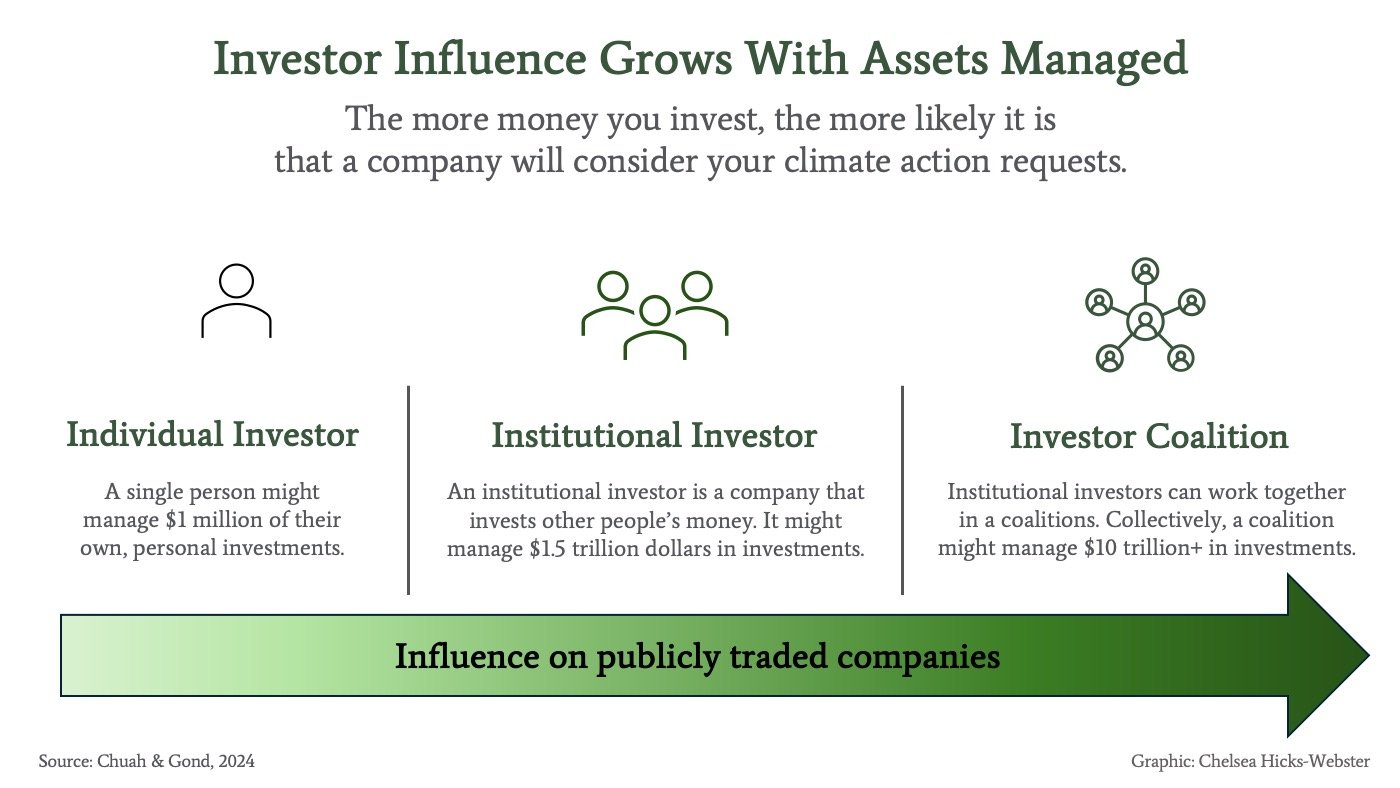
A coalition can include anywhere from two to 20+ institutional investors from anywhere in the world. The coalition usually nominates one or two of its member organizations to lead the process of engaging with the target company. Other members may participate in a lighter touch way.
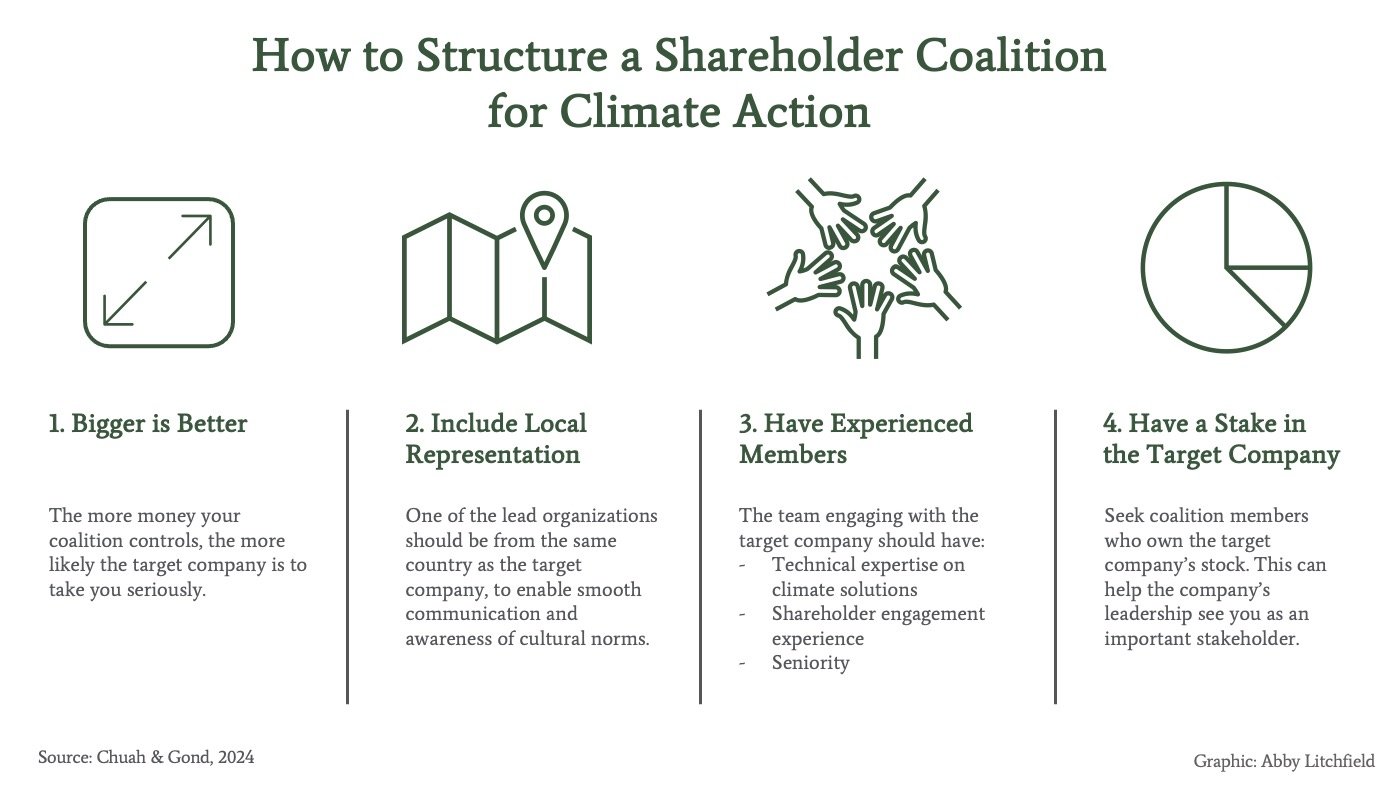
Our review of the existing research shows that there are four coalition attributes that help make engagements more successful on average: size, local representation, experience, and shares held in the company. Below is more detail on each.
Bigger is Better
The size of your coalition is usually viewed as the most important factor in success. The more money your coalition controls, the more likely it is that a company will take your requests seriously. For instance, companies will take more notice of a coalition with $1 trillion in assets compared to another with only $2-3 billion.
If you can’t pull together a team with that many assets, however, don’t worry. It’s not absolutely required. You can use the other attributes below to make your coalition more compelling.
Include Local Representation
Often, having at least one lead organization from the same country as the target company’s headquarters can be useful. It will ensure that coalition members share the same language and cultural norms as staff at the target company, making communication more effective. In Japan, for example, there are strong norms around hierarchy and respectful behaviour. Someone socialized in a Western country may not be familiar with these norms, and unintentionally offend target company staff.
Have Experienced Members
Once the lead organizations are selected, they nominate their staff to participate in an engagement team. It’s particularly important for the lead engagers to include senior, experienced people (though senior members can certainly mentor junior staff). That experience should include:
-
Technical expertise: If the coalition is asking an oil company to expand renewable energy production, for example, the engagement team should ideally include someone with technical expertise in both oil and renewables.
-
Shareholder engagement experience: Navigating a target company is tough. Investors must figure out who to talk to and what to say in different contexts – skills that come with practice. Coalitions should include people with past shareholder engagement experience.
-
Seniority: If the coalition is talking to the target company’s CEO or the board of directors, sending someone with the credibility to negotiate with senior leaders can boost receptivity.
Have a Stake in the Target Company
Another factor that can tilt coalitions towards success is the shareholding stake coalition members have in the target company. Do members hold a large percentage of the company’s total stock? If so, leaders at the target company may see your coalition as a more important stakeholder.
You May Not Need All Four Attributes
If you’re engaging a firm that won’t be receptive to change, it’s best to ensure your coalition has as many of the attributes above as possible. Our research shows, however, that you don’t always need that level of perfection. If the target company is profitable and has a strong environmental track record, it won’t be as hard to motivate them to make climate-friendly changes. In these cases, having a large coalition is important, but it’s still possible to be convincing if your coalition is missing either local representation or experience.
This nuance makes shareholder engagement more accessible for many investors. For example, imagine if your target firm is in Japan, but you don’t have a relationship with any Japanese investors. That would make it harder to have local representation. But if the target firm is receptive, you can probably work with the experienced European investors you already know to effectively make the case for change.
Ground Your Requests in the Target Company’s Context
Once your coalition has the right members in place, you’ve got a solid foundation. But how you engage with the target company is also critical.
To convince a target company to tackle climate challenges, investor coalitions must first understand how the company works. Then, they can then make requests that are feasible within the company’s financial, operational, political, and cultural context.
For example, if the coalition wants a company to adopt a new emissions reduction technology, they could start by reaching out to the company’s investor relations department. Investor relations might share insights on how the company is governed, and refer them to the Chief Technology Officer (CTO). Conversations with the CTO might reveal how technology decisions are made, barriers to change, and which technologies could be feasible, or even beneficial to the company. From there, the coalition or the CTO (encouraged by the coalition) could pitch a feasible technology solution to the board, maybe even pointing to a relevant government grant that would cover some of the cost. If the board agrees, the company could find a consultancy to help with implementation.
Getting to know the company, and pitching a well-researched, feasible idea will make your request an easier ‘yes’ than approaching the board directly with an unvetted idea.
Shareholder Engagement Benefits Investors
When institutional investors form coalitions and work with companies to advance climate action, there are many benefits.
Hopefully, the target company will take the recommended action, which can lower risk for investors. Often, this is also a win for the target company, whose climate impacts will also be reduced. Company leaders may have been unaware of their vulnerability to climate change or of how to address these risks effectively.
Success is far from guaranteed, but if the target company refuses to take action, all is not lost. The engagement process itself gives investors deeper knowledge of the company and the ability to divest if the risk is too high. It may also give investors the confidence and legitimacy needed for more radical action, such as lobbying policy makers to advance change through regulation.
The post Coalitions Can Help Institutional Investors Improve Their Climate Impact appeared first on Network for Business Sustainability (NBS).
]]>
https://nbs.net/coalitions-can-help-institutional-investors-improve-their-climate-impact/feed/
0
- Source: https://nbs.net/feed/


