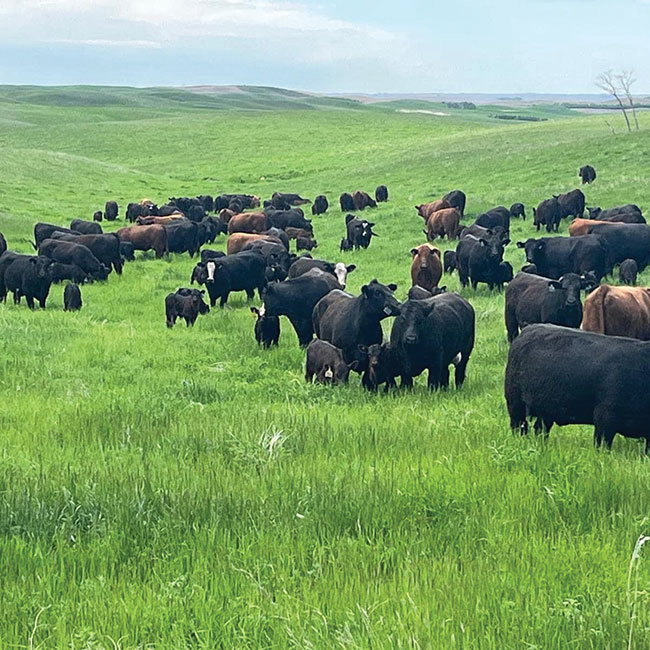
Based in Kirrimuir, Alta., Double F Farms is celebrating four decades in business this year.
Back in 1985 Harvey and Joyce Ference saw a wheat field in Alberta and decided to pursue their vision of changing it into a feedlot and a cow/calf operation. Forty years later, their son Craig and wife Jinel continue to honor this vision as they grow their business, with plans to perhaps eventually hand it down to the next Ference generation.
“My dad started farming with his brothers back in 1975,” says Craig. “They went their separate ways in 1985, which is when our family farm got its start.”
After graduating from university in 2004, Craig took a year off, and then came back home to work on the family business in 2005. “That’s when the expansion of the business really took off,” he says. “We were kind of a mixed farm at the time, but then we branched out more heavily into cattle, both finishing feed lots and cow/calf, while still maintaining the grain farm for diversification. We also keep a fleet of equipment for custom work, which helps us to spread the risk financially.”
Craig and Jinel met in university. She was studying education and he was studying business. “I did minor in agriculture,” he says, “and that has helped with running the farm over the years.”
Despite his studies in both business and agriculture, Craig says that so much has changed since he was in school that what he learned back then isn’t as applicable today as it would have been a couple of decades ago.
“I believe that our world is changing rapidly, including agriculture,” he says. “So the techniques we learned about and used 20 years ago are not necessarily the techniques that make sense today. If you want to be successful, you really have to be dedicated to lifelong learning, and be willing to adjust your approach as you gain new knowledge.”
A business-savvy approach
Craig’s business degree has certainly come in handy over the years as the family business continued to grow. “In 2015, we restructured into multiple companies, just because of the expansion that was taking place,” he says. “It made business sense at the time.”
Currently, the family is working on a succession plan as Craig and Jinel take over the business from the previous Ference generation. “My parents are at that stage in their lives where they’re going to do more for themselves, and leave the business with us,” says Craig. “So, we’re planning for the next phase, and it’s a huge challenge.”
Double F Farms has grown significantly since the early years, and currently they have about 5,000 mother cows, and they run a 12,000-head feed lot, which predominantly feeds 90-day cows. In addition, they grow corn on over 18,000 acres of land.
“That’s predominantly to feed the cattle now,” says Craig, “given the price of grain and the way commodity prices have shifted.”
One of the unique parts of their business, Craig explains, is their custom operation. “We custom corn plant, custom silage, but we also help the older generation of farmers to maintain their farms and stay in farming as long as they want to,” he says. “So, we’ll go in and take care of everything, from planting to harvest, and a lot of that is feed-related. This allows the farmers to maintain their cows, minimize risk and maximize workload so they can maintain their lifestyle.”
Kirrimuir is roughly 20 km west of the Saskatchewan border, and this proximity has allowed the business to expand operations into the neighboring province.
“We run multiple farms in Alberta and Saskatchewan,” says Craig. “We summer grass in Saskatchewan, we have another farm where we graze in the winter and feed in the summer, and our main farm has about a 30-mile radius.”
This massive operation requires a lot of help, and Craig says they employ about 35 individuals during the season, and about 25 in the winter months. What’s unique about their staff is that they come various parts of the world, and are chosen specifically for the skillset they bring.
“We have people from about seven or eight different countries working on our farm,” says Jinel. “Some people are really good with cattle, some are really good with equipment, so we try to draw from the best of the best.”
Craig offers the following example, although he insists that he’s just generalizing and that it wouldn’t be fair to say that everyone from a certain country is good at a specific task. “For instance, Irish guys are great mechanics, and Australians are really good with cattle, but they don’t really like sitting in a tractor all day,” he says.
Farm philosophy
When it comes to running their operation, Jinel notes that she and her husband are driven by a number of core values. “Community is definitely important,” she says. “We like to contribute to our community, and we like to think of our farm as a community with people from all over the world. We also think of the beef industry as our community, so the idea of a community extends far beyond who our neighbors may be.”

Double F’s cattle double as manure spreaders on the farm.
A sense of vision is import, and Jinel explains that a sense of purpose when pursuing well-defined goals is key. “We set our goals, we understand why they’re important, and then we work hard,” she says. “Our vision drives us and it’s what we love to pursue.”
Craig explains that a passion for their industry is paramount. “It’s why we work so hard,” he says. “You wouldn’t work hard if you didn’t love what you do, and agriculture is not a nine-to-five business.”
Both Craig and Jinel believe that the key to success is collaboration. “The generation before us preferred to do it themselves,” he says, “but we believe in collaborating with employees, with our neighbours, with business partners, and with many in the industry. We collaborate with a lot of people, but I think this is what has allowed us to grow and expand.”
Overcoming challenges
Craig and Jinel are optimists at heart, and they view hardships and challenges as opportunities. “We’re problem solvers,” says Craig. Speaking about Trump’s tariff threats, he agrees that they will present big challenges for the industry, and adds, “there will also be huge opportunities there, as long as you keep an open mind and are willing to adapt and to change.”
Last year, they lost 10,000 acres of corn, which was wiped out by a freak hailstorm. “We learned a lot from the experience, and we’re still financially viable,” says Craig. “It wasn’t the year we had hoped for, but at least we lived to see another day.”
Having been in farming for so many years, Craig and Jinel have a long list of challenges they’ve had to deal with. However, they’re not bogged down, and they don’t complain. Instead, they see each problem as an opportunity to learn something new, pivot in a new direction, and work hard to keep going and get closer to their vision of success.
“You can never predict what’s going to happen when Mother Nature is your business partner,” says Jinel. “You have to be able to pivot and deal with what has been thrown at you. That’s why we always have a Plan A, B, C and even D, and we’re willing to learn, pick up the pieces and keep going.”
Manure management
Among most farmers in teir area, Craig and Jinel have a somewhat unique approach to fertilizing their fields. In the off months, they allow their cows to graze on their corn fields, leaving behind their manure. According to Craig, they graze in 1,000-cow groups and consume about 150-200 grazing days per acre
“We have about 2,000 acres of land surrounding our feed lot, so the N and P would come from the manure,” he says. “Our winter grazing on corn is allowing us to capture the manure and urine on the land.”
One of the benefits of this approach is that there’s no need to handle the manure, since the cattle spread it evenly over the field on their own. “We don’t have to take out our equipment, load the manure, and spread it, which also cuts our costs,” says Craig.
This approach, Craig warns, isn’t a quick-fix solution. In some cases, commercial fertilizers is still needed, but not as much. “We’ve been doing this for about five years, and we’ve been testing our soil yearly,” he says. “Now, we’re at the point where some of the heavily grazed fields don’t need that much synthetic fertilizer anymore.”
When the cattle are kept in an outdoor feed lot setting, their manure is collected in the pens, stored and then spread on the fields at the appropriate time by staff. “We have multiple storage sites, and we try to spread everything prior to planting,” says Craig. “We spread again in the fall before everything freezes up.”

Double F has triumphed over adversity, including losing 10,000 acres of corn.
Award-winning couple
In 2018, Craig and Jinel were honored by Canada’s Outstanding Young Farmer’s Program as winners at the national level. According to the organization, the award, “recognizes farmers who exemplify excellence in their profession and promote the tremendous contribution of agriculture.” The Program recognizes individuals in Canada, between the ages of 18 and 39, “who have exemplified excellence in their profession while fostering better urban-rural relations.”
“It’s quite an honor,” says Jinel. “They’re the greatest group of people, all of whom want to be in agriculture and want to see it succeed. It’s also a great opportunity to get together with like-minded individuals and learn from them. We’re all collaborating and networking – berry farmers in Ontario sharing insights with ranchers from Alberta. Great ideas from coast to coast.”
While Craig and Jinel are happy to carry on the tradition of farming that Craig’s parents started, they also realize that this may not be the path in life that their children will want to pursue, and they’re okay with that.
“This is our dream, and we’re living it,” says Craig. “It’s a family business, and we hope our kids will carry on with this passion one day. But if they don’t, we’re fine with that too. We just want to provide them with opportunities in life, and we want them to be as happy with their decisions are we are with ours.” •