
Aeroponic potato cultivation represents a massive leap in agricultural technology, fundamentally changing how one of the world’s most vital food crops is produced. This is not just a niche hobby; it is a global commercial movement that is tackling issues of food security, disease control, and water scarcity head-on.
Introduction to Aeroponic Potatoes
Aeroponic potatoes are potatoes grown without any soil or aggregate medium. The word “aeroponics” comes from the Greek words ‘aero’ (air) and ‘ponos’ (labor). The entire root system of the potato plant is suspended in an enclosed, dark chamber, where it is periodically misted with a nutrient-rich water solution.
This air-based method provides the roots with a perfectly balanced environment of oxygen, moisture, and nutrients, allowing the plant to focus its energy on rapid growth and tuber development. As of late 2024, countries like India, Pakistan, and throughout Latin America are rapidly expanding their aeroponic centers to produce elite, disease-free seed potatoes.
Latest figures show that aeroponic systems can yield 60 to 80 minitubers (small seed potatoes) per plant per cycle.
This exponential multiplication rate, combined with water savings of up to 95% compared to field farming, makes aeroponics a true game-changer in modern agriculture.
Growing Potatoes in an Air/Mist Environment
The central idea behind this method is precision. Instead of searching through soil for water and nutrients, the potato roots receive a fine aerosol mist delivered directly to their surface. This mist is crucial, as it provides the roots with both the necessary hydration and an abundance of life-giving oxygen.
In a soil environment, oxygen levels can be restricted by dense soil or overwatering. In an aeroponic chamber, the roots are constantly bathed in air, leading to accelerated root respiration and healthier, faster plant growth.
Contrast with Traditional and Hydroponic Methods
Aeroponics is revolutionary, especially for potatoes, because it solves the biggest problem in conventional potato farming: soil-borne pathogens.
Traditional Soil-Based Growing: Potato seed degeneration due to viruses and bacteria is a perpetual issue. Seed production can account for up to 50% of the total cost of potato cultivation for farmers. Aeroponics provides a sterile, controlled environment that essentially eliminates the threat of soil-borne diseases like scab, blight, and nematodes.
Contrast with Hydroponics (e.g., Deep Water Culture, NFT): In many hydroponic systems, roots are either submerged or run through a thin film of water. While better than soil, these systems still risk the spread of water-borne diseases like Pythium because all plant roots share the same body of water. Aeroponics, particularly the high-pressure type, isolates the roots in air, offering superior oxygenation and a reduced risk of disease spread, leading to a much cleaner, higher-quality harvest.

Key Benefits Overview
Aeroponic systems deliver a powerful suite of benefits:
| Benefit | Quantitative Figure/Fact | Impact on Cultivation |
|---|---|---|
| Higher Yields | 60-80 minitubers per plant (vs. 5-10 in soil) | Exponentially increases seed multiplication rates. |
| Water Efficiency | Uses up to 95% less water than traditional farming. | Crucial for sustainable agriculture and arid regions. |
| Disease Control | >95% disease-free rate for seed tubers. | Produces elite, virus-free seed stock. |
| Space Efficiency | Ideal for vertical farming, achieving 900+ minitubers per m². | Enables year-round production in urban, indoor environments. |
| Faster Growth | Vegetative cycle can be extended by 1 to 2 months for continuous harvesting. | Quicker time to market and maximized greenhouse usage |
Science & Fundamentals of Aeroponic Potato Growth
Understanding the science of how a potato plant reacts to an air-based environment is key to successful aeroponic farming. The shift from a dense, restrictive soil medium to an open, oxygen-rich chamber fundamentally alters the plant’s physiology, speeding up metabolic rates and focusing energy into tuber production.
Research, including studies sponsored by NASA, has pinpointed the ideal nutrient delivery mechanism for maximum uptake: a mist droplet size between 20 and 50 microns. This precision is what allows the aeroponic method to unlock the potato’s full growth potential.
A. Plant Physiology
In an aeroponic system, potato roots and tubers develop in distinct ways:
Root Structure: Without soil resistance, the root structure is often whiter, more fibrous, and denser than soil-grown roots. They are directly exposed to pure oxygen, which is essential for high rates of respiration and nutrient absorption.
Tuber Formation: Potatoes form tubers on underground stems called stolons. In aeroponics, these stolons grow freely in the dark, humid chamber. The plant’s efficient nutrient and oxygen uptake means it can dedicate more energy to forming and bulking up tubers much faster than its soil-bound counterparts.
B. Nutrient Absorption
The fine mist is the lifeblood of the aeroponic potato. It serves a triple purpose:
Nutrient Delivery: The ultra-fine droplets, ideally in the 20−50 micron range, ensure maximum surface area contact with the root hairs, optimizing the absorption of essential macro- and micronutrients.
Oxygenation: The roots are exposed to air between misting cycles. The mist itself creates high humidity but dissipates quickly, allowing the roots to access near-100% pure oxygen.
Hydration: It maintains high humidity within the root chamber, preventing the delicate root hairs from drying out.
C. The Tuberization Zone
Potato tubers are modified stems that form underground in reaction to a variety of environmental signals, including darkness.
Necessity: For aeroponic potato success, the roots and stolons must be kept in a completely dark and enclosed chamber—the Tuberization Zone. Any light exposure can prevent tuber formation entirely.
Control: This zone must be kept cool and humid, often between 18∘C and 22∘C to encourage stolon tip swelling and tuber initiation. Controlling the temperature of the nutrient solution itself is a key technique to induce tuberization in the root zone, even if the surrounding air temperature is slightly higher.

D. Key Growth Stages in Aeroponics
While the fundamental stages are similar to soil growth, the timing and focus are adjusted:
Rooted Sprout / Vegetative Growth (0-4 weeks): Focus is on establishing a strong, leafy canopy. Nutrients are high in Nitrogen (N) to support shoot growth.
Stolon Formation (4-8 weeks): The plant begins to grow stolons in the dark chamber. Growers may start to slightly stress the plant (e.g., reducing the nitrogen-to-potassium ratio) to signal the beginning of tuberization.
Tuber Initiation and Bulking (8 weeks onward): The most critical stage. The nutrient solution is changed to a high-Potassium (K) and Phosphorus (P) formula to encourage tuber swelling. Sequential harvesting begins, where mature tubers are removed while leaving the plant to produce more.
Maturation: The plant’s vegetative cycle is often prolonged in aeroponics to maximize the harvest of minitubers over an extended period.
Setting Up Your Aeroponic Potato System
Setting up a high-quality aeroponic potato system requires a commitment to precision engineering. Because the pump is the “heart” of the system, quality components are non-negotiable. A common mistake for DIY setups is using low-pressure pumps, which create a fog or drizzle (large droplets) that wets the roots but doesn’t allow for optimal 20−50 micron nutrient absorption. The success of a system hinges on a high-pressure setup delivering a true, fine mist.
A. Core System Components
i. Reservoir: A light-proof container (e.g., a large plastic barrel or specialized tank) to hold the nutrient solution. Must be easy to access for monitoring.
ii. High-Pressure Pump: The most crucial component. It must generate at least 80–100 PSI to properly atomize the nutrient solution into the ideal fine mist. Standard submersible pumps used in simple hydroponics will not work.
iii. Misting Nozzles: Fine-mist, low-flow nozzles (often called “foggers”) are required. They must be made of high-quality material to resist corrosion and clogging. An in-line filter or strainer is essential for clogging prevention.
iv. Enclosed Growing Chamber: A sealed, opaque container (often PVC pipe, custom-fabricated towers, or large bins) where the roots are suspended. This is the Tuberization Zone and must be completely light-proof and root-accessible for easy, sequential harvesting.
v. Support Structure: Plants are held in place using net pots (typically 2-3 inch) that fit into holes in the chamber lid. Neoprene collars or foam inserts are placed around the stem to securely hold the plant and prevent light leaks.
vi. Lighting (if indoors): High-efficiency LED grow lights are preferred. The light intensity and photoperiod (hours of light) must be regulated based on the growth stage, often 18 hours on/6 hours off for vegetative growth.
vii. Timer/Controller: A precise cycle timer is needed to control the pump. Misting cycles are usually very short—seconds on, minutes off (e.g., 5 seconds on, 5 minutes off)—to ensure roots stay humid but don’t become oversaturated.

B. System Designs
DIY Aeroponic Potato Tower (Simple Bucket System): A simple starting point involves a 5-gallon bucket (reservoir) and a second bucket (growing chamber) stacked on top. The high-pressure line runs through the lid of the lower bucket into the upper growing chamber, using a few fine-mist nozzles to spray upward onto the suspended roots. This is manageable for a few plants.
Commercial-Scale Aeroponic Potato Systems: These use insulated, horizontal panels or long, rectangular channels (often referred to as modules) housed in insect-proof greenhouses. They feature redundant pumps, sophisticated climate control (for both air and root zone temperature), and automated monitoring of pH and EC/TDS.
C. Environmental Control
Precision control is vital for maximizing yield and preventing problems.
Temperature Management (Air and Root Zone): Air temperature should be maintained between 20∘
C and 25∘C for healthy foliage. However, the root zone should ideally be cooler, sometimes as low as 18∘
C, to promote tuber initiation.
Humidity Control: High humidity (70-80%) in the air helps the leaves thrive, while high humidity inside the root chamber is crucial to prevent root hairs from drying out between mistings.
Air Circulation and Oxygenation: Powerful fans are required in the growing area to prevent stagnant air and encourage robust stems. Inside the root chamber, air exchange is often necessary to ensure the roots always have access to fresh oxygen.
Step-by-Step Cultivation Process
The cultivation process for aeroponic potatoes starts long before the plant enters the system. Because the goal is often to produce pathogen-free seed stock (minitubers), strict sanitation and preparation are key. This process allows commercial systems to achieve an incredible multiplication rate, often up to 1:45 (one mother plant producing 45 new seed plants).
A. Selecting Seed Potatoes
Choosing the Right Varieties for Aeroponics: Not all potatoes are created equal in an air environment. Fast-maturing, high-yield indeterminate varieties tend to do well. Research shows that certain cultivars, like Kennebec and Agria, can produce a significantly higher number of minitubers (53-54 per plant) compared to others like Désirée.
Proper Chitting (Sprouting) Techniques: Aeroponic systems typically use small, tissue-culture-derived plantlets or stem cuttings that are already guaranteed to be pathogen-free. If starting from micro-tubers, they must be properly ‘chitted’ (allowed to sprout) in a clean, controlled environment before transplanting.
B. Planting and Establishment
How to Secure Seed Potato Pieces in the System: The small plantlet or stem cutting is inserted into the net pot, and a neoprene collar is secured around the base of the stem. The collar holds the plant in place and, critically, blocks all light from entering the Tuberization Zone.
Initial Misting Cycle for Root Development: The system is started on a moderate misting cycle to encourage root elongation. This early phase is vital for the plant to establish a robust, suspended root mass before the heavy demands of tuber production begin.
C. Nutrient Management
The nutrient solution must be meticulously managed and adjusted according to the plant’s growth stage.
Formulating the Perfect Nutrient Solution for Potatoes: Potatoes are heavy feeders. They require a balanced nutrient solution with a high Nitrogen (N) concentration during the vegetative phase to encourage leafy growth, and a sharp shift to a high Potassium (K) and Phosphorus (P) formula during the tuber initiation phase. Calcium is also a critical micronutrient for tuber quality and is often required at a higher concentration than for leafy greens.
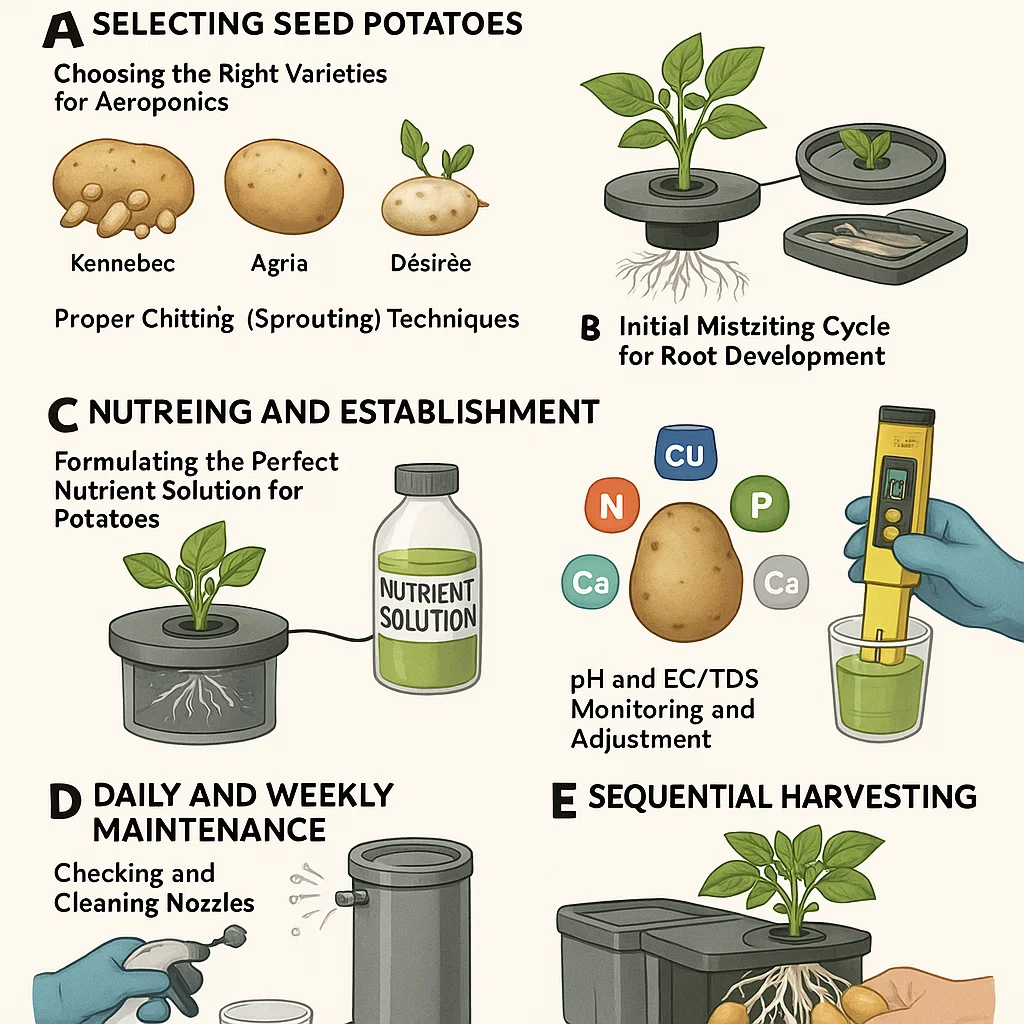
pH and EC/TDS Monitoring and Adjustment:
pH Level: The ideal range is slightly acidic, typically 5.8−6.2, for optimal nutrient uptake. Regular monitoring and adjustment with pH Up or pH Down solutions are mandatory.
Electrical Conductivity (EC/TDS): This measures the strength of the nutrient solution. It needs to be carefully monitored and increased during the bulking phase but may be slightly reduced to signal the plant to begin tuberization.
Solution Temperature and Aeration: The solution should be kept cool (18∘C−22∘C) using a chiller to prevent root pathogens and promote tuber development. The reservoir must also be constantly aerated using an air stone and pump.
D. Daily and Weekly Maintenance
Consistency is key to preventing system failure and disease.
Checking and Cleaning Nozzles: Misting nozzles are the most common point of failure. Clogging is inevitable due to nutrient salt buildup. Regular inspection and cleaning with a mild acid solution (like vinegar) or manual flushing are necessary.
Topping Up the Reservoir: Water is lost through evaporation and plant transpiration. The reservoir must be topped up daily, and the entire solution (a “full dump and refill”) should be changed every 1-2 weeks to prevent nutrient imbalances and pathogen buildup.
System Inspections for Leaks or Pump Issues: Regular, documented checks for leaks in the high-pressure lines and any signs of pump or timer malfunction are essential.
E. Sequential Harvesting
Aeroponics allows for a unique technique called sequential harvesting. Instead of waiting for the entire plant to die back, a grower can simply open the root chamber, pick the mature, desired-size tubers, and close the chamber, leaving the rest of the roots and plant intact to continue producing. This maximizes the yield over an extended growing cycle.
Benefits of Growing Potatoes Aeroponically
The advantages of aeroponics for potatoes are so pronounced that the technology has become the standard for elite seed-potato production globally. The figures speak for themselves, painting a picture of a resource-efficient, high-output farming method.
A. Maximum Yield in Minimal Space (Vertical Farming Potential): Aeroponics is perfectly suited for controlled-environment and vertical farming. The ability to stack growing modules vertically allows for a massive increase in production per square meter.
Statistic: Commercial aeroponic systems can achieve a production density of over 900 minitubers per m2, a density unachievable in any soil or substrate-based system.
Impact: This efficiency makes it the method of choice for urban farming and countries with limited arable land.
B. Water and Nutrient Efficiency
Aeroponics represents one of the most resource-efficient agricultural systems available.
Water Conservation: Aeroponics uses up to 95% less water than traditional field irrigation because the solution is recirculated, and the root environment is fully enclosed, minimizing evaporation.
Nutrient Efficiency: Because the nutrients are delivered directly to the roots in a fine mist, plants absorb more and waste less. Aeroponics is reported to use 30% less nutrient solution than many hydroponic methods.
C. Purity and Cleanliness
This is the single biggest benefit driving the commercial adoption of aeroponics.
Disease Elimination: By removing the soil, growers eliminate the source of over 90% of potato diseases. A 2022 study found that aeroponically produced seed tubers maintained a >95% disease-free rate versus approximately 70% for conventional field-grown seeds.
Pest Reduction: The indoor, controlled, and soil-less environment is naturally inhospitable to many common pests like nematodes and tuber moths, drastically reducing or eliminating the need for pesticides.
D. Year-Round Production and Faster Growth Cycle
In a controlled greenhouse environment, aeroponic systems allow for continuous, year-round production, independent of seasonal or climatic constraints.
Faster Growth: Due to optimal oxygen and nutrient delivery, the initial vegetative growth is often accelerated, and the harvesting cycle can be extended up to two months, allowing for multiple sequential harvests from a single plant.
E. Ideal for Seed Potato Production (Disease-Free Seed Stock)
Aeroponics is primarily used commercially to produce elite, pre-basic seed potatoes (called minitubers).
High Multiplication Rate: This method achieves an average multiplication rate of 1:45, meaning one mother plant produces 45 disease-free seeds. This is crucial for rapidly multiplying new, high-value potato varieties.
Economic Advantage: By producing certified, clean seed stock, aeroponics lowers the overall cost of potato cultivation by ensuring the subsequent field crops start with the highest quality, most productive seeds possible.

Challenges and Troubleshooting
Despite the revolutionary benefits, aeroponic potato farming requires vigilance and a technical understanding of the system, as its reliance on precision machinery means that component failure can be catastrophic.
A. Common Problems
Nozzle Clogging: The single most common problem. Fine-mist nozzles can clog easily due to mineral or nutrient salt precipitation.
Solution: Install high-quality in-line filters and regularly flush the system with fresh water or a mild acid (like vinegar) solution to dissolve mineral buildup.
Pump Failure (The Single Point of Failure): A high-pressure pump malfunction, especially in hot weather, can cause the suspended root systems to dry out and die within hours.
Solution: Implement system redundancy by having a backup pump or an immediate failover to a low-pressure drip system to keep the roots wet until repairs can be made.
Power Outages: Loss of power is a serious threat.
Solution: The system should be backed up by a UPS (Uninterruptible Power Supply) or an emergency generator to ensure the pump and environmental controls remain operational.
Root Diseases (e.g., Pythium): Although rare, pathogens can take hold in the humid root chamber.
Solution: Maintain strict sanitation, ensure the nutrient solution is below 22∘C, and consider weekly treatments of food-grade hydrogen peroxide (H2O2) in the nutrient solution to oxidize and kill pathogens.
Nutrient Deficiencies or Toxicities: Symptoms like yellowing leaves (Nitrogen deficiency) or burned leaf tips (salt toxicity) occur quickly due to the direct route of nutrient delivery.
Solution: Daily monitoring of pH and EC/TDS is non-negotiable. Maintain the pH in the 5.8−6.2 sweet spot and adjust the EC to match the plant’s growth stage.
Pest and Disease Management (Even Without Soil)
While soil-borne pathogens are eliminated, insect pests like aphids, spider mites, and whiteflies can still enter the greenhouse and infest the leafy canopy.
Prevention Strategies: The primary defense is an insect-proof greenhouse and maintaining a clean, sanitized environment. All tools, hands, and new plantlets must be sterilized before entering the grow space.
Organic and Safe Treatment Options: If an outbreak occurs, safe, organic treatments like neem oil, horticultural soaps, or the introduction of beneficial predatory insects (e.g., ladybugs) are preferred over chemical pesticides.
Advanced Topics and Considerations
Aeroponic potato cultivation is a technology that is constantly being refined, moving beyond the hobbyist scale into large-scale, controlled-environment agriculture that has implications for global food security.
A. From Hobbyist to Commercial Production
There is a significant distinction between small DIY aeroponic systems and large commercial operations, primarily due to cost and precision.
The Cost-Benefit Nuance: While some smaller-scale enthusiasts find the high initial cost of a high-pressure pump system prohibitive for growing table potatoes, commercial farms find it highly economically viable because their end product is high-value, disease-free seed stock (minitubers). The investment in precision equipment is justified by the massive increase in quality and yield.
Commercial Focus: The business model is focused almost entirely on minituber production—creating the foundational G0 (Generation Zero) seed that is then sold to farmers to grow field potatoes.
B. Economic Viability
For commercial seed producers, the economic benefits are clear and outweigh the high setup costs.
High Yield, High Value: The ability to produce 5.39 times more minitubers than conventional substrate-based methods, coupled with the premium price commanded by certified, virus-free seeds, ensures a rapid return on the initial investment.
Resource Savings: The long-term savings from using 95% less water, 30% less nutrient solution, and virtually no chemical pesticides translate into lower operating expenses and a more profitable, sustainable business model.
Comparison with Other Hydroponic Methods for Potatoes
Aeroponics is superior to other hydroponic methods for potato seed production due to its optimal oxygen delivery.
| Method | Root Environment | Key Benefit for Potatoes | Limitation |
|---|---|---|---|
| Aeroponics | Suspended in air, misted | Highest oxygenation, best yield of small minitubers. | High initial cost, pump/nozzle failure risk. |
| Nutrient Film Technique (NFT) | Thin film of water flow | Low running costs, good for small plants. | Poor tuberization due to limited dark root zone/oxygen. |
| Deep Water Culture (DWC) | Roots submerged in solution | Simple to set up, high water volume stability. | Risk of root rot and low oxygen saturation in deep water. |
Aeroponic Potatoes Future in Food Security
Aeroponics is not just a commercial farming technique; it is poised to play a major role in securing the global food supply in the face of climate change and population growth.
The NASA Connection: Aeroponics was largely pioneered by NASA as a Bioregenerative Life Support System (CELSS) to grow food crops, like potatoes, in space and on other planets. NASA research confirmed that the ideal droplet size for nutrient uptake is 20−50 microns. The technology has since been brought back to Earth, proving its effectiveness for growing high-yield, high-carbohydrate food in the most resource-constrained environments imaginable.
Global Expansion: With ongoing projects and center expansions in Asia, Africa, and Latin America, aeroponics is helping developing nations achieve self-sufficiency in elite seed potato production, stabilizing their food supplies and increasing farmer profitability.
Conclusion
Aeroponic potato cultivation represents a paradigm shift from traditional, resource-intensive agriculture to a new era of precision, high-output farming. Driven by the need for superior seed quality and increased resource efficiency, this technology offers an unrivaled solution for producing pathogen-free minitubers, achieving a massive multiplication rate of 60-80 tubers per plant while conserving up to 95% of water.
While the barrier to entry includes higher initial costs and a requirement for technical vigilance, the long-term return on investment, particularly for commercial seed production, is substantial. Aeroponics is no longer a futuristic concept; it is a current, scalable, and economically viable technology that is vital to the global effort to secure food systems, modernize agriculture, and feed a growing population in an environment of increasing resource scarcity.


