
The global aeroponics market is experiencing aggressive and sustained growth, signaling a massive commercial justification for its specialized equipment. The market was valued at a robust USD 12.42 Billion in 2024 and is projected to skyrocket to USD 35.85 Billion by 2032.
This growth is driven by a remarkable Compound Annual Growth Rate (CAGR) of 14.17% over the forecast period, confirming that large-scale commercial entities and savvy investors are heavily relying on and justifying the substantial investment in advanced aeroponic technology.
Aeroponics Farming Equipment Demands Specialized Hardware
Aeroponics is distinct from simpler growing methods because it absolutely requires highly reliable mechanical and electronic components that can maintain an extremely precise environment. It’s not enough to simply submerge roots in water. Unlike basic hydroponic setups, aeroponics requires hardware designed to deliver nutrients at an exact droplet size and an exact, programmed timing.
This intense focus on precision means that the cost of specialized equipment is not merely a high expense, but a fundamental investment in operational efficiency and predictable crop output. When the system is designed to deliver perfection, the hardware must be perfect too.
A. Efficiency, Yield, and Return on Investment (ROI)
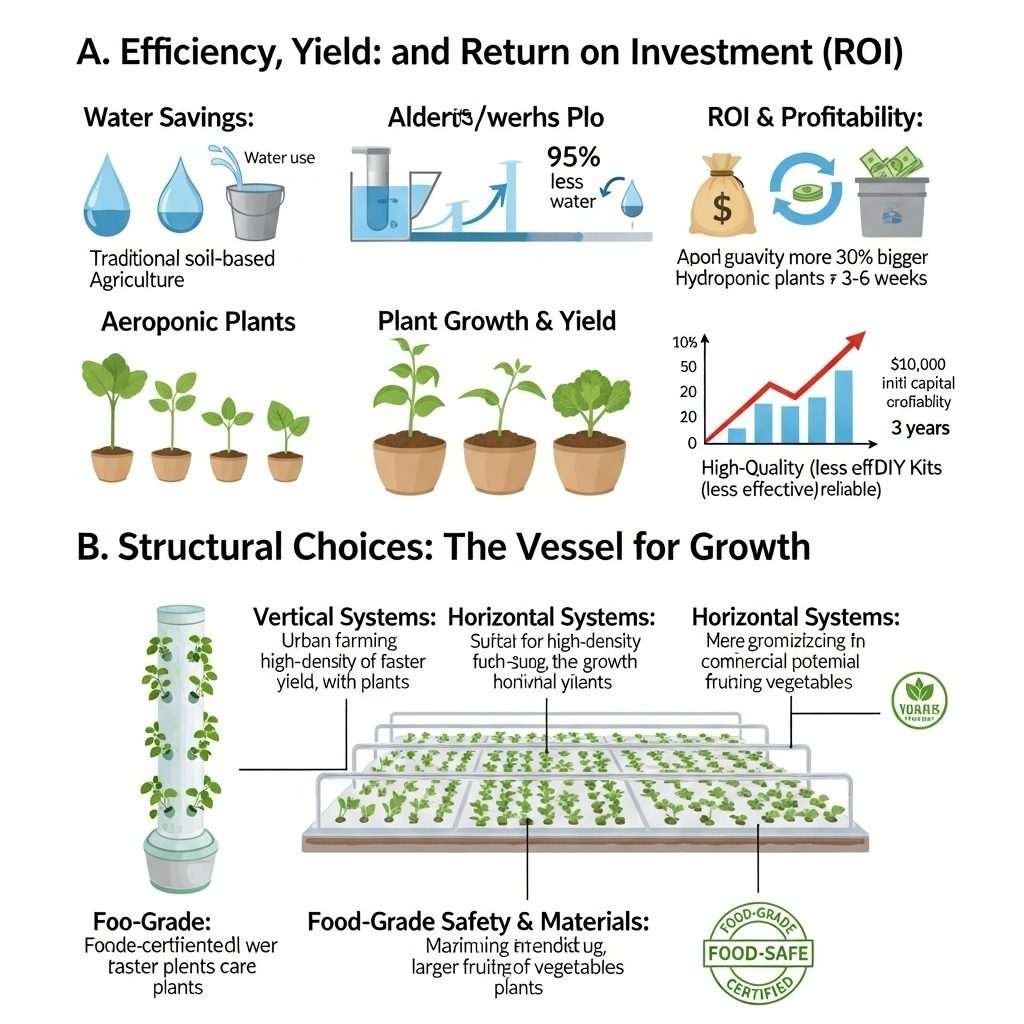
The high initial capital expenditure required for commercial-grade aeroponic equipment is overwhelmingly justified by the system’s extreme efficiency metrics. Aeroponics systems utilize a smart, closed-loop design where the nutrient solution is carefully recirculated, allowing the method to use up to 95% less water compared to traditional soil-based agriculture. This massive water conservation is a critical economic and environmental benefit.
Beyond water savings, the increased oxygenation provided by the mist delivery system results in superior plant performance. While plants might establish roots slightly slower in the very early stages compared to traditional hydroponics, aeroponic plants typically overtake their counterparts after three to six weeks of growth. The payoff is substantial: mature aeroponic plants are often found to be around 30% bigger at maturity than hydroponically grown ones, delivering significantly more produce in a shorter period of time.
For successful commercial growers, this enhanced efficiency and superior yield directly translate into a tangible ROI. Growers often find that this system allows them to recoup their initial capital costs and reach profitability in approximately three years. This rapid financial return provides the necessary validation for investing in high-end systems, which, for a complete residential tower setup with all advanced features, can cost up to $10,000. The cost of DIY kits is much lower, but they offer less efficiency and reliability, underscoring the value of high-quality equipment.
B. Structural Choices: The Vessel for Growth
The physical structure of the aeroponic system—the “vessel for growth”—must be chosen with care, based on the spatial requirements of the facility and the goals for the specific crop.
Vertical vs. Horizontal Systems
Vertical Systems: Often built as towers, these are highly optimized for space utilization. They are best suited for urban farming or smaller spaces where they deliver faster yields by limiting the maximum size of individual plants to maximize density.
Horizontal Systems: These are designed for larger commercial facilities where maximizing the growth potential of individual plants (for instance, larger fruiting vegetables) is the primary goal.
Regardless of their orientation, all equipment components that come into contact with the plants or the nutrient solution—including grow chambers, pipes, and reservoirs—must strictly adhere to food-grade safety standards. It is mandatory to use certified food-safe materials, such as specific PVC panels.
These materials meet the rigorous sanitation requirements set by regulatory bodies, ensuring the facility does not introduce contaminants that could harm the crops or consumers. Furthermore, white PVC panels offer the critical added benefit of high reflectivity, which helps manage heat and maintain a stable, cool temperature within the facility.
Misting and Nutrient Delivery Hardware
The precise delivery of nutrients through atomization is the technical core of aeroponics. This process requires specialized mechanical systems that go far beyond the capability of standard pumps used in DIY or basic hydroponic setups. This system divides into two main categories: low-pressure and high-pressure aeroponics.
The success of commercial aeroponics hinges on generating a dense nutrient mist using high-pressure pumps operating between 60 and 90 PSI and delivering that mist at the ideal functional droplet size of 30 to 80 microns. Achieving this requires highly specialized, industrial-grade equipment.
A. High-Pressure vs. Low-Pressure Systems
Low-Pressure Aeroponics (LPA): This approach uses less specialized equipment, often relying on simple submersible pumps and standard garden sprayers. While cheaper and easier to assemble (with DIY kits available for around $321.79), LPA systems fundamentally fail to produce the extremely fine mist required to maximize root oxygenation and subsequent nutrient absorption.
High-Pressure Aeroponics (HPA): HPA is recognized as the superior commercial method due to the creation of a highly oxygenated root environment and superior efficiency. Achieving this optimal environment demands industrial-grade, highly specialized equipment to generate and maintain the consistent micro-droplets necessary for success.
B. Specialized Pumping and Valving Equipment
The heart of an HPA system is the pumping and pressure regulation hardware. HPA systems require powerful pumps, such as diaphragm or positive displacement types, and a pressurized reservoir capable of sustaining pressures ranging from 60 to 90 PSI (Pounds per Square Inch). This high pressure is essential to ensure that the nutrient solution is forced through the specialized nozzles effectively.
To control the short, precise bursts of mist required by the plant roots, high-quality solenoid valves are an absolute necessity. These valves must be engineered to withstand the continuous stress of switching a high-pressure, abrasive nutrient solution. Commercial-grade solenoid valves are often rated for a maximum pressure of 100 PSI, typically operate on 12 Volt DC power, and must be constructed with chemically resistant materials like polypropylene bodies and Viton R◯ or EPDM diaphragms and seals. The robustness of these specific components is vital, as system failure due to valve or pump malfunction leads to rapid crop death from lack of moisture.
C. The Challenge of Precision Misting Nozzles
The ultimate success of the equipment rests on the misting nozzles, which convert the high-pressure liquid into the precise droplet size necessary for root absorption. Early NASA research suggested an ideal droplet size between 5 and 50 microns.
However, the choice of a commercial nozzle is a careful balance between theoretical efficiency and practical operational reliability. While ultrasonic atomizers (often called Fogponics) produce an ultra-fine dry fog of less than 5 microns, this equipment has practical drawbacks, including the tendency of the ceramic transducer element to break due to salt buildup and the issue of heating the nutrient solution.
Consequently, most commercial HPA systems rely on mechanical pressure nozzles designed to target the slightly larger 30 to 80 micron range. This range is preferred because droplets smaller than 30 microns tend to lack the necessary momentum to efficiently “impinge” (hit) and adhere to the root structures, resulting in significant mist loss. The selection of this practical range over the theoretical maximum efficiency ensures consistent nutrient delivery and operational longevity.
Because these nozzles are engineered for such fine atomization, they are highly susceptible to clogging from nutrient salts or solid debris. Therefore, equipment design must prioritize specialized nozzle types, such as Maximum Free Passage (MFP) or FullJet R◯ designs.
These are constructed with wider, open internal passageways that allow larger particles to pass through, significantly minimizing downtime and ensuring the spray pattern remains consistent even when recirculated nutrient solutions are used. Regular inspection and cleaning, even when the spray appears consistent, are necessary to protect this critical component.
Aeroponic Cultivation Equipment: Intelligent Climate
In an aeroponic environment, regulating the root zone is paramount, and the necessary equipment serves as a life-support system. Maintaining a stable temperature and ensuring pristine water quality are non-negotiable requirements for system health.
The temperature control equipment must strictly maintain the ideal root zone temperature within a narrow band of 62°F to 71°F,
and the chiller unit should be deliberately oversized by 20% to guarantee it can manage peak thermal loads without failing.
A. Root Environment Regulation: Thermal Equipment
Temperature control equipment is required not just for the plant’s comfort, but because temperature directly governs the Dissolved Oxygen (DO) available to the roots. Oxygen is transported inside the plant as DO, and the highest concentration (around 9 ppm DO) occurs specifically at 68°F. If the nutrient solution temperature rises too high, the DO levels crash, leading to severe root stress or suffocation.
Therefore, the ideal root zone temperature must be strictly maintained within a narrow band of 62°F to 71°F. Achieving this requires industrial-grade water chillers and heaters. When specifying this thermal equipment, the grower must use specific engineering calculations to size the unit correctly, ensuring it can handle the constant heat load generated by ambient conditions and the high-pressure pumps.
The required cooling capacity (BTU/hr.) must be calculated using the flow rate and the required temperature differential (ΔT). Furthermore, standard engineering practice dictates that the chosen chiller unit should be oversized by 20% to guarantee it can manage peak thermal loads without failing, even during the hottest parts of the day.
B. Water Preparation and Hygiene Equipment
The precision inherent in aeroponics requires starting with a known, pure baseline for water quality. Using Reverse Osmosis (RO) systems to treat the input water is highly beneficial, as it removes salts and minerals, leaving water that is virtually 0 ppm (parts per million).
By eliminating these unknown variables, the grower gains complete control, allowing them to precisely calculate the exact amount of nutrients added to the solution and accurately estimate how much the plants have absorbed. This level of control is fundamental to optimizing yield in high-tech aeroponic setups.
The closed-loop nature of aeroponic systems also demands specialized cleaning equipment and stringent sanitation protocols. To mitigate the risk of mold, disease, and nutrient residue buildup, aeroponic systems must be thoroughly cleaned and disinfected at least semiannually, ideally coinciding with a change in crop planting or the end of a growing season.
This process requires hardware that can be easily disassembled, drained, and cleaned using approved disinfectants and mild soaps to physically remove debris, ensuring the system remains hygienic and operational.
Equipment for Photosynthesis Optimization
Since aeroponic systems are frequently deployed indoors, the lighting hardware is not supplemental—it is the sole energy source for photosynthesis. Modern aeroponic equipment relies almost exclusively on smart LED grow lights that allow for dynamic adjustment of both intensity and spectrum throughout the plant’s life cycle. For the crucial flowering and fruiting stage, the equipment must generate a significantly higher intensity, aiming for a Photosynthetic Photon Flux Density (PPFD) of 800–1000μmol/m2/s.
A. Dynamic LED Specifications
The lighting system must act as an environmental controller, delivering the right biological signals to the plant at the right time. This requires highly sophisticated hardware capable of shifting color temperature and light intensity on demand, often controlled by an external digital system. Specialized timing equipment (or Programmed Logic Controllers, detailed below) is necessary to manage the precise photoperiods.
B. Equipment Tuning for Growth Stages
The required lighting hardware settings vary dramatically between the plant’s vegetative and reproductive phases of growth:
Seedling and Vegetative Equipment Requirements: During the early stages, the system must deliver light that emphasizes the blue spectrum. This is achieved using a Color Correlated Temperature (CCT) between 5000K and 6500K, which encourages compact, healthy growth and prevents the development of weak or “leggy” stems. The required intensity for this phase is relatively moderate, targeting a PPFD of 100–300μmol/m2/s, typically delivered over an 18-hour on / 6-hour off cycle.
Flowering and Fruiting Equipment Requirements: As the plant matures, the lighting system must shift its output to emphasize red wavelengths (CCT:3000K–4000K), as these wavelengths trigger flowering hormones and support reproductive development.
During this high-demand stage, the equipment must generate significantly higher intensity, aiming for a PPFD of 800–1000μmol/m2/s, generally provided over a shorter 12-hour on / 12-hour off cycle. The inclusion of supplemental LED fixtures capable of providing UV and Infrared (IR) wavelengths can further enhance final crop quality and yield.
| Variety Name | Growth Stage | Color Temperature (CCT) | Dominant Wavelength | Required PPFD (μmol/m²/s) | Photoperiod |
|---|---|---|---|---|---|
| Example Variety | Seedling / Vegetative | 5000K – 6500K | Blue (for compact growth) | 100–300 | 18 hours On / 6 hours Off |
| Flowering / Fruiting | 3000K – 4000K | Red, Deep Red, UV/IR | 800–1000 | 12 hours On / 12 hours Off |
Sensors and Digital Management
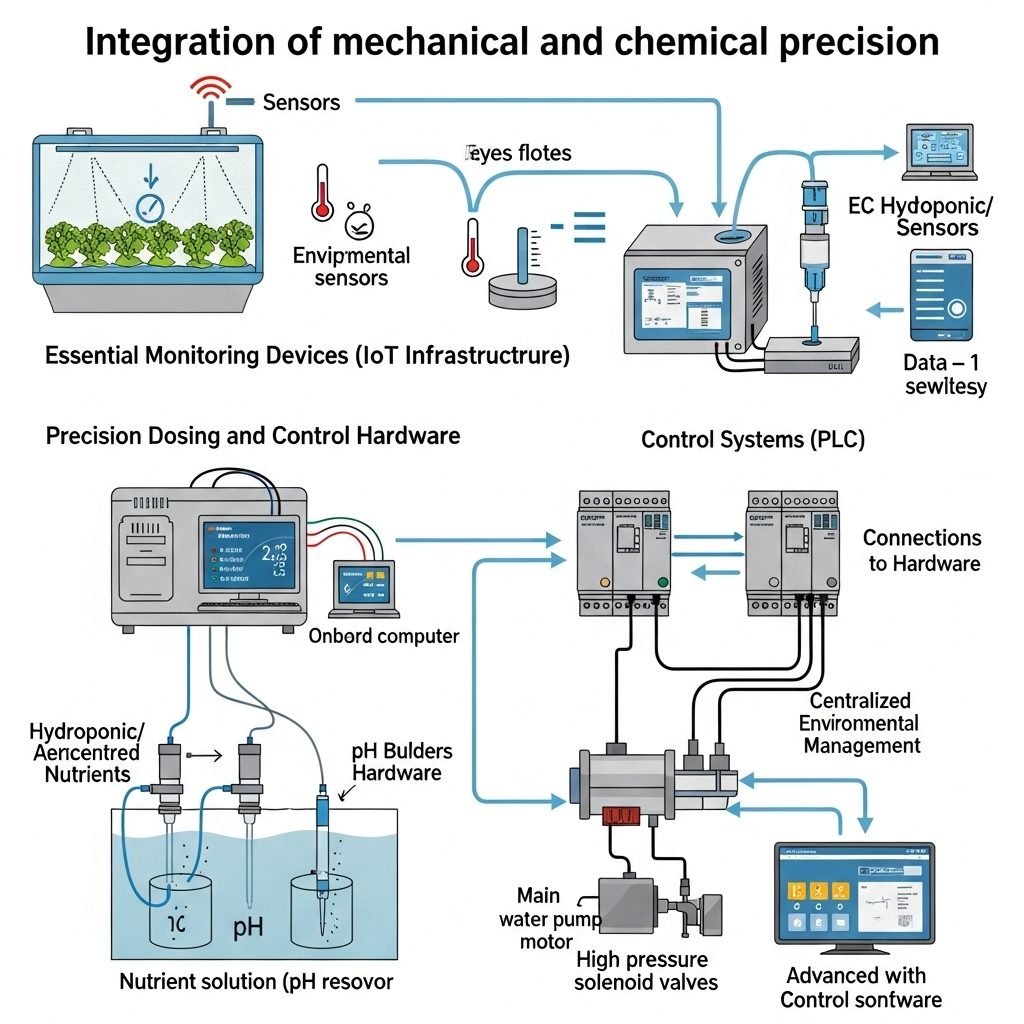
The mechanical precision of HPA must be matched by equal chemical precision, which is provided by the automation equipment layer. This integration of hardware and software is essential for maintaining the delicate balance required for optimal growth. The continuous operation and control of these systems are managed by industrial-grade Programmed Logic Controllers (PLCs), which are key to achieving high-quality, high-yield results.
A. Essential Monitoring Devices
Automated vertical farming systems rely on the Internet of Things (IoT) infrastructure, using sophisticated sensors as the system’s “eyes and ears” to constantly collect objective, numerical data, thus eliminating human delay or error.
Key sensor types include environmental sensors to monitor temperature and humidity within the grow chamber, and specialized hydroponic/aeroponic sensors. Most critical are the Electrical Conductivity (EC) and pH probes. EC measures the strength of the nutrient solution, while pH measures its acidity—both of which fluctuate rapidly as plants absorb different elements. Constant, accurate monitoring of these parameters is crucial for maintaining crop health.
B. Precision Dosing and Control Hardware
The collected sensor data is instantly fed into sophisticated control hardware, which then executes corrective actions.
Automated Dosing Units (ADUs): ADUs are pieces of hardware equipped with peristaltic pumps that introduce concentrated nutrients or pH buffers into the reservoir when the monitored EC or pH levels drift out of the optimal range. These systems constantly measure pH, EC, and temperature, reporting data to an onboard computer for instant analysis. This guarantees nutrient consistency, minimizing the risk of “nutrient burn” or deficiencies and optimizing plant uptake.
Control Systems: PLCs: While simple timer-based systems can be used to regulate basic water cycles, commercial operations rely on Programmed Logic Controllers (PLCs). PLCs are industrial-grade computers designed for continuous operation and highly accurate control. PLCs specifically manage the critical timing of the main water pump motor and, crucially, the split-second switching of the high-pressure solenoid valves.
They ensure the real-time monitoring and control of the root environment, which is directly linked to achieving high-quality, high-yield results. Furthermore, advanced control software can interface with these PLCs and smart relays to manage the entire grow environment, including
- CO2 management,
- humidity control,
- fans,
- vents, and
- lighting systems,
- centralizing complex environmental management.
C. Equipment Maintenance and Calibration
The accuracy of the entire automation system is only as good as its sensors, meaning diligent maintenance of the probes is absolutely essential for protecting the investment and ensuring crop health. EC/TDS (Total Dissolved Solids) probes must be cleaned and calibrated frequently to obtain accurate, repeatable results.
A standard protocol involves rinsing the probe with purified, deionized water, and using a separate beaker of fresh standard solution as an additional rinse step before performing the calibration. Since EC/TDS calibration standards are easily contaminated, using clean containers and calibrating from low concentration standards to high concentration standards without rinsing between them is a strict best practice.
Failure to maintain these sensing devices means the grower is making management decisions based on faulty data, which quickly undermines the precision advantages of the entire aeroponic system.
Practical Equipment Management and Investment Metrics
Understanding the high costs and necessary operational management associated with aeroponic equipment is essential for any potential grower. The sophisticated hardware required—powerful pumps, chillers, automated systems, and high-intensity LED lights—requires significant electrical energy. More granular data suggests that a single commercial aeroponic tower uses roughly 0.216 kWh, a figure that is a vital input for operational planning.
A. Energy Consumption and Operational Planning
Aeroponics is rightly heralded for its resource efficiency, specifically in water usage. However, the sophisticated hardware required—powerful pumps, chillers, automated systems, and high-intensity LED lights—requires significant electrical energy.
For year-round commercial production, the energy needed per square meter can average approximately 250 kWh/m2 annually, though this figure varies widely based on local climate and heating demands. More granular data suggests that a single commercial aeroponic tower uses roughly 0.216 kWh.
These energy consumption figures are vital inputs for operational planning and financial forecasting. The deployment of smart automation equipment allows for detailed tracking of energy use, enabling smarter energy purchasing decisions and overall optimization of climate control, which helps ensure the profitability of the high-initial equipment investment.
B. Tailoring Equipment for Diverse Crops
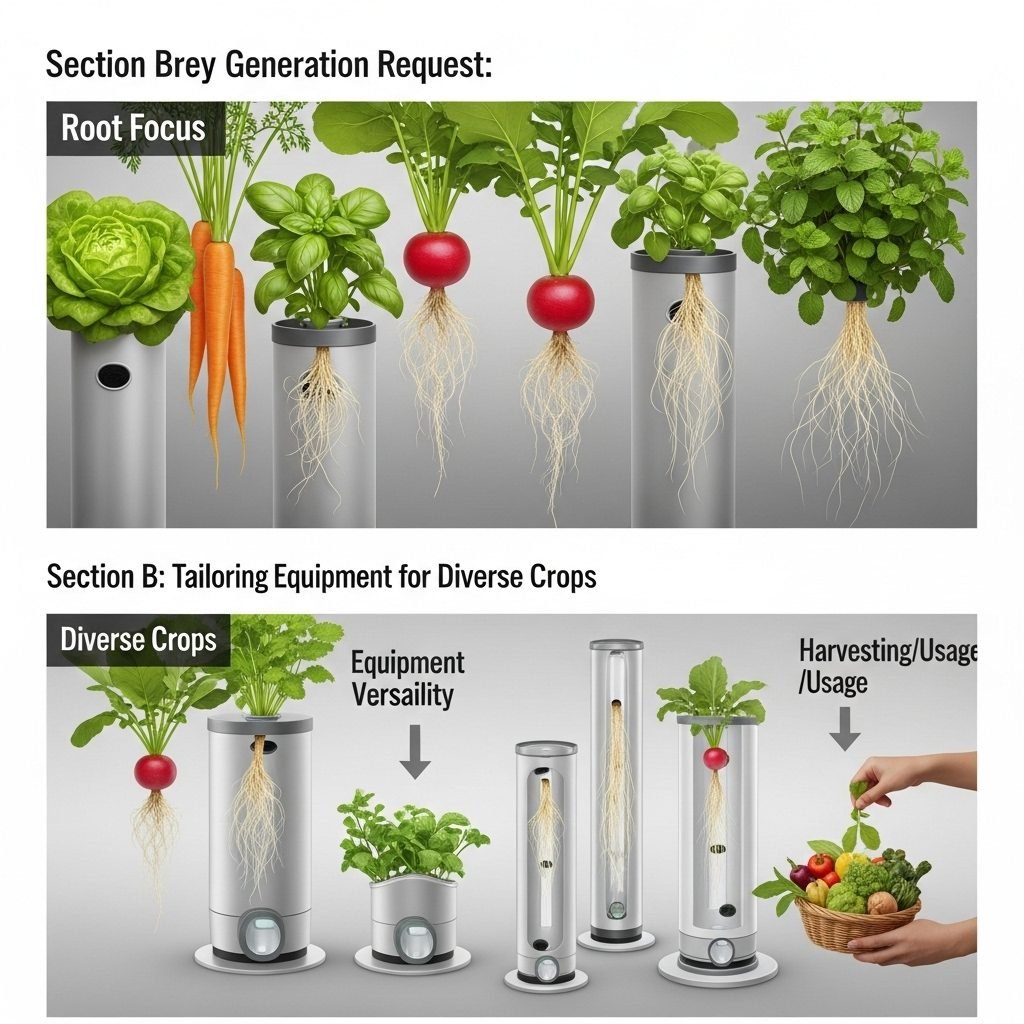
One of the great advantages of aeroponics lies in the versatility of its equipment configuration, which allows for the cultivation of a wider array of plants compared to some specialized hydroponic setups. Because aeroponic systems suspend the roots without obstruction, they offer unique benefits for root vegetables.
The unobstructed growth space means that crops like carrots, radishes, and other tubers can be grown effectively alongside traditional aeroponic staples like leafy greens and herbs. Equipment manufacturers must design the grow chambers and structural elements to comfortably accommodate the length and size of these root vegetables, making aeroponics a highly versatile equipment option for those seeking real food production, not just foliage.
Conclusion
The success of aeroponic farming is inextricably linked to the performance and reliability of its specialized equipment. The technical requirements are substantial: maintaining a root zone temperature between 62°F and 71°F using precisely calculated thermal regulation equipment, generating a dense nutrient mist using high-pressure pumps operating between 60 and 90 PSI, and ensuring that this mist is delivered at the ideal functional droplet size of 30 to 80 microns.
This mechanical precision is amplified by the sophisticated digital management layer. IoT sensors and Programmed Logic Controllers (PLCs) integrate real-time environmental data with Automated Dosing Units (ADUs), ensuring nutrient levels are flawless. This combined technological capability results in the compelling efficiency figures that drive the market: up to 95% water reduction and plants that are typically 30% larger than those grown in less precise systems.


