
As the planet faces mounting climate threats, carbon sinks have become crucial allies in reducing greenhouse gases. These natural and artificial systems absorb and store carbon dioxide (CO2) from the atmosphere, helping to balance human emissions.
Beyond their environmental role, carbon sinks also generate carbon credits, which drive climate finance and support global net-zero ambitions. This article explores the world’s largest carbon sinks, their significance, and how carbon credits are fueling a low-carbon economy.
Nature’s Carbon Vaults: Forests, Oceans, and Soils
Forests: Earth’s Green Lungs
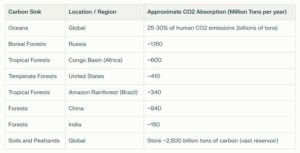
Forests are among the most powerful carbon sinks on the planet. Globally, they absorb around 30% of CO2 emissions from human activities. Trees capture carbon through photosynthesis and store it in biomass and soils. Boreal forests in Russia hold the largest terrestrial carbon stock, followed by tropical forests in the Amazon and Congo Basin, and temperate forests in the U.S. and China.
Yet forests are under threat. In 2023 and 2024, extreme wildfires and deforestation sharply reduced forest carbon uptake. Bolivia, for example, suffered its largest fire season in 2024, releasing 400 million metric tons of CO2. These events turned forests from carbon sinks into net emitters, highlighting the urgent need for forest conservation, restoration, and sustainable management. Protecting forests is essential to avoid overloading natural systems that cannot absorb unlimited carbon.
READ MORE:
- Meta and EFM Join Forces to Deliver 676,000 Forest Carbon Credits by 2035
- What’s Next for Forest Carbon Credits? This UK Climate Tech Startup is Boosting Trust with Real-Time Data
- Microsoft’s 234,000 Carbon Credit Purchase Restores Mexican Rainforest
Oceans: The Planet’s Largest Carbon Sink
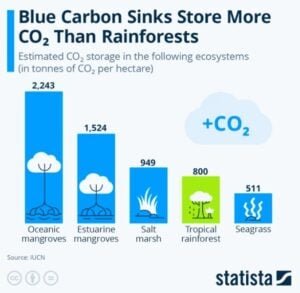
Oceans absorb roughly 25-30% of human-generated CO2 and about 90% of excess heat from global warming. They store carbon through biological processes and chemical absorption, sequestering it in water, sediments, and marine life.
However, rising ocean temperatures are weakening this sink. In 2023, oceans absorbed nearly a billion tons less CO2 than usual—equivalent to about half of the European Union’s annual emissions. Reduced solubility of CO2 in warmer water threatens climate stability. Protecting marine ecosystems and limiting ocean warming are critical to maintaining this natural buffer.
READ MORE:
- Frontier’s $31.3M Offtake with Planetary Signals a New Era for Ocean Carbon Removal
- Blue Carbon Credits Hit Record High as Demand Outpaces Supply
Soils and Peatlands: Hidden Giants of Carbon Storage
Soils store more carbon than the atmosphere and living vegetation combined. Through regenerative agriculture—practices like cover cropping, crop rotation, and reduced tillage—soil carbon can be enhanced. Peatlands, though covering just 3% of the land, hold vast carbon reserves. Yet drainage and degradation turn them into net emitters. Restoration efforts not only recapture carbon but also revive biodiversity, making them dual-purpose climate solutions.
Collectively, forests, oceans, and soils absorb around half of anthropogenic CO2 emissions, serving as crucial buffers against climate change. But these systems are finite and vulnerable. Recent data show that relying solely on natural sinks without reducing fossil fuel emissions is risky.

MUST READ:
- Top 4 Carbon Projects in 2025: The Game-Changers in Climate Action You Need to Know
- Microsoft and UNDO Partner for 15,000 Tons of Carbon Removal Using Enhanced Rock Weathering!
Artificial Carbon Sinks: Technology Steps In
While natural sinks face limits, innovation offers new pathways. Artificial carbon sinks aim to capture and store CO2 at scale.
Direct Air Capture (DAC) extracts CO2 directly from the air and stores it underground or uses it in industrial applications. Bioenergy with Carbon Capture and Storage (BECCS) combines biomass energy production with carbon capture to achieve net removals. Though promising, these technologies require scaling, investment, and supportive policies to complement natural sinks.
By combining natural and artificial solutions, the world can accelerate progress toward net-zero emissions while reducing the pressure on fragile ecosystems.
KNOW MORE:
- Microsoft’s Major Biochar Deal Aims to Offset 1.24M Tonnes CO2
- Google, Meta, and Others Invest $41M in Carbon Removal Credits
Carbon Credits: Turning Carbon into Climate Finance
Carbon credits are tradable instruments representing verified reductions or removals of CO2. They provide financial incentives for businesses, landowners, and countries to invest in climate-positive projects.
Key Ways Carbon Credits Are Generated
- Renewable Energy Projects
Projects replacing coal and fossil fuels with solar, wind, or other renewables generate credits from avoided emissions. Initiatives like the Coal to Clean Credit Initiative (CCCI) also prioritize social sustainability by supporting communities affected by the transition. - Forestry and Land Use Projects
Credits arise from afforestation, reforestation, avoided deforestation, and forest conservation. Regenerative agriculture and agroforestry also sequester carbon in soils while improving biodiversity and water quality. - Agricultural Methane and Waste Management
Capturing methane from livestock manure, landfills, and biogas plants generates credits. These projects prevent potent greenhouse gases from entering the atmosphere. - Industrial Energy Efficiency and Green Hydrogen
Improving industrial processes to cut emissions or producing green hydrogen through renewable-powered electrolysis offer emerging credit opportunities. - Soil Carbon and Peatland Restoration
Enhancing soil carbon and restoring degraded peatlands generate removal credits, reversing emissions while improving ecosystem health.
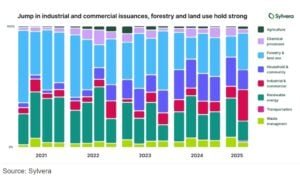
Verification and Standards: Every carbon credit project must measure and report its emissions reductions against a baseline. Third-party verification under standards like Verra, Gold Standard, or CCCI ensures transparency and environmental integrity.
SEE MORE:
- Carbon Credits Farming (Everything You Need To Know)
- Biodiversity Credits: A New Way of Funding Nature Protection
- Planting Trees for Carbon Credits: Everything You Need to Know
The World’s Largest Carbon Sinks
Conclusion: Balancing Emissions with Action
Carbon sinks—forests, oceans, and soils—remain indispensable in the fight against climate change. They stabilize the climate while providing biodiversity, water, and social benefits. Artificial carbon sinks and verified carbon credits further amplify their impact, linking environmental action with economic incentives.
Recent data from 2023-2025 show that natural sinks are under increasing stress: wildfires, deforestation, rising ocean temperatures, and soil degradation all reduce carbon absorption. Experts warn that relying on sinks alone to balance emissions is dangerous.
However, these systems are not unlimited. Without major emission reductions, natural sinks risk being overwhelmed. A holistic climate strategy combines:
- Immediate cuts in fossil fuel emissions.
- Protection and restoration of natural sinks.
- Deployment of artificial carbon removal technologies.
- Robust carbon credit frameworks to fund climate action.
Through this integrated approach, the world can safeguard natural carbon reservoirs, promote innovation, and accelerate the transition to a low-carbon economy. The message is clear: protecting and enhancing carbon sinks is not optional—it is essential for achieving net-zero goals and securing a resilient, sustainable future.
MUST READ:
- Carbon Credits Supply to Skyrocket 35x by 2050 – But at What Price?
- CDR Credit Sales Hit Record High, Powering Market Growth in 2025
- Are Nature-Based Solutions and Blockchain the Future of Carbon Credits?
The post Carbon Sinks and Carbon Credits: How Nature and Innovation Are Fighting Climate Change appeared first on Carbon Credits.


