
Watering your plants well is one of the most important parts of gardening. A good watering can makes this job easier, more precise, and even more enjoyable. I recently started using the GUKJOB 35 oz stainless steel watering can — and as an agriculture scholar and gardening lover, I decided to put it to the test.
In this blog post, I’ll talk about what this watering can is, how it works, its advantages and drawbacks, and my personal experience using it for my indoor plants. I’ll also bring in the science, the market trends for indoor gardening, and some practical advice for gardeners like you and me.
What Is GUKJOB 35 oz Metal Watering Can?
The GUKJOB 35 oz Metal Watering Can is a small, stylish watering can made of 304 stainless steel, with a long gooseneck (curved) spout. It is designed primarily for indoor plants, bonsai, small potted plants — though it can also be used for small outdoor gardening. The capacity is 35 fluid ounces (about 1,000 ml), which is a moderate amount: big enough to water several small plants, but light enough to carry comfortably.
The design is both functional and decorative: it has a wooden handle, a matte finish (in the black version), and a semi-opening at the top for easy filling. The long spout allows precise watering, making it easy to reach tight or dense areas without spilling water. Here’s a more detailed look at the GUKJOB watering can and its features:
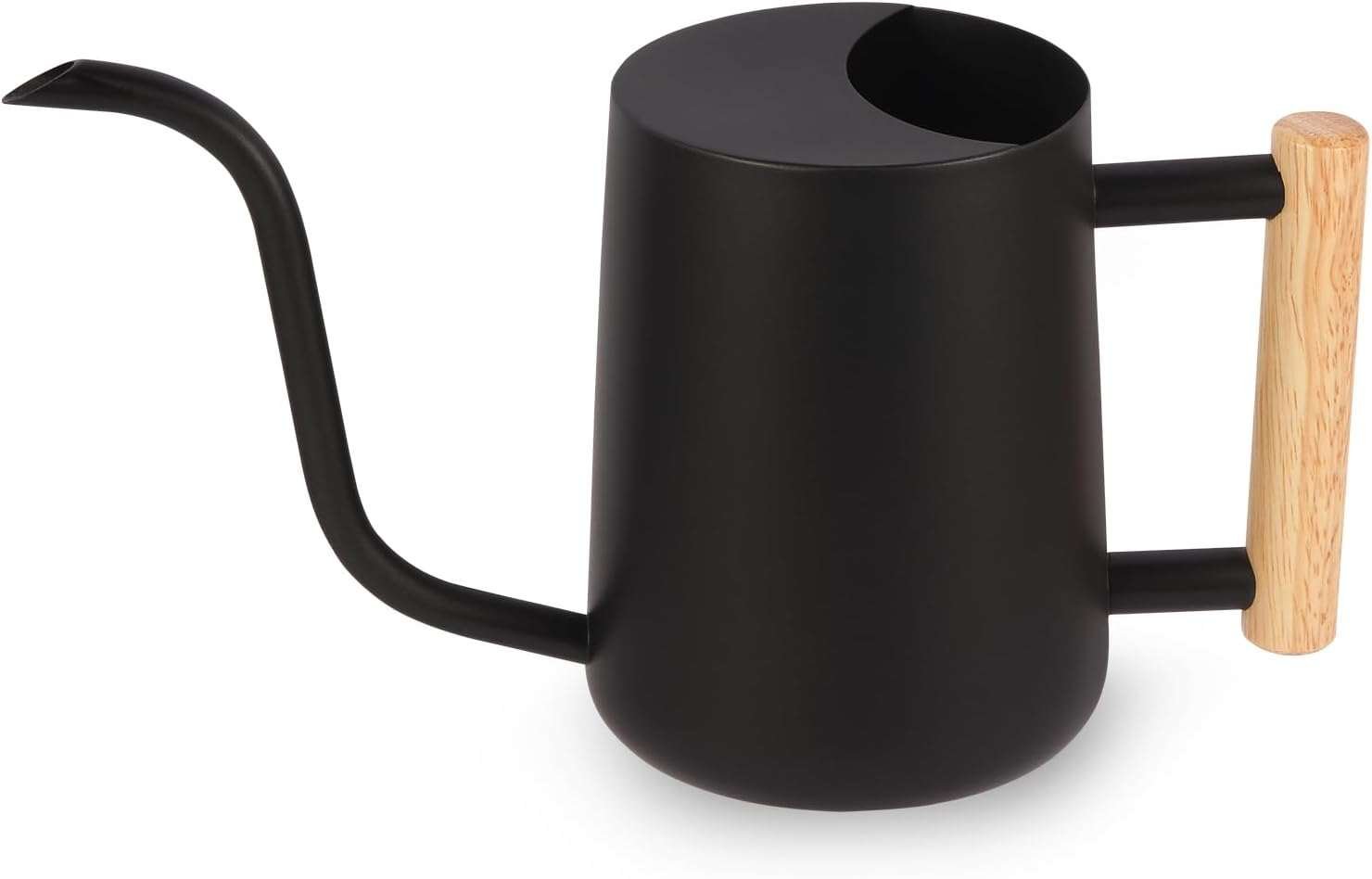
- Brand: GUKJOB
- Material: Premium 304 stainless steel — durable, rust-resistant, and sturdy.
- Color: Black (matte finish) — gives a modern, decorative look.
- Dimensions: Approximately 5.87 in (depth) × 10 in (width) × 4.41 in (height), weight ~ 73.7 grams (empty).
- Capacity: 35 oz / ~1,000 ml.
- Spout: Extra-long gooseneck design — for precise targeting of water, even in tight spots.
- Opening: Semi-opening on top for quick filling; built-in spill guard to reduce mess.
- Handle: Thick, natural wood — comfortable grip, non-slip.
- Safety Plug: Comes with a plug for secure transport.
- Decorative Design: Looks good on display; can double as a décor piece when not in active use.
Pros & Cons of GUKJOB Metal Watering Can
| Pros | Cons |
|---|---|
 Durable Material: Made from 304 stainless steel, which resists rust better than many cheaper metals. Durable Material: Made from 304 stainless steel, which resists rust better than many cheaper metals. |
 Limited Capacity: 35 oz may not be enough for large outdoor plants or very large pots — you might need to refill more often. Limited Capacity: 35 oz may not be enough for large outdoor plants or very large pots — you might need to refill more often. |
| Precise Watering: The long, curved gooseneck spout allows you to water exactly where needed without spilling. |
Weight When Full: While balanced, stainless steel still adds weight; when full, it may be heavier than plastic cans. |
| Comfortable Handle: Wooden handle feels good in the hand and does not slip easily. |
Price: Stainless steel watering cans tend to be more expensive than plastic ones. |
| Easy to Fill: Semi-opening on top makes it easy to fill from a tap or faucet. |
Maintenance Needed: If water is left inside, there is a risk of mineral buildup or rust over time if not cleaned. |
| Decorative: Stylish, modern design that looks nice in the home, not just hidden away. |
Not Fully “Smart”: Unlike automatic or self-watering systems, this is manual; you have to pour by hand. |
| Good Capacity: 35 oz is enough for several small-to-medium plants, reducing trips. |
Limited Color Options: While it has a matte black version, some users may prefer more colors or finishes. |
Why Metal Watering Can Matters?
Watering is one of the most basic yet vital tasks in gardening and plant care. Giving your plants the right amount of water, in the right place, at the right time is critical to their health. A good watering can does more than just carry water — it helps you deliver it in a way that encourages strong root growth, prevents overwatering, and supports efficient plant care.
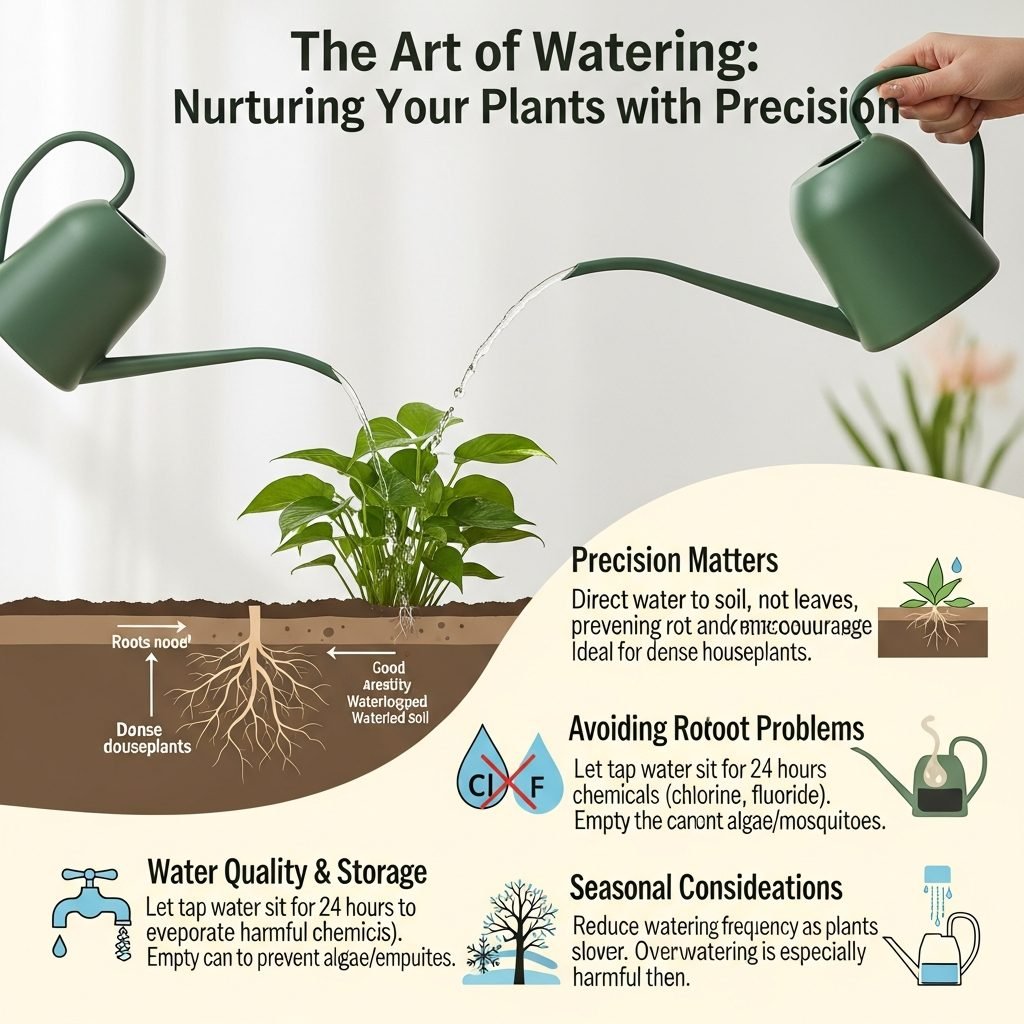
a. Proper watering avoids root problems: Plant roots need oxygen as much as they need water. If the soil stays saturated for too long, oxygen can’t reach the roots, leading to root rot.
b. Precision matters: Using a long, narrow spout (like the gooseneck on this can) helps you direct water exactly to the soil — not splashing on leaves — which is especially useful for dense houseplants.
c. Water quality and leftover water: Leaving water standing in a can can lead to problems: algae growth, mosquito larvae, or mineral buildup. Also, the kind of water you use is important. Tap water sometimes has chemicals (like chlorine or fluoride) that can harm sensitive plants. Letting water sit for 24 hours helps these chemicals evaporate.
d. Seasonal considerations: In winter, many houseplants grow slowly, so they require less frequent watering. Overwatering during this time can be especially harmful.
e. Avoiding overwatering: Overwatering is a common mistake. Certain plants are particularly vulnerable (e.g., succulents, fiddleleaf figs). To put the importance of a good watering can in context, here are some relevant trends and research:
The global indoor plant market is growing strongly: according to Business Research Insights, it is estimated to be USD 10.86 billion in 2025, and projected to reach USD 15.89 billion by 2035, with a compound annual growth rate (CAGR) of 3.88 %.
Other market research suggests an even higher CAGR: according to Proficient Market Insights, the market could grow from USD 21.65 billion in 2025 to USD 32.22 billion by 2033 (CAGR ~ 4.87 %).
According to Data Bridge Market Research, the indoor plants market was valued at USD 20.68 billion in 2024, and is expected to reach USD 30.25 billion by 2032 (CAGR ~ 4.87 %).
The rise of smart indoor gardening systems is also notable: according to a market report, the system’s market size was USD 895.70 million in 2025 and is projected to reach USD 2,345.40 million by 2032, growing at a CAGR of 13.5%.
Within the indoor plant sector, the indoor foliage plants submarket is growing: its size is expected to increase at a CAGR of about 4.3% between 2025 and 2035.
These trends show that more people are investing in indoor plants, and with that, plant care tools like watering cans are becoming more important. A high-quality, well-designed watering can is not just a nicety — it’s a useful tool for a growing market of plant lovers.
My Experience with GUKJOB 35 oz Metal Watering Can
As someone who studies agriculture and also has a passion for indoor gardening, here’s how I use the GUKJOB watering can in my own setup:
i. Plants I Water: I have a mix of dense indoor foliage plants — Calathea, Monstera, and a variety of pothos. These plants often grow close together, with overlapping leaves, making precise watering important.
ii. Watering Frequency: I water these plants roughly twice a week, depending on the soil moisture and my local climate.
iii. Filling & Carrying: I fill the watering can under a regular tap. Thanks to the semi-opening on top, I can pour water in easily without spilling. Once filled, the wooden handle feels stable in my hand.
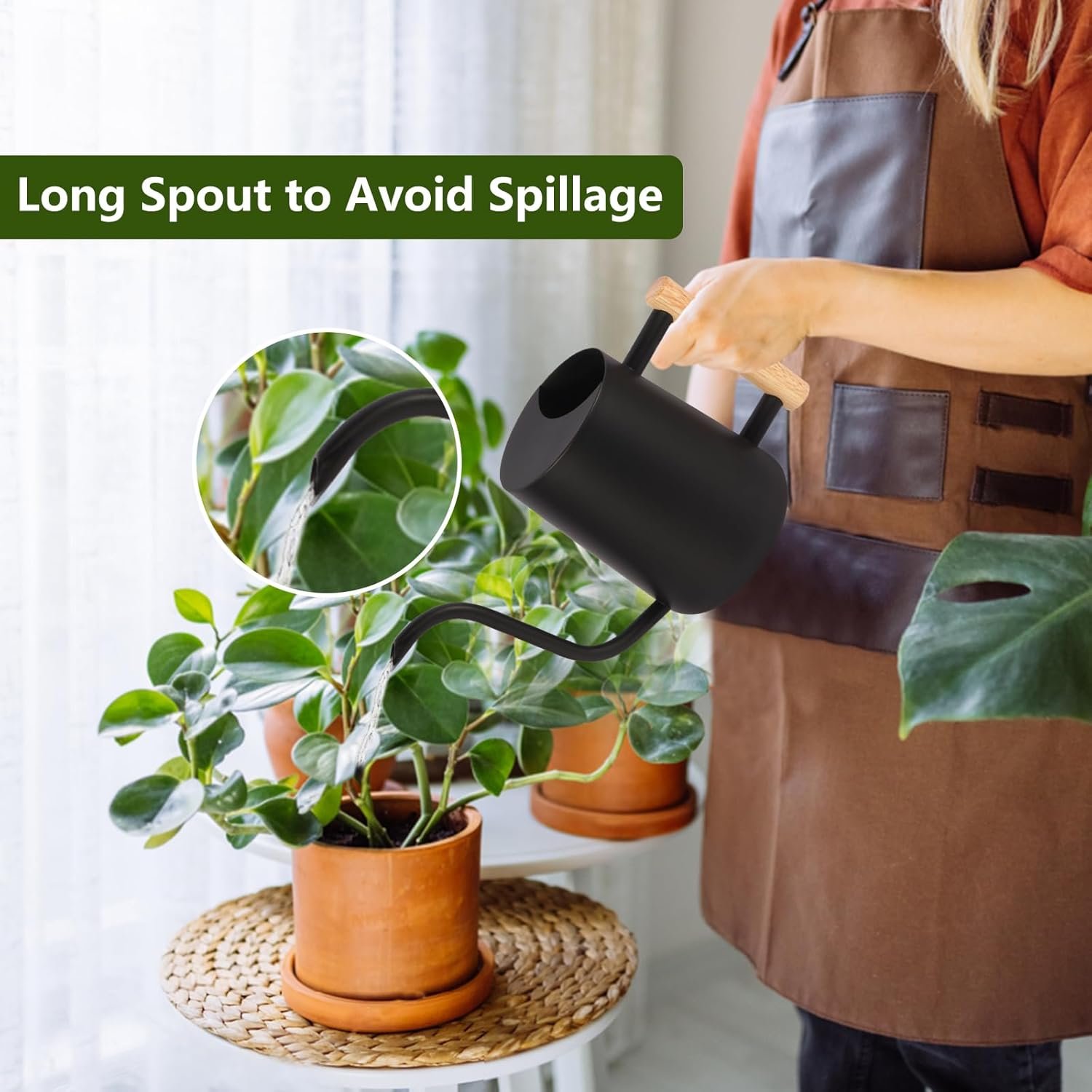
iv. Use of Spout: The long gooseneck spout is a game-changer. I can reach into tight areas, direct water exactly to pots, and avoid watering the leaves. This is especially helpful for the Calathea leaves, which I try not to wet too much.
v. Maintenance: After each use, I make sure to empty the leftover water (this is important for metal watering cans). I rinse it occasionally to avoid mineral buildup.
vi. Aesthetic Use: When not in use, I keep the watering can on a shelf. It fits well with my plant décor — its black matte finish and wooden handle make it look like a designer object rather than just a tool.
Overall, I feel that the can is well-balanced, functional, and beautiful — exactly what I want in a tool that is used daily and sits on display.
Performance of GUKJOB 35 oz Metal Watering Can
Here’s how the GUKJOB watering can performs in real-life use:
a. Precision: Thanks to the curved spout, I can water exactly where it’s needed without over-splashing. Even in tight clusters of plants, I don’t drip water on nearby leaves.
b. Flow Control: The water flows steadily, not too fast, allowing good absorption in soil rather than running off.
c. Durability: After several weeks of regular use, there is no rust or paint peeling. The stainless steel feels very solid, and the powder-coated finish helps protect it.
d. Comfort: Even when full, it’s comfortable to lift. The wooden handle gives a good grip, and the weight distribution feels balanced.
e. Filling Ease: Filling is quick and mess-free because of the semi-open lid.
f. Transport: With the safety plug, I can transport the can from one place to another without spilling water.
g. One small performance note: when it’s very full, the weight is noticeable, but not so much that it’s a real burden. For my use-case (six or more small to medium plants), a 35 oz capacity is quite efficient.
Practical Tips for GUKJOB 35 oz Metal Watering Can
Here are some tips, based on my experience, for using this watering can (and watering tools in general) effectively:
i. Empty After Use: Don’t leave water inside for long. Standing water in a metal can may lead to mineral buildup or, over time, even corrosion. (Some gardening guides strongly encourage emptying the can after each session.)
ii. Clean Regularly: Rinse it periodically, especially if you use hard tap water. This helps avoid clogging of the spout and mineral deposits.
iii. Use Room-Temperature Water: Very cold water can shock plant roots; letting water stand for a while (or mixing with warm water) is helpful.
iv. Water at the Base: Use the gooseneck spout to aim water at the soil, not the leaves — this helps prevent fungal problems.
v. Manage Fill-Ups: Since the capacity is moderate, plan your watering: fill up in a way that allows you to water all your plants without unnecessary trips.
vi. Store Well: Keep the can in a dry spot when not in use, especially if your area is humid, to prolong the life of the metal.
vii. Use Filtered or Rainwater: If possible, use filtered or collected rainwater. This reduces minerals and helps the watering can last longer.
viii. Teach Kids Gardening: Because the can is relatively light (even when full), it’s a great size for children to help – teaching them care, responsibility, and love for plants.
Comparisons with Alternatives Metal Watering Can
| Feature / Type | GUKJOB 35oz Stainless Steel Watering Can | Plastic Indoor Watering Can | Larger Metal Watering Can (2–3L) | Spray Bottle / Mister |
|---|---|---|---|---|
| Capacity | 1L (35 oz) – perfect for small indoor plants | Varies, usually 0.5–1L | 2–3L – good for large outdoor pots | Small, usually 0.3–0.5L |
| Material & Durability | 304 stainless steel – rust-resistant, scratch-resistant | Plastic – can crack or fade over time | Metal – durable but heavier | Plastic – lightweight but fragile |
| Precision Watering | Long gooseneck spout for exact root-zone watering |
Limited – often wide spout, harder to target roots | Moderate – larger spout may splash on leaves | Not suitable – delivers mist, not deep watering |
| Ease of Use | Lightweight, well-balanced, comfortable wooden handle |
Very light, easy to lift |
Heavy when full – harder to control | Easy for misting leaves, but not soil |
| Decorative / Aesthetic | Modern, matte black with wood handle – looks great on display |
Basic design – less decorative | Functional – design less stylish | Functional – mainly utility, not decorative |
| Best Use | Indoor plants, bonsai, dense foliage, small pots | Small indoor plants, beginners | Large pots, outdoor plants | Leaf misting, humidity control, seedlings |
| Price | Higher – premium material and design | Low – budget-friendly | Moderate to high depending on size | Low – affordable and easy to replac |
Final Recommendations
Overall, the GUKJOB Plant Watering Can, 35oz (1L), 304 Stainless Steel with Long Curved Spout (Black) is a high-quality, stylish, and very functional watering tool for plant lovers, especially those who grow many indoor or balcony plants.
Best for:
- Houseplant enthusiasts with dense foliage plants like Calathea, Monstera, Pothos, Philodendron, etc.
- People who want a watering can that is also a decorative piece.
- Those who value precision watering and want to avoid spills and leaf wetting.
- Users who want a durable, rust-resistant stainless steel can instead of cheap plastic.
Not ideal for:
- Very large gardens or farms (capacity too small).
- People who want the cheapest possible option.
- Users with many big outdoor pots who may need a larger 2–3L can.
- From my own farming and gardening mindset, I see this watering can as a specialized tool:
- It will not replace your big outdoor watering can or hose.
- But it will become your favorite partner for caring for indoor plants, bonsai, and delicate foliage.
If you are building a beautiful, practical plant corner in your home or office, this product fits perfectly. It combines good science (precise watering), good ergonomics (lightweight and comfortable), and good design (modern décor).


