
Gardening and farming require not just passion and hard work, but also good timing — especially when it comes to watering. In many parts of the world (including regions like ours), water is a precious resource. Over-watering, under-watering, or irregular watering schedules can stress plants, waste water, or shrink yields.
In this review I am going to discuss my experience with the Orbit 62061Z 1-Outlet Programmable Digital Hose Watering Timer — a small but powerful tool that turns a regular faucet into a programmable sprinkler system.
What is Orbit 62061Z Digital Hose Watering timer?
The Orbit 62061Z is a digital hose watering timer. In simple words — it’s a compact device that you connect between your outdoor faucet (tap) and a garden hose (or soaker hose/ sprinkler). Once installed, instead of manually turning on/off the faucet every time you water, the timer opens and shuts the water flow according to a schedule you program.
You set when the timer should start watering, how long it should water, and how often. After that, the timer does the rest — automatically. It can also pause watering during rain (with a “rain-delay” feature) or allow manual watering if needed. Think of it as giving your garden a regular watering schedule, without you needing to remember or run outside. Here are the basic product details you shared and what they mean in simple terms:
- Brand: Orbit
- Model: 62061Z, 1-Outlet Digital Hose Timer
- Color: Green
- Material: Plastic
- Dimensions: 5″ D x 10″ W x 3″ H
- Weight: Very light (around 0.01 ounces listed, basically very lightweight)
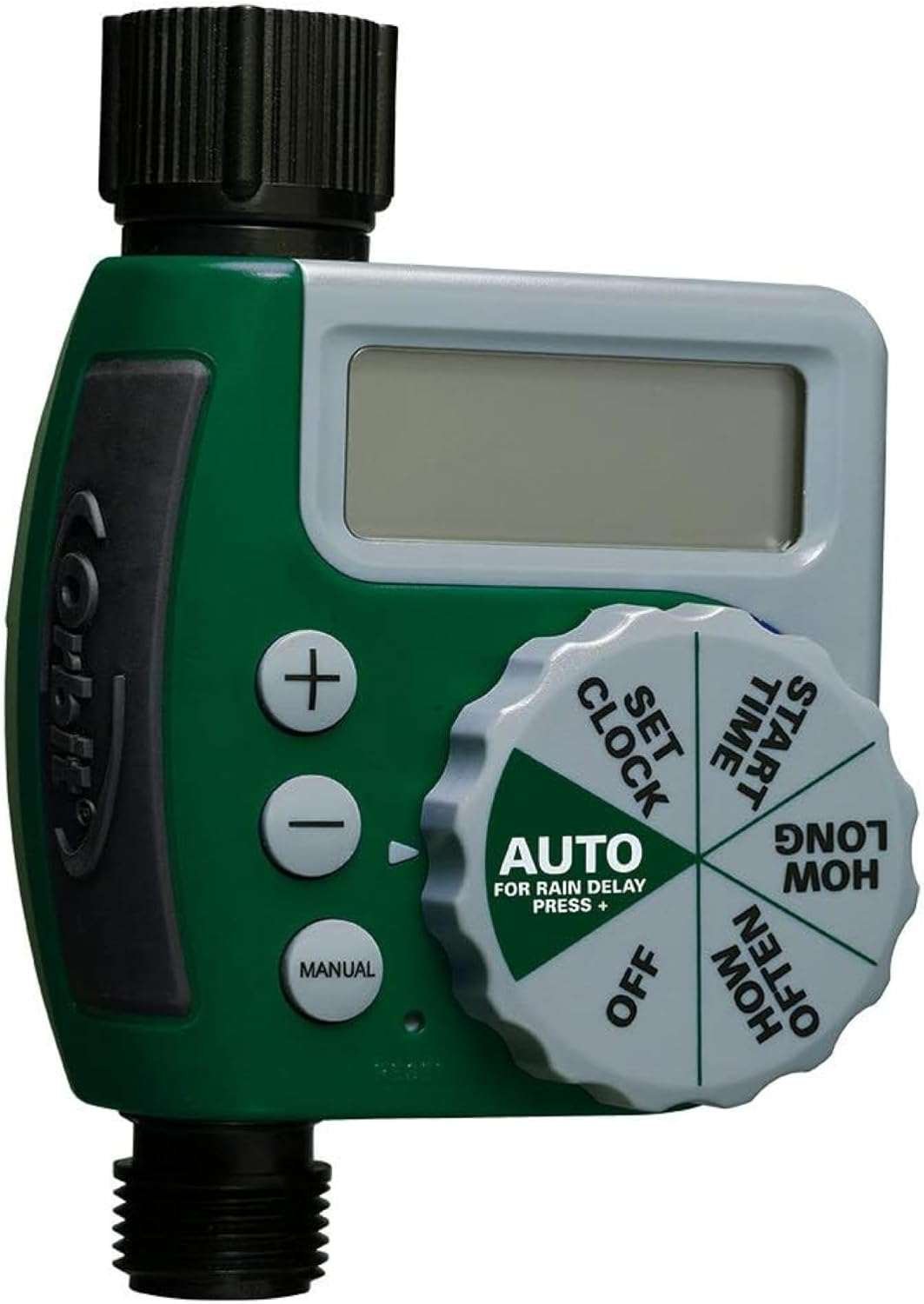
Key Features
Automatic Watering System
i. Turns any outdoor faucet into a programmable sprinkler system.
ii. You can set start time, watering duration, and watering frequency.
Water and Money Saving
i. Avoids overwatering and underwatering.
ii. Helps reduce water bills by applying water only when needed.
User-Friendly Design
i. Large, easy-to-read LCD screen.
ii. Simple dial and buttons for programming.
iii. Program is saved even when you change batteries, so you don’t have to reprogram every time.
Rain Delay Feature
i. Built-in 24, 48, or 72-hour rain delay.
ii. This means if it rains or rain is expected, you can pause watering for 1–3 days without deleting your main program.
Durable and Weather-Resistant
i. Water-resistant construction.
ii. Designed to handle outdoor conditions.
iii. Suitable for both home users and professional landscapers.
Flexible Timing Options
i. Watering duration can range from as short as 1 minute to as long as 240 minutes (4 hours).
ii. Frequency can range from every 6 hours to once every 7 days.
Manual Watering Mode
A manual button allows you to turn water on instantly without disturbing your program.
Very useful when you want a quick wash, fill a bucket, or give extra water during a heatwave.
Orbit as a brand is well known in North America and in other parts of the world for irrigation solutions like PVC-Lock, Blu-Lock, Drip-Lock, and B-hyve smart controllers. They have more than 50 years of experience in the irrigation industry, especially for residential outdoor watering.
Pros & Cons of Orbit Outlet Programmable Watering timer
Here’s a quick summary of what works and what doesn’t:
| Pros | Cons |
|---|---|
 Automates watering — you don’t have to remember to water manually Automates watering — you don’t have to remember to water manually |
 Requires battery — if battery dies and you don’t notice, plants may miss watering Requires battery — if battery dies and you don’t notice, plants may miss watering |
| Saves water by allowing precise watering schedule and duration |
Single-outlet limits watering to one hose — may not be enough for large gardens |
| Rain-delay helps avoid waste after rain |
Plastic housing may degrade over many years under harsh sun / UV exposure |
| Manual override for extra flexibility |
Not “smart” — doesn’t sense soil moisture or rainfall automatically (unless you intervene) |
| Easy to install — no plumber or complicated setup needed |
For heavy-duty or farm irrigation, may not be enough — limited to hose pressure/flow and small area |
| Good value for money for small-scale gardening |
Cannot regulate water flow rate — only on/off — may lead to over-watering if schedule is not adjusted properly |
Why Watering timer Matters?
In agriculture and gardening, watering is often the single largest usage of water — especially in dry climates or during dry seasons. However, poor watering practices often lead to water waste, plant stress, and inefficiencies. According to irrigation-efficiency studies, 30%–60% of irrigation water is wasted due to issues like leaks, misaligned sprinkler heads, poor scheduling, or simple over-watering.
By giving plants more water than they need — or watering when they don’t need it — gardeners waste both water and money, and may even harm soil structure or plant health. A programmable timer like the Orbit 62061Z helps bring discipline into watering.
It ensures water is delivered on schedule, for a set amount of time, and can avoid watering during rainy periods (via the rain-delay). This helps avoid human error — like forgetting or watering too long — and helps conserve water.
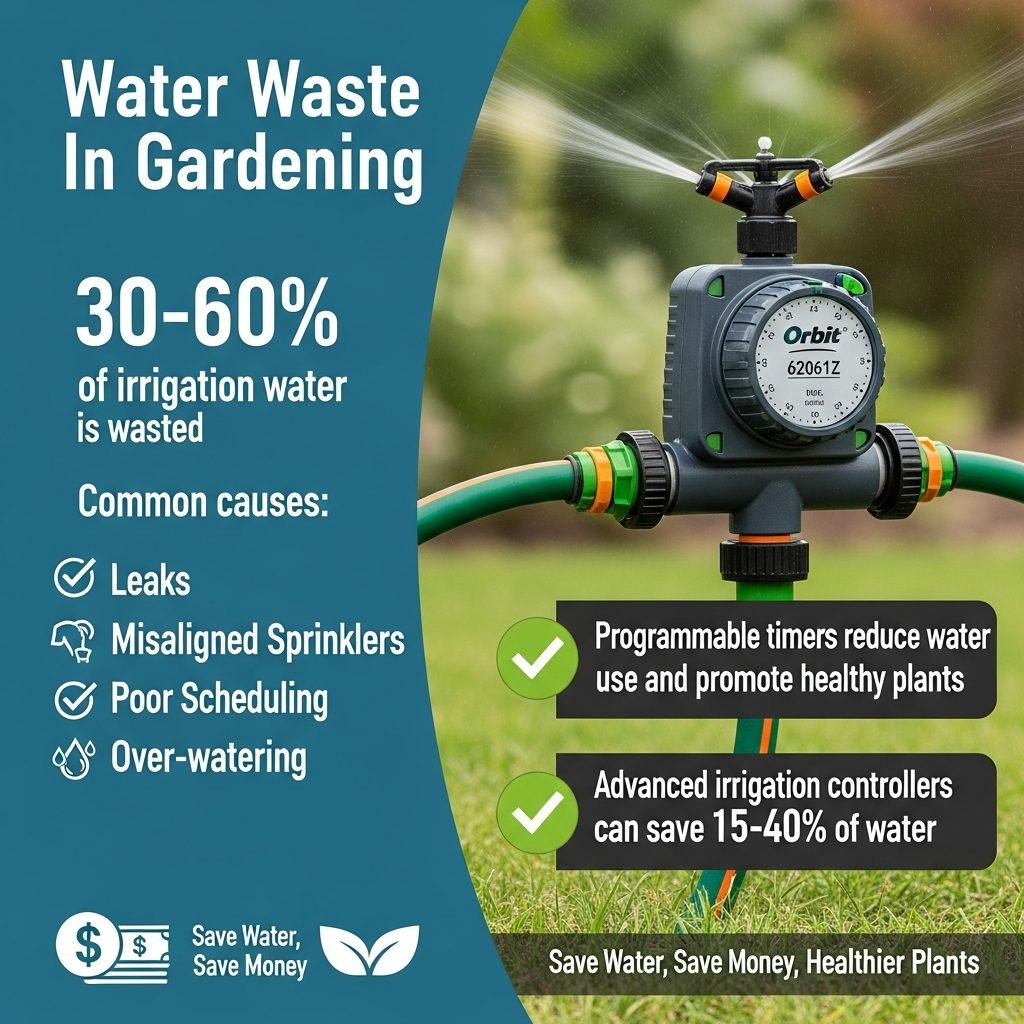
Modern irrigation control systems — whether simple timers or advanced “smart” controllers — have been shown to significantly reduce water use. The U.S. Department of Energy notes that with advanced irrigation controllers, water savings range from 15% to 40%, depending on climate, plant type, programming, and system size.
Other studies show that optimized irrigation (with correct scheduling) can reduce water consumption by 20%–50% compared to traditional, manually controlled systems — especially when using efficient methods like drip irrigation or soaker hoses near root zones.
In short, technology—even simple timers—combined with thoughtful scheduling, can lead to substantial water savings, more consistent moisture for plants, and better water-use efficiency. For regions where water scarcity is a concern, such improvements can be very impactful.
Why This Matters for Small Farmers / Gardeners
For gardeners or small-scale farmers, tools like Orbit 62061Z offer a low-cost entry into more efficient watering. They don’t need big irrigation infrastructure, sensors, sprinklers, or high-end controllers. A simple tap, hose and timer can make a big difference: consistent watering, water saved, and less manual labor.
In places like Pakistan — where water conservation is becoming increasingly important — adopting such simple technologies can reduce waste, conserve groundwater or canal water, and help maintain healthy crops with less resource use.
According to research summarized by energy and water-use agencies, advanced irrigation controllers can reduce water consumption by 15%–40% on average for landscaping and gardens. Inefficient irrigation — due to leaks, mis-scheduling, or over-watering — leads to 30%–60% water waste in many gardens and landscapes worldwide.
Use of efficient irrigation (such as micro-irrigation, drip, or timed systems) can lower water usage by 20%–50% compared to traditional sprinkler systems that rely on manual watering or uncontrolled watering.
In controlled studies, replacing conventional irrigation with smart/timed irrigation has led not only to water savings but improved soil moisture consistency and healthier plant growth — which may translate to better yields or garden performance.
Beyond water savings, efficient irrigation also contributes to energy savings (because less pumping, pumping hours) and reduced environmental impact — less runoff, less over-extraction of water, and better sustainability. These statistics reinforce that a simple timer device like Orbit’s can — when used wisely — contribute to significant water and energy savings, especially in water-stressed areas.
My Experience with Orbit Digital Hose Watering timer
As a gardener and agriculture student, I always want to apply practical solutions that match our climate and resource context. Here is how I used the Orbit 62061Z in my home garden setup:
I connected the timer to an outdoor faucet. From the outlet of the timer, I attached a soaker hose that runs through a bed of tomato plants. I programmed the timer to water twice a day (morning and evening), each cycle lasting about 20 minutes, since tomatoes in summer heat benefit from early morning and late evening watering.
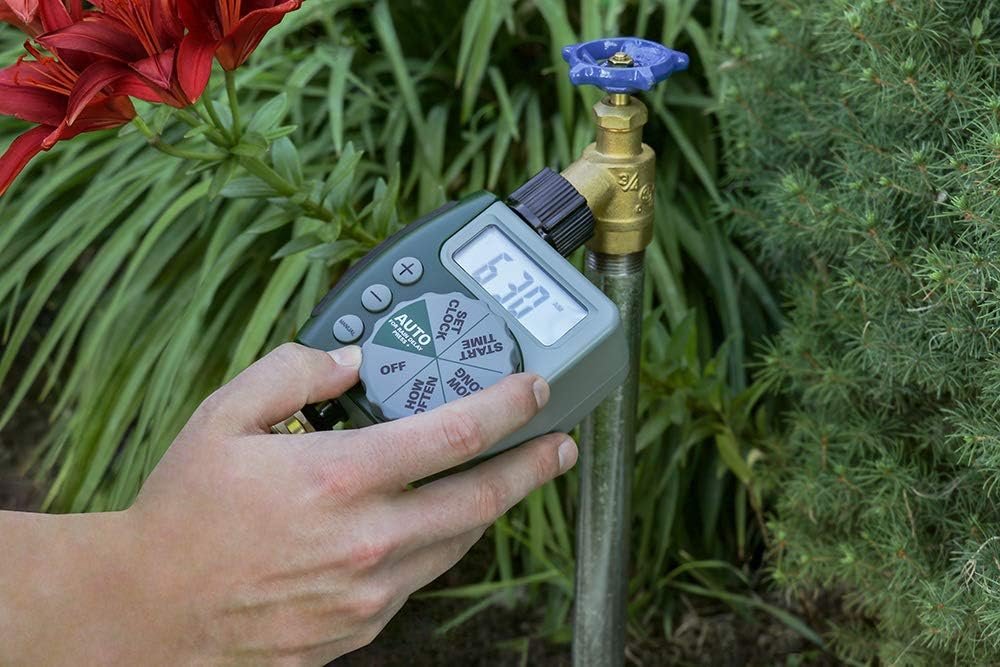
I also occasionally used the manual watering option on hot days or after transplanting seedlings. In monsoon or rainy days, I used the rain-delay option to pause automatic watering for 48–72 hours to avoid over-watering. I ensured batteries were fresh and replaced them before they died; this way I avoided missed watering cycles.
What I observed after 2–3 months of use:
i. Healthier plants: My tomato plants looked greener, with less wilting. Fruit set was good, and I didn’t notice over-watering problems (waterlogging, root rot) — probably because watering was consistent and controlled.
ii. Water use felt lower: I did not keep an exact meter, but perceptively I felt I was using less water — no frantic hoses watering for hours, no forgotten taps — just scheduled, measured watering.
iii. Convenience: As someone juggling studies and other tasks, I loved not having to remember garden chores every day. The timer did the job automatically, even when I was busy or away for a few hours.
iv. Flexibility: When weather changed (rain, cloudy days, hot spells), I could quickly adjust watering schedule manually — without needing to be near the faucet physically.
Overall, the setup worked smoothly for my small garden with a few fruiting vegetables. It made irrigation simpler, reduced workload, and gave good results.
Performance of Orbit Programmable Digital Watering timer
In my experience (over one growing season so far), the Orbit 62061Z performed reliably. Its digital programming interface was easy to understand; the LCD remained readable even under strong sunlight; and the rain-delay feature worked well when needed.
The manual watering option was useful on transplanting days or when young seedlings needed extra care. The water flow pressure through the timer remained adequate for my soaker hose — no noticeable drop.
However, I did take one precaution: I always disconnected the timer and drained the hose at the end of season (before winter) — to avoid plastic degradation and possible leaks. I also replaced the battery once after 4–5 months.
In short: for a small garden or vegetable bed, the performance was impressive — consistent, reliable, and low-maintenance.
Practical Tips for Orbit Watering timer
If you decide to use the Orbit 62061Z (or similar hose timers) in your own garden or small farm — here are some tips from my experience + general good practices:
a. Use a soaker hose or drip hose instead of overhead sprinkler — especially in hot climates, to minimize evaporation and deliver water directly to root zone.
b. Water early morning or late evening — this reduces water loss due to evaporation and helps plants absorb water better.
c. Use rain-delay when it rains / expecting rain — avoid over-watering, soil waterlogging, water waste.
d. Monitor soil moisture manually at first — check soil by hand or feel to ensure the watering schedule matches plant needs; adjust duration/frequency as needed depending on season, heat, rainfall.
e. Replace batteries regularly — don’t wait until display shows low battery; missed cycles can stress plants.
f. Winterize (if relevant) — drain hoses and disconnect timer if you expect freezing temperatures (freezing can crack plastic/valves over time).
g. Combine with mulch or soil cover — this helps retain moisture longer and reduces watering frequency.
h. For larger gardens, consider multi-outlet timers or split into zones — since a single-outlet may not supply enough for multiple zones or large area.
i. Re-evaluate schedule seasonally — plants’ water needs change with weather, season, growth stage. Don’t leave same schedule throughout the year.
j. Consider upgrading later — if you expand your garden or want more precision (soil moisture sensors, smart controllers), but start with a simple timer is a good first step.
Comparisons with Alternatives Watering timer
When you think about irrigation / watering options for a small garden or yard, you have a few choices. Here is how Orbit 62061Z compares
| Feature | Orbit 62061Z Timer | Traditional Manual Watering |
|---|---|---|
| Watering control | Automatic on/off based on schedule | Fully manual, depends on your time and memory |
| Watering frequency | Can be set from every 6 hours to once every 7 days | Irregular; varies with your routine and availability |
| Watering duration | Adjustable from 1 to 240 minutes per cycle | Estimated by feel; easy to over- or under-water |
| Rain adjustment | Has rain-delay (24–72 hours) when you activate it | You must remember not to water after rain |
| Ease of use | Simple dial and LCD screen; “set and forget” | No device to learn, but requires daily effort |
| Power requirement | Runs on batteries; needs replacement occasionally | No batteries or power needed |
| Coverage | One hose/outlet at a time (single zone) | Can move hose anywhere, but only when you are there |
| Water use efficiency | More consistent and controlled; helps reduce waste | Depends on user; easy to leave tap on too long |
| Setup | Tool-free installation on outdoor faucet | No setup, just attach hose directly to faucet |
| Best suited for | Home gardens, small lawns, vegetable beds, busy users | Very small spaces or users who enjoy manual watering |
Final Recommendations
If you are a small-scale gardener, hobby farmer, kitchen-garden lover or someone with a small yard or vegetable patch, the Orbit 62061Z is — in my opinion — a very useful, practical and affordable tool.
It helps ensure consistent watering, saves water, and gives you freedom and convenience (watering while you travel, or busy with other work). For climates where water shortages or irregular rainfall are common, and for gardeners who want to optimize water use — it is a worthwhile investment.
However, be aware of its limitations: it only supports one watering line at a time, you might need multiple units for different zones, and long-term durability can be a concern (especially in harsh or humid climates). Also, unlike “smart” irrigation systems, it won’t automatically adjust to rain or soil moisture — you need to manage settings manually.
In my own gardening experience, the benefits of regular watering schedule, healthier plants (especially tomatoes & vegetables), and water savings outweighed the drawbacks. If you adopt good practices (such as using soaker hoses, watering at optimal times, protecting the timer in off-season) you can get many seasons of good performance out of it.


