
In today’s world of gardening and small‑scale farming, efficient use of water is more important than ever. With changing weather patterns and increasing pressure on water supplies, gardeners need reliable tools to manage irrigation smartly. One of the simplest — and yet very useful — tools I discovered for my own gardening and small‑farm work is the Orbit 62034 Mechanical Water Timer.
This small, inexpensive device helps me control watering for my lawn, plants, and garden without any fuss. In this article, I share a detailed review of this timer: what it is, how it works, its advantages and disadvantages, and how it has helped me — especially in my context as an agriculture scholar and passionate gardener
What is Orbit 62034 Mechanical Water Timer?
The Orbit 62034 Mechanical Water Timer is a simple device you attach between a faucet (spigot) and a garden hose (or sprinkler/soaker‑hose). Once attached, you use a dial to set a watering duration — from 15 up to 120 minutes — and the timer automatically shuts off the water flow when the time ends. In essence, it works like a classic kitchen “egg timer,” but for garden watering. Some key aspects:are
- No batteries or electronics needed — purely mechanical timing.
- Manual watering option is available: you can bypass the timer if you want continuous water flow.
- It uses standard garden hose/faucet connections, making installation easy and compatible with most setups.
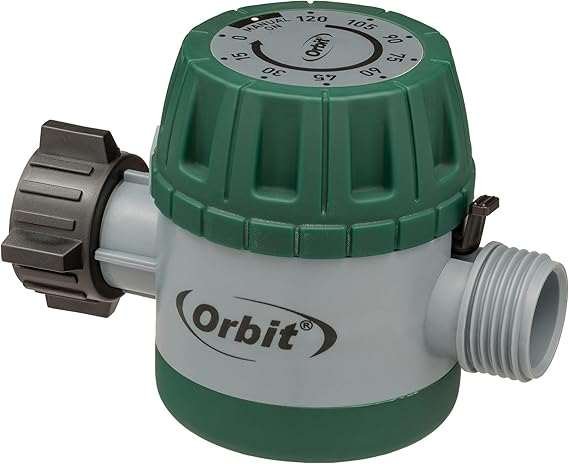
Product Overview
- Watering Duration: 15–120 minutes per watering session.
- Operation: Mechanical — no batteries or programming needed. Just twist the dial.
- Manual Override: Yes — you can use the faucet normally without removing the timer.
- Material & Build: Typically made of weather-resistant plastic (or a mix including metal in some models) to resist rust/corrosion and outdoor conditions.
- Ease of Use: The dial is oversized, so it’s easy to adjust even with wet or gloved hands.
- Connections: Fits standard garden hoses/spigots, with a swivel coupling for easy attachment.
Overall, the design philosophy is simple — no electronics, no smart-phone apps, just basic, dependable water timing.
Pros & Cons of Orbit 62034 Mechanical Water Timer for Lawn
| Pros | Cons |
|---|---|
 No batteries or electronics — minimal maintenance. No batteries or electronics — minimal maintenance. |
 Limited to manual start each session; no scheduling or automation. Limited to manual start each session; no scheduling or automation. |
| Easy to install and use — suitable for most faucets/hoses. |
Some users report occasional leaks at connections or timer body. |
| Oversized dial — easy even with wet/gloved hands. |
Maximum watering duration 120 minutes may be insufficient for very large gardens or long irrigation cycles. |
| Saves water by shutting off automatically — avoids overwatering or forgetting sprinklers on. |
No smart features — e.g., cannot adjust watering based on weather or soil moisture. |
| Manual watering override adds flexibility. |
Flow or pressure might be slightly reduced compared to direct faucet–hose connection, depending on hose and setup. |
Why Mechanical Water Timer for Lawn Matters?
Efficient watering matters a lot — especially in gardening or farming contexts where water scarcity, drought stress, or limited water supply can hamper plant growth. Using a timer helps ensure water is delivered just the right amount, for the right time — avoiding overwatering (which wastes water and can harm plants) and underwatering (which stresses them).
Research and industry reviews show that even basic timer‑based irrigation (though not as smart as sensor-based systems) can contribute to water savings and improved plant health. With more advanced (sensor- or weather-based) systems, reported water savings often range between 15% to 40%.
While the Orbit 62034 doesn’t have sensors, the basic principle — preventing over-watering by limiting run time — already aligns with those water‑conservation goals.
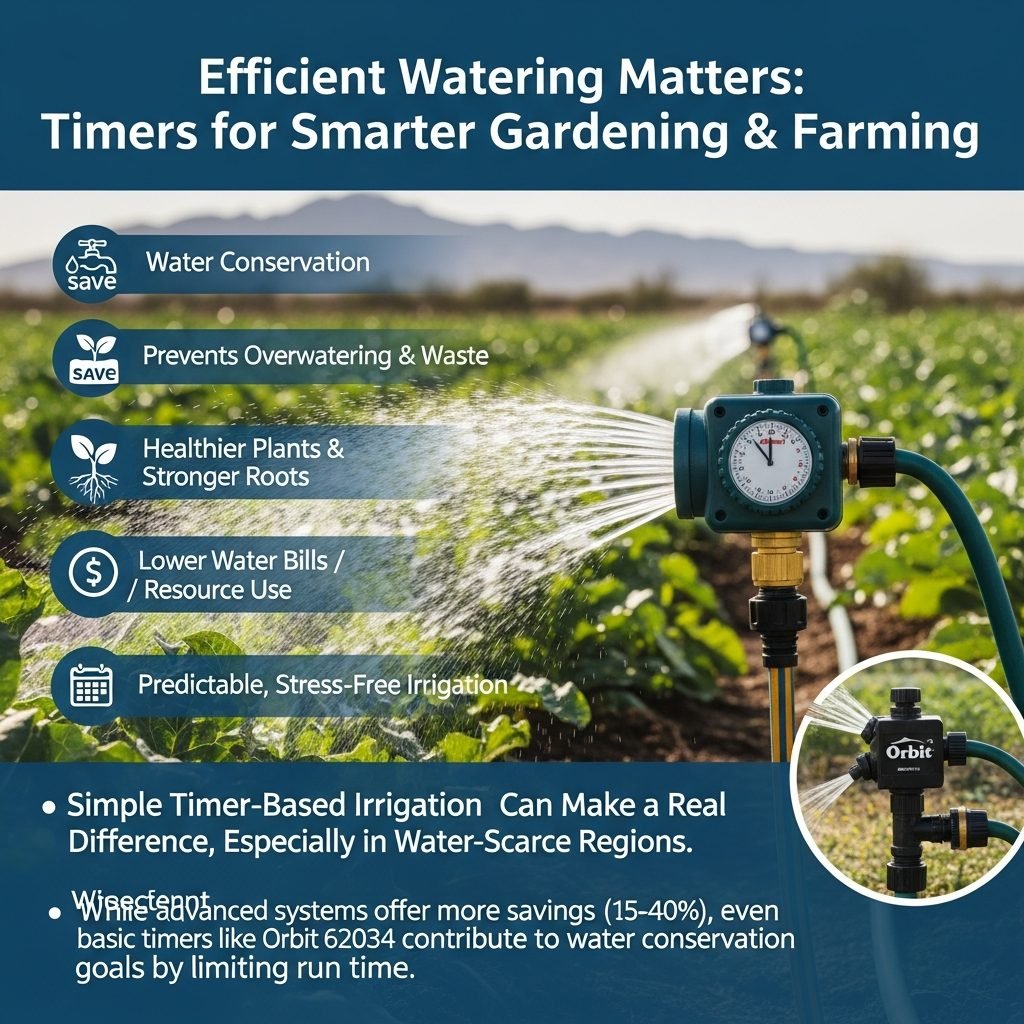
For gardeners and farmers (especially in semi‑arid environments or places with water scarcity), such timers can make a real difference: less wasted water, lower water bills or resource use, and more predictable irrigation — which translates into healthier plants, stronger root development, and less stress.
Controlled studies on advanced irrigation controllers show water savings between 15% to 40% compared to conventional watering practices. In one real-world case, a large landscaped area reduced irrigation water use by ~40% after switching to a water‑smart control system.
While simple mechanical timers like Orbit’s are less sophisticated than sensor-based controllers, they still contribute to more efficient water use by eliminating human forgetfulness and excessive run times — a common source of waste. Many gardening authorities note that timers help avoid both overwatering and underwatering.
These statistics and findings highlight that even modest technological interventions (like a simple timer) can contribute meaningfully toward water conservation and efficient irrigation — especially relevant in regions with limited water supply or in smallholder farming/gardening contexts.
My Experience with Orbit Mechanical Irrigation Timer
I installed the Orbit 62034 timer on several spigots around my property: one for the vegetable garden, one for a small orchard zone, and another for lawn sprinklers. I used a mix of hose-mounted sprinklers and soaker hoses depending on the area.
- For vegetable beds and small trees, I generally set the timer to 20–30 minutes in the early morning.
- For lawn sprinkling, I used 30–45 minutes depending on soil dryness and temperature.
- I also tried filling water troughs and small cisterns for occasional use — the timer worked well for that too.
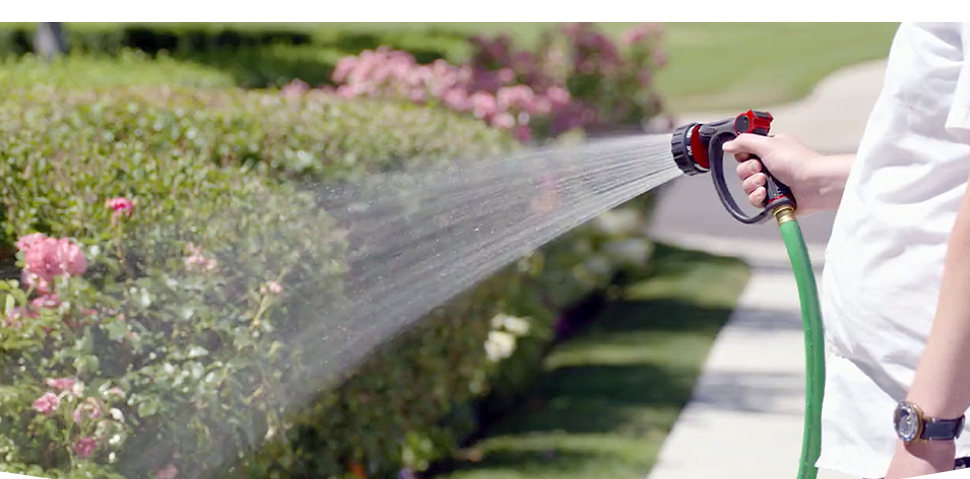
Over many weeks, I found the timer hit the right balance between convenience and control: I simply set the dial and walked away, without fear of forgetting to turn off the tap. Compared to earlier manual watering routines — where I often got distracted and ended up either overwatering (wasting water) or underwatering (plants suffering) — this felt much more efficient and reliable.
However, a few times I noticed slight dripping at the hose connection — likely due to washers loosening or needing to be replaced. Also, for larger watering jobs (e.g., long soaker hoses or multiple sprinklers), the 120‑minute maximum felt limiting. Overall though, the simplicity, reliability, and water‑saving potential of the Orbit 62034 impressed me.
Performance of Orbit 62034 Mechanical Water Timer
In typical garden/lawn use, the Orbit 62034 performs as advertised: it delivers water for the set duration and shuts off automatically when time’s up. Installation is quick, and once set up, I rarely had to fiddle with it.
Compared to manual watering, it saved me significant time and mental effort: no more early mornings rushing to turn off taps, no more mid‑day check-ins, no more wasted water due to forgetfulness.
In terms of durability, the plastic body held up over months (including under direct sun). The oversized dial remained easy to operate even when wet. The manual override worked reliably when I needed continuous water.
On the downside:
i. For extensive watering (large gardens or multiple sprinklers), the 120‑minute cap might not be enough.
ii. The lack of digital scheduling means repeated manual start‑up each session — not ideal if you want “set and forget” long‑term automation.
iii. A few drip issues at hose connections — mostly fixable with well-maintained washers/seals.
Practical Tips for Orbit Mechanical Water Timer
Having used the timer and reviewed user feedback, here are some tips — especially useful for gardeners, small farmers, or those with limited water supply (like in many parts of Pakistan
i. Shade the timer if possible — prolonged direct sun can degrade plastic or rubber parts over time.
ii. Check washers/seals regularly — watering systems often leak at hose or faucet connections if washers wear out.
iii. Use for smaller zones or short watering sessions — best for vegetable patches, small lawns, soaker hoses, or supplemental watering.
iv. Avoid overloading with multiple sprinklers or large-drip hoses — since the timer may limit flow/pressure.
v. Use manual override for tasks like filling containers — e.g. cisterns, troughs, or watering pots manually without timing.
vi. Don’t expect high automation — if you need frequent, scheduled watering, you may want to complement this timer with more advanced (sensor-based or programmable) systems.
Comparisons with Alternatives
To put things in perspective, here’s how the Orbit 62034 compares with other types of watering timers available now
| Feature | Orbit 62034 Mechanical Timer | Digital Hose Timer | Smart Wi-Fi Timer | Manual Watering |
|---|---|---|---|---|
| Operation | Mechanical, no batteries | Battery-powered, digital display | Wi-Fi, app-controlled | Manual faucet operation |
| Watering Duration | 15–120 minutes | Programmable, multiple intervals | Custom schedules, multiple zones | User-controlled |
| Ease of Use | Very simple, dial-based |
Moderate, requires setup | Advanced, needs smartphone | Simple but needs attention |
| Maintenance | Low, no batteries | Medium, battery replacement needed | High, software updates & app needed | Low, manual operation only |
| Water Efficiency | Automatic shut-off, prevents waste |
Programmable, moderate accuracy |
Smart control, very precise |
Depends on user attention |
| Cost | Budget-friendly | Moderate | High | Minimal |
Final Recommendations
For gardeners, small‑scale farmers, or hobbyists — especially in regions where water conservation matters — the Orbit 62034 Mechanical Water Timer is a solid, budget‑friendly, and effective tool. Its mechanical simplicity and automatic shutoff help prevent water waste, save time, and ensure your plants get just the right amount of moisture.
Use it if you:
- Have a small or medium garden, lawn, or orchard
- Want a low‑maintenance, battery‑free watering solution
- Prefer simplicity and reliability over smart features
- Want to save water and avoid overwatering
Maybe skip or complement it if you:
- Have a large garden or multiple irrigation zones needing long or frequent watering cycles
- Want programmable scheduling or automation (weather-based or soil-moisture–based)
- Depend on high water pressure or multiple sprinklers at once


