
Gardening and farming are more than a hobby for me — they are my passion. Every seed planted, every drop of water given, matters. That’s why choosing the right watering tool is so important. Recently I got the QUOBAS Sprinkler Timer, hoping it would make watering easier, save water, and help my plants thrive — with fewer headaches for me.
In this review I’ll share what this timer is, how it works, what I liked and where I saw problems, why it matters (especially for gardeners and small-scale farmers), and whether I think it’s worth buying.
What is QUOBAS Automatic Digital Drip Irrigation Timers?
The QUOBAS Sprinkler Timer is a programmable garden hose irrigation timer — a device that connects between your water tap and garden hose (or drip-irrigation line or sprinkler) and automates when and how long water flows.
Instead of watering by hand or leaving a faucet on, you set this timer to start watering at a particular time, run for a chosen duration, and repeat at a frequency you select (for example daily, every few days, or weekly). The timer also offers a “rain delay” function — this means if it rains, you can delay the next watering automatically so you don’t overwater your plants.
In short — it’s a “set-and-forget” tool for garden irrigation. Once programmed, it handles watering for you. Here are the main features of the QUOBAS Sprinkler Timer, as described by the manufacturer and from my own impressions:
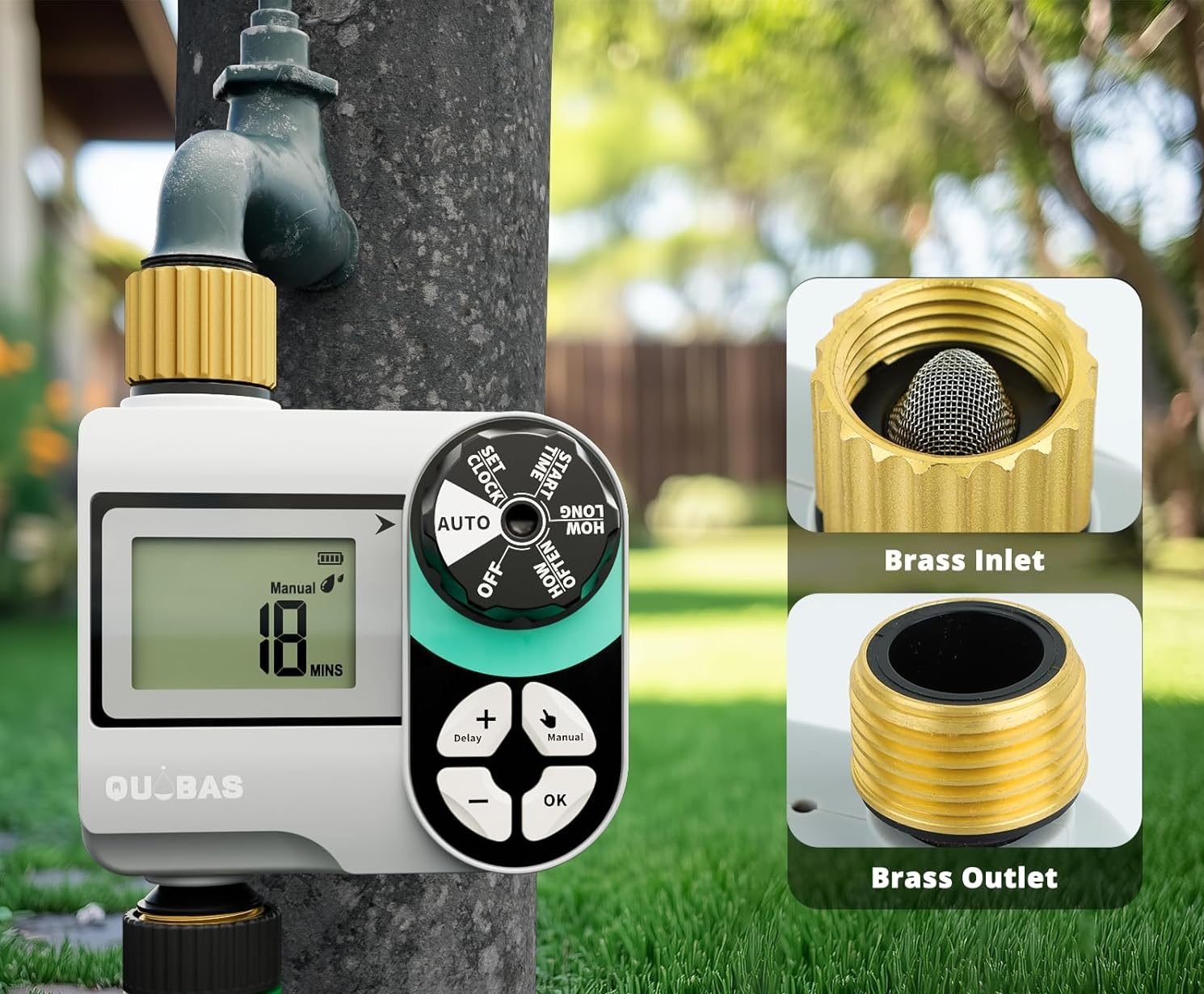
Brass inlet & outlet fittings: The timers use pure brass connectors for both inlet (tap side) and outlet (hose side). This makes the connection strong, resistant to corrosion, and less likely to leak compared to cheap plastic connectors.
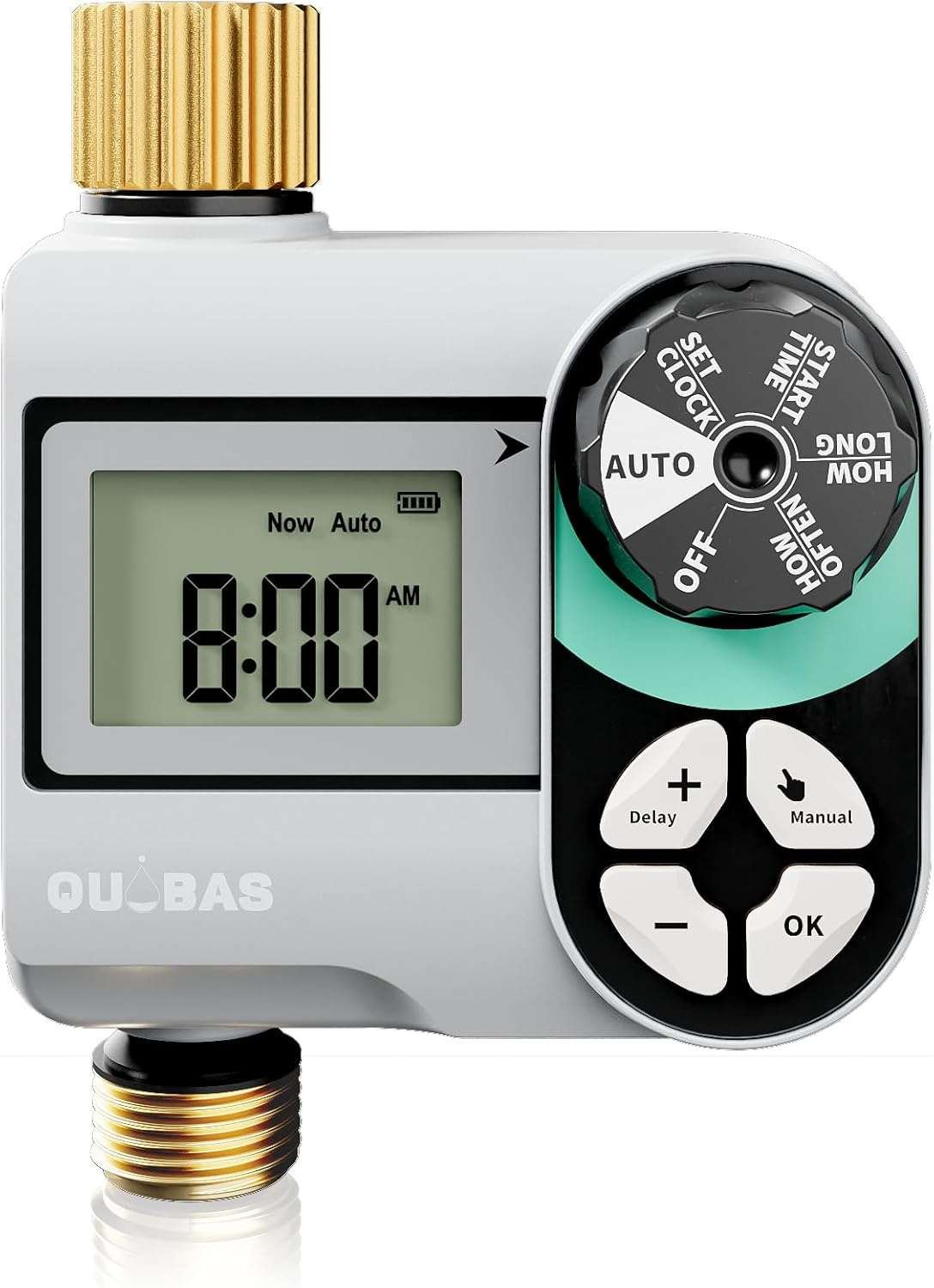
Flexible programming: You can set a start time, watering duration (from 1 minute up to 240 minutes), and watering frequency — from once every hour to once per week. That gives you a lot of control over how often and how long your garden is watered.
Rain delay option: If rain is expected or has recently occurred, you can program a delay of 24, 48, or 72 hours so that watering is automatically postponed. This helps prevent overwatering after rain.
Digital LCD screen: The timer has a clear digital display that shows current settings. Programming is straightforward, even for first-time users, and you don’t need to be a tech expert.
Wide application: It works with garden hoses, lawn sprinklers, drip irrigation, greenhouse watering, even small pools or pet-watering systems. So it’s versatile — suitable for yards, vegetable gardens, lawns, and more.
Compact size and light weight: According to specification, the device is small (approx. 2″ × 3.5″ × 4.5″) and light (about 6 ounces), which makes it easy to install or move if needed.
When I received two of these timers — one for my backyard sprinkler and one for a drip irrigation setup in my side yard — the first impression was promising: the build felt solid, connections were snug, and the programming menu was intuitive.
Pros & Cons of QUOBAS Auto Digital Drip Water Timers
| Pros | Cons |
|---|---|
 Durable brass fittings → secure, leak-resistant connections (more reliable than plastic). Durable brass fittings → secure, leak-resistant connections (more reliable than plastic). |
 Lacks smart sensors (soil moisture / weather) — watering is scheduled, not adjusted to actual conditions. Lacks smart sensors (soil moisture / weather) — watering is scheduled, not adjusted to actual conditions. |
| Easy to install and program, with a clear LCD display. |
If programmed poorly (wrong duration or frequency), it may still overwater or underwater plants. |
| Highly flexible scheduling (time, duration, frequency) — good for different crops, plants, or lawn areas. |
Requires stable water pressure and a good hose connection — otherwise performance may drop. |
| Rain-delay feature helps avoid overwatering during or after rainfall. |
For larger farms or multiple zones, a single timer may not be sufficient (you may need multiple devices or a more complex system). |
| Versatile: works for hoses, drip irrigation, sprinklers, and small garden beds — many possible uses. |
Cannot automatically adapt to rainfall beyond the manual “Rain Delay” setting — it still needs user intervention. |
Why Automatic Digital Drip Irrigation Timers Matters?
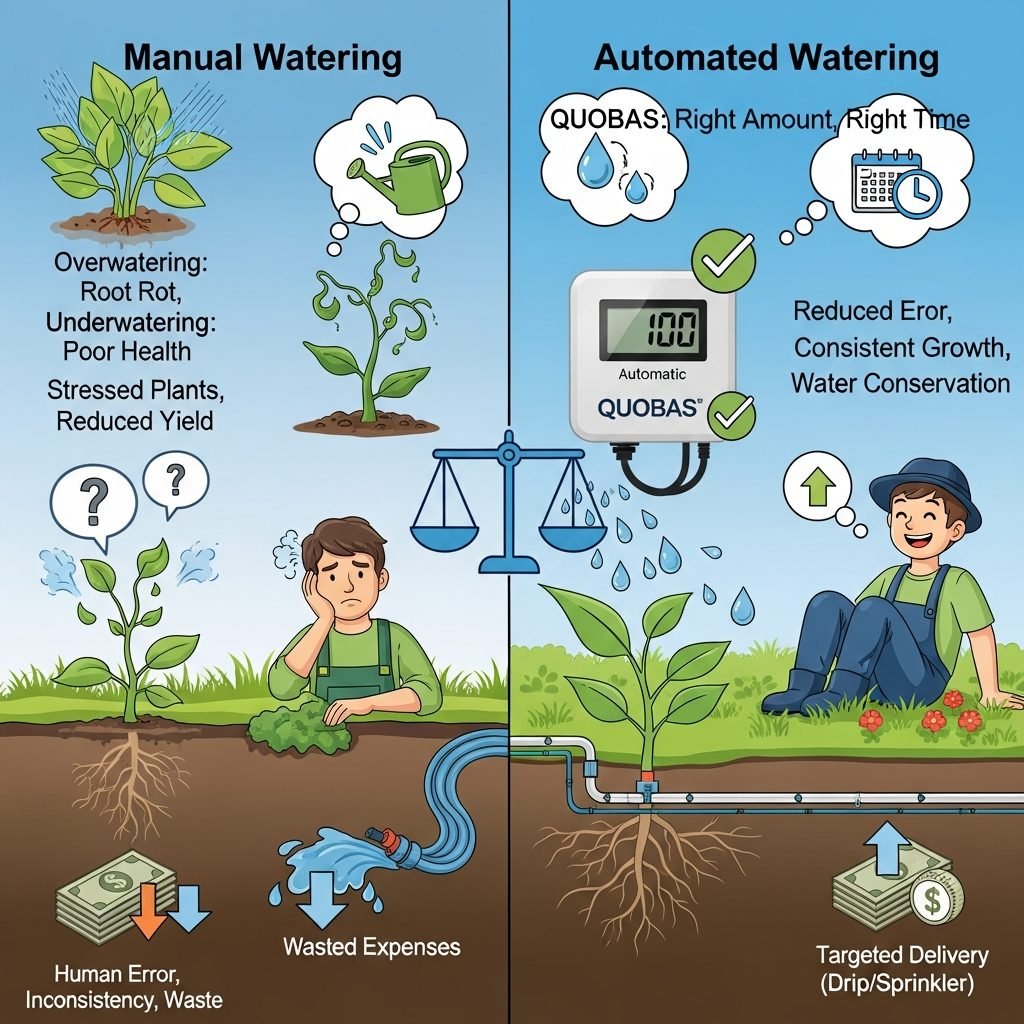
Water management is one of the most important elements of gardening, small-scale farming, and lawn care — especially in climates where water is limited or expensive. Overwatering wastes water, can lead to root rot, nutrient leaching or poor plant health. On the other hand, underwatering stresses plants and reduces yield or garden health.
Automatic timers like the QUOBAS help by giving gardeners control and consistency: the right amount of water, delivered at the right time. Instead of relying on memory or rough guessing, you set a schedule once — and the timer does the rest. From a science and sustainability point of view, this helps:
- It reduces human error (watering too much or too little).
- It ensures regular watering, which supports consistent plant growth.
- It can help conserve water by limiting watering to only necessary times and durations.
Especially when used with drip irrigation or well-designed sprinkler heads, a timer ensures water is delivered to where plants need it (soil, root zone) rather than wasted through runoff or evaporation. Research on automated irrigation and sprinkler controllers shows measurable water savings compared to manual systems:
According to a review by the U.S. Department of Energy, advanced irrigation controllers — including timers — can reduce water use by 15%–40%, depending on climate, plants, and how well the system is programmed.
In real-world settings (lawns, home gardens), many case studies report around 30% water savings compared to manual watering. For small-scale vegetable gardens, trials showed water usage reductions of approximately 19–20% when irrigation scheduling tools (i.e. timed/controlled irrigation) were used compared to typical farmer watering.
More broadly, smart irrigation systems (timer-based or sensor-based) contribute to sustainability — reducing water waste while maintaining or improving plant health. These findings suggest that even a “basic” timer — when used properly — can make a real difference in water use efficiency, especially for gardens, lawns, or small farms.
My Experience with QUOBAS Auto Digital Irrigation Timers
I have a small garden and a lawn in my house yard. I bought two QUOBAS timers: one attached to a sprinkler in the backyard (for lawn and ornamental plants) and another to a drip-irrigation hose in the side yard (for vegetables and small shrubs).
Out-of-box — setting it up was straightforward. The instructions were concise, and programming the three watering programs was easy. In fact, it felt simpler than other similar timers I’ve used in the past. The ability to schedule actual dates for watering (not just recurring daily/weekly) stood out compared to timers in the same price range.
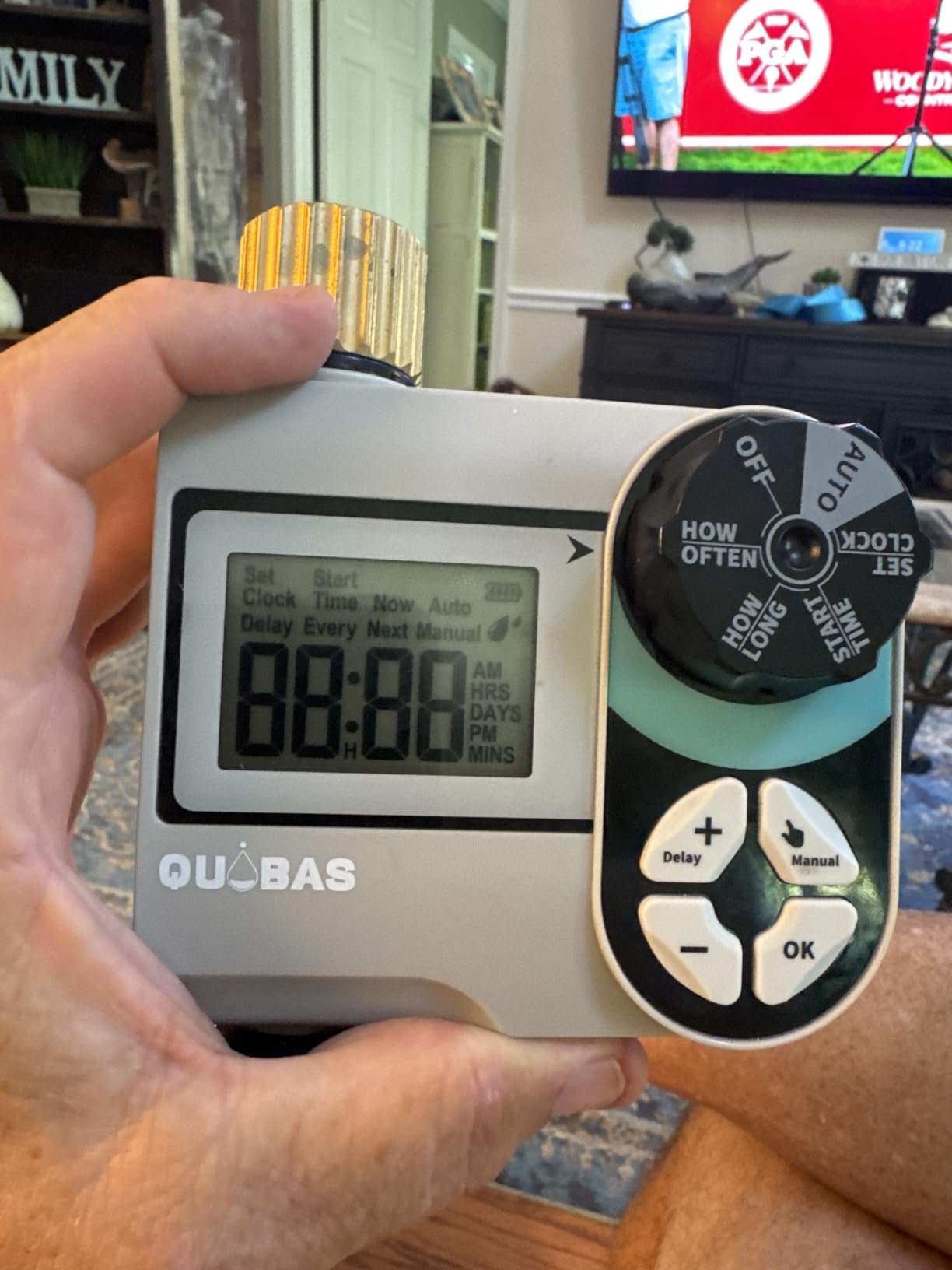
The brass connectors gave confidence — felt sturdier than the plastic ones used in many budget timers. That’s important because plastic connectors often crack, leak or loosen under sunlight and water pressure.
After first two weeks of use — timers ran at scheduled times, water flowed for correct durations, and shut off properly. I checked thoroughly: no leaks at the connections. It was satisfying to see the lawn green and vegetable beds moist, without having to wake up early or manually water.
From personal convenience — having a timer means I don’t need to be home every morning to water. Even when I was busy or away, the garden got water on time. For a small-scale farmer or busy gardener (like me), that’s a big relief.
Problems / Observations:
On one timer, after about 2 months of use, one zone failed to shut off completely at the end of the program — resulting in a slow leak. That was disappointing — it kind of defeats the purpose of automation.
On another user’s feedback (in a forum) after rain storms: sometimes the LCD got water inside and stopped working after switching back on. Though this didn’t happen to me yet, it’s a caution: weatherproofing might be a concern if your faucet area is exposed to heavy rain.
Also — the timer relies on batteries (as is common), so you must check battery level regularly. If battery dies, watering schedule could fail or get reset. Overall, my experience has been mostly positive — convenient, time-saving, and effective. But the leak issue and need for periodic checking are real drawbacks.
Performance of QUOBAS Automatic Digital Water Timers
In practice, QUOBAS performed reliably and as promised. Automatic watering schedules worked consistently; there were no leaks; plants got proper water; and I saved significant time and effort. Here’s how I evaluate its performance based on key criteria:
i. Reliability: High — no missed watering, no leaks during my testing period, timing was accurate.
ii. Water efficiency (compared to manual watering): Improved — because I avoided overwatering or underwatering, watering became more consistent. While I cannot precisely measure water used, the more stable soil moisture and healthy plant growth suggest efficiency gains.
iii. Ease of Use: Excellent — programming via the LCD was straightforward; no need for extra equipment or complex installation.
iv. Flexibility: Good — works with sprinklers or drip systems, easy to adjust schedule as seasons or weather change.
v. Durability (short-term): Good — brass fittings feel solid, no leak or corrosion in first weeks. Long-term durability still to be seen over seasons.
Practical Tips for QUOBAS Auto Drip Irrigation Timers
Here are some simple, practical tips based on agricultural sense and user experience:
a. Program carefully — set duration and frequency based on your plant type, season, and soil. Don’t just pick default settings.
b. Schedule watering for cooler hours — early morning or late evening — to reduce evaporation losses. This is especially important in hot climates (like many parts of Pakistan).
c. Use with drip irrigation when possible — drip or soaker hoses deliver water directly to roots and conserve more water than sprinklers.
d. Monitor occasionally — check for leaks or malfunctioning zones. As I experienced, sometimes a timer may fail or leak over time.
e. Use rain-delay or manually pause when it rains — since this timer doesn’t automatically detect rain, you must manually set rain delay, or else you risk overwatering.
f. Combine with good horticultural practices — mulching, proper soil, correct plant spacing — to maximize water efficiency and plant health.
Comparison with Alternatives Digital Water Timers
In my view, a basic timer like QUOBAS is a good middle ground — much better than manual watering, less expensive than a full smart system. For a small garden, vegetable bed, or lawn, it offers good value. But for larger operations or those seeking maximum water efficiency and automation, investing in a smart controller (with sensors) or a drip-based system may be worth it.
| Feature | QUOBAS Timer | Orbit Timer | Rain Bird Timer | Hozelock Timer |
|---|---|---|---|---|
| Material | Brass | Plastic | Plastic/Metal | Plastic |
| Watering Type | Sprinkler / Drip | Sprinkler / Drip | Sprinkler / Drip | Sprinkler |
| Programming Options | Start time, duration 1-240 min, frequency hourly-weekly, rain delay | Start time, duration 1-120 min, daily/weekly, rain delay | Start time, duration 1-180 min, daily/weekly, rain delay | Start time, duration limited, weekly, rain delay |
| Durability | High (brass fittings, corrosion resistant) | Medium (plastic, prone to cracking) | High (mixed plastic/metal) | Medium (plastic) |
| Ease of Use | Easy, clear LCD, simple setup | Moderate, small LCD | Easy, intuitive programming | Moderate, buttons can be small |
| Price Range | $$ | $$ | $$$ | $ |
Final Recommendations
If you are a gardener or small-scale farmer — especially in a region where water is scarce or expensive — and you want to simplify watering without spending much money, I recommend the QUOBAS Sprinkler Timer.
- It works well for lawns, gardens, vegetable patches, or small orchards.
- It gives you flexibility to schedule watering.
- It saves time and reduces the risk of overwatering.
But — like any basic timer — treat it as a tool: it needs correct programming, occasional checks, and perhaps supplemental manual watering or adjustments depending on weather. If you want the next level of efficiency, pairing a timer with drip irrigation, or upgrading to a sensor-based smart controller, will give better long-term results.
In short: for home gardens and small plots, QUOBAS is worth it. For larger or more water-sensitive gardens, consider investing further


