
For many gardeners — whether you tend houseplants, container gardens, or outdoor plots — one of the hardest questions is: when exactly does my plant need water? Water too much, and roots may rot; water too little, and plants wither. That’s why tools that help us understand what’s really going on beneath the surface are invaluable.
The XLUX Soil Moisture Meter promises to take the guesswork out of watering by giving you an immediate read on the moisture level deep in the soil. In this review I’ll walk you through what it is, how it works, how it performed in my own gardening setup, and whether I recommend it for fellow plant lovers — especially those who want to avoid under- or over-watering.
What is XLUX Soil Moisture Meter for Water Monitor?
The XLUX Soil Moisture Meter is a simple analog soil moisture sensor designed for use with indoor plants, potted plants, container gardens, or small outdoor gardens. It uses a metal probe that you insert into the soil (to a certain depth), and a large dial on the device instantly shows whether the soil is “dry,” “moist,” or “wet.”
According to the manufacturer, it doesn’t need batteries — the reading is mechanical — and it’s intended as a low-cost, easy-to-use way to determine when watering is actually needed beneath the surface, rather than judging moisture by feel or appearance of the topsoil. Here are the basic specs and features of the XLUX Soil Moisture Meter you provided:
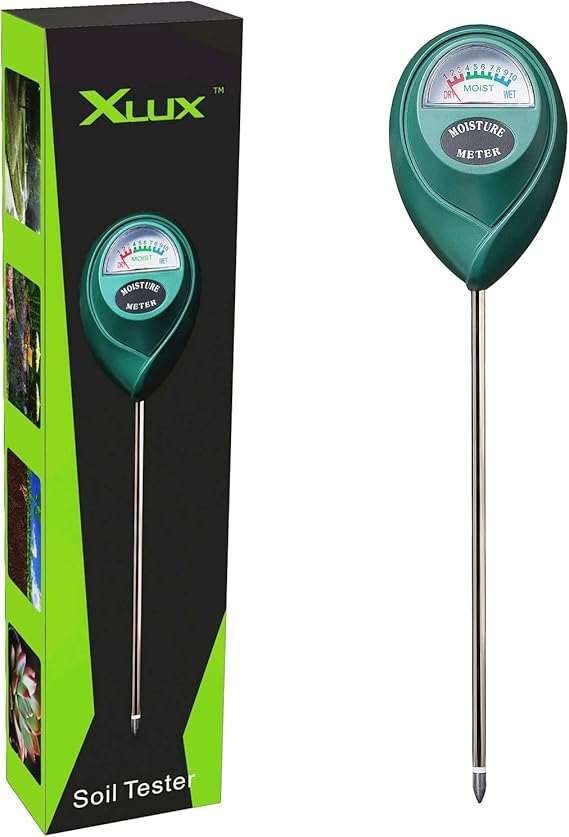
- Brand: XLUX
- Color: Green
- Dimensions: 2.36″ W × 10.24″ H — compact enough for pots and small containers
- Battery: No batteries required — purely mechanical analog device
- Mounting / Use Type: Tabletop / handheld — you just insert into soil when testing
- Measurement Method: Single metal probe; dial with three zones (dry, moist, wet) and ten scales for granularity
Ease of Use: Very simple — insert the probe, read the dial immediately, then remove (manufacturer advises not to leave it in soil more than 5 minutes to avoid corrosion)
Damage / Root Disturbance: Minimal — single probe causes much less disturbance than multi-probe or bulky sensors; removing the probe brings out little soil so roots remain largely undisturbed.
In short: XLUX offers a basic, no-frills, easy, and low-cost way to check soil moisture, suitable for everyday gardeners, indoor plant keepers, or small garden enthusiasts.
Pros & Cons of XLUX Soil Moisture Meter
| Pros | Cons |
|---|---|
 Very easy to use — just insert and read Very easy to use — just insert and read |
 Probe must be removed in 5 min to avoid corrosion Probe must be removed in 5 min to avoid corrosion |
| No batteries or power required |
Not suitable for very hard or rocky soil |
| Gives moisture reading from deeper soil, not just surface |
Single probe may not represent moisture evenly in large containers |
| Affordable and accessible for home gardeners |
Readings can be influenced by soil type or salinity |
| Helps avoid overwatering or underwatering |
Not foolproof — improper use or soil mix can cause misleading readings |
Why Soil Moisture Meter Matters?
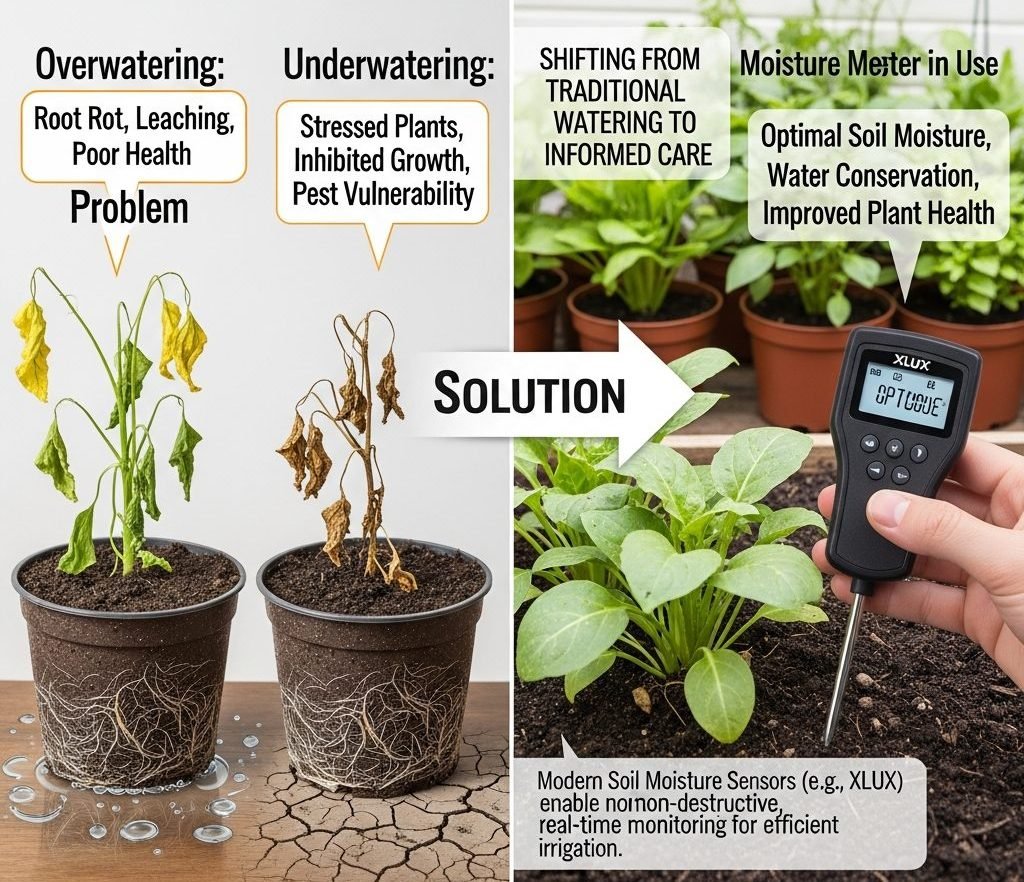
Water is the lifeblood of plants, but not all water use is equal. Overwatering — keeping soil too wet for too long — can lead to oxygen deprivation in the root zone, root rot, nutrient leaching, and poor plant health. On the other hand, underwatering stresses plants, inhibiting growth and making them vulnerable to pests and drought.
As gardens — indoor or outdoor — shift from traditional watering routines to more precise, informed care, tools like moisture meters become critical to maintain optimal soil moisture and avoid the guesswork. Also, with increasing awareness of water conservation, especially in regions where water is scarce or expensive, proper irrigation management becomes both an ecological and economic concern.
Modern soil moisture sensors (even simple ones like the XLUX meter) are part of a broad set of technologies developed for precision agriculture and gardening. A recent 2025 review highlights how soil moisture sensing — whether invasive (probes) or non-invasive techniques — plays a key role in optimizing irrigation strategy, improving crop productivity, and conserving water.
Traditional “destructive” methods (like drying soil in a lab oven) give accurate moisture content but obviously are impractical for regular use. By contrast, probe-based sensors — like XLUX — offer non-destructive, in situ, real-time moisture monitoring, making them useful for containers, pots, and small-scale gardening.
That said — according to the research — probe-based sensors are more suitable for small-scale or container plants, home gardens, greenhouses, or resource-limited farms because they are inexpensive, easy to use, and require little maintenance.
However, their readings can vary depending on soil type, salinity, organic matter, compaction, and drainage — factors gardeners must keep in mind. To understand why soil moisture sensors (or simple moisture meters) are increasingly recommended — even for home gardens — consider these data and research findings:
A recent 2025 review on soil moisture sensing technologies underlines the importance of precise soil moisture monitoring for enhanced crop productivity, sustainable water use, and efficient irrigation.
i. Sensor-based watering systems have shown that real-time soil moisture measurements can help maintain soil moisture in ideal ranges (e.g., 40–60%) — avoiding over- or under-watering — and significantly reduce water waste by up to 20–30% compared to fixed-schedule watering.
ii. Overwatering can lead to root oxygen deprivation, waterlogging, reduced nutrient absorption, and root diseases — all of which hamper plant health and yield.
iii. On the flip side, underwatering (or inconsistent watering) can cause stress in vegetative growth, reduce yield and quality, and make plants more susceptible to drought and pests.
In practical terms, using soil moisture sensors has become part of “precision gardening / precision agriculture” movement — helping gardeners and farmers use water and nutrients efficiently, avoid plant stress, and support sustainable environmental practices.
Given increasing climate variability, water scarcity, and rising interest in home gardening (especially in urban or peri-urban areas), tools like this meter serve not just convenience — but environmental responsibility.
My Experience with XLUX Soil Moisture Sensor
Over the years, I’ve used different tools and products, but as I started growing more potted plants, indoor plants, and container gardens — sometimes even in small urban conditions — I realized how tricky watering could be. Soil that looks dry on top might still be wet deep down; pots of different sizes and soil mixtures behave differently.
Guesswork often led to inconsistent results. So when I got the XLUX Soil Moisture Meter (the shorter probe version), I was hopeful. Here is how I used it:
I tried it first on plants I had just watered, others I knew needed water, and some I was unsure about. In every case, the readings matched what I expected — “wet” for recently watered, “dry” for thirsty soil, and “moist” for those in between. Based on the reading, I only watered when needed.
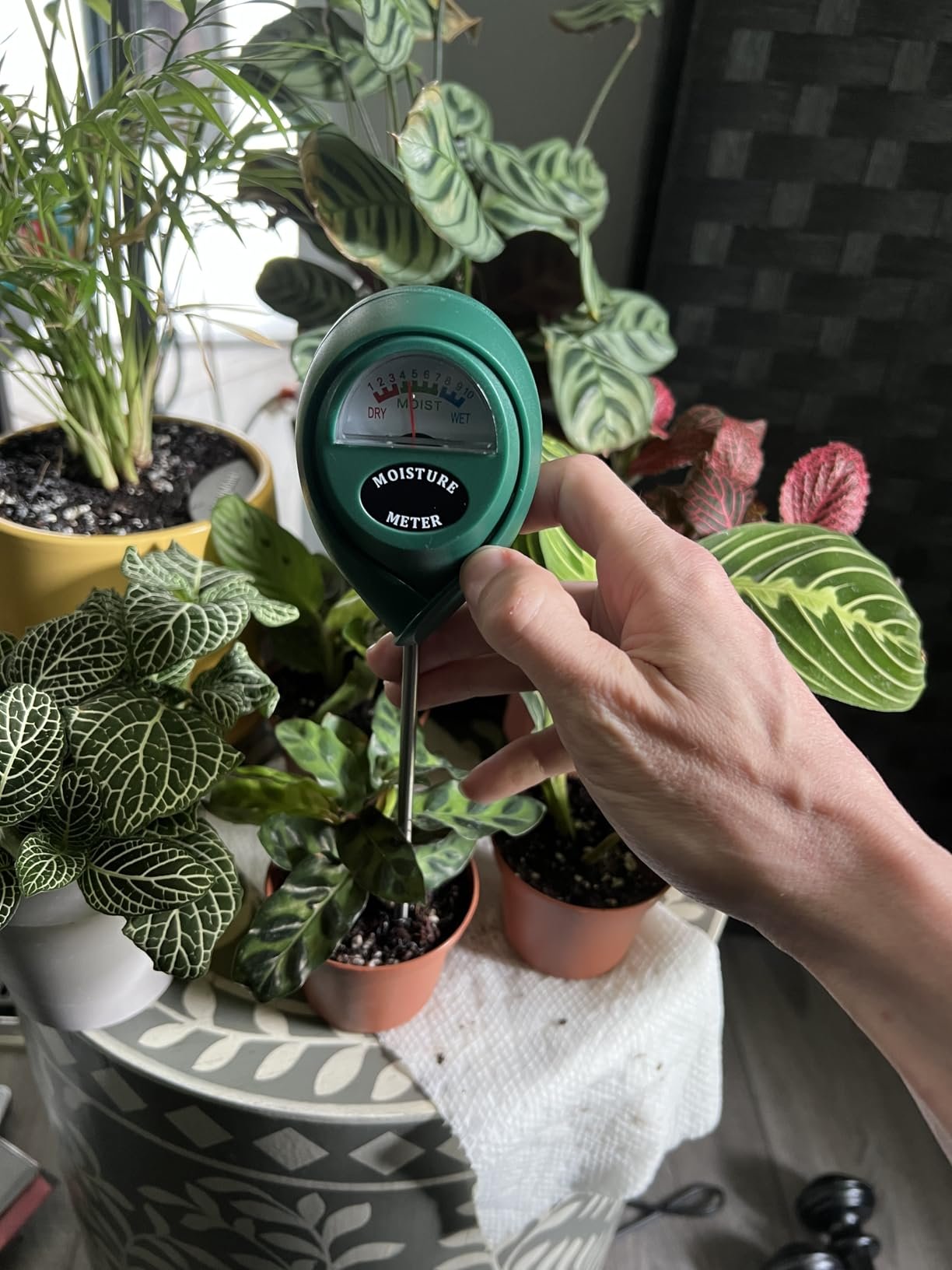
Over a few weeks, I noticed less wilting, fewer yellow leaves, and more stable growth (especially in houseplants brought indoors during hot days). The meter effectively prevented overwatering — a common issue when plants are grown in pots or containers.
For small to medium pots (up to ~14-inch diameter), the meter was very practical. Because the probe was compact, it reached the soil depth of the pot well enough. I also appreciated the convenience: no batteries, instant reading, easy to read dial, and minimal disturbance when testing.
However — I did follow the instruction: I did not leave the probe inserted for more than a few minutes; after testing, I wiped the metal tip clean (to prevent corrosion). I also avoided very dense, hard-packed soil, where the probe struggled to penetrate.
Overall: for my uses — balcony gardening, potted plants, indoor plants during winter — the meter was a simple but very effective addition to my plant-care toolkit.
Performance of XLUX Soil Moisture Water Monitor
For typical potting soils — medium grain, not overly coarse — the meter is a usefufl guide. For very free-draining or chunky soils, I use it with caution and cross-check with the “feel/weight” or “visual signs” methods.
a. Accuracy: Generally good for standard potting soil or garden soil. It detected moisture differences between dry, moderately moist, and wet soil quite well.
b. Speed: Instant reading — as soon as I inserted the probe. No waiting, no calibration, no batteries.
c. Ease of use: Very straightforward — even a beginner gardener can use it without prior sensor knowledge.
d. Limitations: A few — in well-draining or very loose soil mixes (e.g. sandy mixtures, soil with a lot of perlite or bark), the meter sometimes continued to read “Dry,” even right after watering; possibly because electrical conductivity is low and the metal probe can’t sense moisture properly in such loose, fast-draining mixes.
This matches what other users online mention: in light soils, moisture meters that rely on conductivity might under-read.
e. Durability/Long-term Use: As per manufacturer instructions, I avoid leaving the probe in soil for more than a few minutes. With this practice, over several months (about 6 months now), the meter has been reliable. But I remain cautious — probes may corrode over very long use, especially in moist soil; thus regular cleaning after each use seems wise.
Practical Tips for XLUX Soil Moisture Meter
Based on experience + literature, here are some practical recommendations:
i. Use only when needed — don’t leave the probe in soil for hours or permanently; the manufacturer warns against that due to possible corrosion.
ii. Clean the probe after each use — wiping off soil (especially wet soil) helps prevent rust or conductivity issues.
iii. Test at root-level depth — for potted plants, insert probe to a depth comparable to the main root zone (not just surface) to get a useful reading.
iv. Be cautious with loose or well-draining soil mixes — in sandy or perlite-rich soils, conductivity-based meters may under-report moisture; in such cases, use additional cues (weight of pot, soil texture, leaf turgor) or more advanced sensors.
v. Use the meter as a guide, not the sole authority — different plants have different moisture preferences. Combine meter readings with plant-specific knowledge (type of plant, pot size, drainage, climate).
vi. For large pots / deep-rooted plants — one reading might not cover the whole root zone. Consider multiple readings at different spots or depths, or monitor soil over time rather than once.
Comparison with Alternatives Soil Moisture Sensor
| Method / Tool | How It Works | Best For / When to Use |
|---|---|---|
| XLUX Soil Moisture Meter | Insert the metal probe into soil; dial shows Dry / Moist / Wet instantly. | Potted plants, indoor plants, container gardening, small to medium planters. |
| Finger Test / Pot Hefting | Check moisture by inserting finger 1–2 inches or lifting pot to feel weight. | Quick checks for small pots, simple home gardening, shallow soil. |
| Wooden Stick / Skewer Method | Insert wooden stick into soil; check if soil sticks or feels damp. | Coarse soil, sandy mixes, or soils where metal probes don’t work well. |
| Digital / Smart Moisture Sensors | Electronic sensors measure soil moisture or VWC, often show digital numbers. | Outdoor gardens, large beds, gardeners needing more accuracy or automation. |
| Soil Moisture + Environmental Sensor Systems | Advanced sensors measure moisture, temperature, humidity, and sometimes nutrients. | Greenhouses, farming, precision irrigation, large-scale cultivation. |
Final Recommendations
If you’re a gardener, plant lover, or farmer working with potted plants, indoor gardening, container plants, balcony gardens, or small households — I recommend the XLUX Soil Moisture Meter. It is:
- Simple and easy to use — ideal for beginners or busy people who want a quick check before watering.
- Battery-free and low maintenance — no need to charge or calibrate.
- Valuable as a moisture guide — helps avoid overwatering or underwatering, thus supporting root health and plant vitality.
That said: treat it as a tool, not a guarantee. Use it alongside good soil, proper drainage, plant knowledge, and observation. If your soil is very coarse or free-draining, consider combining meter use with other methods (finger test, pot weight, visual plant cues), or use a more advanced sensor for precise moisture content.
For larger gardens, agricultural plots, or highly automated irrigation, you might consider more advanced soil moisture sensors or automated systems — but for everyday gardening or growing potted plants, XLUX strikes a good balance of simplicity, affordability, and effectiveness.
In summary: yes — I recommend the XLUX Soil Moisture Meter, especially for gardeners like you and me who want an easy, immediate, and affordable way to know exactly when to water. It’s not perfect — no moisture meter is — but as part of an informed watering routine, it can significantly improve plant health, reduce water waste, and save you time and worry.


