
Gardening and farming are more than just hobbies for me — they are passions. As someone who studies agriculture and spends a lot of time caring for plants, I know how important it is to understand the soil and growing conditions. Overwatering, poor soil pH or insufficient sunlight can easily hamper plant growth.
That is why I’m always on the lookout for simple but effective tools to help monitor soil and plant conditions. Recently I tried the YAMRON 4-in-1 Soil Moisture Meter — a device that promises to measure soil moisture, pH, temperature, and even sunlight intensity. In this review I will share my honest experience, backed with facts and tips.
What Is YAMRON 4 in 1 Digital Soil Moisture Meter?
The YAMRON 4-in-1 Soil Moisture Meter is a handheld digital tool designed for gardeners, farmers, and plant lovers. It is meant to give quick readings of key soil and environmental parameters: how wet the soil is (moisture), how acidic or alkaline the soil is (pH), what the soil or ambient temperature is, and how much light the plants receive.
All of these factors — water, soil chemistry, temperature, and light — are critical to plant health. This instrument aims to give you a scientific-like snapshot of soil/plant conditions so you can make informed decisions rather than relying solely on guesswork.
- Soil moisture — how much water the soil holds
- Soil pH — the acidity or alkalinity of the soil
- Soil (or ambient) temperature — to help gauge root-zone or pot conditions
- Sunlight intensity — to estimate how much light the plant is receiving
It shows all results on a backlit LCD screen, enabling reading even in low light. The manufacturer claims it provides quick, accurate data within seconds, helping gardeners decide when to water, when to adjust pH, or whether plants are getting enough light.
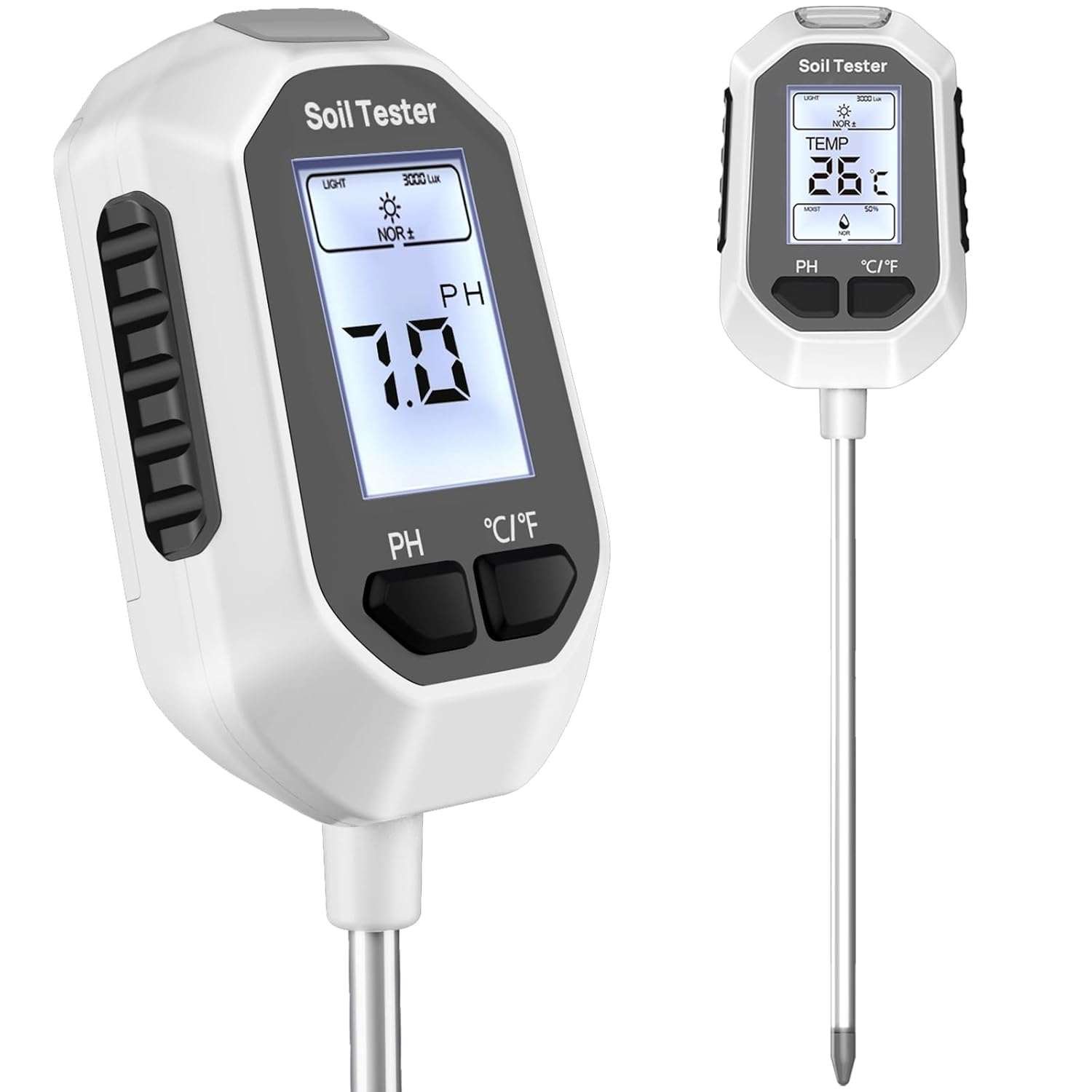
In simple terms: it’s a multi-purpose soil and plant environment tester — combining four useful measurements in one small gadget. Here’s a quick overview of the main features and specifications of this meter:
- Brand: YAMRON
- Functions: Moisture, pH, Temperature, Sunlight intensity (4-in-1)
- Display: Large LCD screen with backlight — readable in dark or dim conditions
- Operation: Powered by 4 × AAA 1.5 V batteries (not included) with low-battery alert
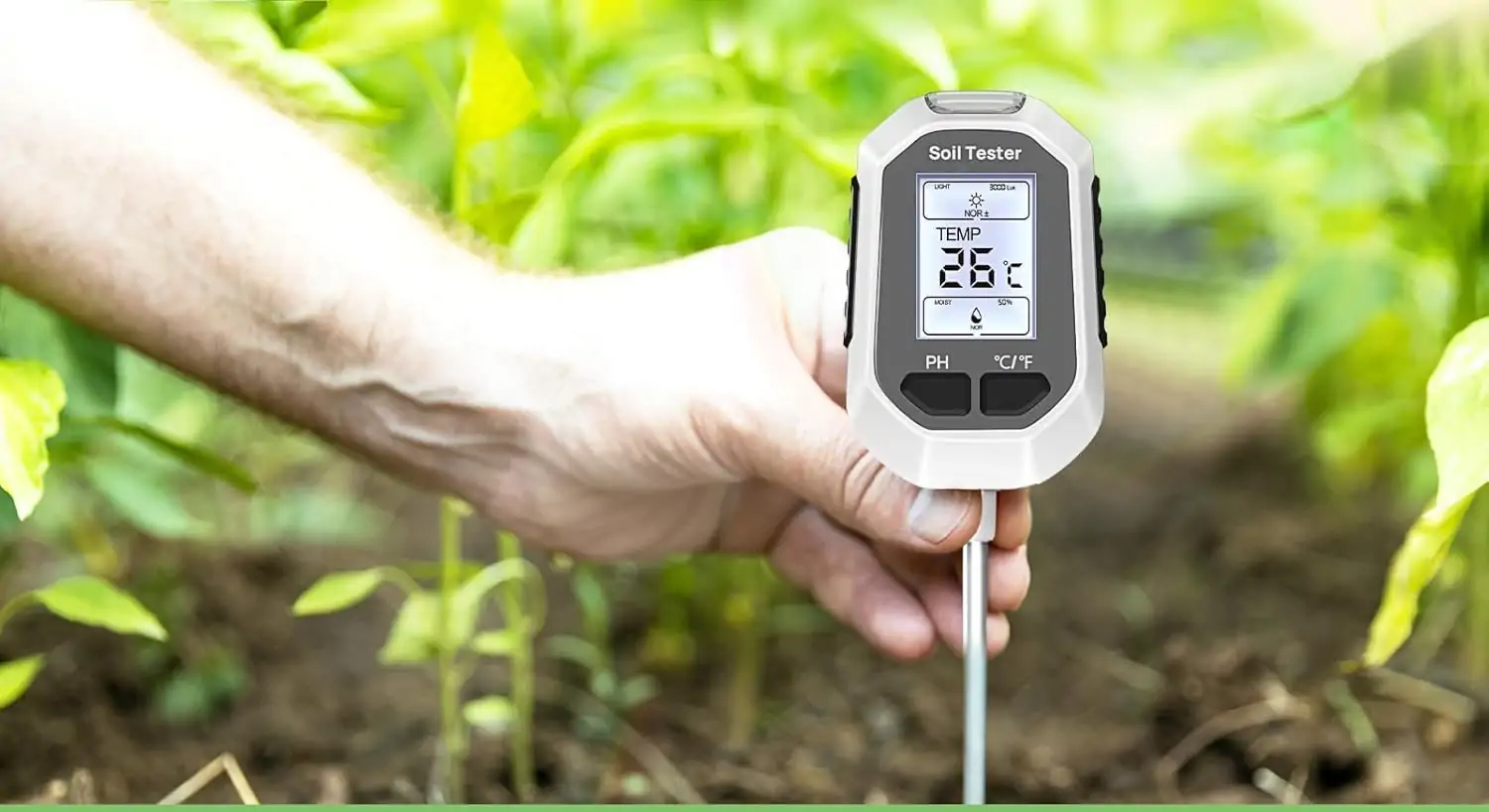
- Probe usage: The probe must be inserted ~10 cm (~4 inches) into soil; wait about 10 seconds for reading
- Ease of use: Designed to be intuitive — even for beginners. Ideal for gardens, pots, farms, indoor plants, succulents, and more.
- Versatility: Can be used indoors or outdoors; potted plants or soil beds
Because it gives numerical readings (rather than vague “wet/medium/dry” bars), the idea is that gardeners and growers can make informed, science-driven decisions — not guesses.
Pros & Cons of YAMRON 4 in 1 Digital Soil Moisture Sensor
| Pros | Cons |
|---|---|
 Multi-functional: moisture, pH, temperature, sunlight — all in one tool. Multi-functional: moisture, pH, temperature, sunlight — all in one tool. |
 pH readings may not always be highly precise (e.g., slight deviations). pH readings may not always be highly precise (e.g., slight deviations). |
| Digital, backlit display — easy to read in low light or at night. |
Must not be used in dry, hard soil — needs soil moistened beforehand. |
| Quick and simple to use — just insert probe, wait ~10 seconds. |
For best results, you need to take multiple readings (at least 5 spots) and average them — extra work. |
| Helps make objective watering and soil-management decisions (less guesswork). |
Doesn’t measure soil fertility (nutrient levels like NPK), only pH, moisture, temp, light. |
| Lightweight and portable — easy to move between pots, garden beds, etc. |
Soil meter durability may decline over time; digital meters can malfunction if misused. |
Why Digital Soil Moisture Meter Matters?
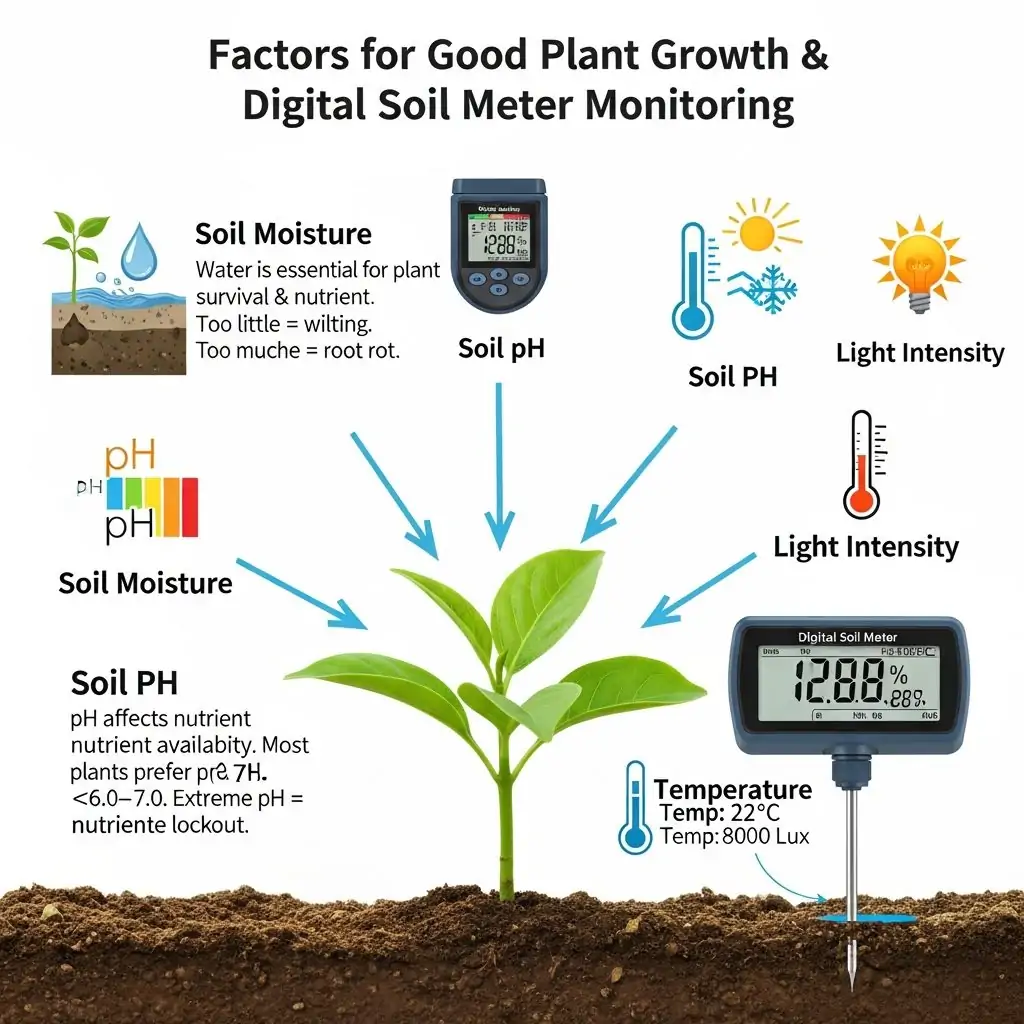
Good plant growth depends on a balance of several soil and environmental factors. Here’s why each measurement matters:
i. Soil moisture: Water is essential for plant survival and nutrient uptake. Too little — plant wilts, roots dry out. Too much — roots rot, fungal issues.
ii. Soil pH: pH affects nutrient availability. Many plants prefer soil in a neutral to slightly acidic range (e.g., pH ~6.0–7.0). If pH is too acidic or too alkaline, certain nutrients become unavailable or toxic.
iii. Temperature: Soil (or ambient) temperature influences root activity, microbial life in soil, nutrient uptake, germination, and more. Extreme temperatures can stress plants.
iv. Light intensity: Plants need sufficient light for photosynthesis. Insufficient light slows growth; too much (for shade-loving plants) may cause leaf burn or stress.
Having a tool that helps monitor all these at once means you have a better “snapshot” of your plant’s environment — you can water, fertilize, adjust light or temperature in a rational way rather than by guesswork.
Digital soil meters like this one generally work based on electrical conductivity and sensors: the metal probe sends a small electrical signal into the soil; the meter measures how easily electricity passes between probe electrodes. Since water conducts electricity but dry soil doesn’t, wetter soil gives higher conductivity (moisture reading).
For pH, some meters use a crude sensor whose reading can be influenced by soil moisture and consistency — making accuracy more variable. Temperature is measured by a built-in thermometer sensor. Light intensity is measured via a light sensor (lux meter inside) that reads ambient light where the meter sits.
Such devices are not laboratory-grade instruments — but they offer a useful approximation of conditions, especially for home gardeners and small farms.
A recent study on soil-monitoring sensors concluded that portable soil meters (measuring pH, moisture, temperature) are becoming widely used in agriculture and horticulture as cost-effective alternatives to traditional laboratory soil tests.
The same research found that such sensors support precision watering and soil management, enabling better yield with lower water and fertilizer use — especially important in water-scarce regions.
Regarding ideal soil pH, multiple horticulture guides recommend a slightly acidic to neutral range (pH ~6.0–7.0) for most vegetables, houseplants, and garden plants.
Soil moisture sensors have been shown to help conserve water: one application using sensors-driven irrigation reduced water usage while maintaining or increasing crop yield.
On soil temperature and pH — a 2025 study highlighted that soil temperature variation strongly affects nutrient uptake and microbial activity, hence plant health; real-time monitoring helps in adapting fertilization and irrigation practices accordingly.
My Experience with YAMRON Soil Moisture Meter
I used the YAMRON meter in a mixture of potted plants and garden beds. Most of my containers are for vegetables and herbs (tomatoes, chilies, spinach, mint), while the garden beds contain shrubs and seasonal flowers. The soil is mostly loamy, mixed with compost and organic matter.
For pots, I use standard potting mix with some compost added. We have a semi-subtropical climate — hot summers, cool winters — so monitoring moisture, temperature, and pH is particularly helpful around planting, watering, and fertilization times.
a. Moisture measurements: After watering, I inserted the probe at about 10 cm depth. The meter displayed a moisture reading around 40–55 % for recently watered soil, and 15–25 % when soil was relatively dry. This matched fairly well with how soil felt by hand and by lifting the pot (heavier when wet, lighter when dry). Because of this, I could avoid over-watering or under-watering, especially during hot spells.
b. pH readings: In my garden beds and pots (which had compost-amended soil), readings were mostly around 6.5–7.2 — ideal for most of the plants I grow. That helped me decide that I didn’t need to add lime or sulfur. On a few older beds (untested for years), I got pH around 5.8 (slightly acidic), so I added some lime — and saw better plant growth over the next weeks.
c. Temperature readings: The meter reported soil temperatures of ~22°C in winter mornings and ~32–35°C in summer afternoons (in shallow pots). This helped me plan watering times: I watered early morning or late evening when soil temperature was lower, to avoid heat stress.
d. Sunlight readings: For my container herbs on a balcony, the meter’s sunlight intensity reading helped me find better spots. Under some overhangs, light was too low — the meter confirmed that. After moving pots to a sunnier edge, readings went up, and the herbs grew more vigorously.
Overall, I found the meter particularly useful for container gardening and small garden beds — where soil conditions can vary widely and manual guessing often leads to over- or under-watering.
What Didn’t Work / Issues
The pH readings were sometimes a bit “off.” On one occasion, after heavy watering, the meter showed pH ~7.5 (slightly alkaline), but when I tested soil again after a day, it dropped to ~6.8. So pH readings seemed to fluctuate based on soil moisture and probably uneven soil mixing.
The meter cannot measure nutrient levels (NPK) — so while pH and moisture are useful, I still need to rely on composting and fertilization practices without knowing exact nutrient content.
When soil was very dry, the probe was hard to insert; instructions say you should wet the soil 10 minutes before measurement. That is fine — but it means extra work and sometimes less spontaneous measurements.
For larger garden beds (very deep root systems), the 10 cm probe may not represent moisture or pH at root depth — meaning the reading may mislead if roots go deeper.
Performance of YAMRON Moisture Sensor
After several weeks (about 2 months) of regular use, I can summarize performance as follows:
a. Consistency: Moisture and light measurements were fairly consistent across repeated tests, especially when soil moisture was moderately stable (not too dry or saturated).
b. Usefulness: The meter influenced my watering and pot placement decisions significantly — plants appeared healthier, with fewer signs of over-watering (yellowing leaves, root rot) or under-watering (wilting, stunted growth).
c. Precision: For moisture and light — good enough for practical gardening. For pH — acceptable for a general idea, but I would still trust a lab soil test if I needed high precision (e.g. for sensitive crops or soil amendment planning).
d. Durability & Convenience: The meter is lightweight and easy to carry. The backlit display is helpful. Battery life is acceptable. But the requirement to pre-moisten soil and take multiple readings is a minor inconvenience, especially if you manage many beds or pots.
In short: for home gardens, container gardening, small farms or hobby farms — the meter performs well and adds real value. For large-scale agriculture or professional soil management (fertility analysis, deep-rooted crops), it’s a helpful tool but not a complete solution.
Practical Tips for YAMRON Soil Moisture Meter
Based on my experience (and research), here are some practical tips for using this kind of 4-in-1 soil meter effectively:
i. Moisten soil before testing — Especially if soil is dry and hard. Wait 10 minutes after watering before inserting the probe, to avoid damaging the meter and get accurate readings.
ii. Take multiple readings — Insert the probe in 4–6 different spots (especially in garden beds or large pots) and average the results for moisture and pH, to reduce variability.
iii. Measure at root depth — Try to insert the probe at roughly the depth where most roots are (not only surface soil), to get meaningful data.
iv. Use consistent timing — For soil temperature and moisture — measure at similar times of day (e.g., morning) for better comparisons.
v. Clean probe after use — Especially after testing clay soils or fertilized soil. This helps maintain accuracy and prolong meter life.
vi. Use pH reading as a guide, not gospel — If you need precise pH (e.g. for soil amendment or sensitive crops), consider confirming with a lab test. The meter is excellent for routine checks.
vii. Combine with visual checks — Don’t rely only on meter — also watch your plants. Soil meters complement, not replace, traditional care (sunlight, pot weight, leaf health, watering patterns).
viii. Record data over time — Keep a log of moisture, pH, temperature, and light readings. Over weeks or months, you’ll see patterns and be able to adjust care accordingly (watering schedule, fertilization, pot relocation, etc.).
Comparison With Alternative Soil Testing Sensors
| Method / Tool | Key Features | Cost / Ease | Best Use |
|---|---|---|---|
| Analog Moisture Meter | Measures only soil moisture | Low cost, very easy to use | Beginners, potted plants, simple watering decisions |
| YAMRON 4‑in‑1 Digital Meter | Measures moisture, pH, temperature, light | Mid-range, easy digital readings | Home gardens, small farms, potted plants |
| Dedicated Digital pH Meter | Measures soil pH (sometimes temp) | Mid-range, requires calibration | Soil acidity management, sensitive plants |
| Smart / IoT Soil Sensors | Continuous monitoring, app support | High cost, setup needed | Large gardens, greenhouses, data-driven irrigation |
| Laboratory Soil Test | Full soil analysis: pH, nutrients, organic matter | High cost, slow, requires lab | Crop planning, nutrient management, detailed soil health |
Final Recommendations
If you are a gardener, small-scale farmer, or plant lover — especially if you grow container plants, vegetables in pots, herbs, or maintain small garden beds — I strongly recommend the YAMRON 4-in-1 Soil Moisture Meter. It’s lightweight, easy-to-use, gives useful data, and helps you make informed watering and soil-management decisions.
However, treat its data as guidance: always combine meter readings with visual inspection, common sense, and — when needed — lab soil tests, especially for soil fertility or detailed nutrient management. If I were you: I would buy one, use it regularly for watering and pH checks, and also do a lab soil test once or twice a year for a full picture of soil health.


