
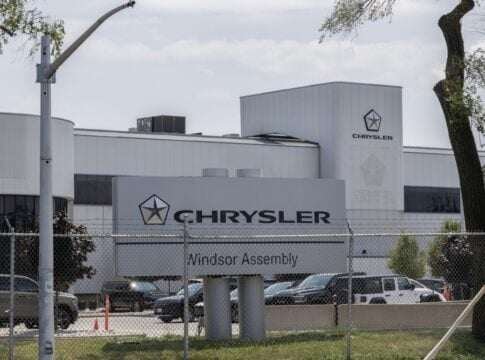
Canada’s decision to issue a default notice to Stellantis in late 2025 has become one of the year’s major industry stories. The move followed Stellantis’s decision to shift production of the Jeep Compass from its Brampton, Ontario, plant to Illinois in the United States.
The Canadian government claims this breaks earlier funding deals linked to jobs, manufacturing, and future electric vehicle (EV) plans. Stellantis argues that the change is temporary and linked to wider production adjustments in North America.
Beyond the contract disagreement, the situation raises bigger questions. It impacts the company’s EV rollout, its public image on ESG issues, and its long-term net-zero plan. It also tests how governments handle public incentives for the clean energy transition.
How the Conflict Started
The dispute began when Stellantis paused work at the Brampton plant earlier in 2025. The company said market conditions were shifting and that it needed time to reassess future models. The plant was getting ready for new Compass production. It expects stronger hybrid and electric models in the coming years. The pause led to layoffs for around 3,000 workers.
Months later, Stellantis moved production to Illinois. For Canada, this was a major concern. The federal government gave significant financial support, $222 million, to help the company keep operating in Brampton and Windsor. This included investments related to EVs.
The government of Canada and Ontario had pledged “roughly C$500 million” in public support for capital spending at the said Canadian assembly plants.
Officials said the shift broke the terms of the deal, so they issued a default notice and started a 30-day dispute resolution process.
Stellantis responded by saying it remains committed to Canada. It pointed to ongoing activity at the Windsor battery plant and other projects. The company said the Brampton change is an “operational pause,” not a permanent withdrawal.
Stellantis’s spokesperson, Lou Ann Gosselin, stated that:
“Stellantis continues to engage with the government in the dispute resolution process under the agreement. We are working towards our shared objective of securing a long-term, sustainable future for automotive manufacturing in Canada, including in Brampton.”
The outcome now depends on ongoing talks between Stellantis and the government.
Impact on EV Plans in Canada and North America
Stellantis has set major goals for expanding EV and hybrid production across the world. The company needs new factories, battery plants, and supply chain networks to reach these targets. Because of this, the Brampton decision creates uncertainty for Canada’s place in that strategy.

The Compass was expected to become one of the company’s next electrified models produced in Canada. Moving production may slow down that plan. It also impacts the country’s aim to create a solid EV manufacturing base. This includes battery cell production, mineral processing, and final assembly.
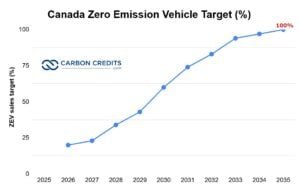
Canada targets 100% zero-emission vehicle sales by 2035. It has interim goals of 20% by 2026 and 60% by 2030. This plan supports battery production, expected to reach a market size of US$57.50 million by 2025, with a 22% annual growth rate.
Stellantis’ Windsor battery plant, in partnership with LG Energy Solution, focuses on lithium-ion cells for North America. Government support links it to Brampton operations.
Notably, Budget 2025 includes a new $50 million Critical Minerals Fund starting in 2026. It also features Accelerated Investment Incentives for EV-related assets, such as zero-emission vehicles and clean equipment.
The dispute reflects broader pressures from U.S. trade policy, including tariffs on imported vehicles. Stellantis shifted production to avoid higher costs under these tariffs. While the move triggered Canada’s default notice, it highlights how trade measures can influence automakers’ production decisions.
Tariffs raise the costs of cross-border manufacturing. This can push companies to focus on saving money instead of keeping local commitments. This happens even when public funding and EV projects are involved.
This case shows how EV strategies depend on long-term commitment. Moving a model meant to aid future electrification brings up concerns about execution and timing. It also highlights how cross-border rules, tariffs, and manufacturing incentives can shape decisions, even when they clash with broader sustainability goals.
Why Production Moves Matter for Net-Zero Pathways
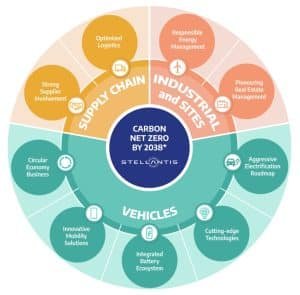
Stellantis aims to reach carbon net zero by 2038. This includes emissions from its factories, supply chain, and the use of its vehicles. Reaching that target requires steady progress in electric vehicle adoption, cleaner production, and more renewable energy.
The dispute with Canada may not change the company’s long-term goals, but it affects the pathway toward them. When EV projects slow down, carbon reductions slow as well. This is especially true in North America, where passenger vehicle emissions are a big part of climate plans.
Several risks emerge:
- Delays in EV launches reduce the pace of emissions cuts from new vehicles.
- Interrupted supply chains increase emissions when materials travel longer distances.
- Delays in battery plant ramp-up limit production of low-carbon models.
- Short-term reliance on combustion models keeps fleet emissions higher for longer.
To stay on track, Stellantis must show how it will balance financial pressures with commitments to carbon reductions. The company has to explain how production adjustments fit into its net-zero roadmap and what new steps it will take to reduce emissions.
Its strategy combines cleaner manufacturing, electrification, and circular‑economy practices to lower greenhouse‑gas emissions. So far, the carmaker achieved the following:
-
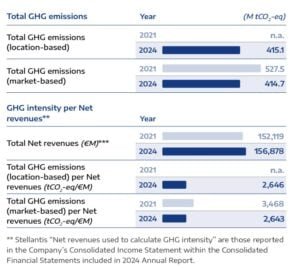
By 2024, Scope 1 and Scope 2 emissions dropped about 39 % relative to 2021 levels.
-
59 % of the electricity powering Stellantis operations came from decarbonized sources in 2024, up from 45 % in 2021.
-
Has expanded circular‑economy practices, recycling over two million vehicle parts globally in 2023, including bumpers, wheels, catalytic converters, and high‑voltage batteries.
Stellantis is pursuing an aggressive electrification roadmap, offering more battery‑electric and hybrid models. It is building an integrated battery ecosystem, including sustainable sourcing and recycling.
Also, efforts target emissions across the full “well‑to‑wheel” and “cradle‑to‑grave” lifecycle, including production, operations, and vehicle use.
A Turning Point for EV and ESG Expectations
Governments across the world are offering major financial incentives to support EV manufacturing. These include tax credits, direct funding, and long-term partnerships with automakers. Canada’s firm response to Stellantis shows that public funding may come with much stricter enforcement in the future.
This dispute could reshape how public-private partnerships work in the clean energy transition. It shows that governments want companies to fulfill their duties. This includes not only financial responsibilities but also creating jobs, making EVs, and developing supply chains.
The decision to move production affects Canadian workers, EV timelines, and carbon-reduction goals. It shapes the company’s reputation with governments and investors. It also highlights the challenges automakers face when balancing cost pressures with sustainability goals.
The Stellantis-Canada conflict is a test of how well the auto industry can manage the shift to electric mobility while meeting net-zero commitments. As talks continue, the results will influence future EV projects in Canada and beyond. It will also shape how governments structure funding deals tied to clean technology transitions.
The post Canada’s Stellantis Dispute: What It Means for EVs and Net-Zero Goals appeared first on Carbon Credits.


