
Gardening and farming are not just hobbies for me—they are a passion. As an agriculture scholar, I have spent countless hours experimenting with various tools and techniques to ensure my plants thrive. One tool that has truly transformed my plant care routine is the Censinda Soil Moisture Meter.
Whether you have indoor houseplants, a garden, or a small farm, this simple device can help you understand your soil like never before. In this review, I will share my detailed experience with this product, along with the science behind it, statistical trends, practical tips, and comparisons with alternative tools.
What Is Censinda Soil Moisture Monitor Sensor?
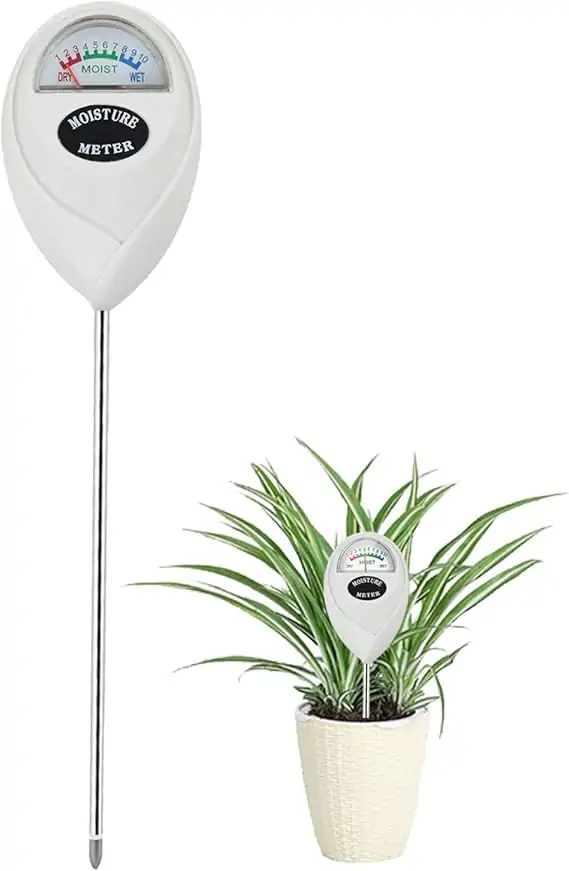
The Censinda Soil Moisture Meter is an analog soil hygrometer / moisture sensor designed to help plant owners know whether their soil is dry, moist, or wet. Unlike digital or battery‑powered devices, it works mechanically — you just insert its probe into the soil (ideally near the plant’s root zone) and read a moisture level on a scale (1–10). According to the manufacturer:
- Levels 1–3 indicate Dry soil
- Levels 4–7 indicate Normal / Moist soil
- Levels 8–10 indicate Wet soil
Because it requires no batteries or electricity, it is very simple to use: just push the probe into the soil and see where the dial lands. Its probe length (about 6.7 inches) allows it to reach deeper into the soil — closer to the root region — which is more useful than judging from just the surface moisture. Here’s a quick glance at the key specifications of the meter I used:
- Brand: Censinda
- Color: White
- Weight: approx. 60 g
- Probe length: ~6.7 inches (about 17 cm)
- Overall size: ~10.2 × 2.3 × 1.5 inches
- Moisture scale: 1–10 (1–3 = Dry, 4–7 = Moist, 8–10 = Wet)
- Power: No battery / power required — fully mechanical
- Use: Indoor and outdoor plants — potted plants, hanging baskets, garden soil, small raised beds, lawns, etc.
The device is light, portable, and easy to handle. The analog dial gives a quick visual indication. Manufacturer instructions caution that the meter is intended for soil only — inserting into rocky or very hard soil can damage the probe. Also, it’s advised not to leave the meter permanently in the soil, and to clean the probe after each use to prolong its life.
Pros & Cons of Censinda Soil Moisture Sensor
| Pros | Cons |
|---|---|
 No battery or electricity needed — simple and always ready to use No battery or electricity needed — simple and always ready to use |
 Analog reading gives only a relative moisture level (Dry / Moist / Wet), not precise water content Analog reading gives only a relative moisture level (Dry / Moist / Wet), not precise water content |
| Lightweight and portable — easy to use for many plants, indoor or outdoor |
Not recommended for very hard, rocky, or compacted soils (risk of damaging probe) |
| Long probe — reaches near root zone, which is more useful than surface moisture reading |
The meter does not tell you exactly when to water — you still need to decide based on plant type |
| Helps prevent overwatering or underwatering — especially useful for potted plants and sensitive species |
For very large or irregular pots, moisture may vary at different depths — one reading may not represent the whole pot |
| Affordable and good value for beginner and hobby gardeners |
Some gardeners and horticulturists question accuracy; readings may not always match actual soil moisture content |
Why Moisture Monitor Sensor Matters?
Soil moisture — the amount of water held in the soil — is one of the most fundamental factors for healthy plant growth. If soil is too dry, plants cannot access enough water and may wilt; if soil is too wet, roots may suffocate and rot because of lack of oxygen.
Devices like the Censinda meter rely on fairly simple principles: many soil moisture meters estimate the soil water content indirectly — often by measuring electrical conductivity or resistance between probes, which changes depending on how much water is present in the soil.
By giving quick feedback about the moisture level near the root zone, the meter helps gardeners and farmers make better-informed decisions about when to water. This is far better than relying only on surface dryness, appearance of leaves, or arbitrary watering schedules.
As explained in articles on soil moisture sensors — they offer more precise and real-time data than older methods (like relying on weather forecasts or traditional watering calendars) — helping optimize irrigation and improve plant health.
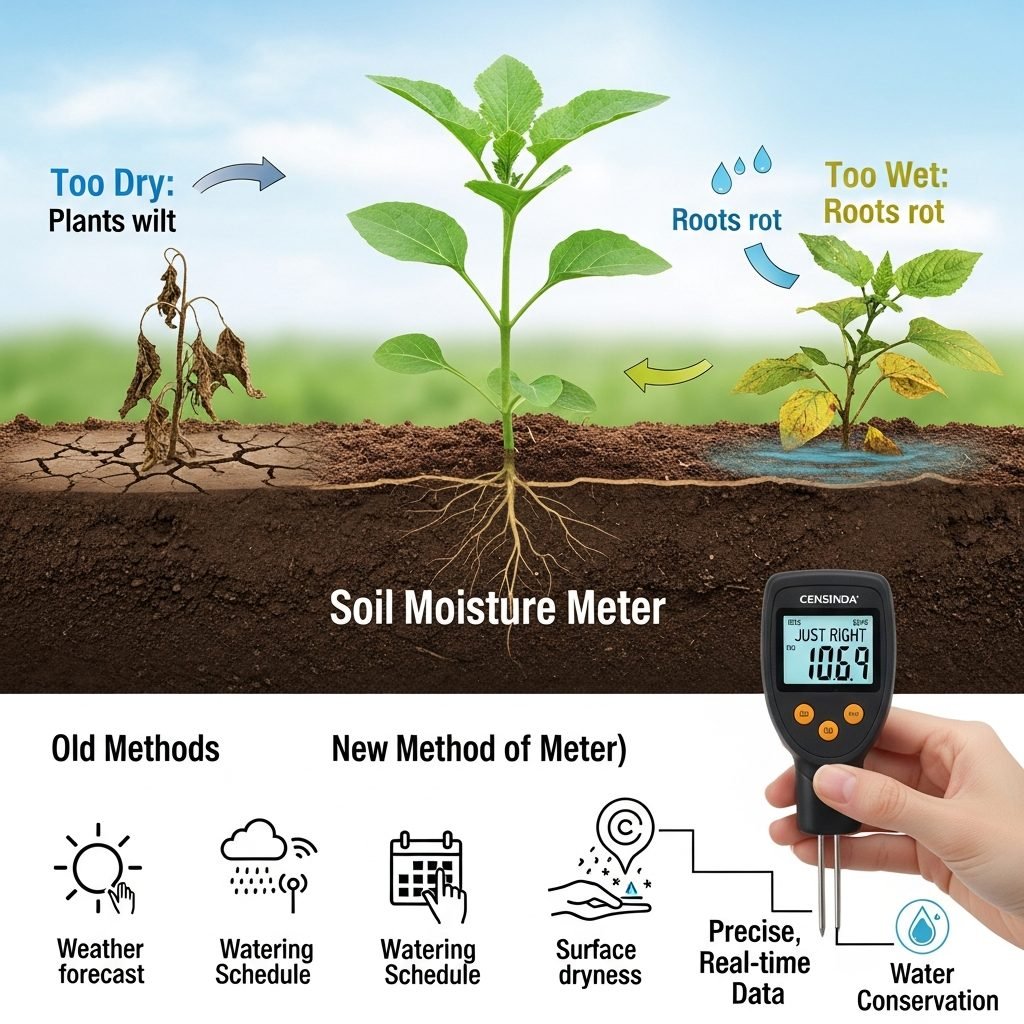
Especially in climates or regions where water is scarce or irregular — or where overwatering is a common issue — such a simple tool can make the difference between thriving plants and plants that struggle.
While my personal review is anecdotal, broader agricultural science supports the value of soil moisture monitoring. According to recent reviews of soil‑moisture monitoring technologies, modern sensors (from simple analog probes to advanced wireless sensors and remote‑sensing networks) have proven critical in enabling precision agriculture — helping farmers save water, reduce waste, and increase yield by irrigating only when necessary.
Research shows that soil moisture sensors contribute to more efficient irrigation scheduling by offering real-time feedback from the soil’s root zone, which is key for optimizing water use and ensuring healthy plant growth.
My Experience with Censinda Soil Moisture Monitor
I own more than 30 different plants — a mix of indoor potted plants, hanging baskets, and a few small outdoor beds. I bought the Censinda meter primarily because I often struggled with inconsistent watering: sometimes I felt the topsoil dry and water, only to discover days later that the lower soil was still moist — but by then roots had started to show stress.
a. Initial impressions: Right out of the box, the meter felt light but sturdy. The probe was easy to push into standard potting soil (though I avoided pushing it into extremely compact soil or rocky mix).
b. First few uses: Insert the probe about 2–4 inches deep, wait for the dial to settle, and read moisture level. I found it surprisingly effective at flagging over- and under-watering — especially with plants in small pots. There were times when I thought soil was dry by touching the top, but the meter read “moist,” and indeed plants were doing fine.
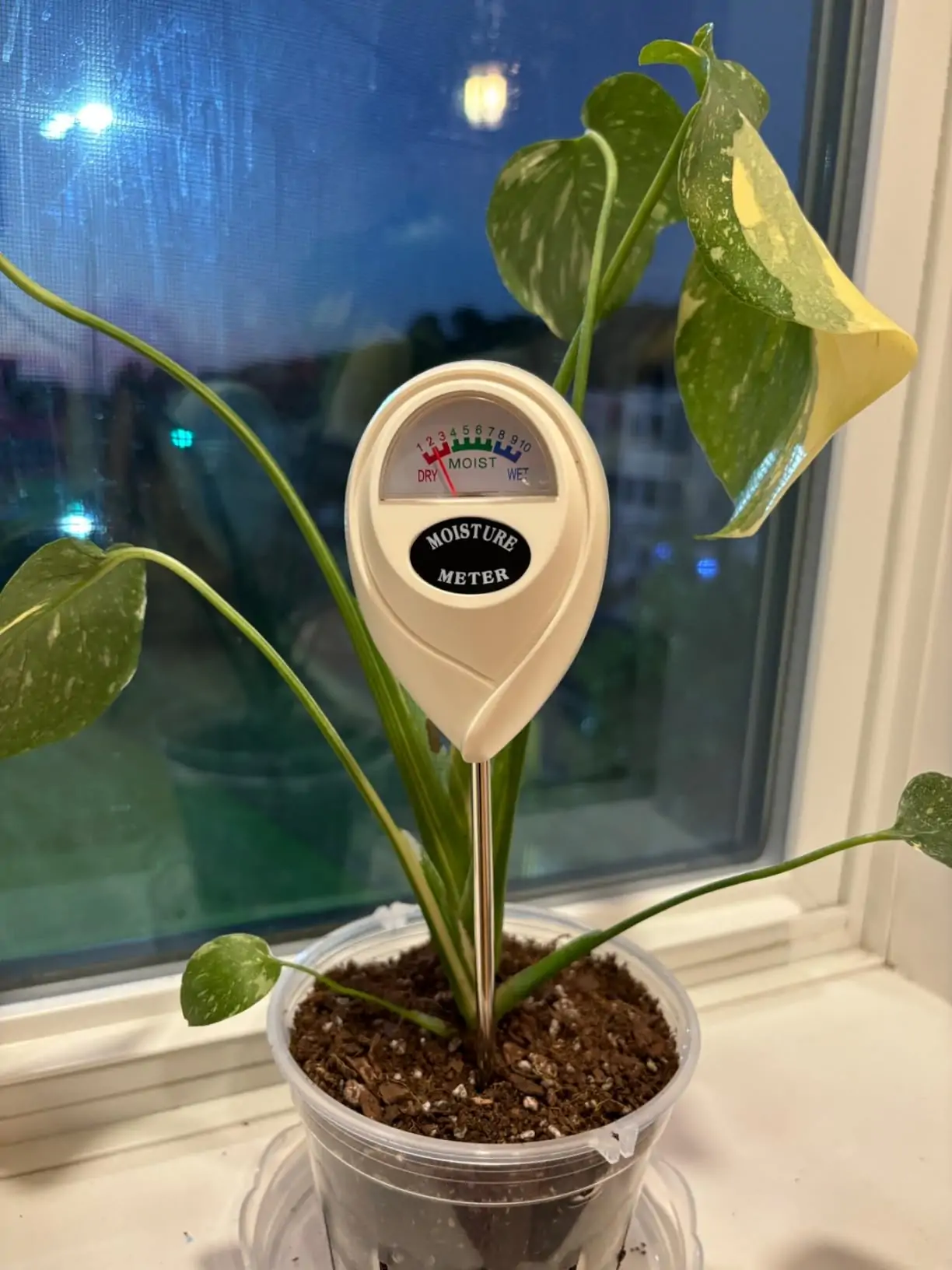
c. Durability and convenience: Because it needs no batteries or power, I could carry it between rooms or from indoors to outdoors. After each use I wiped the probe clean (as recommended), and so far — after a few weeks — it shows no signs of damage or corrosion. I no longer worry about having to recharge or replace batteries.
d. Observations over time: Since using the meter, I’ve adjusted my watering schedule for several plants; some need water only every 10–12 days rather than every week. The overall health of many of my plants improved: leaves look greener, soil conditions seem more stable, and I’ve even avoided a nasty outbreak of fungus gnats — likely because the soil isn’t staying soggy for long.
Overall, the meter quickly became a regular tool for me — especially after I realized how misleading surface-dryness can be.
Performance of Censinda Soil Moisture Sensor
In my experience, the Censinda Soil Moisture Meter performs well for typical home gardening and indoor/outdoor potted plants. Its key strengths are simplicity, portability, and reliability — no switches, no batteries, no fuss. The moisture scale (1–10) gives enough resolution to meaningfully distinguish dry vs. moist vs. wet, which is more useful than a simple “wet/dry” meter.
That said, as with all analog meters, it gives a relative reading rather than a precise moisture percentage. For most houseplants or garden beds, that’s fine — you only need a rough idea to guide watering. For more precise farming, greenhouse management, or scientific experiments, more accurate sensors (digital, capacitance, TDR, or remote sensing) might be necessary.
Also, I found that for very large or deep pots, you may need to test at different depths to ensure the lower soil isn’t over- or under-watered. And if soil is too compact or rocky, pushing the probe may be difficult or risk bending the metal — so gentle handling is important.
Practical Tips for Censinda Soil Moisture Sensor
Based on my experience and research, here are some tips for getting the most out of a soil moisture meter like this:
i. Insert probe near root zone: Push the probe deep enough (about 2/3 of the root zone) rather than just surface level to get a meaningful reading.
ii. Avoid hard or rocky soil: If soil is compact or full of stones, loosen gently first — forcing the probe can damage it.
iii. Don’t leave it in soil permanently: Use the meter to check moisture, then remove and wipe clean. Leaving it in can lead to corrosion or inaccurate readings over time.
iv. Use more than one reading per pot when needed: For large containers or deep soil, test at different depths — sometimes the top is dry but deeper soil is still moist.
v. Combine with other observations: Use the meter alongside your knowledge of plant species, environmental conditions (sunlight, temperature), and soil type — because moisture needs vary across plants.
vi. Regular checks — but not too often: Frequent monitoring is useful, but don’t over-probe especially if soil is sensitive or roots are close to surface.
Comparisons with Alternatives Monitor Sensor
There are many kinds of soil moisture or soil‑water sensors available — from simple analog meters like this one, to advanced digital probes, capacitance or TDR sensors, and even satellite-based or IoT‑enabled systems.
| Method / Tool | Battery Needed | Accuracy for Root-Zone Moisture | Ease of Use | Cost / Accessibility | Best For |
|---|---|---|---|---|---|
| Censinda Soil Moisture Meter | No battery required | Good — measures deeper soil moisture | Very easy: insert probe, read dial | Low cost, widely available | Indoor & outdoor potted plants, home gardens, beginners & experienced users |
| Digital Soil Moisture Meters | Often need batteries or power | Good — many have precise sensor readouts | Easy, but setup/calibration may be needed | More expensive than analog meter | Users wanting high precision & digital readings, larger gardens or farms |
| Manual Finger / Visual Test (“stick finger in soil / look at surface”) | No batteries | Low — only shallow surface estimate, root-zone may differ | Instant, no tool needed | Free | Quick checks, small plants, emergency checks |
| Weight / Lift Pot Method (lifting pot to judge dryness) | No battery | Very approximate — soil type & container affect weight | Simple, but subjective and inconsistent | Free | Experienced gardeners familiar with their soil/pots, small plants |
| Soil Moisture Sensor + Smart Systems (automated probes + alerts / irrigation control) | Yes — usually needs power or battery + possible connectivity | High — continuous or periodic monitoring, often more data | More complex: installation, integration, maintenance | High initial cost | Larger gardens, smart irrigation setups, heavy users wanting automation |
Final Recommendations
Based on my experience and what science and horticulture experts say, I wholeheartedly recommend the Censinda Soil Moisture Meter for:
- Home gardeners with potted plants (indoor or outdoor)
- Beginners or hobbyists who want a simple, no-fuss way to monitor soil moisture
- People who have many plants (like me) and struggle to manage watering schedules manually
- Anyone wanting to avoid overwatering or underwatering without spending much
That said, if you are managing large garden beds, greenhouse crops, or commercial farming — especially where water usage efficiency, yield consistency, or precision irrigation matter — consider upgrading to a digital or capacitive moisture sensor, or even a more advanced soil‑moisture monitoring system.
In conclusion: for a modest price and minimal effort, the Censinda Soil Moisture Meter can save many plants from unnecessary stress, make watering more intelligent, and help you become a more confident, data‑driven gardener. For me, it has become a trusty partner — and I wish I had found it years ago.


