

Ebb has taken a major step forward in the carbon removal space by signing its first carbon removal offtake agreement with Google. Under this prepurchase deal, Ebb will remove 3,500 tonnes of carbon dioxide from the atmosphere. While the volume is modest, the signal is powerful. It shows growing confidence in ocean-based carbon removal and, more importantly, in Ebb’s strategy of scaling climate solutions through existing industrial infrastructure.
How Ebb’s Ocean Carbon Removal Technology Works
Ebb focuses on ocean alkalinity enhancement, a method that accelerates a natural carbon storage process. In nature, the ocean absorbs carbon dioxide from the air and converts it into bicarbonate, a stable form of carbon that can remain stored in seawater for thousands of years. Over time, this process has already absorbed about 30% of all human-made CO₂ emissions since the Industrial Revolution.
The company speeds up this natural mechanism using an electrochemical system. The result is safe, durable carbon storage that aligns with the ocean’s existing chemistry. Importantly, the company does not rely on building new, standalone facilities. Instead, it integrates directly into desalination plants.
Turning Desalination Waste Into Climate Value
Desalination plants produce fresh water by removing salt from seawater. However, this process also generates large volumes of brine, a highly concentrated salty waste stream. Globally, desalination facilities produce more than 100 million tonnes of brine every day.
Ebb intercepts this brine before it returns to the ocean. The brine then passes through its modular electrochemical system, which converts it into an alkaline solution. Once released back into the ocean, this solution increases the water’s ability to draw CO₂ from the atmosphere.
This approach delivers several benefits at once.
- First, it enables large-scale carbon removal.
- Second, it can increase freshwater yield at desalination plants.
- Third, it produces valuable chemical co-products that can be reused within the plant or sold to other industries.
By transforming waste into multiple revenue streams, Ebb makes carbon removal more economically attractive for its partners.

Infrastructure Integration Changes the Game
One of the biggest barriers to carbon removal is cost. Building new infrastructure from scratch requires time, capital, and regulatory approvals. Ebb avoids many of these challenges by integrating with existing systems.
Desalination plants process hundreds of millions of tonnes of seawater every day. This scale creates a massive opportunity. According to Ebb, current global desalination capacity could support billions of tonnes of carbon removal per year if fully leveraged.
As a result, integration reduces both deployment costs and operational complexity. It also allows Ebb to scale faster than many other carbon removal pathways. This infrastructure-first model sits at the heart of the company’s partnership with SWA.
Strengthening Google’s Carbon Removal Strategy
Google’s decision to purchase carbon removals from Ebb reflects its broader climate strategy and its commitment to reach net-zero emissions across its operations and value chain by 2030. However, as Google’s business continues to expand, its overall emissions have also moved higher.
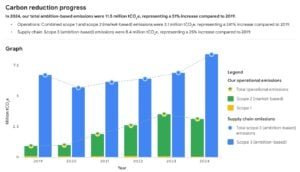
- In 2024, Google’s total ambition-based emissions reached 11.5 million tonnes of CO₂ equivalent, marking a 51% increase compared to 2019.
During the same period, combined Scope 1 and Scope 2 emissions rose sharply, driven largely by the rapid growth of energy-intensive data centers. At the top, Scope 3 emissions from the supply chain remained the largest contributor, totaling 8.4 million tonnes of CO₂ equivalent.
Google has long backed early-stage carbon removal through offtake agreements. In 2024 alone, it signed 16 new deals worth more than $100 million, covering about 728,300 tonnes of CO₂e. This lifted Google’s total removal portfolio to roughly 782,400 tonnes—a fourteen-fold jump from the previous year.
In this context, the Ebb agreement fits squarely into Google’s strategy. While the company keeps pushing decarbonization, it is also investing in high-quality carbon removal to tackle emissions that remain hard to cut in the near term.
For Google, the deal offers access to durable removals with clear monitoring and storage pathways. For Ebb, it validates a scalable, globally replicable model—highlighting how industrial partnerships can speed up carbon removal at scale.
Beyond Carbon: Creating Additional Value
Ebb’s technology does more than remove carbon. The ocean alkalinity process also produces an acid co-product. Rather than treating this as waste, Ebb is exploring ways to turn it into value.
The company has been working with X, the Moonshot Factory, to explore innovative uses for this acid stream. These efforts underline Ebb’s broader vision: carbon removal should not exist in isolation. Instead, it should support water security, industrial efficiency, and sustainable chemical production.
This multi-benefit approach strengthens the business case and reduces reliance on carbon credit revenue alone. Concisely, through these purchases, Google aims not only to neutralize its own remaining emissions but also to help push promising technologies toward commercial scale.
The post Google’s 3,500-Tonne Carbon Removal Deal with Ebb Signals Growing Confidence in Ocean-Based Climate Solutions appeared first on Carbon Credits.


