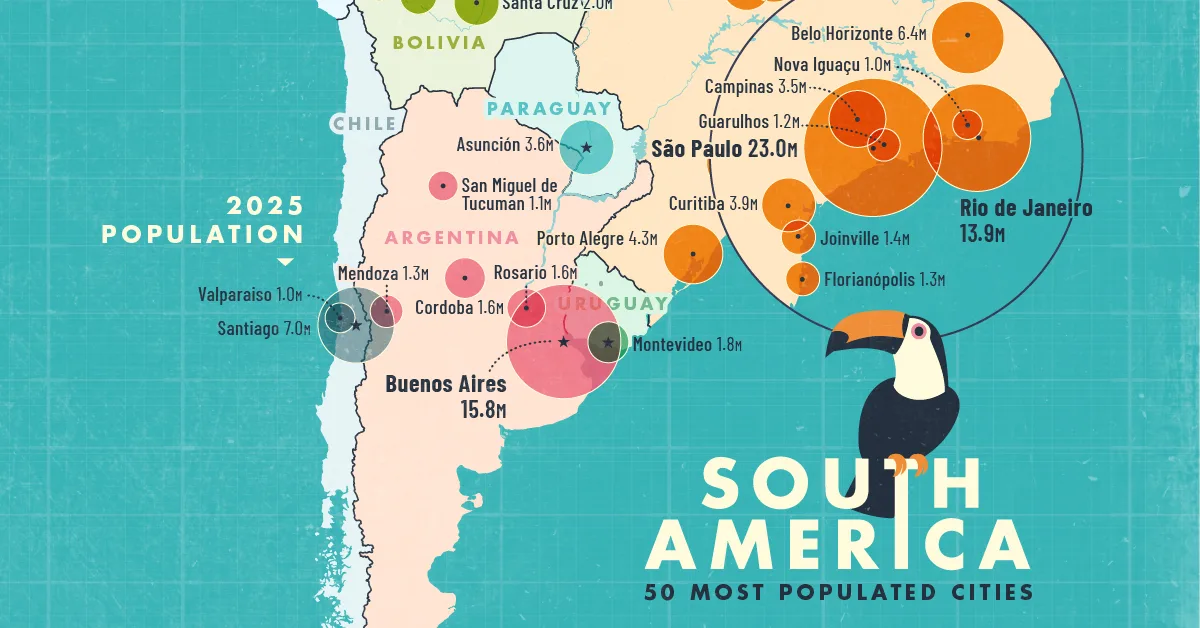
Mapped: South America’s Most Populated Cities
This was originally posted on our Voronoi app. Download the app for free on iOS or Android and discover incredible data-driven charts from a variety of trusted sources.
Key Takeaways
- São Paulo is South America’s largest city, with nearly 23 million people, far ahead of any other urban center.
- Brazil dominates the ranking, accounting for more than half of the continent’s 50 most populated cities.
South America is home to some of the world’s fastest-growing and most densely populated urban areas.
This map highlights South America’s most populated cities, showing where people are concentrated and how urban growth varies by country.
The data for this visualization comes from World Population Review (2025).
Brazil’s Urban Dominance
Brazil stands out as the continent’s urban heavyweight. São Paulo alone approaches 23 million residents, making it not only South America’s largest city but one of the largest in the world. In fact, São Paulo’s population exceeds that of well-known megacities like Mexico City, Moscow, Beijing, and New York.
Rio de Janeiro follows closely, reinforcing Brazil’s central role in the region’s urban landscape.
| Rank | City | Country | Population |
|---|---|---|---|
| 1 | São Paulo |  Brazil Brazil |
22,990,000 |
| 2 | Buenos Aires |  Argentina Argentina |
15,752,300 |
| 3 | Rio de Janeiro | Brazil |
13,923,200 |
| 4 | Bogota |  Colombia Colombia |
11,795,800 |
| 5 | Lima |  Peru Peru |
11,517,300 |
| 6 | Santiago |  Chile Chile |
6,999,460 |
| 7 | Belo Horizonte | Brazil |
6,351,680 |
| 8 | Brasilia | Brazil |
4,990,930 |
| 9 | Recife | Brazil |
4,344,050 |
| 10 | Fortaleza | Brazil |
4,284,450 |
| 11 | Porto Alegre | Brazil |
4,268,960 |
| 12 | Medellin | Colombia |
4,172,810 |
| 13 | Salvador | Brazil |
4,029,910 |
| 14 | Curitiba | Brazil |
3,889,140 |
| 15 | Asuncion |  Paraguay Paraguay |
3,627,220 |
| 16 | Campinas | Brazil |
3,491,580 |
| 17 | Guayaquil |  Ecuador Ecuador |
3,244,750 |
| 18 | Caracas |  Venezuela Venezuela |
3,015,110 |
| 19 | Goiania | Brazil |
2,927,080 |
| 20 | Cali | Colombia |
2,916,790 |
| 21 | Belem | Brazil |
2,453,800 |
| 22 | Manaus | Brazil |
2,434,640 |
| 23 | Maracaibo | Venezuela |
2,432,440 |
| 24 | Barranquilla | Colombia |
2,396,400 |
| 25 | Valencia | Venezuela |
2,030,790 |
| 26 | Quito | Ecuador |
2,017,260 |
| 27 | La Paz |  Bolivia Bolivia |
1,997,370 |
| 28 | Santa Cruz de la Sierra | Bolivia |
1,955,356 |
| 29 | Montevideo |  Uruguay Uruguay |
1,788,170 |
| 30 | Cordoba | Argentina |
1,640,600 |
| 31 | Rosario | Argentina |
1,631,090 |
| 32 | Natal | Brazil |
1,575,050 |
| 33 | Cochabamba | Bolivia |
1,460,280 |
| 34 | Joao Pessoa | Brazil |
1,447,780 |
| 35 | Bucaramanga | Colombia |
1,411,010 |
| 36 | Maceio | Brazil |
1,387,920 |
| 37 | Joinville | Brazil |
1,374,630 |
| 38 | Florianopolis | Brazil |
1,323,850 |
| 39 | Barquisimeto | Venezuela |
1,281,730 |
| 40 | Maracay | Venezuela |
1,270,320 |
| 41 | Mendoza | Argentina |
1,257,180 |
| 42 | Guarulhos | Brazil |
1,169,577 |
| 43 | Cartagena | Colombia |
1,105,540 |
| 44 | Aracaju | Brazil |
1,081,930 |
| 45 | Teresina | Brazil |
1,068,550 |
| 46 | San Miguel de Tucuman | Argentina |
1,051,040 |
| 47 | Valparaiso | Chile |
1,024,430 |
| 48 | Nova Iguacu | Brazil |
1,002,118 |
| 49 | Ciudad Guayana | Venezuela |
991,388 |
| 50 | Arequipa | Peru |
983,715 |
Beyond these megacities, Brazil places numerous cities throughout the top 50, including Belo Horizonte, Brasília, Recife, and Fortaleza. Population is not concentrated in a single part of the country, with major cities spread from the south near Uruguay to the north near Venezuela.
Major Hubs Across the Southern Cone
Argentina, Colombia, and Peru also feature prominently. Buenos Aires ranks second overall, with more than 15 million people, reflecting its status as a political, cultural, and financial hub. Colombia places multiple cities on the list, including Bogotá, Medellín, Cali, and Barranquilla.
These cities serve as national anchors for commerce and transportation. Their growth mirrors broader demographic shifts from rural areas into metropolitan regions across the continent.
Rising Cities Beyond the Megacities
While the top five cities dominate by size, many mid-tier cities are rapidly expanding. Places like Santa Cruz de la Sierra, Campinas, and Arequipa illustrate how secondary cities are absorbing population growth as megacities become more saturated.
Learn More on the Voronoi App 
If you enjoyed today’s post, check out The World’s Safest (and Least Safe) Countries on Voronoi, the new app from Visual Capitalist.