
Joby Aviation is moving into a new phase of growth and confidence. The company, which is developing electric air taxis for commercial passenger travel, announced major investments to double its manufacturing capacity in the United States. By 2027, Joby plans to build four aircraft per month, showing how serious it is about leading the future of advanced air mobility.
This expansion aligns with rising global support for electric vertical takeoff and landing (eVTOL) aircraft. With strong demand, government backing, growing partnerships, and accelerating certification progress, Joby is positioning itself at the front of a rapidly emerging industry.
Joby’s New Strategy: Building More Aircraft, Faster
Joby’s production growth plan is based on real industry momentum. The company already operates manufacturing facilities in California and Ohio, both of which will support the production ramp-up.
Recently, Joby revealed that it has over $1 billion in potential aircraft and service sales, highlighting confidence from customers and governments. At the same time, support from U.S. authorities has strengthened. The country’s eVTOL Integration Pilot Program, announced in September, aims to speed up the launch of air taxi services.
A Presidential Executive Order has directed the Department of Transportation and the Federal Aviation Administration (FAA) to allow mature eVTOL aircraft to begin operations in select cities as early as next year, even before full certification is completed.
According to Joby founder and CEO JoeBen Bevirt, this moment marks the beginning of a “new golden age of aviation.” He believes Joby will soon be one of the few companies in the world capable of building aircraft at high volumes while maintaining quality and safety.
Given the maturity of its air taxi program and the level of market demand, Joby says now is the right time to invest in equipment, facilities, and skilled workers. The company is already purchasing new capital equipment and expanding operations to support non-stop, round-the-clock manufacturing in California.
In July, Joby completed an expanded factory in Marina, California. In October, it began producing propeller blades in Ohio, ahead of bigger manufacturing activities planned in the state. These milestones show that Joby is not just announcing plans—it is actively executing them.
Toyota Partnership Strengthens Manufacturing Power
A key pillar of Joby’s growth strategy is its long-term collaboration with Toyota Motor Corporation. In May 2025, Joby closed the first $250 million tranche of a strategic investment from Toyota. Both companies are now finalizing a strategic manufacturing alliance designed to support Joby’s production ramp-up.
Toyota brings decades of expertise in high-volume, precision manufacturing, something that could be a game-changer as aviation transitions toward electric mobility. Joby has credited Toyota’s knowledge and guidance as essential to scaling up safely and efficiently.
Together, the companies share a vision: making electric air taxis a reliable, trusted part of future transportation.
Certification Progress and Flight Readiness
Joby is also moving steadily toward FAA certification. The company recently began power-on testing of the first FAA-conforming aircraft built for Type Inspection Authorization (TIA). This is the final and most critical stage of FAA Type Certification, during which FAA test pilots will fly Joby’s aircraft themselves. Four additional FAA-conforming aircraft required for TIA are already under production.
Meanwhile, Joby ended 2025 on a strong note with its final international flight demonstration of the year at Japan’s Fuji Speedway. Conducted in partnership with Toyota, the campaign included 14 piloted flights and marked Joby’s fourth major global demonstration of the year.
This capped a year filled with progress. In 2025 alone, Joby completed more than 850 flights across its fleet, logging over 50,000 miles, a 2.6× increase from the previous year. This expanding flight activity is essential for collecting real-world performance data, validating design decisions, and proving reliability.
Proving Real-World Operations Around the Globe
Joby’s aircraft flew in three major markets in 2025—the United States, the United Arab Emirates, and Japan. Highlights included:
- 41 flights at the World Expo 2025 in Osaka
- 21 flights in the UAE during environmental and operational testing
- Active participation in the Dubai Airshow, where Joby was the only eVTOL aircraft to perform a full week of flights
Joby also completed point-to-point flights between public airports, including routes between Marina and Monterey and Marina and Salinas in California. In the UAE, Joby completed the first piloted point-to-point air taxi flight from Margham to Al Maktoum International Airport.
The company also advanced future technologies. It successfully flew a turbine-electric demonstrator aircraft, only three months after first revealing the concept, proving how fast it can innovate. Meanwhile, Joby’s Superpilot™ autonomous flight technology logged over 7,000 miles during a major U.S. defense exercise.
Overall, Joby’s aircraft covered more than 9,000 miles in 2025, supporting over 4,900 test objectives. This data is now feeding directly into final FAA certification activities and helping finalize operating and maintenance manuals.
- READ MORE: JOBY Aviation Stock Soars on Blade Acquisition and Electric Air Taxi Commercial Launch Plans
Joby sees urban air mobility as a strong complement to existing transportation, offering faster, quieter, and cleaner travel. Its fully electric air taxi reduces emissions per passenger, and in 2024, the company also demonstrated hydrogen-electric flight, showing potential for longer-range operations.
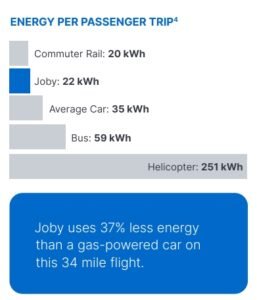
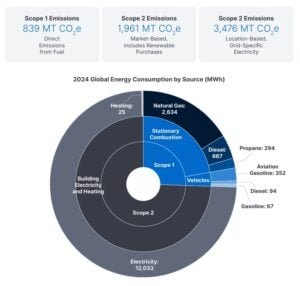
Despite a 29% rise in energy use due to manufacturing growth, Joby cut emissions by 44% in 2024 by relying on renewable electricity.
- Renewable electricity use increased 19% from 2023
- 84% of facility power came from renewables, including 3% from on-site solar
- Employees used 268,355 kWh for EV charging, replacing about 7,182 gallons of gasoline
Thus, the company continues to scale while lowering its environmental footprint.
AAM: A Growing Market With Huge Potential
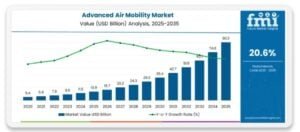
Joby’s expansion is happening within a booming global Advanced Air Mobility (AAM) market. Industry forecasts suggest:
- Analysts say global AAM revenue could reach $1.76 billion by the end of 2025, with some estimates much higher. By 2035, the market could soar to $90.3 billion, growing at more than 20% CAGR
- Urban Air Mobility (UAM), a key segment, could jump from $6.59 billion in 2025 to $126 billion by 2035
Infrastructure development, including vertiports and air traffic systems, will help unlock this growth.
At the same time, Joby’s own market outlook is strong. The Joby eVTOL aircraft market was valued at $1.4 billion in 2024 and is projected to reach $13.8 billion by 2033, growing at a robust 28.7% CAGR. As cities face congestion and pollution challenges, clean electric air taxis are emerging as a real solution for passenger travel, logistics, and emergency response.
Significantly, JOBY stock (NYSE: JOBY) trades at $13.85, up 4.92% or $0.65 today amid positive momentum from manufacturing expansions and certification progress.

If Joby succeeds, daily mobility could change forever. Short, fast, zero-emission air taxi flights may soon become as normal as booking a ride-share today. And with global governments and major companies backing the vision, the world appears ready for this new era of aviation.
ALSO READ:
- Uber Stock Hits Record High with Joby and Blade Air Mobility Deal
- Archer Aviation Stock (ACHR) Soars: Leading the U.S. eVTOL Market with Zero-Emission Air Taxis in NYC, LA, and Beyond
The post Joby Aviation’s 2027 Vision: Four Electric Air Taxis per Month and Stronger Emission Cuts Amid Advanced Air Mobility Boom appeared first on Carbon Credits.


