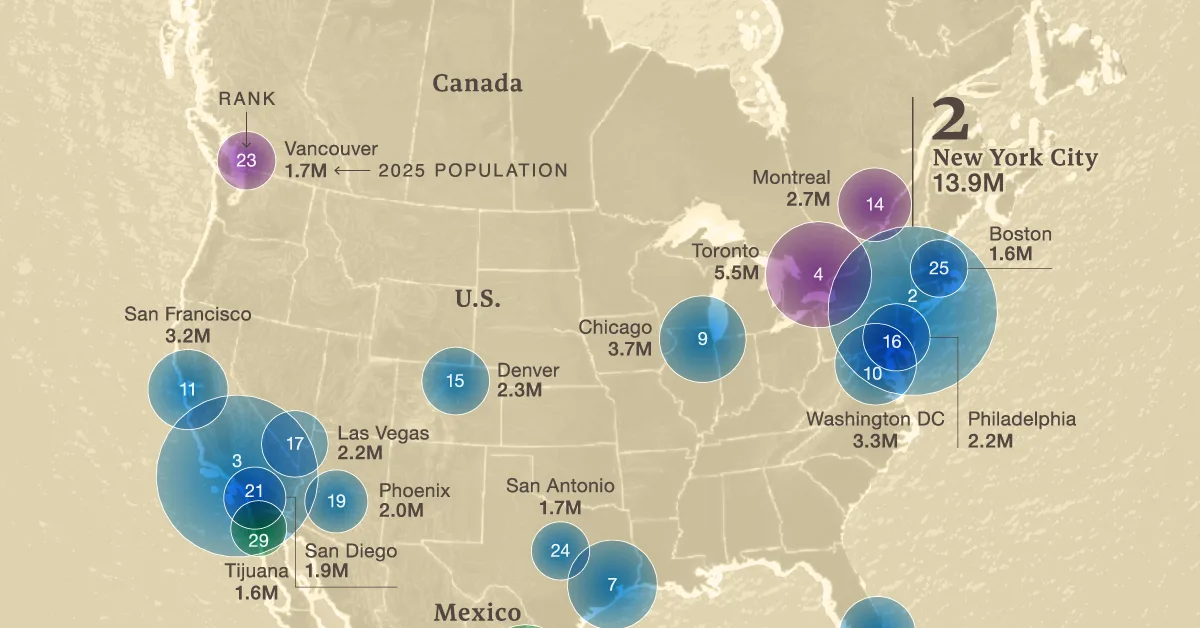
Ranked: The 30 Largest Cities in North America in 2025
See visuals like this from many other data creators on our Voronoi app. Download it for free on iOS or Android and discover incredible data-driven charts from a variety of trusted sources.
Key Takeaways
- Mexico City, New York City, and Los Angeles are the only three cities with populations exceeding 10 million.
- The U.S. is home to 15 of the top 30 most populous cities in North America.
With 17.7 million residents, Mexico’s capital is bigger than New York City and Chicago combined.
Over the next decade, Mexico City is forecasted to add another 175,000 to its population. The Big Apple, in contrast, is set to shrink by about 189,000 residents.
This graphic shows the biggest North American cities by population, based on data from the United Nations World Urbanization Prospects 2025.
 Urban populations can be measured in different ways. In this methodology, the UN looks at satellite-mapped urban footprints for consistency. For this reason some city populations may not line up exactly as you may expect.
Where Are the Largest Cities in North America
Below, we show the 30 most populous cities in North America in 2025:
| Rank | City | Country | 2025 Population |
|---|---|---|---|
| 1 | Mexico City |  Mexico Mexico |
17,734,000 |
| 2 | New York City |  U.S. U.S. |
13,920,000 |
| 3 | Los Angeles | U.S. |
12,740,000 |
| 4 | Toronto |  Canada Canada |
5,494,000 |
| 5 | Santo Domingo |  Dominican Republic Dominican Republic |
4,600,000 |
| 6 | Guadalajara | Mexico |
4,135,000 |
| 7 | Houston | U.S. |
3,955,000 |
| 8 | Monterrey | Mexico |
3,938,000 |
| 9 | Chicago | U.S. |
3,683,000 |
| 10 | Washington, D.C. | U.S. |
3,270,000 |
| 11 | San Francisco | U.S. |
3,163,000 |
| 12 | Miami | U.S. |
2,912,000 |
| 13 | Guatemala City |  Guatemala Guatemala |
2,838,000 |
| 14 | Montreal | Canada |
2,669,000 |
| 15 | Denver | U.S. |
2,266,000 |
| 16 | Philadelphia | U.S. |
2,232,000 |
| 17 | Las Vegas | U.S. |
2,184,000 |
| 18 | San José |  Costa Rica Costa Rica |
2,171,000 |
| 19 | Phoenix | U.S. |
1,972,000 |
| 20 | Puebla | Mexico |
1,948,000 |
| 21 | San Diego | U.S. |
1,915,000 |
| 22 | Port-au-Prince |  Haiti Haiti |
1,868,000 |
| 23 | Vancouver | Canada |
1,708,000 |
| 24 | San Antonio | U.S. |
1,686,000 |
| 25 | Boston | U.S. |
1,640,000 |
| 26 | San Salvador |  El Salvador El Salvador |
1,615,000 |
| 27 | Tegucigalpa |  Honduras Honduras |
1,607,000 |
| 28 | Havana |  Cuba Cuba |
1,594,000 |
| 29 | Tijuana | Mexico |
1,558,000 |
| 30 | Panama City |  Panama Panama |
1,527,000 |
With the largest population by far, the Mexico City region drives almost 25% of Mexico’s GDP.
Trade and transportation is the capital’s most prominent sector, bolstered by shifting supply chains and nearshoring. After Mexico City, Guadalajara, known as the “Silicon Valley of Mexico” is the country’s second-most populous city, at 4.1 million.
Meanwhile, New York City sits at a population of 13.9 million in 2025. Since 2020, the financial hub has lost about 128,000 residents, with many moving to Florida, Texas, and California. In contrast, Los Angeles has grown by nearly 250,000 over the same period to reach 12.7 million.
Ranking fourth is Toronto, Canada’s leading financial center. Like Los Angeles, it has added roughly 250,000 residents since 2020, making it one of the country’s fastest-growing major cities. Looking ahead, Toronto is projected to grow by another 370,000 people over the next decade, largely driven by international migration.
Learn More on the Voronoi App 
To learn more about this topic, check out this graphic on the two largest cities on every continent.