
India is taking bold steps to expand its nuclear energy capacity, aiming to secure a stable, low-carbon power supply for the future. As per reports, India’s largest power producer, NTPC, recently signed non-disclosure agreements (NDAs) with Russia’s state-owned Rosatom and France’s Electricité de France (EDF) to explore collaborations on large-scale Pressurized Water Reactor (PWR) projects.
These exploratory agreements are intended to cover the full lifecycle of nuclear projects—from design and construction to operation and maintenance—while prioritizing domestic technology development and manufacturing.
The move reflects India’s growing electricity needs and its commitment to climate goals. Nuclear power is seen as a reliable complement to intermittent renewable sources like solar and wind, offering steady baseload energy. Analysts see NTPC’s engagement with Rosatom and EDF as a clear signal that India plans to accelerate nuclear growth through international partnerships. Through its nuclear arm, NTPC Parmanu Urja Nigam, the company targets 30 GW of nuclear capacity by 2047.
Global Expertise Meets Indian Execution
Rosatom and EDF are global leaders in PWR technology, with proven track records in large-scale nuclear projects. By combining their expertise with NTPC’s local execution capabilities, India hopes to create a model that maximizes local value and strengthens domestic nuclear know-how. While the NDAs are non-binding, they set the stage for detailed technical and commercial evaluations, including the potential localization of key components and training of Indian engineers.
Recent government reforms have also made nuclear energy more attractive to private and international players. Laws such as the SHANTI Bill, passed in late 2025, eased liability rules and opened doors for private sector participation in a sector historically dominated by public entities.
Union Budget 2025-26 and Nuclear Priorities
The Union Budget 2025-26 highlighted nuclear energy as a cornerstone of India’s long-term energy strategy. The government set an ambitious goal of achieving 100 GW of nuclear capacity by 2047. This vision aligns with India’s broader energy transition under the “Viksit Bharat” initiative, which aims for energy security, reduced fossil fuel dependency, and a cleaner environment.
A major feature of the budget was the launch of the Nuclear Energy Mission for Viksit Bharat. This initiative focuses on research, development, and deployment of advanced nuclear technologies, including SMRs.
Significantly, the government allocated $2.4 billion to develop at least five indigenously designed SMRs by 2033. These reactors are intended to provide flexible, scalable, and low-carbon power, especially in remote areas or for repurposing retiring coal plants.
Bharat Small Reactors: Local Solutions for Industrial Power
Alongside SMRs, India is expanding its use of Bharat Small Reactors (BSRs). These 220 MW Pressurized Heavy Water Reactors (PHWRs) are designed for safety, performance, and reduced land requirements, making them ideal for deployment near industrial hubs such as steel and aluminium plants. Private companies provide land, cooling water, and capital, while the Nuclear Power Corporation of India Limited (NPCIL) handles design, quality assurance, and operations. This model blends private investment with public oversight to accelerate nuclear deployment and support India’s decarbonization goals.
The development of BSRs complements India’s renewable energy targets. By 2030, India aims to generate 500 GW from non-fossil fuel sources and meet 50% of energy needs from renewables, as pledged at COP26.
Small Modular Reactors: A Flexible Future
SMRs offer a transformative approach to nuclear power. With capacities ranging from 30 to over 300 MWe, they are smaller, faster to build, and more adaptable than traditional reactors. SMRs can be manufactured in factories and deployed in modular units, reducing construction time and costs. Their flexible design allows them to serve both grid-connected and off-grid applications, helping stabilize India’s power supply while complementing renewables.
India’s expertise with PHWRs provides a solid foundation for developing indigenous SMRs. The government plans to integrate SMRs into the energy mix to address land constraints, reduce reliance on fossil fuels, and meet climate commitments under the Paris Agreement.
Expanding Nuclear Capacity Across India
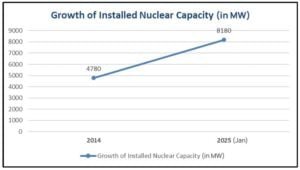
- India’s nuclear capacity stood at 8,180 MW as of January 2025.
The government plans to increase this to 22,480 MW by 2031-32 through the construction of ten reactors across Gujarat, Rajasthan, Tamil Nadu, Haryana, Karnataka, and Madhya Pradesh.
Pre-project activities for ten more reactors are also underway, aiming for progressive completion by 2031-32. In addition, India signed a preliminary agreement with the USA to establish a 6×1208 MW nuclear power plant in Kovvada, Andhra Pradesh.
A milestone in domestic nuclear capability was achieved on September 19, 2024, when Rajasthan Atomic Power Project’s Unit-7 (RAPP-7) reached criticality. This marked a controlled fission chain reaction in one of India’s largest and third indigenous nuclear reactors, underscoring the country’s growing ability to design, build, and operate reactors.
Safety, Innovation, and Domestic Uranium Resources
Safety remains a core priority. Indian nuclear plants operate under strict protocols, with radiation levels consistently below international benchmarks. At the same time, India is exploring new technologies such as high-temperature gas-cooled reactors for hydrogen co-generation and molten salt reactors to harness thorium, which is abundant domestically.
Other recent developments include the discovery of new uranium deposits at the Jaduguda Mines, extending the life of India’s oldest uranium mine by over fifty years. Commercial operations have begun for two 700 MWe PHWR units at Kakrapar, Gujarat, and the Prototype Fast Breeder Reactor (PFBR 500 MWe) has achieved key milestones in 2024, including primary sodium filling and core loading.
NTPC and NPCIL have also signed a supplementary joint venture, ASHVINI, to develop new nuclear facilities, including the 4×700 MWe PHWR Mahi-Banswara Rajasthan Atomic Power Project. These initiatives illustrate India’s commitment to leveraging both international collaboration and domestic expertise to grow its nuclear sector.
India is rapidly transforming its nuclear energy landscape. By combining global expertise with domestic innovation, promoting SMRs and BSRs, and easing regulatory barriers, the country is set to meet growing energy demand while cutting carbon emissions.
The Nuclear Energy Mission for Viksit Bharat positions India as a future leader in advanced nuclear technology, contributing to energy security, environmental sustainability, and long-term economic growth. With a clear roadmap and international partnerships, India’s nuclear power journey is poised for a significant surge toward its 2047 goals.
The post NTPC Partners with Rosatom and EDF, Sparking a Nuclear Energy Revolution in India appeared first on Carbon Credits.


