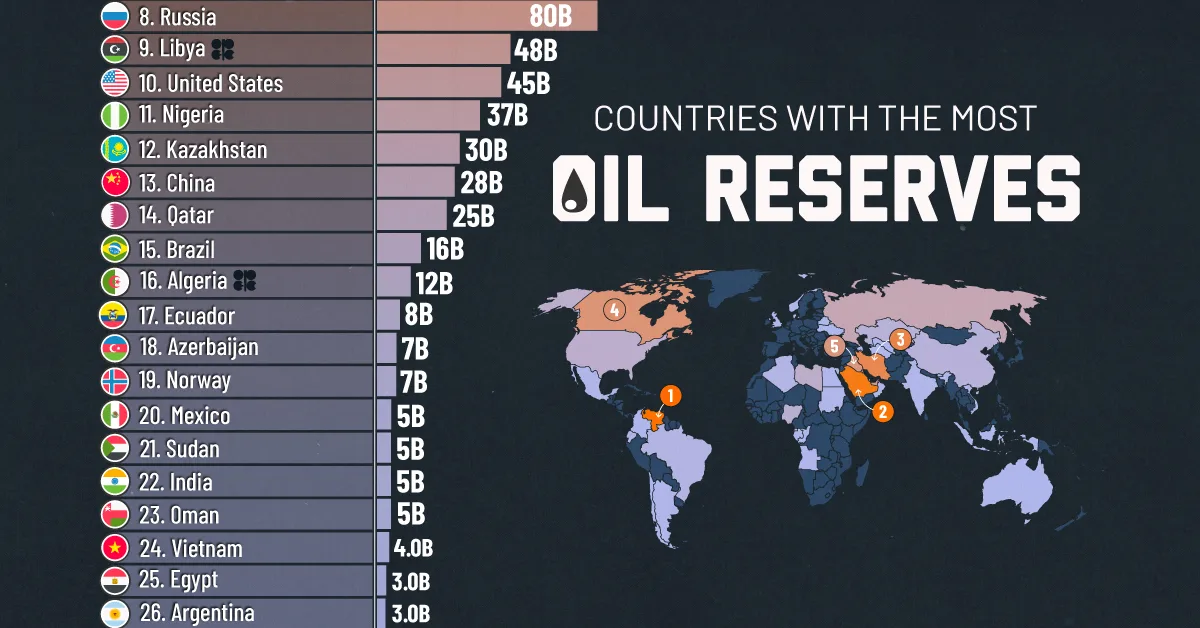
 See more visuals like this on the Voronoi app.
How Venezuela’s Oil Reserves Compare to the Rest of the World
See visuals like this from many other data creators on our Voronoi app. Download it for free on iOS or Android and discover incredible data-driven charts from a variety of trusted sources.
Key Takeaways
- Venezuela holds the world’s largest proven oil reserves, accounting for about 17% of the global total.
- Despite its vast reserves, Venezuela’s oil production remains a fraction of its historical peak.
Venezuela sits atop the largest oil reserves on the planet, yet its role in global energy markets is far smaller than in past decades.
While countries like the United States and Saudi Arabia dominate daily oil production, Venezuela’s output has steadily declined over the past several decades.
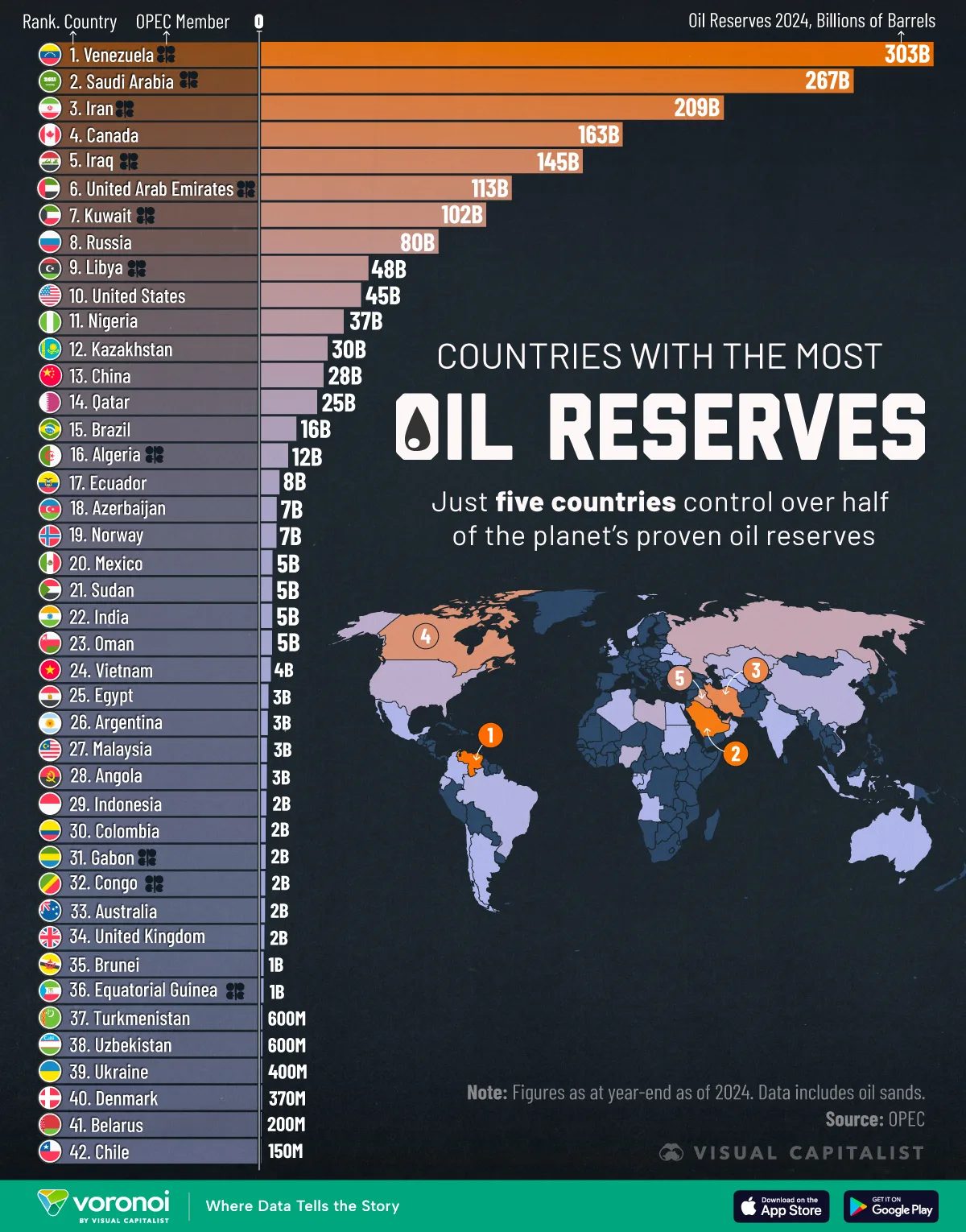
This visualization compares proven oil reserves across major producing countries. Reserves represent the volume of oil that can be economically produced under current conditions. The data for this visualization comes from OPEC’s Annual Statistical Bulletin 2025.
Venezuela’s Unmatched Reserve Base
Venezuela holds an estimated 303 billion barrels of proven oil reserves, the largest of any country and well ahead of Saudi Arabia. These reserves account for roughly 17% of the global total.
Most of this oil is concentrated in the Orinoco Belt, where deposits are predominantly heavy crude. While abundant, this type of oil is more expensive to produce and requires specialized infrastructure.
| Rank | Country | 2024 (Billion Barrels) |
|---|---|---|
| 1 |  Venezuela Venezuela |
303,221 |
| 2 |  Saudi Arabia Saudi Arabia |
267,200 |
| 3 |  Iran Iran |
208,600 |
| 4 |  Canada Canada |
163,000 |
| 5 |  Iraq Iraq |
145,019 |
| 6 |  United Arab Emirates United Arab Emirates |
113,000 |
| 7 |  Kuwait Kuwait |
101,500 |
| 8 |  Russia Russia |
80,000 |
| 9 |  Libya Libya |
48,363 |
| 10 |  United States United States |
45,014 |
| 11 |  Nigeria Nigeria |
37,280 |
| 12 |  Kazakhstan Kazakhstan |
30,000 |
| 13 |  China China |
28,182 |
| 14 |  Qatar Qatar |
25,244 |
| 15 |  Brazil Brazil |
15,894 |
| 16 |  Algeria Algeria |
12,200 |
| 17 |  Ecuador Ecuador |
8,273 |
| 18 |  Azerbaijan Azerbaijan |
7,000 |
| 19 |  Norway Norway |
6,912 |
| 20 |  Mexico Mexico |
5,136 |
| 21 |  Sudan Sudan |
5,000 |
| 22 |  India India |
4,981 |
| 23 |  Oman Oman |
4,971 |
| 24 |  Vietnam Vietnam |
4,400 |
| 25 |  Egypt Egypt |
3,300 |
| 26 |  Argentina Argentina |
2,999 |
| 27 |  Malaysia Malaysia |
2,700 |
| 28 |  Angola Angola |
2,550 |
| 29 |  Indonesia Indonesia |
2,410 |
| 30 |  Colombia Colombia |
2,019 |
| 31 |  Gabon Gabon |
2,000 |
| 32 |  Congo Congo |
1,811 |
| 33 |  Australia Australia |
1,803 |
| 34 |  United Kingdom United Kingdom |
1,500 |
| 35 |  Brunei Brunei |
1,100 |
| 36 |  Equatorial Guinea Equatorial Guinea |
1,100 |
| 37 |  Turkmenistan Turkmenistan |
600 |
| 38 |  Uzbekistan Uzbekistan |
594 |
| 39 |  Ukraine Ukraine |
395 |
| 40 |  Denmark Denmark |
365 |
| 41 |  Belarus Belarus |
198 |
| 42 |  Chile Chile |
150 |
Despite its reserve dominance, Venezuela ranked just 21st in oil production in 2024, producing about 960,000 barrels per day.
At its peak in the 1970s, the country pumped as much as 3.5 million barrels per day, representing more than 7% of global output at the time. Production fell sharply during the 2010s and averaged roughly 1.1 million barrels per day last year, or about 1% of global production.
Politics, Sanctions, and Investment Challenges
Decades of mismanagement, underinvestment, and international sanctions have constrained Venezuela’s oil sector.
Although some Western firms, including U.S.-based Chevron, continue to operate in the country, their presence has diminished significantly as sanctions expanded and exports were targeted.
Venezuela was a founding member of OPEC, alongside Iran, Iraq, Kuwait, and Saudi Arabia, but its influence within the group has waned as production declined.
Learn More on the Voronoi App
If you enjoyed today’s post, check out The Future of World Energy Supply (2024–2050), Charted on Voronoi, the new app from Visual Capitalist.
- Source: https://www.visualcapitalist.com/how-venezuelas-oil-reserves-compare-to-the-rest-of-the-world/