

Asia is stepping into a powerful new phase of climate leadership. Once dominated by fragmented pilot programs and uneven policies, the region’s carbon markets are now evolving into ambitious, interconnected systems. Together, they could help bridge an estimated $800 billion annual climate finance gap while accelerating the global push toward net zero.
The latest World Economic Forum (WEF) report, “Asia’s Carbon Markets: Strategic Imperatives for Corporations 2025,” sends a clear message. Carbon markets are not just compliance tools. They are strategic engines that can deliver cost savings, innovation, risk protection, and competitive advantage. With China’s emissions trading system (ETS) projected to reach tens of billions in value by 2030 and regional cooperation accelerating, companies that move early could unlock big wins. Those who delay risk losing ground in the fast-moving decarbonization race.
Asia’s Carbon Markets: Big Emissions, Bigger Opportunity
Asia produces more than half of the world’s greenhouse gas emissions and drives around 55% of global GDP. Yet regional carbon markets currently cover only a fraction of Asia’s emissions. That gap signals massive untapped potential.
Today, Northeast Asia leads the charge. Japan runs cap-and-trade and voluntary mechanisms. South Korea operates a strong national ETS. China, the region’s heavyweight, continues to expand its national ETS and relaunched its Chinese Certified Emissions Reduction (CCER) program to support high-quality offsets. Meanwhile, Singapore’s carbon tax is gaining global attention, and ASEAN is pushing toward common frameworks to support cross-border trading. Japan’s Joint Crediting Mechanism (JCM) also showcases how bilateral cooperation can unlock climate finance while supporting partner countries.
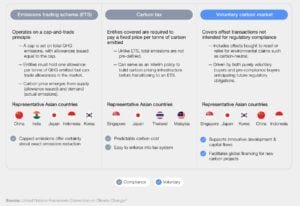
China’s latest climate commitments mark a major turning point. The country aims to reduce economy-wide emissions below peak levels by 2035 while expanding ETS coverage to sectors like steel, cement, and aviation. Demand for CCER credits could reach 300–500 million tonnes per year by 2030, boosting liquidity while still keeping integrity in focus.
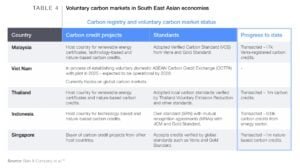
India, Indonesia, Vietnam, and other Southeast Asian nations are also pushing ahead. However, fragmentation, inconsistent rules, and uneven standards still hold back efficiency. This is where Article 6 of the Paris Agreement becomes essential. It provides the legal foundation to enable credible international carbon trading, prevent double counting, and facilitate market connections across borders.
- RELATED: Indonesia Aims to Sell $1B Carbon Credits at COP30, While Other Countries Step Up Their Carbon Plans
The Path to Regional Carbon Market Integration
The WEF outlines a practical roadmap to transform Asia’s patchwork of systems into a powerful regional network. This approach centers on trust, transparency, and high-integrity climate outcomes.
- Build a Regional Carbon Market Council
A coordinated governance body could align standards, share data, settle disputes, and push long-term collaboration. Think of it as an “ASEAN-plus” climate platform with real authority. - Harmonize Rules and Methodologies
Markets need a common language. Aligning monitoring, reporting, verification (MRV), additionality benchmarks, and eligibility rules would allow companies to trade with confidence across markets from Tokyo to Jakarta. - Invest in Digital Infrastructure
Digital registries, blockchain systems, and AI-driven verification tools can help reduce fraud, speed transactions, and build trust. Better technology means faster trading and cleaner data. - Launch Cross-Border Carbon Trading Corridors
Strategic bilateral pilots—such as expanding Japan-Singapore cooperation—can prove what works, create confidence, and show real economic value. - Reward Early Movers
A structured acceleration program could support companies that invest early in cross-border market initiatives, helping scale high-quality climate projects while unlocking fresh capital.
If done right, these steps could mobilize billions of dollars for Asia’s energy transition. They could also help direct investment to countries with lower-cost abatement options, creating a fairer and more efficient climate finance ecosystem.
- READ MORE: Voluntary Carbon Market in 2026: Top Forecasts and What They Mean for Investors
- ALSO READ: Global Carbon Pricing and Revenues: How Carbon Markets Hit Over $100 Billion
Why Corporations Need to Act Now
For businesses, carbon markets are no longer simply about ticking regulatory boxes. They influence competitiveness, pricing, investment choices, and long-term business survival. The WEF identifies three key corporate imperatives.
Imperative 1: Engage Early
Companies that enter markets sooner gain strategic advantages. They can hedge price risks, secure high-quality offsets, and prepare for tighter future rules. Firms in China or Korea, for example, can already use offsets to meet part of their compliance needs—often at far lower costs than internal abatement.
Imperative 2: Reinvent Supply Chains
Carbon exposure does not stop at factory gates. Businesses need to understand emissions across suppliers and logistics chains. Partnering on climate projects—such as reforestation, renewable energy, biochar, or methane reduction—can create new value streams while managing regulatory risk. Early action may also shield exporters from potential cross-border carbon taxes in markets like Europe.
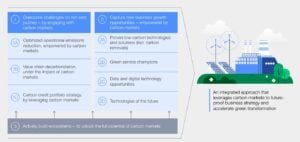
Imperative 3: Transform Business Strategy
Carbon must move from sustainability departments into boardroom decision-making. Companies are beginning to apply internal carbon prices, often around $50 per tonne, to guide investment. This shifts capital toward electrification, efficiency upgrades, carbon capture, and other future-proof technologies. Studies already show significant financial upside when firms integrate market strategy with decarbonization planning.
China: The Region’s Powerhouse
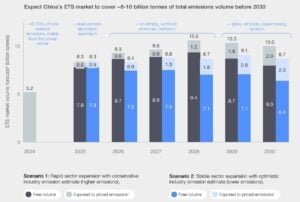
China remains the anchor of Asia’s carbon market story. Its ETS already covers power emissions at an unprecedented scale and is set to expand to heavy industries by mid-decade. Analysts expect coverage to reach 8.7–10.6 billion tonnes by the late 2020s.
Meanwhile, the CCER revival focuses on quality. Key areas include forestry, renewables, and methane capture. Many projects are being designed to align with Article 6 eligibility, opening the door to potential international demand as global buyers look for credible reductions.
China is also tightening rules. Benchmarks are expected to strengthen steadily by 2026, prompting industries to decarbonize more rapidly. That means corporate strategy matters. Companies preparing now—by improving efficiency and securing offsets—will stand stronger when compliance pressure rises.
- SEE MORE:
- China Revives Its Carbon Credit Market: Price Swings & Future Outlook
- China Moves Toward Carbon Cap: Xi Jinping Pledges 7–10% Emissions Cut by 2035
Opportunities, Risks, and the Global Impact
Asia’s carbon integration could reshape global climate economics. The region has the potential to supply 1–2 gigatonnes of credits annually, helping cut global decarbonization costs and improving access to finance.
Yet challenges remain. Differences in baselines and accounting systems raise risks of double-counting. Political tensions could disrupt cooperation. Market credibility will depend on strong regulation, transparency, and trust.
Still, momentum is real. New coalitions, government partnerships, and private sector investments continue to build confidence. Asia is moving from experimentation to execution.
The Bottom Line: Move Now or Fall Behind
Asia’s carbon markets are accelerating toward a defining moment around 2026. Policies are tightening. Digital systems are improving. Cross-border cooperation is growing. And corporations are realizing that carbon strategy equals business strategy.
Companies cannot afford to wait. They should:
- Audit emissions and compliance exposure
- Explore trading opportunities and pilot projects
- Engage policymakers and industry platforms
- Invest in credible, high-quality climate solutions
Those who act early will shape markets, reduce risks, and build competitive strength in a trillion-dollar low-carbon economy. Those who hesitate may find themselves outpaced in a decarbonizing world.
Asia is no longer just part of the climate story. It is becoming the engine of the next chapter.
The post How China’s Carbon Market Is Fueling Asia’s Biggest Climate Finance Opportunity appeared first on Carbon Credits.


