
Microsoft’s (MSFT) strategic partnership with the Midcontinent Independent System Operator (MISO) marked a major shift in how the US power grid adapts to rising electricity demand. Announced on January 6, 2026, the collaboration brought artificial intelligence and cloud computing directly into grid operations.
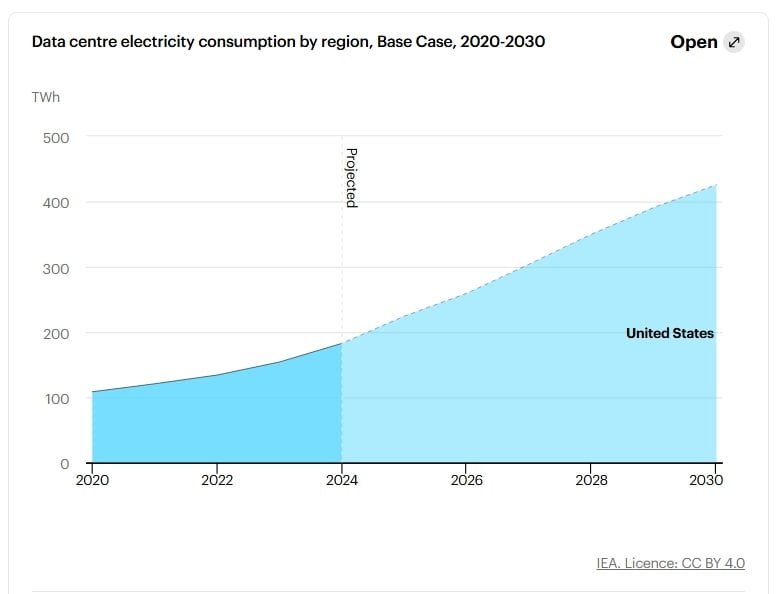
As per IEA, US data centers consumed about 183 terawatt-hours (TWh) of electricity in 2024. That represented more than 4% of total US power use. AI workloads continue to push that number higher. Thus, the goal was clear: prepare the grid for explosive growth from data centers, electrification, and clean energy—without sacrificing reliability or climate goals.
MISO’s Grid Faces a New Era of Relentless Demand Growth
MISO operates one of the largest power systems in North America. It serves about 42 million people across 15 US states and the Canadian province of Manitoba. At peak times, the grid handles around 127 gigawatts of electricity.
That scale now faces unprecedented strain. AI-driven data centers, electric vehicles, heat pumps, and industrial electrification are pushing electricity demand higher. MISO’s interconnection queue already holds more than 350 gigawatts of proposed new generation—most of it wind, solar, and storage. Legacy planning tools struggle to keep pace with evolving needs.
Extreme weather adds another layer of risk. Heatwaves, cold snaps, and storms test grid reliability just as renewable output fluctuates. At the same time, delays in transmission approvals slow the connection of clean energy projects.
MISO has made progress. It approved roughly $22 billion in long-term transmission investments, designed to support up to 120 gigawatts of new resources. Wind and solar already hit record levels, including a new solar peak in early 2025. Still, aging infrastructure and fragmented data systems limit how fast the grid can evolve.
This is where Microsoft comes into play.
How Microsoft’s AI and Cloud Tools Change Grid Operations
The partnership centers on building a unified data platform using Microsoft Azure and Foundry AI. Instead of siloed systems, MISO gains a single, secure environment to analyze grid conditions in near real time. And the impact shows up across operations.
Better Forecasting and Planning
AI models improve long-term transmission planning. They simulate how wind, solar, storage, and demand growth interact across seasons and weather scenarios. This helps MISO plan lines that reduce congestion, limit curtailment, and avoid overbuilding fossil backup power.
Faster, Smarter Reliability Decisions
Machine learning tools detect abnormal grid conditions earlier. During extreme weather, AI helps operators diagnose problems and respond faster. MISO already tested similar tools during winter events, where they improved market efficiency and system coordination.
Easier Collaboration and Innovation
Microsoft tools like Power BI and Microsoft 365 Copilot allow teams to visualize data and share insights quickly. Analysts spend less time cleaning data and more time solving problems. This speeds up innovation and supports faster decision-making as conditions change.
Together, these upgrades turn the grid from a reactive system into a predictive one.
Data Centers Are Reshaping US Electricity Demand
EIA’s data shows demand rose to around 200 TWh in 2025 and can surpass 250 TWh in 2026. By 2030, consumption could double or even triple, reaching 426 TWh or more. Hyperscalers like Microsoft drive much of this growth.
This surge reversed a long-standing trend. From 2010 to 2020, US electricity generation declined slightly each year. Since 2021, growth returned. Generation rose about 2% annually and is expected to increase by 2.4% in 2025 and 1.7% in 2026.
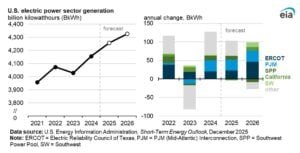
Regional impacts vary. Texas (ERCOT) and the Mid-Atlantic/Ohio Valley (PJM) see the fastest growth. PJM demand is expected to rise more than 3% annually through 2026. ERCOT could see double-digit growth as large loads come online.
Energy mixes are shifting, too. Natural gas remains dominant, but solar grows fastest. In ERCOT, solar generation may jump more than 90% between 2024 and 2026. In PJM, coal and solar both expand as demand surges.
MISO sits between these regions, making grid efficiency critical to prevent higher emissions.
Grid Intelligence: A Tool to Control US Emissions
Smarter grids directly support decarbonization. When operators forecast conditions more accurately, they rely less on fossil fuel peaker plants. Better transmission planning reduces renewable curtailment. Faster responses during stress events avoid inefficient emergency generation.
EIA expects total CO2 emissions in 2025 and 2026 to be 1.9% and 0.9% higher, increases in 2026 are associated with relatively higher natural gas-fired electricity generation, associated with rising electricity demand for data centers and cryptocurrency mining.

Thus, these improvements can potentially lower system-wide emissions—even as electricity demand rises. Even though challenges remain, the benefits outweigh the risks. Data privacy, cybersecurity, and regulatory alignment need careful management. Grid operators must also ensure AI tools remain transparent and auditable.
In conclusion, the Microsoft–MISO alliance shows how technology can unlock the next phase of the energy transition. Likewise, Google and other hyperscalers have also launched similar initiatives with PJM.
In short, AI will not just support the grid—it will become a core tool for decarbonization across the United States.
The post Microsoft–MISO AI Partnership Sets Path for Smarter, Cleaner US Electricity Grid appeared first on Carbon Credits.


