
L’Oréal, the global beauty giant, has unveiled its first cohort of startups participating in its new sustainable innovation program, L’AcceleratOR. The program chose 13 startups focused on climate, nature, and circularity. They were selected from nearly 1,000 applicants across 101 countries. It aims to find, pilot, and scale solutions that address key environmental challenges in the beauty industry and beyond.
The initiative is part of L’Oréal’s larger sustainability plan, called “L’Oréal for the Future.” This plan includes bold goals for climate action, resource use, and a shift to a circular economy by 2030 and beyond.
Inside L’AcceleratOR: Funding, Pilots, and Scale
L’AcceleratOR is a €100 million (about US$116 million) sustainable innovation program. The funding will be provided over a five-year period. The program helps startups and small to medium-sized enterprises (SMEs) that create sustainable solutions for L’Oréal and the beauty industry.
L’AcceleratOR is in partnership with the University of Cambridge Institute for Sustainability Leadership (CISL). Selected startups will enter an intensive support phase led by CISL. They will receive funding, expert guidance, and access to L’Oréal’s research and testing capabilities. The aim is to help these companies become pilot-ready and scale their solutions for broader use.
The accelerator focuses on key strategic themes tied to L’Oréal’s sustainability goals:
- Next-generation packaging and materials
- Nature-sourced ingredients
- Circular solutions
- Data intelligence tools to measure and reduce environmental impacts
Startups may run six- to nine-month pilots with L’Oréal and its partners. Successful pilots may be scaled across global operations if they show measurable benefits.
Ezgi Barcenas, Chief Corporate Responsibility Officer, remarked:
“To accelerate sustainable solutions to market, we are being even more intentional and inclusive in our pursuit of partnerships through “L’AcceleratOR”. We are really energized to be co-designing the future of beauty with the University of Cambridge Institute for Sustainability Leadership, and these 13 change makers.”
The 13 Startups and Their Focus Areas
The selected startups and SMEs represent a range of sustainable innovations across climate, nature, and circularity. They fall into four main categories:
- Packaging and materials
- Nature-sourced ingredients
- Circular solutions
- Data intelligence
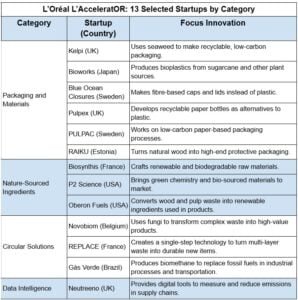
These 13 startups use different ways to cut environmental impact. They focus on product design, supply chain management, and manufacturing to promote circularity.
How L’AcceleratOR Fits L’Oréal’s 2030 Strategy
L’AcceleratOR is part of L’Oréal’s broad 10-year sustainability roadmap, “L’Oréal for the Future.” The roadmap covers four main areas: climate, nature, materials circularity, and communities. It includes the 2030 goals that aim to transform operations while driving innovation in sustainable solutions.
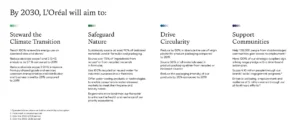
Some of L’Oréal’s key targets under the roadmap include:
- 100% renewable energy for all operations.
- Sustainable sourcing of at least 90% bio-based materials in formula and packaging.
- 100% recycled or reused water for industrial purposes.
- Reducing virgin plastic use by 50%.
- Sourcing 50% of packaging from recycled or bio-based materials.
- Cutting Scope 1 and 2 emissions by 57% and some Scope 3 emissions by 28% against a baseline year.
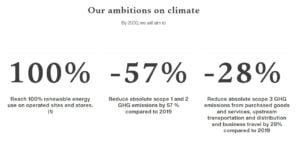
The L’AcceleratOR program expands these efforts by tapping external innovation. L’Oréal supports startups to speed up solutions that can cut environmental impacts throughout its value chain.
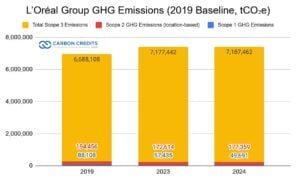
L’Oréal’s Scope 3 emissions are by far the largest part of its footprint, as seen below. This reflects impacts from sourcing, production inputs, logistics, product use, and end-of-life. In 2024, Scope 1 and 2 fell further to about 227,051 tCO₂e, showing continued reductions in direct and energy-related emissions. Total emissions, though, remained roughly stable at 7.41 million tCO₂e, increased with Scope 3 again the largest component.
L’Oréal also has other sustainability initiatives. For example, its Fund for Nature Regeneration has invested more than €25 million (about US$29.1 million) in projects like forest, mangrove, and marine ecosystem restoration. This reflects L’Oréal’s commitment to nature and biodiversity alongside climate action.
Water stewardship is another strategic focus. In 2024, 53% of the water used in L’Oréal’s industrial processes came from reused and recycled sources. This was supported through water recycling systems in areas facing water stress.
Implications for the Beauty and Consumer Goods Sector
L’Oréal’s accelerator initiative reflects a larger industry trend. Many global companies are increasingly investing in sustainable technologies through partnerships, incubators, and venture funds. These partnerships aim to speed up climate, nature, and circular solutions. They combine corporate scale with startup agility.
The L’AcceleratOR program connects L’Oréal with companies that use innovation and partnerships to achieve their environmental goals. It also shows that sustainability strategies can go beyond internal changes. They can support the larger ecosystem, too. Helping startups scale can benefit whole industries, not just single companies.
This trend is important in areas like packaging, materials science, green chemistry, and digital climate tools. Packaging waste and carbon emissions from supply chains are major problems for consumer goods. This is especially true in beauty and personal care.
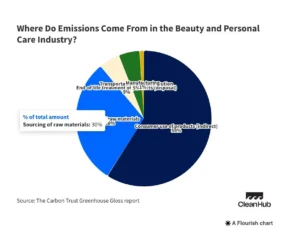
The beauty industry accounts for about 0.5% to 1.5% of global greenhouse gas emissions. Most of these emissions come from the value chain, not from company factories. For many beauty companies, around 90% of total emissions are Scope 3, such as raw materials, packaging, transport, and product use.
Raw material sourcing, including agricultural inputs and plastics, can make up 30% to 50% of industry emissions. Consumer use also adds a large share, especially for products that require water and heat.
The industry produces about 120 billion beauty packaging units each year worldwide. Much of this packaging is single-use and hard to recycle. A typical beauty product can generate several kilograms of CO₂-equivalent over its life cycle, from production to disposal.
Notably, most emissions are in the value chain. So, new solutions in packaging, materials, and data tools are key to cutting the beauty sector’s climate impact. This is what L’Oréal seeks to address. By supporting solutions in these areas, it hopes to change old industry practices.
Early Expectations and Next Steps
The 13 selected startups will now enter the pilot readiness phase of the L’AcceleratOR program. During this phase, the startups will refine their technologies with CISL guidance and L’Oréal support. The goal is to ensure their solutions are ready for real-world testing in commercial environments.
If pilot outcomes are successful, solutions may be scaled beyond initial tests. Some could fit into L’Oréal’s global operations or be used by industry partners. This would speed up sustainable progress.
L’Oréal and CISL plan future cohorts for the L’AcceleratOR program. Future rounds will create chances for more companies. They will also expand the pipeline of sustainable solutions.
By partnering with the University of Cambridge Institute for Sustainability Leadership and supporting startups across packaging, materials, ingredients, circular systems, and data tools, L’Oréal aims to fast-track real solutions that reduce environmental impacts.
The initiative boosts L’Oréal’s sustainability plan, “L’Oréal for the Future.” This plan sets bold goals for 2030, focusing on renewable energy, resource use, cutting emissions, and promoting circularity.
The pilot and scaling opportunities in the program can help new technologies join global supply chains. This support will aid L’Oréal and its partners in tackling climate, nature, and circular economy challenges towards its net-zero goals.
The post L’Oréal Taps 13 Global Startups to Boost Climate, Nature, and Circular Innovation appeared first on Carbon Credits.


