
The American Soybean Association’s World Initiative for Soy in Human Health program continues to expand markets for U.S. soy in Central Asia. The rapidly advancing region is creating promising new opportunities for soybean farmers across both the food and feed sectors. Kazakhstan, Kyrgyzstan, Tajikistan, Turkmenistan, Georgia, Armenia, Azerbaijan and Uzbekistan are poised to increase their demand for high-quality protein, positioning U.S. soy at the forefront of expansion.
WISHH has worked with partners in several of these countries over the past few years. It has sponsored trade teams as well as brought partners to the United States where they met with growers and learned about innovations in soybean processing, product development, and new food applications for soy. But a new phase of WISHH’s work in Central Asia is kicking into gear.
A key driver of the momentum is WISHH’s Trans-Caspian Corridor U.S. Soy Strategy, which also aligns with heightened U.S. interest and investment in Central Asia. The Trans-Caspian Strategy is an approach to expanding U.S. soy exports into markets with rapidly growing populations and economies by focusing on capacity-building and targeted marketing. It also addresses buyer education, regulatory challenges and logistics.
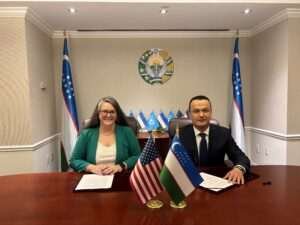
WISHH Executive Director Gena Perry signs a memorandum of understanding with the Uzbekistan Ministry of Investment, Industry and Trade. The MoU will, in part, build connections between Uzbek buyers and U.S. soy suppliers.
“Right now, the United States has less than 1% of the market share for soybean trade in the region, but we are on a road to change that,” said WISHH Executive Director Gena Perry. “We are leveraging funding from USDA with both the state and national soy checkoffs in countries that we feel are one of the next frontiers for trade.”
That alignment was on display in December when WISHH and the government of Uzbekistan formalized a collaboration by signing a memorandum of understanding to expand the country’s soy value chains and advance trade between the two countries. The parties signed the MoU against the backdrop of the C5+1 Summit annual meeting between the United States and the five Central Asian countries. The agreement provides the groundwork for a commitment to improving food security, strengthening private-sector capacity and building connections between Uzbek buyers and U.S. soy suppliers. As Uzbekistan’s poultry, dairy and aquaculture industries continue to grow, so does its need for high-quality protein sources to meet domestic demand.
Additionally, farmer support is key to WISHH’s strategy in the region. For example, the Minnesota Soybean Research & Promotion Council was among the first to recognize Uzbekistan’s potential as a future soy market. Through its checkoff program, the council invested in early market development and relationship-building that helped introduce U.S. soy to local feed and food industries. Minnesota’s work with WISHH helped open doors with local partners, raise awareness about the value of U.S. soy and establish key partnerships that are growing across Central Asia.
Farmers realize WISHH’s role in creating demand for U.S. soy means scouting long-term global trends and having a sound plan in these emerging and developing markets.
“WISHH’s staff puts work into finding markets that offer real potential for the soybeans we grow,” said WISHH Committee Chair Morey Hill, noting WISHH celebrated its 25th anniversary in 2025. “From market assessments to well-thought-out strategic plans, you can see why us farmers are excited about the next 25 years.”
The post WISHH Leads U.S. Soy Expansion in Central Asia’s Emerging Markets appeared first on American Soybean Association.


