

Some of the world’s biggest tech companies and space startups are racing to build data centers in space. These orbital data centers are meant to support the massive computing needs of artificial intelligence (AI). Companies see space as a place to get abundant solar energy and natural cooling without the limits of Earth’s power grids. This idea moved from theory to early testing in late 2025–2026 and gained spotlight at the AIAA SciTech Forum 2026 in Orlando, Florida, last week.
Several tech giants, including Google, SpaceX, and Blue Origin, are exploring space‑based computing. At the same time, startups like Starcloud have already launched prototypes with advanced AI hardware into orbit. These efforts reflect growing interest in solving energy, cooling, and infrastructure challenges that terrestrial data centers face.
Why the Tech Giants Look to Space
AI needs more computing power than ever. Traditional data centers on Earth use huge amounts of electricity and water for power and cooling. In the U.S., data centers used over 4% of total electricity in 2024 and could increase to between 6.7% and 12% by 2028 if current trends continue.
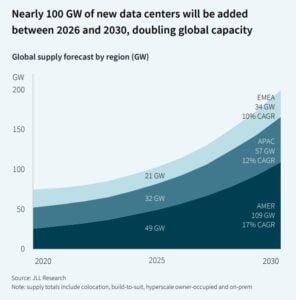
At the same time, global data center electricity demand may nearly double by 2030 to about 945–980 terawatt‑hours per year due to AI and cloud services.
- Space offers two major advantages: near‑constant solar power and natural cooling.
Solar panels in orbit can be up to 8x more efficient than on Earth because there is no atmosphere to block sunlight. Heat can also be released directly into space by radiation, without the need for water‑based cooling systems.
These factors could lower energy costs and help AI computing scale without straining terrestrial power systems. Companies see space as a place where solar energy is abundant, and energy from the sun is almost always available, especially in certain orbits.
What the Tech Giants Are Doing
Google: Project Suncatcher
Google has announced a research initiative called Project Suncatcher. The project aims to put AI computing hardware into orbit using solar‑powered satellites.
The tech giant plans to launch two prototype satellites equipped with its own AI chips by early 2027 to test whether they can run in space. The goal is to create blueprints for future space‑based data centers.
Google says these satellites will use Tensor Processing Units (TPUs), chips designed for AI tasks, and connect via laser links instead of traditional wires. The company’s CEO said that using solar energy in space could help support the AI industry’s rapidly rising computing needs.
Starcloud: First AI Model in Orbit
Starcloud, a startup backed by Nvidia and venture capital firms, has achieved an important milestone. In late 2025, the company launched a satellite called Starcloud‑1 carrying an Nvidia H100 GPU. This satellite successfully trained and ran AI models, including a version of Google’s Gemma model, in orbit. This marked the first AI model training in space.
Starcloud aims to expand this capability with future satellites. The company has proposed building a large space data center with about 5 gigawatts (GW) of solar panels spread over several kilometers. The design would deliver more compute power than many terrestrial data centers with efficient energy use.
SpaceX and Blue Origin
Elon Musk‘s SpaceX and Blue Origin are also exploring space data centers. SpaceX plans to use its Starlink satellite network and future satellites that could carry AI compute hardware.
Reports suggest SpaceX may launch upgraded Starlink satellites with terabit‑class capacity starting in 2026. Musk has also talked about using reusable rockets to place larger compute hubs into orbit at scale.
Blue Origin, backed by Jeff Bezos, reportedly has a team working on technology for orbital data centers. The aim is to develop systems that can support AI workloads beyond Earth. These efforts build on Blue Origin’s long history in rocket and space technology.
Global Competition: Startups and Nations Join In
Space data centers are attracting attention beyond the big tech names. Multiple startups and international players are racing to build compute infrastructure in orbit.
Companies like PowerBank Corporation and Orbit AI are planning space‑based nodes or cloud services powered by solar energy. Moreover, Axiom Space has outlined plans for data center modules on its private space station by 2027.
Outside the U.S., China is also advancing space compute projects. The Three‑Body Computing Constellation aims to deploy thousands of satellites equipped with high‑performance GPUs and AI models. The long‑term goal is to provide a combined computing capacity of 1,000 peta‑operations per second (POPS) — a measure of compute power far beyond many ground‑based supercomputers.
This global competition highlights how nations and companies see orbital data centers as strategic infrastructure for AI and other advanced computing tasks.
Challenges and Engineering Hurdles Above the Atmosphere
Building data centers in space is not easy. Engineers must solve many technical problems before full‑scale orbital centers become common.
- Radiation: Space radiation can damage GPUs and other chips. Orbital data centers need heavy shielding and backup hardware.
- Cooling: Space has no air or water. Systems must use radiative cooling, which is complex but essential.
- Debris: Crowded orbits raise collision risks. Large structures could worsen the Kessler syndrome.
- Costs: Launching hardware is costly. Firms expect costs to fall to about $200 per kilogram by the mid-2030s, improving feasibility.
Potential Benefits: Solar, Cooling, and Scaling
Despite the challenges, space‑based data centers offer potential benefits that are hard to match on Earth. More remarkably, the market is set for rapid growth as demand for AI compute expands.
Analysts expect the market to rise from about $1.77 billion in 2029 to nearly $39.1 billion by 2035. This shows an annual growth rate of about 67.4%. This surge is driven by rising AI workloads, growing satellite constellations, and the need for more sustainable, high-performance computing beyond Earth-based limits.

Major advantages of orbital data centers include:
Continuous Solar Power
Satellites in certain orbits can receive sunlight almost 24 hours a day. This could allow data centers to run on clean solar energy constantly, without interruptions from night, clouds, or weather. Solar panels in orbit operate at efficiencies up to eight times those on Earth’s surface.
Natural Cooling
The vacuum of space can help with cooling. Heat radiates into cold space at temperatures as low as 4 Kelvin (−269°C). This natural cooling eliminates the need for water‑intensive cooling systems used by terrestrial data centers.
Compute Scaling
As AI models grow larger, so too does their compute demand. Space data centers could provide new capacity that is not limited by Earth’s land, water, or grid constraints. If prototypes prove successful, large orbital systems might be scaled over the next decade.
Future Outlook: Will AI Go Beyond Earth?
Tech companies and startups are actively exploring space‑based data centers to meet the rapidly rising computing requirements of AI. Google’s Project Suncatcher, Starcloud’s prototypes, and efforts by SpaceX and Blue Origin show that orbital compute infrastructure is moving from concept to early reality.
Space offers nearly constant solar energy and natural cooling, which could ease the energy and environmental pressures associated with traditional data centers. Still, radiation, heat management, space debris, and launch costs are major challenges ahead.
The next few years — especially prototype launches around 2027 — will show whether space data centers can become a practical part of the future AI infrastructure landscape.
The post Tech Giants Like NVIDIA and Google Eye Space to Power AI with Orbital Data Centers appeared first on Carbon Credits.


