Today, anaerobic digestion provides a proven way to value-add to manure, which of course is already a highly valuable commodity by itself. There are about 400 manure digesters in the U.S., mostly using dairy manure, but also swine, poultry, and beef manure, with hundreds more in Europe and other locations around the globe. Biogas from the process can generate electricity and/or heat, and can power vehicles as well, all while reducing farm GHG emissions and providing digestate to use as fertilizer or bedding. This provides revenue for farmers once ROI is achieved.
Digesters come in full-sized and mini models but generally make more economic sense for large operations because of the capital costs, but also the need to manage the anaerobic process effectively for sufficient ongoing gas production.
But what about the aerobic process? We all know that aerated manure composting provides a huge amount of heat. Simple but innovative systems to capture that heat can be built and managed easily and cheaply. This makes them very well suited for the many smaller farms of New England, other similar regions of North America, and beyond.
“Comparing the two ways to harvest energy from manure, anaerobic and aerobic, digesters are known about but not common, but systems that harvest energy aerobically, what we are doing, they are very rare globally,” says Sazan Rahman, assistant professor and controlled environment agricultural researcher at the University of New Hampshire (UNH).
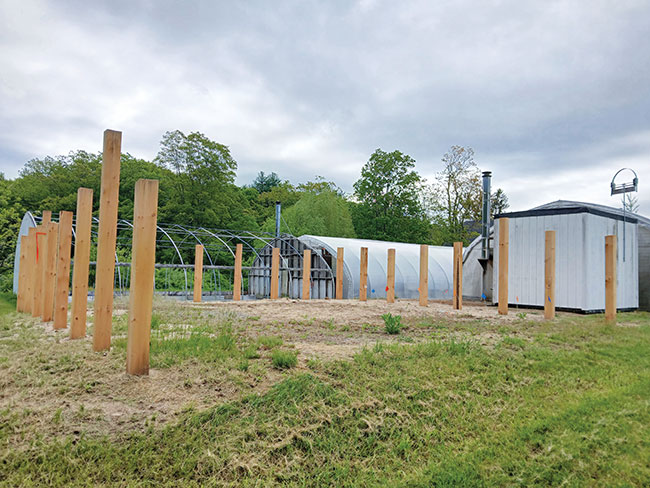
Rahman and one of his graduate students, Hafizur Rahman, have recently designed two heat capture and transfer systems from composting manure, with a comparison of their performances to start this coming winter at the UNH Woodman Horticultural Research Farm.
Hailing from Bangladesh, Sazan Rahman did his masters in mechanical engineering and Ph.D. in bioresource engineering degrees in Canada, investigating how to optimize the energy consumptions in controlling the heating, ventilation and air conditioning for agricultural buildings and how renewable energy sources like geothermal, solar and manure can be integrated into those controlled environment agricultural systems (greenhouses being the main example). He started at UNH in mid-2023 and had discussions there with John Aber, who has since retired but had studied how biofilters can be used to reduce gases such as ammonium from composting manure, allowing the warm air from the composting process to be safely used. Aber had done his research at UNH’s Organic Dairy Research Farm, where the Joshua Nelson Energy Recovery Compost Facility was built in 2013. The system uses a heat exchanger, enabling heat from the composting manure to warm water that’s further heated and used for cleaning and sterilizing milking equipment.
“I also started reading papers and looking at ideas and secured a grant from NH Agricultural Experiment Station that allowed a graduate student to work on the project,” explains Rahman. “There is so much potential to use manure in this way, in this region and other similar regions. Only 6,329 out of 30,717 farm in New England’s six states apply manure to the field, mainly because of risks related to pathogenic bacteria. So, there is a huge amount of energy going to waste. Instead of letting that happen, you can build simple, low-costs systems that can capture and use that energy for many uses, including food production.”
Imagining the possibilities
One scenario to use the heat could be a farm in New Hampshire where the farmer constructs a commercial greenhouse on site. And while yes, there’s a substantial capital cost to that, if heat from the farm’s manure can support year-round production of vegetables, ROI on capital costs can be achieved relatively swiftly, with operational costs minimal. There’s little or no natural gas needed to heat the greenhouse, so environmental impact is minimal. In addition, the farmer has another source of income, local food production is boosted, and more manure (in safer, composted form) can be used to fertilize field crops.
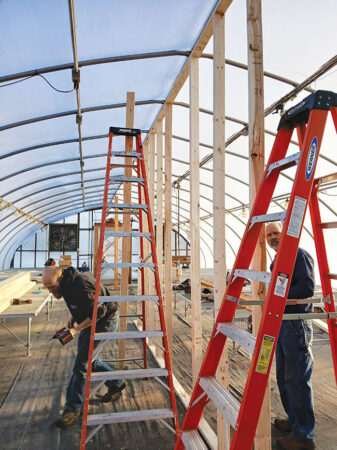
The installation process for the high-tunnel, commercial greenhouses used in the New Hampshire study.
But existing greenhouse operations near farms could also use manure heating during the cold months of each year. Again, like a greenhouse on a farm, avoiding the use of natural gas would be a huge savings and slashes the environmental impact of greenhouse food production. Rahman adds that the manure in either scenario is only composted for seven to 15 days, and in this second scenario, “it can be returned to the farm as fresh manure is picked up. There would be a cost for manure transport, but that might be shared by the farmer and the greenhouse operator. We will look at all the economics as the project progresses.”
But there’s also the value of composted manure. While much of that value depends on composting expertise and manure type, the high temperatures during composting destroy bacteria such as E. coli, and species of salmonella and campylobacter that are a concern with the application of raw manure to fields. The heat during composting can also kill weed seeds that may be present. Composted manure generally has a more balanced nutrient profile (although typically lower in nitrogen) than raw manure, releases nutrients more slowly and smells a lot less. Composted manure can also enhance soil structure and soil moisture retention compared to raw manure.
Comparing two systems
As mentioned, Rahman and his graduate student, Hafizur Rahman will be testing two heat capture systems. One involves ‘compost air’ warming a 1000-liter water tank with an adjacent heat pump that distributes heat to the greenhouse. “The induction side of the coil is against the tank, and the other is in the greenhouse,” explains Rahman. “The heat from the coil radiates into the greenhouse environment, and fans constantly circulate that heat through convection.”
The second system directly circulates warm compost air into the greenhouse after gases like ammonium are greatly reduced. This involves a proprietary system that has another function as well. “We also need to dry the air,” Sazan Rahman explains. “The air in greenhouses is already very humid, so we’ve designed a system that results in both dry and clean air.”
Both systems will use manure from the UNH Fairchild Dairy Teaching and Research Center and the UNH Equine Center, blended with waste hay. Rahman explains that cattle manure is very dense and hard to aerate, and without aeration, composting will not occur. Adding horse manure with the bedding mixed in makes the resulting blend more porous. “Horse manure also has a lot of fiber in the form of lignin and a higher content of other materials that enhance microbial activity to a small amount,” says Rahman. “Adding it enables constant heat from the manure composting process and also keeps heat production going longer.”
Over the coming winter and for two more after that, Rahman and Rahman will evaluate and compare the heating efficiency and economics of the two systems (the greenhouse is being partitioned). They will also analyze the crop (hydroponic lettuce in this case) in terms of yield and quality. Automated monitoring systems in the greenhouse and the compost pile will collect data on heat output, air quality and other parameters.
However, there’s some preliminary data from this past winter on temperature, air quality, and heat output that Rahman will present at ASABE 2025 in July (the conference of the American Society of Agricultural & Biological Engineers). “We will also seek feedback from the experts in attendance that will assist us to fine-tune the systems,” says Rahman.


Composting method
The aeration of the compost piles will be achieved through air fed through perforated pipes underneath. “Aeration can also be accomplished with manual turning of the compost, but that adds complexity,” says Rahman. “We also don’t want a system that needs high air pressure, which would mean a lot of ventilation horsepower/energy consumption.” To make aeration through perforated pipes and regular fans work, as mentioned, the material to be composted needs to be good and porous, but it must also be arranged in layers. While the design is proprietary, Rahman can say that it’s an open system with fresh air constantly being introduced into the manure.
An open system does mean that not all the heat from the composting manure is captured, but Rahman explains that if you try to capture more heat through using an enclosed bin system, aeration becomes an issue. In addition, using a compost pile with fresh air constantly being introduced also means that the airborne bacteria in the warm ‘compost air’ is kept at a low level.
Regarding challenges before the trials start this fall, Rahman lists the biggest to be how to best protect the composting manure from rain and snow. “We’re looking at various ways to cover it and insulate it to some extent,” he says, “but we know that in the cold winter temperatures, to keep a large amount of heat being generated from the composting process, we’ll need to introduce new manure frequently. We have to balance the quality of the warm ‘compost air’ with the need for continuous aeration, but we also have to keep the composting process going at a high rate, at a high temperature. We have to look at the heat that the greenhouse needs, how much heat the composting can produce, and how much is lost from the system. Producing 1.7 times the heat that’s needed is generally the safety factor.”
But no matter how fast the progress on these compost heat systems, there are bigger plans afoot. Rahman envisions fully sustainable greenhouses that integrate composted manure heating with other renewable energy sources like solar and geothermal, enabling farmers to produce food with minimal energy use.
“The aspect that’s most exciting is making this work as cheaply as possible so that we can benefit livestock and greenhouse farmers,” he says. “You don’t have to spend a lot of money, just set up a system with some pipes and fans. You get manure from local farms, you use the heat from composting it and the farm gets composted manure back, which is safer and better than raw manure to spread in the fields. There is also more local food and less environmental impact, so it benefits everyone.” •