
Since his presidency began last year, Donald Trump has embarked on an all-out campaign to destroy the nation’s nascent offshore wind industry. He has halted all wind lease sales in federal waters, issued stop-work orders for nearly-completed wind farms, and told oil industry executives that his “goal is to not let any windmills be built.” Last month, his Interior Department said it would terminate five major wind farms that are under construction in the north Atlantic Ocean, citing vague “national security” issues. These wind farms would together generate around 5.6 gigawatts of power, enough to supply around 4 million homes.
Trump’s actions have all but destroyed the U.S. offshore wind industry, which was already facing significant economic challenges during the Biden administration. While developers behind the terminated wind farms recently secured court orders allowing them to complete construction, other potential wind installations have been scrapped, and investors are retreating from offshore projects. Even as solar energy continued to grow at a rapid clip in 2025, wind saw virtually no growth in the United States.
That’s not just bad for the climate — it will also make it harder to keep the lights on in the U.S. northeast. The nation’s densest region is counting on dozens of new wind farms to meet rising power demand; the stretch of coastal states from Maine to Virginia have collectively committed to buy more than 45 gigawatts of offshore wind power by 2040, almost ten times more than the five nearly-complete projects will provide. The region does not have many other good options for filling the gap. Without wind, residents of states like Massachusetts and New York will pay more money for dirtier fuel. The energy future of these states now hinges on whether they can tempt offshore wind developers back to a market that the federal government has just spent a year destroying.
“The market is at less than zero confidence right now,” said Kris Ohleth, director of the Special Initiative on Offshore Wind, an independent organization that supports the buildout of the industry.
The country’s first crop of major offshore wind farms has been a generation in the making. Developers have been trying to sink steel turbines onto the ocean floor since the turn of the century, but their projects collapsed amid high costs and community opposition. It wasn’t until the Obama administration that the federal government laid the groundwork for wind leases in federal waters near Long Island, conducting landmark studies that identified ocean zones where wind is strongest and environmental risks are lowest. That attracted major renewable energy developers like the Danish firm Ørsted and the Norwegian company Equinor, who leased territory in the north Atlantic and sketched out billion-dollar wind farms.
Even before Trump, these projects were on shaky financial ground. Ørsted and its peers signed power contracts with states including New York, New Jersey, and Massachusetts before the COVID-19 disruptions, but pandemic-driven shortages and the supply-chain chaos of Russia’s war on Ukraine drove up costs for construction materials like steel and copper. State governments also demanded developers put up more money for port improvements and onshore manufacturing jobs.
At the same time, developers encountered a wave of opposition from fishermen’s groups, conservative activists, and shoreline residents concerned about their ocean views. Prominent Republicans like U.S. Representative Jeff Van Drew of New Jersey championed these groups. The opposition filed several lawsuits that slowed down the permit process for a few major wind farms, with one suit even reaching the Supreme Court.
“These were new, first-of-a-kind-in-the-U.S. permits, and we were trying to improve the permitting process as we were going along,” said Elizabeth Klein, who led the Interior Department’s Bureau of Ocean Energy Management under former President Biden. (Klein said that by the end of Biden’s term the average environmental permit review took between two and three years, much longer than the more established procedure for offshore oil and gas.)
After the 2024 election, Trump’s sudden assault on the industry destroyed what little investor confidence was left. Even though several companies still hold leases that give them the right to build wind farms in federal waters, the industry has frozen in place. Other than the handful of major wind farms that are suing Trump for permission to finish construction, there are no large-scale projects in the pipeline. This freeze stands in stark contrast to the fate of solar energy, where installed capacity grew by 27 percent in 2025.
“In order for someone to get a commercial gleam in their eye, you need alignment with the federal government, the state government, and the market,” said an energy consultant who has advised offshore wind developers. “That’s gone, and it makes projects literally impossible. There’s no beating around it.” (The consultant requested anonymity in order to speak frankly given federal government backlash against the wind industry.)
Though the Biden administration focused primarily on the north Atlantic, it also auctioned federal wind leases in places like South Carolina, Louisiana, and Oregon. Klein believes that those states may now turn away from offshore wind given the market turmoil — and also because they have increasing access to alternatives like solar and cheap natural gas.
The Northeast does not have the same luxury. It is too dense and too cloudy to allow for large-scale solar farms, and other baseload power sources like nuclear will be hard to site, given population density and local opposition.
“There’s no other energy source coming to save them,” said Klein.
The situation is most acute in New England. In a report analyzing decarbonization scenarios, the energy nonprofit Clean Air Task Force found that offshore wind would have to make up almost half of all power generation by 2050 for the region to fully decarbonize. But it’s not just that these states need offshore wind to ditch fossil fuels. Experts also say that, with federal support, wind could be both the easiest-to-build and the most reliable power source for New England. That’s in part because communities across the region have mobilized against new gas pipelines and power plants. Furthermore, the region’s winter power needs will increase as more homes switch away from heating oil and begin to use electric heat pumps instead. Offshore wind turbines also fare much better in cold weather than power plants fueled by natural gas and oil.
“For all the difficulties, building [wind] and interconnecting is easier than almost anything else you would do,” said John Carlson, the senior Northeast regional policy manager at Clean Air Task Force, which co-produced the report on New England’s decarbonization. “At the end of the day, this has to happen. There isn’t another option.”
The first prerequisite to a revival of the industry would be a cooperative federal government. Given how long it takes to build a wind farm, many experts believe that some form of permitting reform will be necessary to tempt investors back into the market. Clean energy lobbyists and oil industry groups alike have endorsed bills that would prevent presidents from pulling already-approved permits, but Congress has yet to pass one. The most recent negotiations collapsed after Trump’s attempt to terminate the five major wind farms. (Beyond the five nearly-complete wind farms, there are several more projects that have obtained most or all of their federal permits, and their developers may just try to wait out the administration.)
But there are other constraints, one of which is money. Industry insiders say global firms like Ørsted and Equinor have little desire to make further investments in the U.S. market, though they’re still holding on to their federal leases in windy sections of the ocean. There may be smaller developers who may want to take the leases off their hands. Before the current crop of massive European-built wind farms, smaller American developers tried to build minor farms along New England’s coast. These projects collapsed amid local opposition, but it’s possible that American energy developers may now want to get back into the fray. (Both Ørsted and Equinor declined to comment on their future investment plans.)
The problem is that these smaller companies will have a harder time borrowing the billions of dollars it takes to build big wind farms, and they may need to charge more money for the electricity they produce. Experts say that state governments in the region will likely need to grease the wheels for investment by putting up taxpayer money rather than asking developers to bear all the costs.
“The ability for the state to de-risk the investment environment is enormously valuable in terms of making Maine an attractive state,” said Jeremy Payne, a lobbyist for the government affairs firm Cornerstone and the former director of Maine’s renewable energy trade association. Payne said that the state could attract investment by training wind workers or coordinating with neighboring states on transmission corridors for wind power cables, taking some of the work off the developer’s hands.
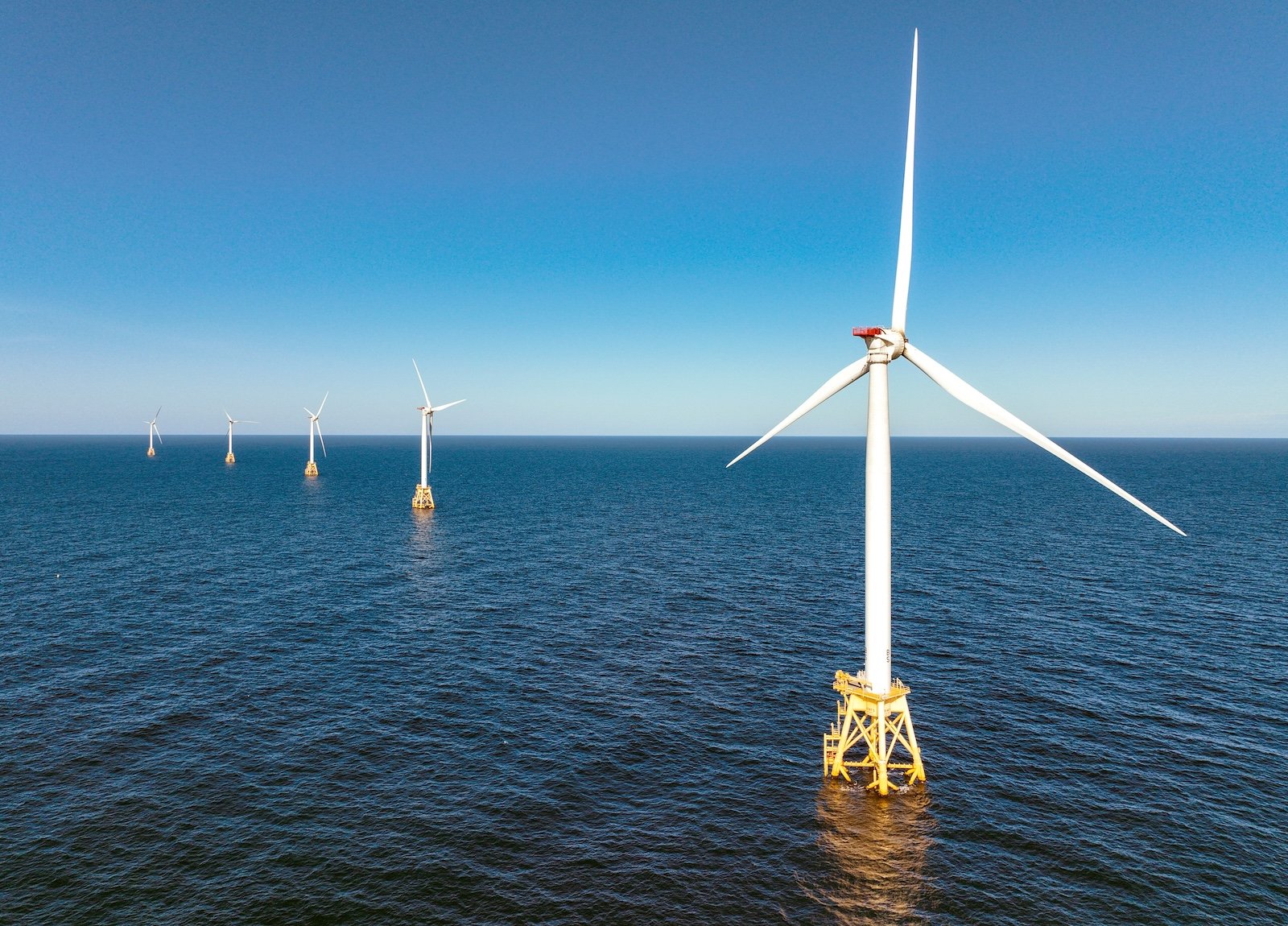
Infrastructure is also a key constraint. The first wind projects required states to spend hundreds of millions of dollars on port upgrades and onshore construction. Massachusetts has spent well over $100 million to upgrade the old whaling port of New Bedford so it can serve as a staging area for massive wind turbine blades that can stretch the length of a football field. New York built a similar wind staging area along the harbor in Brooklyn.
But this infrastructure is still not sufficient to support wind development on the scale that the region needs. The New Bedford port is just a quarter of the size of an offshore wind terminal under construction at the port of Rotterdam in the Netherlands, and it may be too narrow to accommodate some large vessels. Massachusetts is planning to build a second facility in Salem — but Trump canceled a $34 million grant for that project, and its future is now uncertain.
The states along the eastern seaboard must invest now in order to make it easier for future projects to get off the ground. That includes upgrading transmission infrastructure, investing in workforce training, and expanding ports to accommodate larger turbines.
“We understand that whatever we’re doing now, we’re doing for 2029 or maybe 2030,” said Bruce Carlisle, the managing director of offshore wind for the Massachusetts Clean Energy Center, a quasi-state agency that supports the buildout of renewable energy. “We want to make sure we’re balancing state investment with realistic timelines.”
At the same time, Carlisle said states may not get all they originally wanted from wind projects. In the first go-round, states pushed developers to hire local workers for manufacturing and assembly, but Carlisle now says that the states may need to walk some of those requests back, because they will further raise costs for developers. Instead, states may need to let developers source labor and materials from Europe — which has built out far more offshore wind and therefore has a developed labor force and supply chains already — rather than demanding they build out a U.S. manufacturing base.
Given that President Trump has refused to issue new permits for offshore wind, it will likely be impossible for states like New Jersey and Massachusetts to achieve their current procurement targets on time. In the rest of the country, planned projects may never materialize. But offshore wind will still dominate the Northeast power grid in the long run, even if future projects are more expensive and require more state support. For all the blows the industry has taken, the region just doesn’t have good alternatives.
“I think it’s more a question of ‘when’ than ‘if,’” said Ohleth.
toolTips(‘.classtoolTips4′,’The process of reducing the emission of carbon dioxide and other greenhouse gases that drive climate change, most often by deprioritizing the use of fossil fuels like oil and gas in favor of renewable sources of energy.’);
This story was originally published by Grist with the headline Trump destroyed offshore wind. The Northeast can’t live without it. on Jan 28, 2026.


