
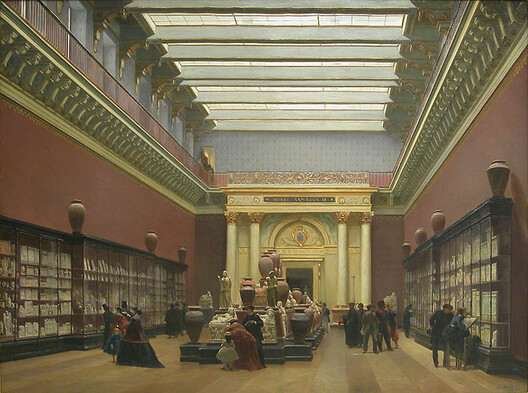
Louvre Museum, Entrance to a section of the Musée Napoléon III. Image © A. Dequier – M. Bard via Wikipedia under Public Domain
This article is part of our new Opinion section, a format for argument-driven essays on critical questions shaping our field.
Traditionally, a museum visit is a calendared occasion with a clearly scripted sequence. Arrival is ceremonially marked—by grand stairs or thresholds, by ticketing and information desks, by an audio guide and a concise institutional preface about mission and history. That deliberate “special occasion” quality extends from how museums were long conceived: deliberately exceptional, tightly curated, and organized around a specific narrative arc. In this model, the museum assumes an authoritative voice—its knowledge deep, vetted, and to be respected rather than contested—while architecture and choreography reinforce a rather singular way of entering, learning, and remembering.
Museums are undergoing a structural reorientation—from fixed, authoritative narratives to porous spatial ecologies that redistribute agency, visibility, and encounter. Previous institutions experimenting with open formats—most notably V&A East Storehouse and Depot Boijmans Van Beuningen—anchor a renewed argument for museum journeys as exploratory rather than purely instrumental through showcasing their well-treasured archive. As society shifts toward open-source modes of knowledge—inviting multiple readings, revisions, and rediscoveries—the spaces that house collections are likewise evolving. Galleries, archives, and back-of-house become visible; process takes its place alongside product; and the visit is reimagined as a porous circuit that diversifies how culture and art are encountered. In this context, András Szántó’s *Imagining the Future Museum* articulates a timely provocation: museums perhaps should start to learn to shapeshift—handing greater “agency” to visitors, releasing them from heavy curatorial intermediation so that they become active participants rather than passive recipients. Museums, in other words, are no longer bound to a single authoritative script—a plural ecology of typologies is now emerging.


