
This is part one of a three-part series looking at manure analyses to help predict nutrient availability.
Rising fertilizer prices and growing interest in maintaining or improving soil health has led to better management of manure and other organic amendments. The phrase “You can’t manage what you don’t measure” rings especially true when it comes to understanding what manure provides, when its nutrients become available and how to maximize its value.
Analyzing macronutrient (N-P-K) content in organic amendments such as manure, compost, digestate and biosolids has always been recommended, however, there is more to manure than just nitrogen (N), phosphorus (P) and potassium (K). It also contains valuable micronutrients, organic matter (OM) and other elements that can offer additional cost savings or highlight management considerations.
Manure composition – such as whether manure is liquid vs solid and the presence of bedding – affects nutrient availability to crops. Application timing, rate and placement, combined with site-specific conditions including soil pH, crop residue, microbial activity and weather, determine utilization of macro, secondary and micronutrients.
A manure analysis often reflects the remnants of a livestock ration, and nutritionist can use this data to fine-tune feeding strategies. Secondary nutrients such as calcium, magnesium, and sulphur, along with micronutrients like boron, copper, iron, manganese, molybdenum, and zinc, are essential for plant growth and when analyzed they can reveal a potential savings in commercial fertilizer. At average application rates there can be significant contribution of secondary nutrients, especially calcium, magnesium and sulphur. Elements like aluminum (Al) and sodium (Na) are also often present – especially in biosolids which are often high in Al and Fe, and compost which can be high in Na – and should be considered in management plans.
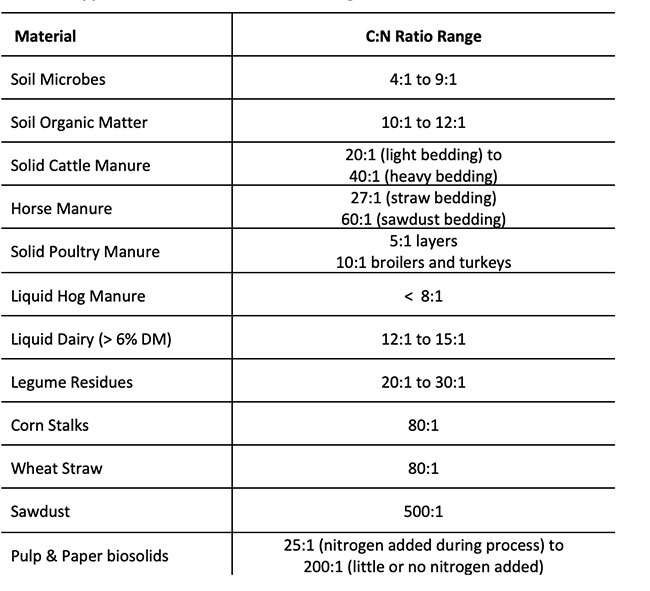
While a manure analysis provides insight into nutrient content, the role of microbial activity plays a less obvious, but key role in mineralizing nutrients and decomposing crop residues. Manure feeds soil microorganisms resulting in a larger and more diverse microbial community to enhance nutrient cycling and enzyme activity in the soil. An analysis that includes carbon to nitrogen ratio (C:N), organic matter and pH will provide insight to nitrogen availability.
Interpreting the analysis:
Dry matter (DM): Given as a percent, the analysis is usually reported in an as-applied format to help better represent what is being land applied. To convert to dry matter bases, the element is divided by the dry matter.
Total nitrogen (N): Total nitrogen in manure is made up of ammonium N (NH4-N) and Organic N. Other forms of N in manure are generally negligible. NH4-N is available quickly but easily lost through volatilization, while organic N is a slow release and dependent on microbial activity.
Phosphorus (P): Manure contains inorganic and organic P. The P in manure is about 80% crop available (compared to commercial sources). Where soil fertility levels are low, the full amount of P may not be immediately available for a growing crop, and supplemental P2O5 may be required.
Potassium (K): The K in manure is mainly in organic form and readily available – assumed to be 90% as available over time as commercial sources.
Sulphur (S): Sulphur in manure is related to amount fed in ration and/or present in water. Mainly in elemental form S is slowly released by microbial activity. Regular manure application will generally provide adequate S to meet crop requirements. Spring application may not provide timely release for winter cereals, canola or alfalfa crops, especially in cool, wet soil conditions.
Trace elements: Calcium (Ca) Magnesium (Mg) Aluminum (Al), Boron (B) Copper (Cu), Iron (Fe), Manganese (Mn), Zinc (Zn) – Trace elements are reported as measured in an analysis. The amount available to a crop uptake is not reported and is often dependent on soil pH, soil microbial activity, soil organic matter levels and soil conditions (temperature/moisture). Generally, in the year of application, about half of the Su, Ca and Mg becomes available. About two-thirds of the B, Cu, Fe, Mn and Zn becomes available for crop uptake.
Total salts (TS): Total salts include sodium (Na), K, NH4, Mg, Ca, and Al. Materials with high total salts could cause seedling/germination injury when planting occurs too quickly after application or if material is surface applied (no-till) in very dry soil conditions.
Carbon to nitrogen ratio (C:N): C:N ratio indicates how quickly carbon breakdown may occur. N is the food source for microorganisms breaking down carbon. C:N over 25:1 (e.g., manure with high bedding) could result in short-term soil N deficiency.
Organic matter (OM)/ Organic carbon (OC): OC is easier to measure in an analysis and is often used to determine OM in an analysis. OM is about 58 percent OC (% OC x 1.724 = % OM). Soil OM levels are higher where manure is applied regularly. OM impacts nutrient cycling and water holding capacity in the soil.
pH: Manure pH can affect soil pH and can affect nutrient availability and nutrient loss. NH4-N is volatilized more rapidly as pH and temperature rises above 7.5. Less methane is produced when pH is under 6.5.
Part two in this series will focus on C:N ratio and part 3 on pH influence on nutrient availability. •


