
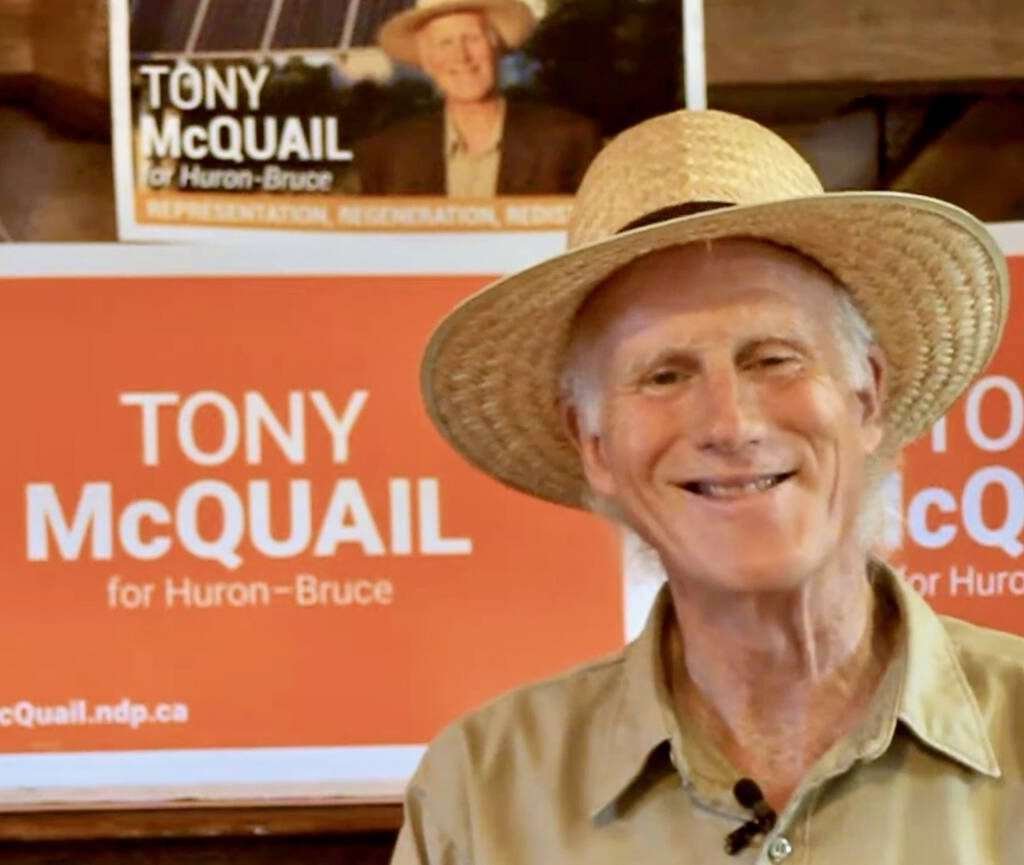
It’s very rare to see a farmer running for leadership of a political party in Canada — but Tony McQuail is bucking that trend.
The Ontario farmer is one of the candidates vying for the leadership of the federal New Democratic Party, which is building toward a leadership convention in Winnipeg on March 29.
Why it matters: Farmers rarely show up in federal party leadership races, so McQuail’s leadership bid is rare.
McQuail began working in agriculture more than 50 years ago, as a hired hand on a dairy operation in the early 1970s. He struck out on his own at 21, buying his first farm, where he slept in the barn above the livestock for a few years while his house was under construction. He and his wife Fran operated Meeting Place Organic Farm in Ontario for 40 years before selling it to their daughter.
An advocate of ecosystem management, and a perennial candidate for the party federally and provincially, McQuail said running for the leadership is the culmination of a lifetime of involvement in the NDP. He said he sees the need for innovation solutions to complex problems, and the agriculture sector is the right place to look for them.
“We have to get much more creative,” McQuail said. “And the farm community is a place to really make some big changes.”
McQuail has been a leader in the organic movement and also did a stint as executive assistant to the Ontario Minister of Agriculture and Rural Affairs.
Leadership of the federal NDP opened after former leader Jagmeet Singh stepped down following the 2025 election. McQuail is one of five vying for the position.
Many of McQuail’s positions intersect politics and agriculture. He said he started paying attention to the impacts Ottawa could have on farmers during the Arab oil embargo of the 1970s.
“The Liberals and Conservatives in power defended high interest rates as a way to fight inflation, which was ridiculous,” he said. “In fact, it added to inflation, because then any homeowner or any small businessperson or any farmer who had a mortgage or a line of credit was now getting hit with high interest in addition to high energy prices.”
McQuail’s “four R’s”
McQuail’s campaign is built around a principle of “four R’s” each of which could have implications for Canadian farmers.
When it comes to the first R, representation, McQuail’s position is straightforward: the first-past-the-post system has to go.
“For democracy to work, well, you need everybody around the table,” he said. “We’ve got a situation now where nearly half, or more than half the people don’t vote, and of those who do vote, more than half don’t have their vote count toward any representation on election night.”
Under Canada’s current electoral system, seats in the House of Commons are filled by the candidate who received the largest share of the votes in their riding, and the government is formed by the party with the largest share of seats. This leaves many Canadians without a candidate to represent their vote.
McQuail said the system has specifically disadvantaged farmers and other working people.
“By keeping the first-past-the-post system, we ensured that the United Farmers Movement and the independent labour parties… never got representation in proportion to how many votes they got.”
According to 2022 statistics from Fair Vote Canada, three quarters of Canadian voters supported a national citizens’ assembly on electoral reform. Ninety per cent said they supported a system of proportional representation.
The second R is regeneration, including ecosystem health and clean energy.
McQuail said he paid attention to former NDP leader Ed Broadbent’s support for renewable energy in the 1980s but hasn’t seen much movement on the issue since then.
He said a focus on continuous growth has led wealth away from farmers and damaged the land farmers rely on.
“We’re not regenerating the ecosystem and we’re not regenerating our society, our community. In fact, we’re plundering both,” he said.
Next is redistribution, which McQuail said involves creating an economy where “people who are doing the work get a fair share of the wealth they create, and that includes farmers and ranchers.”
The final R is redesign.
“From my perspective as a farmer out on the ground, we are shredding the life support system of the planet that we and all the other living creatures on this planet need” he said. “So, we have to start getting really serious about how we redesign what we’re doing.”
McQuail referred to activist Hazel Henderson’s “cake chart” which suggests every level of society is reliant on the one below it.
“We are hollowing out those lower two layers because they aren’t monetized,” he said. “They don’t show up in the gross national product or the so. So, economists don’t understand it. You’ve got to look after those things.”
Rethinking growth
McQuail said it is important for farmers to realize is “it’s not how much you gross; it’s how much you get to keep from your production and from your sales.”
A challenge for modern farmers, he said, is input suppliers have been focused on “waging war on individual problems, pests, a disease, an insect, a weed.”
“We’ve gotten really good at toxic chemicals, but we haven’t gotten good at managing a complex, biologically based production system,” he said.
He encouraged producers to find ways to use nature to help with the things they’ve “been encouraged to buy stuff to do,” and pointed to the group Farmers for Climate Solutions as a valuable resource.
“I think we as farmers need to recognize that we’re not going to be successful unless we’re in a healthy ecosystem. And that’s not just my farm.,” McQuail said. “It’s the whole rural agricultural ecosystem and community that I’m farming in, or that you’re farming in, wherever you are.”
Regaining farmers’ trust
Though his own roots in agriculture run deep, McQuail knows his party may be starting from a difficult position when courting the producer vote, as history suggests rural ridings tend to skew Conservative. According to a Simpson Centre survey prior to the 2025 federal election, just under 70 per cent of surveyed producers said they felt the Conservative Party of Canada best represented their interests.
Across regions, the NDP was one of farmers’ least-favoured parties.
Despite this, McQuail said he thinks the party can pick up support from those farmers who are disillusioned with the current Liberal government and looking for an alternative.
He said community members he’s fairly sure are Conservatives have approached him to say they appreciate his ideas, though many still don’t see the NDP as “electable.”
“I’ve run five times federally, and I’ve certainly heard many times, ‘I think you’re a great candidate, I like what you’re saying, but I don’t think you can win. Therefore, I’m not going to vote for you.’ That’s how you destroy democracy, creating a system that gives people that kind of a choice.”
He said farmers were “pretty radical in the 1970s,” but have shifted away from that mentality, possibly due to land values increasing, a figure he said does not necessarily translate into material wealth.
“If you swallowed the Kool-Aid and think that the only way you’re going to succeed in farming is getting bigger and using more and more inputs, you’re probably not going to be interested in the message I’m bringing,” McQuail said. “But (my message) comes from over 50 years of experience with this one farm and then working in farm organizations.”
McQuail said the first-past-the-post system has also made farmers appear more politically polarized than they really are. In a follow-up email, he pointed to several past NDP farmer candidates who he believed were short-changed by the electoral system.
“In my own riding I can think of Gordon Hill and Grant Robertson,” he wrote. “If we had had a proportional electoral system both would likely have been elected and farmers would have heard progressive voices on behalf of farmers and the rural community coming from NDP members.”
The post Ontario farmer Tony McQuail takes a run at NDP leadership appeared first on Farmtario.


