Ranked: The Most Reliable Car Brands in 2026
See visuals like this from many other data creators on our Voronoi app. Download it for free on iOS or Android and discover incredible data-driven charts from a variety of trusted sources.
Key Takeaways
- Toyota, Subaru, and Lexus top the 2026 rankings, reinforcing Japan’s long-standing reputation for vehicle reliability.
- Tesla recorded the biggest improvement, climbing eight spots compared to 2025, thanks to stronger reliability scores for the Model 3 and Model Y.
Who makes the most reliable cars?
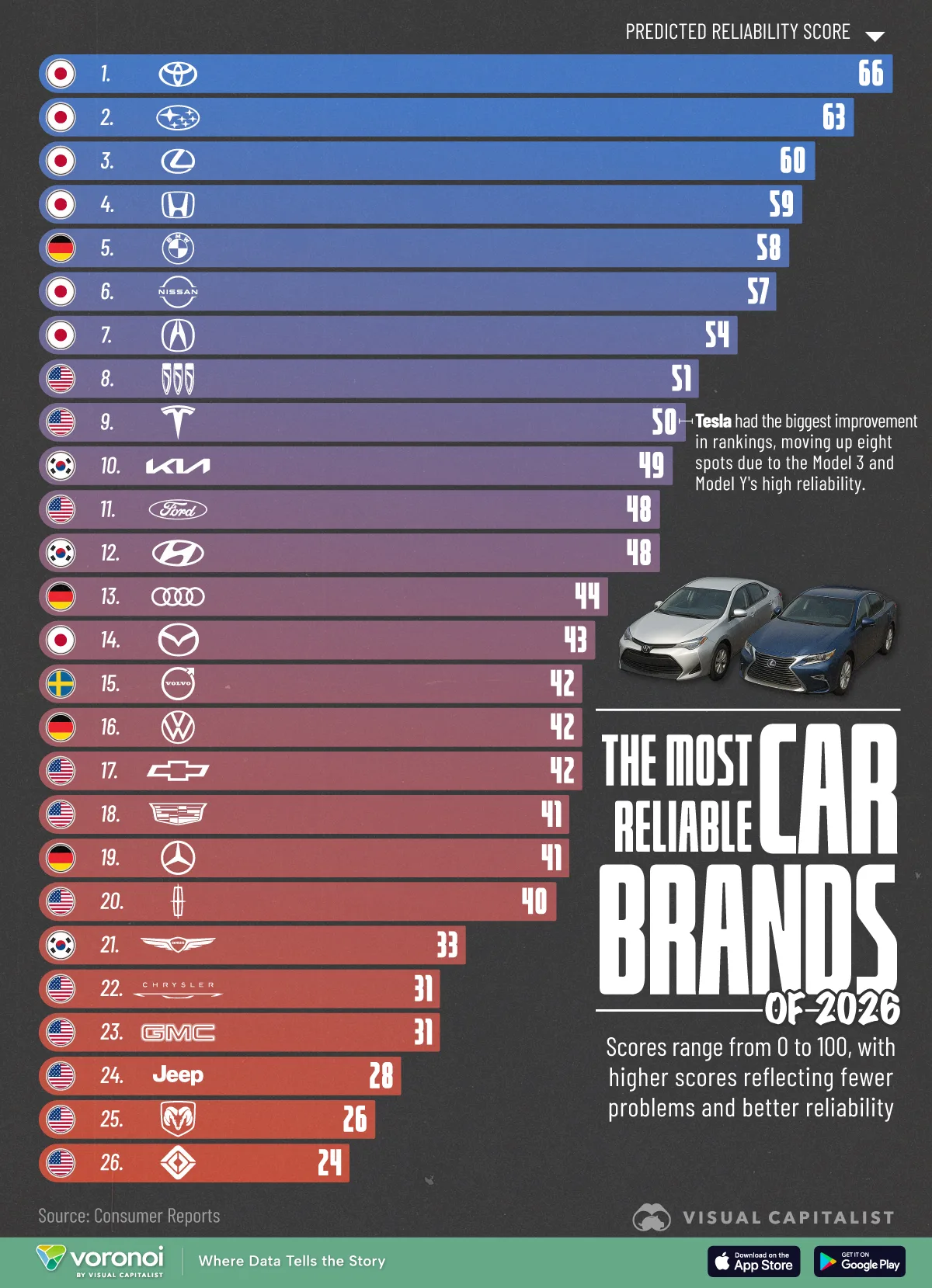
This visualization ranks the most reliable car brands in 2026 based on predicted reliability scores by Consumer Reports.
Consumer Reports calculated predicted reliability scores for nearly every new car, truck, and SUV by analyzing data from its annual member reliability surveys. These surveys collect detailed, self-reported information about problems owners have experienced with their vehicles.
For the most recent analysis, CR used responses covering roughly 380,000 vehicles, allowing them to identify patterns in reliability across brands, models, and powertrains. The aggregated results are then used to score and compare vehicles, highlighting trends such as differences between gas, hybrid, plug-in hybrid, and fully electric models.
Japanese Automakers Lead the Rankings
Japanese brands claim six of the top seven spots in 2026. Toyota leads the list with a score of 66, followed closely by Subaru and Lexus. These manufacturers are known for conservative engineering, long model cycles, and a focus on proven technology.
| Rank | Brand | Predicted reliability score | Country |
|---|---|---|---|
| 1 | Toyota | 66 |  Japan Japan |
| 2 | Subaru | 63 | Japan |
| 3 | Lexus | 60 | Japan |
| 4 | Honda | 59 | Japan |
| 5 | BMW | 58 |  Germany Germany |
| 6 | Nissan | 57 | Japan |
| 7 | Acura | 54 | Japan |
| 8 | Buick | 51 |  U.S. U.S. |
| 9 | Tesla | 50 | U.S. |
| 10 | Kia | 49 |  S. Korea S. Korea |
| 11 | Ford | 48 | U.S. |
| 12 | Hyundai | 48 | S. Korea |
| 13 | Audi | 44 | Germany |
| 14 | Mazda | 43 | Japan |
| 15 | Volvo | 42 |  Sweden Sweden |
| 16 | Volkswagen | 42 | Germany |
| 17 | Chevrolet | 42 | U.S. |
| 18 | Cadillac | 41 | U.S. |
| 19 | Mercedes-Benz | 41 | Germany |
| 20 | Lincoln | 40 | U.S. |
| 21 | Genesis | 33 | S. Korea |
| 22 | Chrysler | 31 | U.S. |
| 23 | GMC | 31 | U.S. |
| 24 | Jeep | 28 | U.S. |
| 25 | Ram | 26 | U.S. |
| 26 | Rivian | 24 | U.S. |
Toyota vehicles are engineered to last well beyond 200,000 miles with proper maintenance, thanks to rigorous quality control at every stage of production and simplified powertrain designs that reduce potential failure points.
In addition to long-term mechanical durability, Toyota’s strong anti-theft reputation places several of its models among vehicles with the lowest theft risk.
Honda and Nissan also perform strongly, reinforcing Japan’s dominance in long-term vehicle dependability.
European Brands Show Mixed Reliability
European automakers cluster in the middle of the rankings. BMW stands out as the top European brand, ranking fifth overall and outperforming several Japanese competitors.
In contrast, Volkswagen, Audi, Mercedes-Benz, and Volvo score in the low-to-mid 40s.
Tesla’s Big Jump Signals EV Maturation
Tesla recorded the largest improvement in the rankings compared to the previous survey, moving up eight spots to ninth place. This gain is driven by strong reliability scores for the Model 3 and Model Y, which now benefit from years of incremental design refinements.
Lower-ranked brands such as Jeep, Ram, and Rivian highlight how newer platforms and performance-focused designs can face early reliability hurdles.
Learn More on the Voronoi App 
If you enjoyed today’s post, check out EV Global Market Share by Country on Voronoi, the new app from Visual Capitalist.