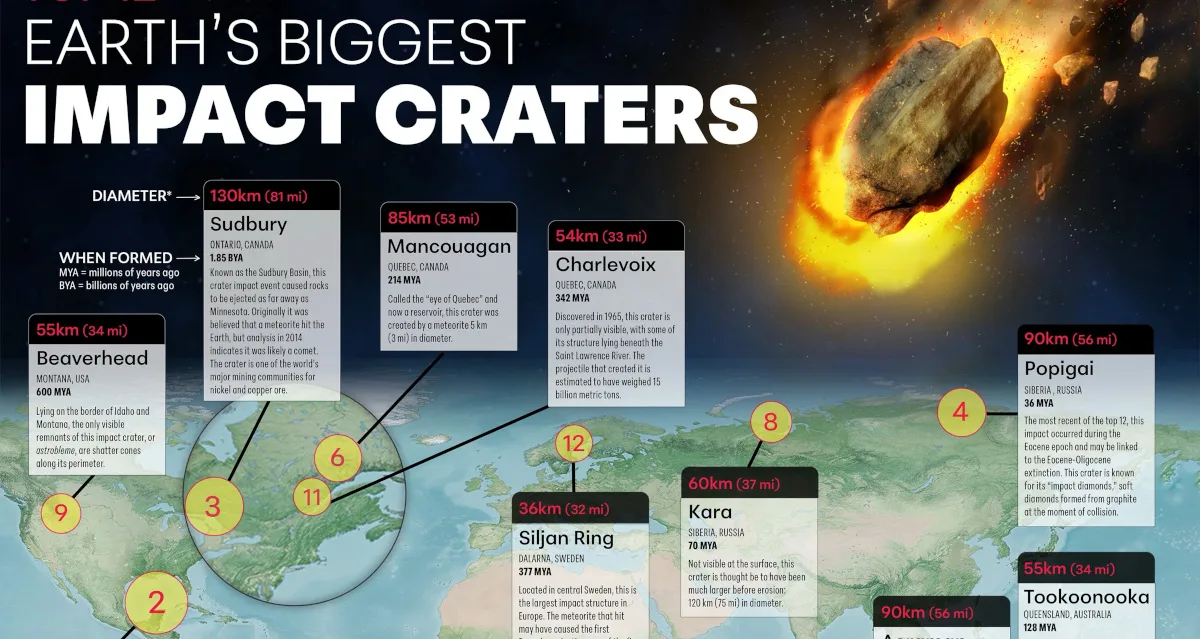
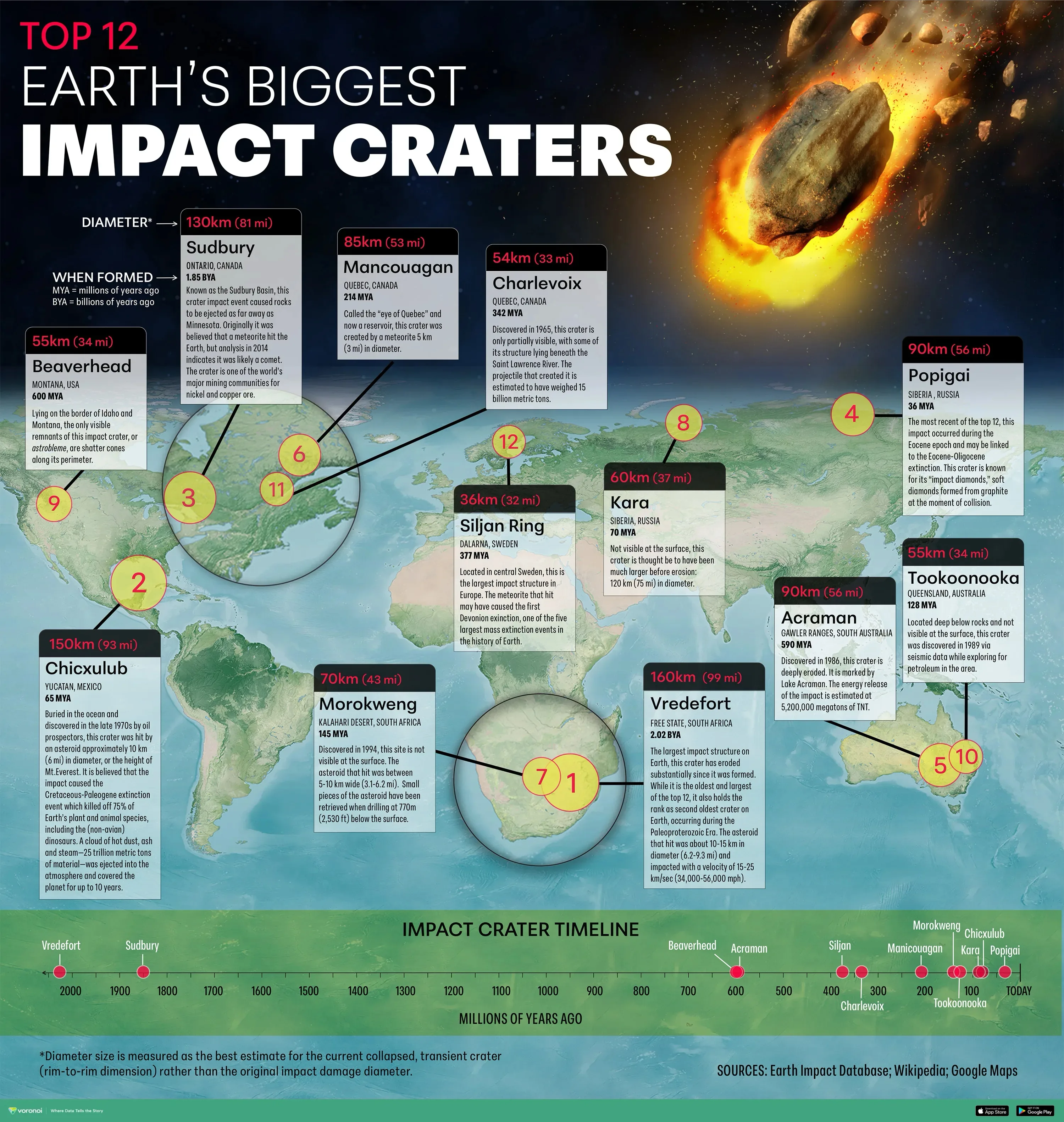
View the high-resolution version of this infographic.
Mapped: The World’s 12 Largest Impact Craters
This was originally posted on our Voronoi app. Download the app for free on iOS or Android and discover incredible data-driven charts from a variety of trusted sources.
Key Takeaways
- The largest known impact crater on Earth is the Vredefort crater in South Africa, measuring 99 miles (160 km) in diameter and formed over 2 billion years ago.
- Crater size doesn’t always correlate with extinction events. Chicxulub, which caused the dinosaur extinction, is smaller than several other craters.
- Some ancient craters, like Sudbury and Morokweng, still show unusual geology and economic mineralization due to their cosmic origins.
A single asteroid strike can reshape a planet, and Earth’s history is marked by several cataclysmic impacts. This map by Julie Peasley uses data from the Earth Impact Database to showcase the 12 largest confirmed impact craters on Earth, ranging from massive basin-forming events to relatively recent collisions.
The World’s Largest Craters by Diameter
The following table ranks the top 12 confirmed impact craters based on their estimated rim-to-rim diameter:
| Crater | Diameter (km) | Location | Age (Millions Years Ago) |
|---|---|---|---|
| Vredefort | 160 | South Africa | 2023 |
| Chicxulub | 150 | Yucatan, Mexico | 65 |
| Sudbury | 130 | Ontario, Canada | 1850 |
| Popigai | 90 | Russia | 36 |
| Acraman | 90 | South Australia | 590 |
| Manicouagan | 85 | Quebec, Canada | 214 |
| Morokweng | 70 | South Africa | 145 |
| Kara | 65 | Russia | 70 |
| Beaverhead | 60 | Montana, US | 600 |
| Tookoonooka | 55 | Queensland, Australia | 128 |
| Charlevoix | 54 | Quebec, Canada | 342 |
| Siljan | 52 | Sweden | 377 |
While Vredefort in South Africa ranks first at 99 miles (160 km), it formed over 2 billion years ago and has been significantly eroded. In contrast, the second-ranked Chicxulub crater in Mexico retains a clearer structure and is famous for its role in the Cretaceous-Paleogene extinction event that wiped out most dinosaurs.
Extinction Events and Impact Size
Interestingly, larger crater size doesn’t always mean greater devastation. As scientists have noted, factors like impact velocity, angle, and composition can be just as important. The Chicxulub impactor likely released over 100 million megatons of TNT-equivalent energy, triggering firestorms, tsunamis, and a global winter.
In contrast, older impacts like Morokweng or Sudbury were equally massive but occurred long before complex life had evolved, so they did not cause any known mass extinction events.
Lasting Geological Signatures
Some craters, such as Sudbury in Ontario, have left behind unique geological formations and mineral deposits. The Sudbury Basin remains one of the most economically important mining regions in the world, rich in nickel and copper.
Others, like the Morokweng crater in South Africa, have even preserved fragments of the original meteorite thousands of meters beneath the surface.
Why So Few Ancient Craters Remain
Despite Earth’s long history, many early craters have vanished due to erosion and tectonic activity. Earth’s oldest impact scars are gradually being lost to time—unlike the Moon or Mars, which preserve theirs far better. This is why craters like Vredefort or Beaverhead are so valuable: they offer rare glimpses into planetary-scale violence from billions of years ago.
Learn More on the Voronoi App 
Curious about the cosmos? Explore Every Moon in the Solar System and dive deeper into the celestial bodies orbiting our planets.