The Countries Driving China’s $1.2T Trade Surplus
This was originally posted on our Voronoi app. Download the app for free on iOS or Android and discover incredible data-driven charts from a variety of trusted sources.
Key Takeaways
- China’s trade surplus reached $1.19 trillion in 2025, a record-breaking figure despite escalating global tensions.
- Hong Kong and the U.S. together accounted for nearly half of China’s total surplus.
- India and Vietnam have emerged as significant contributors, each creating surpluses for China of over $100 billion.
A trade surplus occurs when a country exports more goods and services than it imports, resulting in a net inflow of foreign currency. For China in 2025, this surplus has grown to unprecedented levels, topping $1.19 trillion according to the General Administration of Customs.
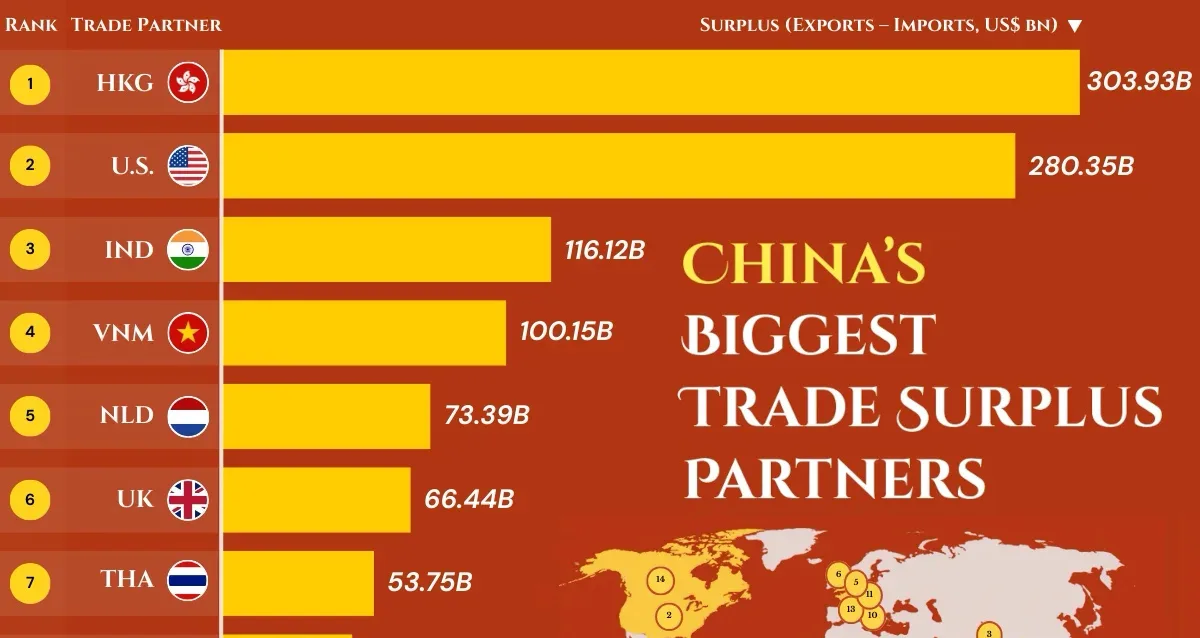
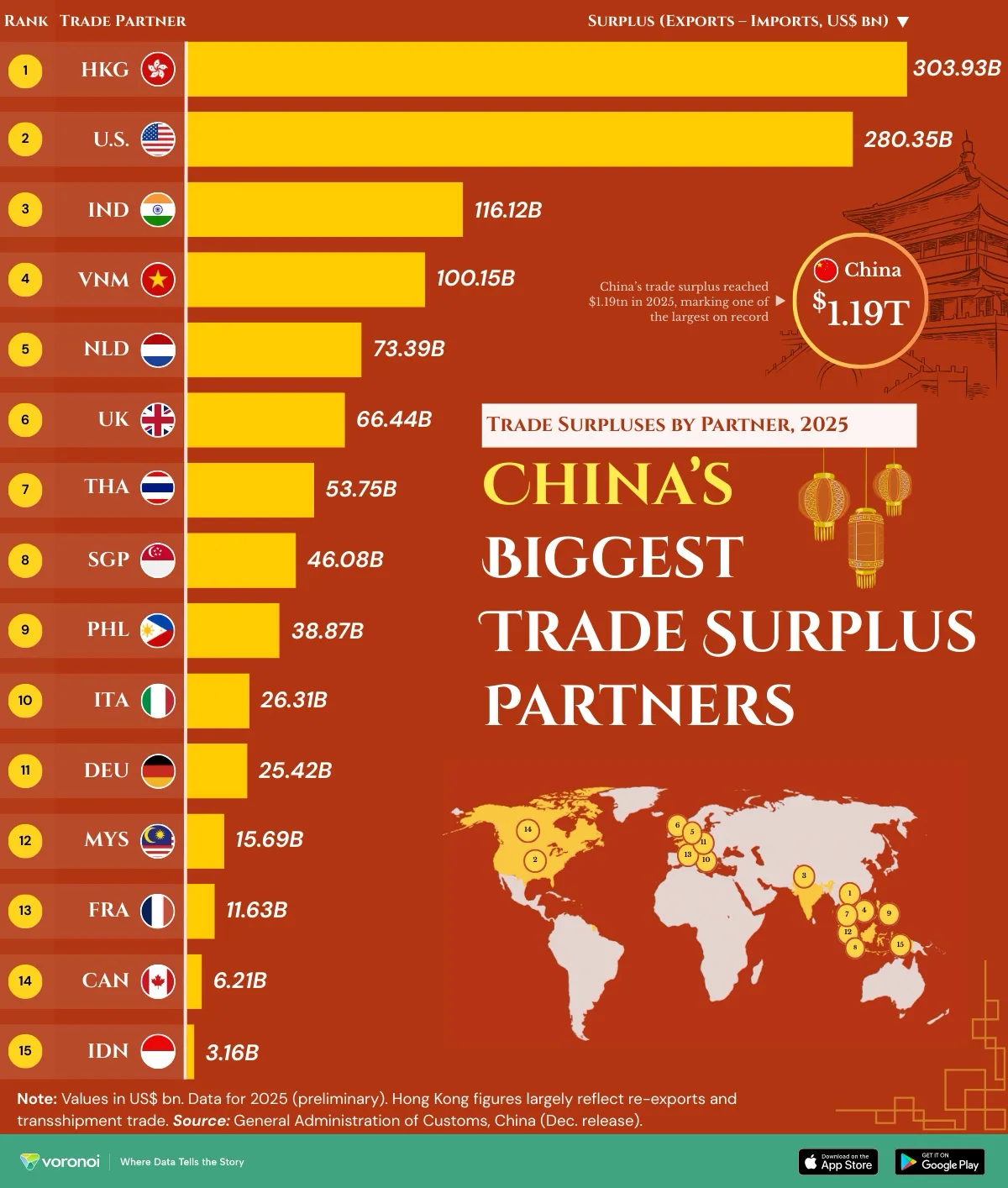
The visualization above, created by Aneesh Anand, maps out which countries contributed most to this surplus. The dataset highlights China’s top 15 surplus partners, showcasing a global pattern of economic interdependence and imbalance.
Breaking Down China’s Trade Surplus by Country
Hong Kong topped the list with a surplus of $303.9 billion, largely due to re-exports and transshipment trade.
| Rank | Trade Partner | China’s Surplus (US$ bn) |
|---|---|---|
| 1 |  Hong Kong Hong Kong |
303.93 |
| 2 |  U.S. U.S. |
280.35 |
| 3 |  India India |
116.12 |
| 4 |  Vietnam Vietnam |
100.15 |
| 5 |  Netherlands Netherlands |
73.39 |
| 6 |  UK UK |
66.44 |
| 7 |  Thailand Thailand |
53.75 |
| 8 |  Singapore Singapore |
46.08 |
| 9 |  Philippines Philippines |
38.87 |
| 10 |  Italy Italy |
26.31 |
| 11 |  Germany Germany |
25.42 |
| 12 |  Malaysia Malaysia |
15.69 |
| 13 |  France France |
11.63 |
| 14 |  Canada Canada |
6.21 |
| 15 |  Indonesia Indonesia |
3.16 |
Close behind Hong Kong was the United States at $280 billion, continuing a long-standing trade imbalance. India and Vietnam, at over $100 billion each, underline China’s deepening trade ties in Asia.
Why Are China’s Trade Surpluses So High?
Despite rising protectionism, tariffs, and diplomatic tensions, China’s manufacturing engine remains robust. Even American tariffs have failed to dent the flow of consumer electronics, machinery, and intermediate goods being exported from China.
Part of the explanation lies in global supply chains. Many goods are still assembled or completed in China, especially electronics, before being shipped abroad. This entrenched role as the “workshop of the world” has kept China’s exports high, even in an era of attempted decoupling.
Trade Imbalances Remain a Sore Point
As the Council on Foreign Relations notes, China’s massive surpluses remain a puzzle to some economists, particularly due to underreported service imports or capital flows that mask the true extent of imbalances.
For major partners like the U.S., this imbalance has long been a political flashpoint. A large trade deficit means the U.S. imports significantly more from China than it exports in return, which has raised concerns about domestic job losses, the decline of American manufacturing, and growing economic dependence.
Successive U.S. administrations have tried to reverse this pattern, most notably through tariffs, reshoring incentives, and supply chain diversification. However, these efforts have yielded limited results. China continues to dominate in key export sectors like electronics, machinery, and intermediate goods, making it difficult for American producers to compete without incurring higher costs.
For policymakers, the trade gap is about more than just numbers. It touches on national security, global influence, and the sustainability of U.S. debt, as trade deficits are often financed by foreign investment in American assets. Reducing the trade imbalance with China remains a central, if elusive, goal in broader economic strategy.
Learn More on the Voronoi App 
For more historical context, check out our related post on Eight-plus years of the US–China trade gap on the Voronoi app.