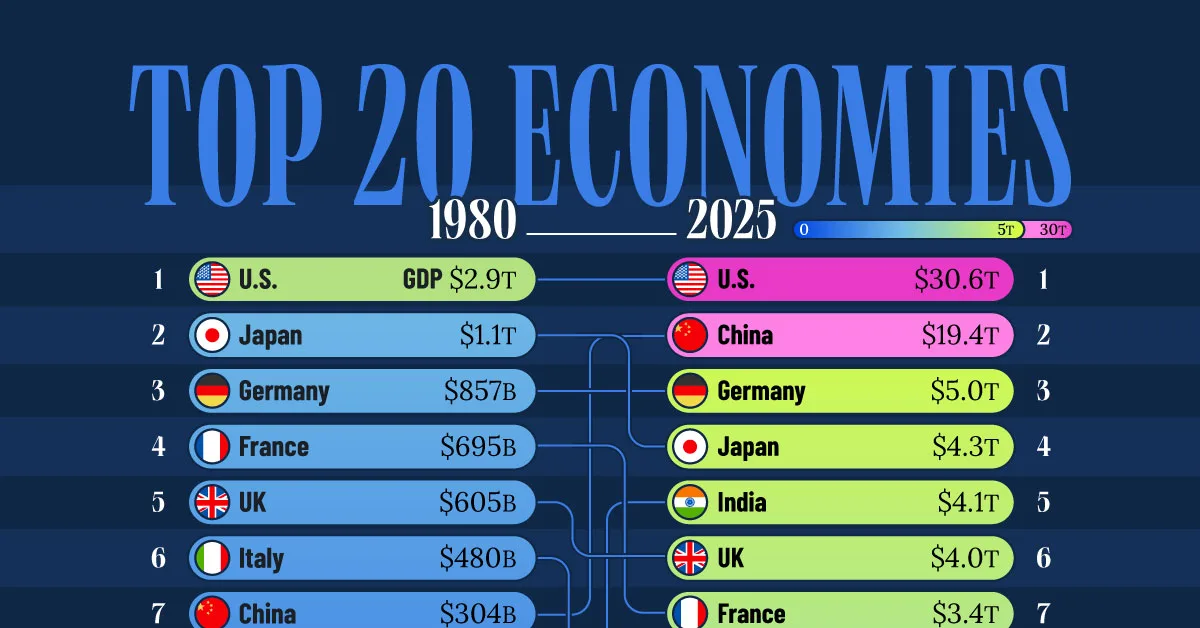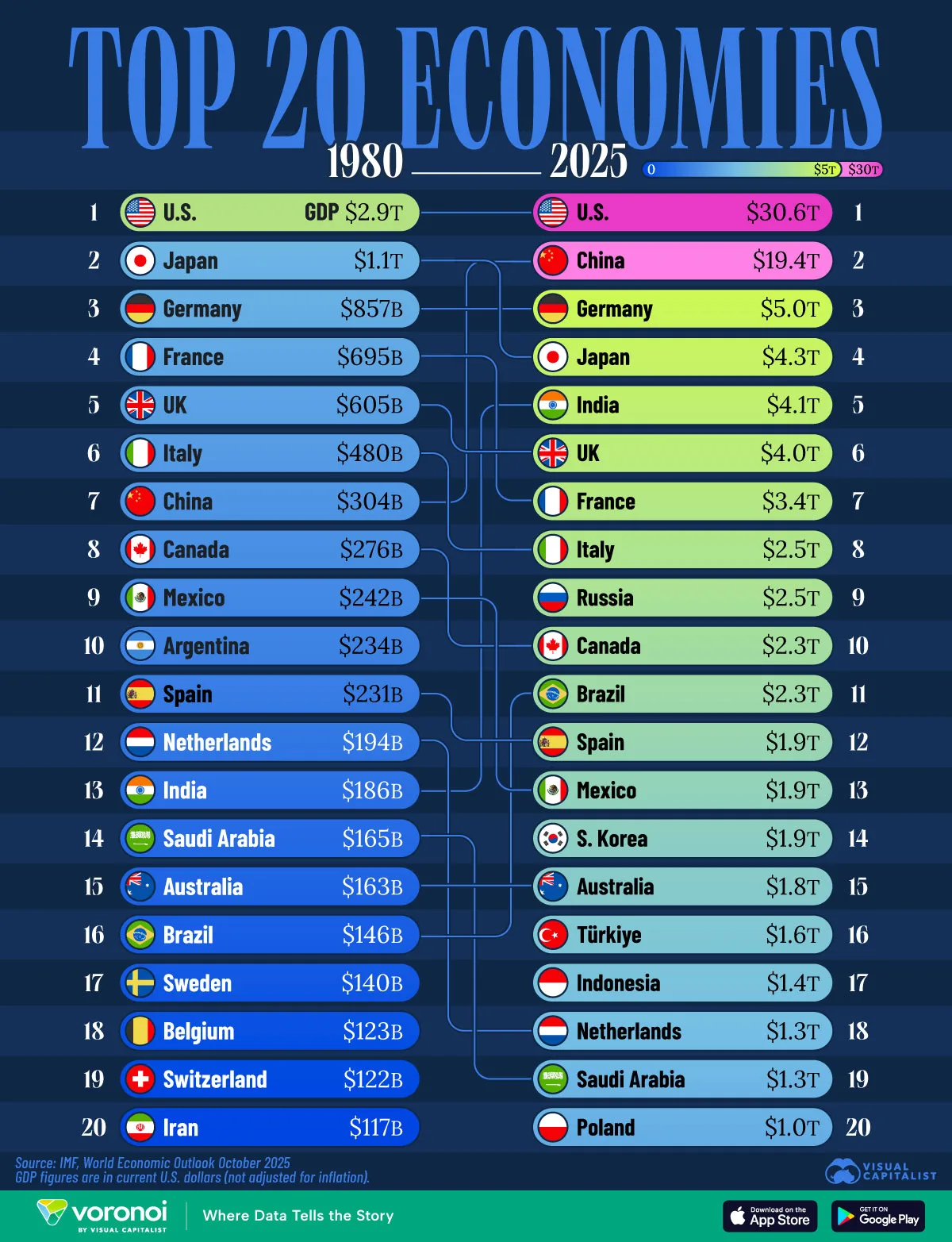
Ranked: The World’s Top Economies in 1980 vs. 2025
See visuals like this from many other data creators on our Voronoi app. Download it for free on iOS or Android and discover incredible data-driven charts from a variety of trusted sources.
Key Takeaways
- The U.S. has remained the world’s largest economy since 1980, with GDP rising more than tenfold in nominal terms.
- China’s rapid rise reshaped the global economic order, moving from outside the top five in 1980 to firmly in second place by 2025.
Over the past four decades, the global economic landscape has undergone a dramatic transformation. While some countries have maintained their dominance, others have surged from relative obscurity into the ranks of the world’s largest economies.
This visualization compares the world’s top economies from 1980 through 2025. The data for this visualization comes from the IMF’s World Economic Outlook (October 2025). GDP figures are shown in current U.S. dollars and are not adjusted for inflation.
The United States’ Enduring Lead
The United States has held the top spot throughout the entire period shown. In 1980, U.S. GDP stood at roughly $2.9 trillion. By 2025, it reached over $30 trillion, far ahead of any other economy.
| Rank (1980) | Country or Entity | 1980 GDP (Billions, nominal) |
|---|---|---|
| 1 |  United States United States |
2,857 |
| 2 |  Japan Japan |
1,129 |
| 3 |  Germany Germany |
857 |
| 4 |  France France |
695 |
| 5 |  United Kingdom United Kingdom |
605 |
| 6 |  Italy Italy |
480 |
| 7 |  China China |
304 |
| 8 |  Canada Canada |
276 |
| 9 |  Mexico Mexico |
242 |
| 10 |  Argentina Argentina |
234 |
| 11 |  Spain Spain |
231 |
| 12 |  Netherlands Netherlands |
194 |
| 13 |  India India |
186 |
| 14 |  Saudi Arabia Saudi Arabia |
165 |
| 15 |  Australia Australia |
163 |
| 16 |  Brazil Brazil |
146 |
| 17 |  Sweden Sweden |
140 |
| 18 |  Belgium Belgium |
123 |
| 19 |  Switzerland Switzerland |
122 |
| 20 |  Iran Iran |
117 |
| 21 |  Indonesia Indonesia |
99 |
| 22 |  Türkiye Türkiye |
97 |
| 23 |  South Africa South Africa |
89 |
| 24 |  Austria Austria |
80 |
| 25 |  Denmark Denmark |
71 |
| 26 |  Venezuela Venezuela |
70 |
| 27 |  Congo (DRC) Congo (DRC) |
69 |
| 28 |  Korea, Republic of Korea, Republic of |
67 |
| 29 |  Norway Norway |
64 |
| 30 |  Poland Poland |
57 |
This sustained dominance reflects a combination of factors, including technological leadership, deep capital markets, strong consumer demand, and the global role of the U.S. dollar.
| Rank (2025) | Country or Entity | 2025 GDP (Billions, nominal) |
|---|---|---|
| 1 | United States |
30,616 |
| 2 | China |
19,399 |
| 3 | Germany |
5,014 |
| 4 | Japan |
4,280 |
| 5 | India |
4,125 |
| 6 | United Kingdom |
3,959 |
| 7 | France |
3,362 |
| 8 | Italy |
2,544 |
| 9 |  Russian Federation Russian Federation |
2,541 |
| 10 | Canada |
2,284 |
| 11 | Brazil |
2,257 |
| 12 | Spain |
1,891 |
| 13 | Mexico |
1,863 |
| 14 | Korea, Republic of |
1,859 |
| 15 | Australia |
1,830 |
| 16 | Türkiye |
1,565 |
| 17 | Indonesia |
1,443 |
| 18 | Netherlands |
1,321 |
| 19 | Saudi Arabia |
1,269 |
| 20 | Poland |
1,040 |
| 21 | Switzerland |
1,003 |
| 22 |  Taiwan Taiwan |
884 |
| 23 | Belgium |
717 |
| 24 |  Ireland Ireland |
709 |
| 25 | Argentina |
683 |
| 26 | Sweden |
662 |
| 27 |  Israel Israel |
611 |
| 28 |  Singapore Singapore |
574 |
| 29 |  United Arab Emirates United Arab Emirates |
569 |
| 30 | Austria |
566 |
China’s Historic Economic Rise
China represents the most dramatic shift in the rankings. In 1980, it ranked well outside the world’s top five, with GDP just over $300 billion.
By 2010, China had overtaken Japan to become the world’s second-largest economy, and by 2025 its GDP reached nearly $19.4 trillion. This rise was driven by rapid industrialization, export-led growth, urbanization, and large-scale infrastructure investment.
Japan’s Plateau and Europe’s Stability
Japan was the world’s second-largest economy throughout much of the 1980s and 1990s, peaking in the mid-1990s. However, slower growth and demographic challenges caused it to slip to fourth place by 2025.
Meanwhile, major European economies such as Germany, the United Kingdom, and France have remained consistently near the top of the rankings. While their growth has been steadier than China’s, they continue to play an outsized role in global trade and finance.
The Rise of Emerging Markets
Beyond China, several emerging markets climbed the rankings over time. India steadily moved upward, entering the top five by 2025, while countries like Indonesia, Türkiye, and Saudi Arabia gained prominence as their economies expanded and diversified.
At the same time, some economies that ranked highly in 1980—such as Italy and Argentina—fell relative to faster-growing peers.
Learn More on the Voronoi App 
If you enjoyed today’s post, check out The World’s $111 Trillion in Government Debt on Voronoi, the new app from Visual Capitalist.