
Focusing on soil fertility could unlock significant gains in forage yield and overall pasture performance.
A global study funded by the University of Guelph’s “Food From Thought” program of 61 unfertilized grassland sites across six continents over 15 years showed fertilization increased pasture biomass by 43 per cent on average.
“(The study showed) it’s hard to predict exactly when and where we are or aren’t going to see a response. The best that we can do is take a pretty good stab at it,” explained Colin Elgie, soil fertility specialist for the Ministry of Agriculture, Food and Agribusiness, during the Beef is ON fall webinar series.
“And one fertilizer program is not really going to fit every single pasture.”
Why it matters
Soil fertility is critical for reducing nutrient loss, increasing yield, and boosting profits, but it starts with soil sampling.
The study revealed that high soil pH, high soil test phosphorus and low species diversity were the main limiting factors to fertilizer response. However, no clear geographical pattern emerged, underscoring the site-specific nature of fertility responses.
“When it comes to site-specific management, the number one step is soil sampling,” Elgie said.
“To me, we’re still not doing enough of it. There are a lot of fields that would benefit from identifying limiting factors that are going on within that field.”
Sampling and technique are crucial for identifying deficient and limiting nutrients, monitoring fertility shifts over time, informing lime decisions and preventing over- and under-fertilization, because pastures rarely have uniform fertility, he advised.
Use the proper tools
He warned against using galvanized metal tools because the zinc can leach into the soil, affecting nutrient analysis. A minimum of 20 cores, taken in a zig-zag pattern across the pasture using stainless steel or plastic tools, clearly and correctly labelled, every four to five years, is needed for an accurate soil assessment and mitigation.
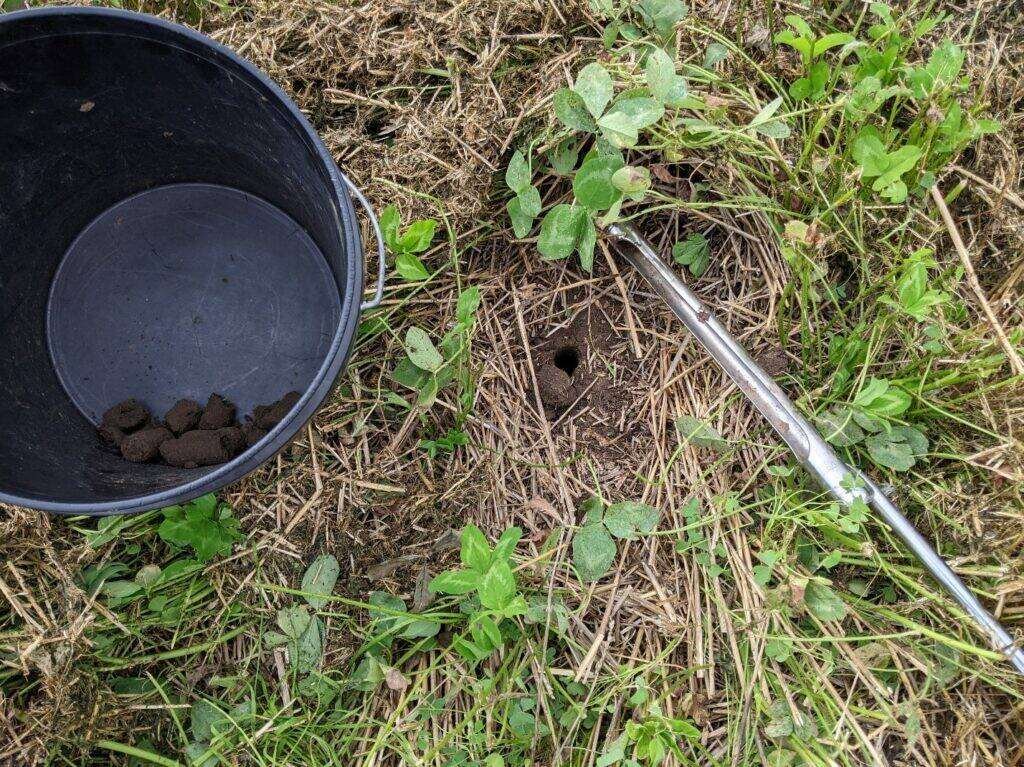
“We want that nutrient-rich zone where the majority of the roots are, the majority of the nutrients are, to really get a good analysis of what’s going on,” Elgie explained, advising a six-inch collection depth.
“That’s also (the depth) where all of our lab tests are calibrated.”
Shallower or deeper core depths will give false high or low results.
Sample the right spots
Additionally, livestock manure areas tend to be concentrated near water, feeders, shade or loafing areas, creating patchy zones of high phosphorus (P) and potassium (K), compared to other areas with much lower levels.
He recommended avoiding those “hot spots” or sampling them separately to obtain better insights for specific management, and accredited soil lab submissions ensure alignment with soil recommendations.
Crop and pasture differences
Compared to row cropping, pasture soil fertility drawdown is slower, but is affected by organic matter (OM) breakdown, soil pH changes due to precipitation and erosion and the addition or removal of nutrients through manure and harvesting or grazing the field.
For example, removing two tons per acre of grass-legume hay removes approximately 80 lbs. N/acre, 22 lbs. P/acre and 90 lbs. K/acre. However, cow-calf stocking at a half pair per acre only removes five lbs. N, 3.4 lbs. P and 0.6 lbs./acre of K.
“We’re actually taking more off the field, but through urine and manure, that nitrogen is returning,” he explained.
“About a quarter to half of that can be lost due to volatilization.”
Additionally, livestock meat and milk production removes about 10 to 30 per cent of ingested phosphorus and potassium from the field.
AgriSuite tools provide bigger picture
Elgie guided producers to use OMAFA’s AgriSuite tools to input soil tests, generate crop-specific nutrient recommendations and estimate nutrient removal under grazing or haying.
The soil test results provide a roadmap for applying the correct product or nutrients based on soil samples, species and stand composition, and for the proper rate to avoid over- or under-application in the right place at the right time, i.e., lime applied as early as possible to ensure the greatest results.
The OM and Cation Exchange Capacity (CEC) on the soil test results provide a background picture of the soil and its ability to hold, cycle and leach nutrients, along with water capacity, followed by pH, Buffer pH and potassium.
“There’s a lot of different things that we can look at here,” said Elgie, pointing to magnesium, zinc, manganese and boron.
“But what it comes down to is, if you don’t have your phosphorus and potassium in line where you want them, then it really doesn’t matter what you do when it comes to some of our secondary nutrients or micronutrients.”
For example, phosphorus has low availability at pH 4.5 and declines at pH 8, while manganese has high availability at pH 4.5 and tapers off sharply at pH 6 and above.
“For most crops, we’ve got a pretty good range of around six to seven and a half that fits well, keeps those nutrients available as much as possible for that plant to be able to grow and yield healthy,” he shared.
“And it is something that is absolutely critical for crop growth.”
Oats and wheat are tolerant of low pH (under 5.5) and still hit 80 to 90 per cent of their relative yield. In contrast, legumes, alfalfa, sweet and red clover, barley, timothy, and some grasses perform poorly at low pH, improving only once soil pH reaches a neutral level – generally between 5.5 and 6.5 as a minimum target.
Elgie explained that the Ag Index of Lime is critical for lime selection. For example, it shows that Calcitic Lime has a 100 per cent neutralizing value, with Dolomitic at 109 per cent, Spanish River Carbonatite at 81 per cent, Canadian Wollastonite at 60-65 per cent, KaLime at 64 per cent and wood ash at 40-80 per cent. Gypsum has zero neutralizing value. The fineness of lime affects its dissolution rate, with finer powders being more effective; some also contain additional nutrients, such as magnesium and potassium, which may be beneficial given cost and transport considerations.
Elgie compared Lime A at $50/ton and Lime B at $30/ton. Although B seems cheaper, the index showed A has 86 per cent efficacy at 3.5 t/acre, while B has 45 per cent at 6.7 t/acre.
“Not all lime is the same,” said Elgie, recommending applying half now and half in two to three years to reduce costs.
“Lime is such an effective way of amending a soil’s fertility that I would sooner spend $200 in lime than I would on phosphorus or potassium.”
Plant species impact
The final part of the equation is the pasture plant mixture’s impact on soil fertility.
A U of G study, led by Prof. Kim Schneider, tested 19 species and mixtures with no fertilizer, 100 pounds of 19-19-19 (pasture standard), and soil-test-based on OMAFA recommendations over three years.
“If we look at the net profit in each of those same situations: the cost of that fertilizer, the cost of application and the yield that we’re getting out of it – Does it pay to apply those?” he asked.
The results showed that soil-test-based fertility produced the highest yields across all species and mixtures, while the balanced blend consistently applied the nutrients most limited for each crop. Grass-legume mixes showed particularly strong profitability, with test-based fertility outperforming the other treatments.
Elgie encouraged producers to soil test, correct pH, build nutrients through inputs, manure or precision ag bale grazing, and use AgriSuite tools to inform decisions and realize pasture gains.
“Improved pasture fertility can absolutely bring improved yield,” he said. “And improved production, which can absolutely enhance that pasture.
The post Improved fertility key to boosting pasture productivity, specialist says appeared first on Farmtario.


