
Innovation doesn’t happen by accident—it’s built. How corporations structure, staff, fund, and measure innovation determines whether bold ideas thrive or get stuck in corporate inertia.
Yet the mechanics behind innovation are often a black box. There’s no one-size-fits-all model, and few companies share how they actually make innovation work—or why it sometimes fails.
That’s why I’ve launched the Leaders in Innovation Series.These conversations from Greentown Labs feature executives from some of the world’s leading companies, offering a behind-the-scenes look at how innovation is truly designed and sustained.
The goal? To uncover what really works—and what doesn’t—when it comes to turning ideas into impact.
Spend enough time talking to innovation leaders and you start to notice a pattern: many of them have dabbled in a bit of everything. Roald Brouwer is no exception. Before becoming CTO at Amrize, a leading North American building materials and envelope company that aims to bring the most advanced solutions to its customers, he moved through roles that, at first glance, don’t form a neat progression at all: geology and geochemistry, tar-sands operations, oil-and-gas strategy, long-horizon R&D, commercial decarbonization.
What makes Brouwer interesting isn’t just the breadth of his experience, but the way he uses that breadth to interrogate how innovation actually happens inside organizations built for stability, not reinvention. He talks less about breakthroughs in terms of genius or vision. Instead, he focuses on constraints, pattern recognition, the slow accumulation of context—in other words, about how you build enough surface area over time that good ideas have something to collide with.
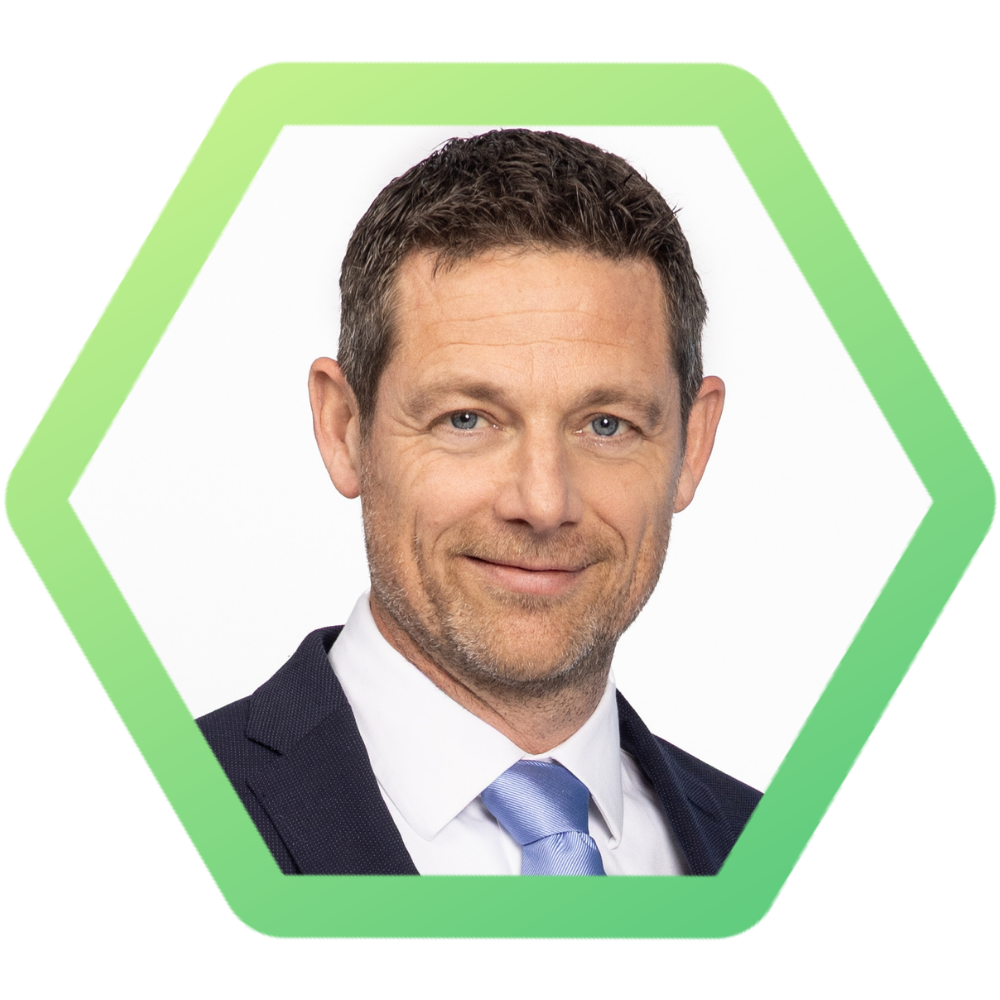
The conversation that follows is less about technology than it is about judgment: i.e., how to know which problems matter, which solutions are worth betting on, and how to make progress in a sector where the stakes leave very little room for wishful thinking. It’s about the mindset Brouwer believes leaders will need if they want to decarbonize industries that weren’t designed to change quickly.
1. Embrace “serendipity by design”
On paper, Roald Brouwer’s career has been full of unexpected turns. After obtaining his master’s in geology and geochemistry, he took up a wide range of positions in the energy sector, relocating around the world to focus on projects such as tar-sands development in Canada and oil-and-gas portfolio analysis in the Middle East. Since then, he’s pivoted from research to operations. Before his current position at Amrize, he ended his nearly 19-year tenure at Shell as the Director of Energy Transition Technologies and then moved to Holcim—and then joined Amrize when it spun off as a fully independent North American business in June 2025. At Amrize, he heads a team that works on innovations in cement, concrete, roofing, or wall systems to make solutions that are more efficient, durable, or resistant for the increasing demands of builders.
Roald calls this journey “serendipity by design”; deliberately putting yourself in unfamiliar territory often enough that interesting things begin to happen. He argues that it’s a way to build a kind of “surface area”—enriching yourself with more contexts, more patterns, and more chances to connect dots others might miss.
Seen through that lens, Roald’s path starts to look like assembling a toolkit. It reminds me of a 2017 paper published in Nature, which makes a simple but potent point: what we label as “serendipity” is usually the delayed payoff of earlier investments in capabilities whose value only becomes clear later.
2. Develop a “sixth sense” for foundational vs. incremental technologies
This idea that Brouwer’s career journey has made him combinatorial, rather than scattered has broader ramifications on his leadership style and intuition. At one point in our conversation, he brings up his “sixth sense” for which technologies will scale. Out of context, this might sound like mystique, but really it’s about pattern recognition. After years of supporting hundreds of deployments across Shell, then evaluating decarbonization options at scale at Holcim and now at Amrize, he’s become equipped with the kind of pattern “library” you need when operating inside an industry where the stakes (economically and climatically) are outsized. And that is important, particularly in the construction business, where novel approaches such as low-carbon cement need time and scope to develop.
One of his quickest filters is whether a technology is foundational or incremental. A foundational technology is robust and scalable and, most importantly, enables new markets (akin to the global, multilateral effects of LLMs). On the other hand, incremental technology is niche, just a finely-tuned optimization; it only nudges one particular industry in the right direction. Both can be valuable, Brouwer argues, but you shouldn’t pretend they have the same upside. An illustrative example is AI. This clearly disruptive innovation is also driving incremental changes in construction, as the rapid growth of data centers pushes an incremental need for ever-improving standards in thermally-efficient or weather-resistant building materials.
3. De-risk before you invest
Where I think Brouwer is more deliberate than many seasoned innovators is in how he uses that intuition. He doesn’t treat his gut as a green light or a veto power. Rather, it’s more of a hypothesis: directionally useful, but still unproven. If a technology could plausibly be foundational and worth billions (or, on the flip side, worth nothing if all goes wrong), it only makes sense to spend a small amount on a de-risking strategy to shrink that uncertainty before committing any serious capital. His sixth sense tells him which bets deserve that experimenting budget and which ones don’t. That is why Amrize, which is also North America’s largest cement maker, partners with startups that develop plant-based building materials.
Brouwer thinks in terms of “value of information.” How much are you willing to pay to learn whether a feasible upside is actually on the table? And what’s the minimum viable test that gets you that answer? The point of this mindset is to push innovation out of the realm of hope and into the realm of probability, because in heavy industry, you can’t fall in love with ideas: you have to measure and measure and measure again.
4. Think beyond “problem-first” vs. “solution-first”
Brouwer’s discipline around de-risking naturally leads to how he thinks about where innovation should even begin. He’s blunt: you don’t start with the technology, but with the problem. In Amrize’s world, that translates into very practicable customer needs—materials that will get a building LEED-certified or finding new ways to adapt ready-mix concrete to changing regional weather conditions. It sounds obvious, but in practice, especially in corporate R&D, teams often get attached to elegant solutions before they’ve actually defined what they’re solving for.
This tracks with existing research. According to researchers in a 2023 paper published in the Journal of Product Innovation Management, problem framing isn’t a preliminary box to tick, but rather the creative engine of innovation. Framing determines where you look, which assumptions you challenge, and which possibilities you’re even capable of seeing.
Brouwer approaches framing the same way he approaches de-risking: by staying in the ambiguity longer than most people are comfortable with. He spends time interrogating the shape of the problem. He asks what’s fixed, what’s fluid, what the real constraints are, and which ones are just inherited habits. He toggles between analytical grounding (the science and economics of decarbonization), intuitive pattern recognition (what he’s seen succeed or fail across decades of deployments), and relational logic (aligning with regulators, customers, etc.).
This is also why he doesn’t see “problem-first” and “solution-first” as opposing camps. Both have their place. Often, novel solutions are pilots and based in partnerships around concrete products. For a new Meta data center, Amrize partnered with Meta and the University of Illinois to develop a first-of-its kind AI-optimized concrete solution with a significantly lower carbon footprint, yet high durability. Specific challenges lead to innovative results. In universities or long-horizon research programs, starting with an open-ended idea is often the point—you wander, allowing yourself to discover unforeseen combinations along the way. This is the “exploration” side of innovation, and Brouwer has always made room for it. His own career, after all, was built on creating those unexpected crossovers.
But he’s equally clear that industry operates under different constraints. Budgets are finite, emissions targets are non-negotiable, and solutions actually have to survive real-world variables. That means you can’t “grocery shop without a list,” as he likens it. You need a clearly framed problem, a defined business case, and a sense of which constraints are truly binding. If exploration without direction becomes waste, then it’s also true that direction without exploration becomes incrementalism.
5. Hire integrators, not perfectionists
So how do you create a team that can actually push innovation forward? When it comes to hiring, Brouwer doesn’t fetishize pedigree or hyper-specialization. Instead, he emphasizes the importance of one archetype: integrators. In other words, people who can connect dots across engineering, operations, economics, policy, etc., without getting lost in the weeds.
In Brouwer’s experience, the teams that move fastest aren’t the ones stacked with domain purists, but the ones with people who can translate between purists. At Amrize, his team needs to take into account the views of different built-environment stakeholders—architects see things one way, specifiers another, and the customers—building contractors and subcontractors—have their own view, as well. Integrators are comfortable juggling these multiple interpretations of a problem, holding ambiguity without freezing, spotting the difference between a constraint that’s real and one that’s assumed.
This echoes what researchers describe as “relational” and “integrative” reasoning, i.e., the ability to align stakeholders, reconcile competing frames, and carry a problem from abstract framing to practical deployment. For Brouwer, these capabilities are not merely nice-to-haves: in industries defined by variability and tight margins, they’re the only way to actually bring solutions from theory to reality.
Looking ahead: finding creativity in constraints
One of the things that struck me most in talking with Brouwer is how little he romanticizes innovation. For him, creativity is less of a lightning bolt than it is a necessity under constraint. Innovation provides a competitive edge, by being able to provide customers with a broader set of solutions for their building projects that includes advanced materials others might not be able to provide. And it allows for Amrize to partner in the built environment by seeing a bigger picture.
Decarbonization, he argues, is both a technical challenge and an economic reframing exercise. If you move quickly enough, constraints can actually widen your opportunity space, bringing urgency, clarity, and focus—three things many innovation programs desperately lack. And they force leaders to ask different, more uncomfortable questions. What if the economics we’re defending are the very things holding us back? What if the limits we treat as fixed are just legacy assumptions waiting to be renegotiated?
If creativity is necessity under constraint, then this decade will tell us who is willing to embrace that necessity, and who is still hoping the future can be built without changing the frame.

Aisling Carlson is the Chief Growth Officer at Greentown Labs. Learn more about Greentown here and about partnership opportunities here.
This article was originally published on Aisling’s LinkedIn.
The post Innovating in the Age of Constraints: Roald Brouwer & Designed Serendipity appeared first on Greentown Labs.


