

The Integrity Council for the Voluntary Carbon Market (ICVCM) published new decisions under its Core Carbon Principles (CCP) program. The update covers three carbon credit methodologies, also called “categories” in ICVCM’s system. One methodology received full approval, and two received conditional approval.
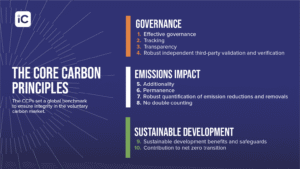
ICVCM’s CCP label is meant to help buyers spot carbon credits that meet a clear, minimum integrity bar. ICVCM uses an Assessment Framework to apply its label. This framework checks how programs and methods handle key issues, including quantification, additionality, monitoring, and verification.
According to Annette L. Nazareth, Chair of the Governing Board, ICVCM
“Demand for CCP-labelled credits has grown steadily, commanding price premiums that reflect buyers’ renewed trust. Policymakers, multilateral institutions, and standard-setters have incorporated the CCPs into their own frameworks, recognising the Integrity Council’s role in building coherence across voluntary and compliance markets.”
The three decisions were:
- Isometric: ISM Reforestation Protocol v1.1 — CCP Approved
- Gold Standard: Methane emission reduction by adjusted water management practice in rice cultivation v1.0 — CCP Approved (Conditional)
- American Carbon Registry (ACR): Improved Forest Management (IFM) on Non-Federal US Forestlands v2.0 — CCP Approved (Conditional)
How the CCP Label Works and When Conditions Apply
A CCP-approved method can earn credits for the CCP label. Projects need to follow the method and the program’s usual rules. In this ICVCM update, the Isometric reforestation method was approved without conditions. This means credits issued under it can get CCP labeling immediately.
A CCP-approved but conditional methodology can still earn the label, but only if specific conditions are met. These conditions can apply to how projects prove additionality. They can also apply to how projects account for risks. Finally, they may apply to how projects set baselines and leakage deductions.
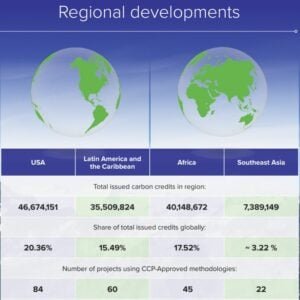
ICVCM also published a market-level snapshot with its February 2026 decisions. It approved eight carbon-crediting programs as CCP-Eligible. It also approved 38 methodologies.
However, 22 methodologies did not meet the requirements. About 105 million credits were approved for the CCP label. Of these, 52 million are available, while 53 million have been retired or canceled. Globally, here’s ICVCM’s carbon credit achievement:
Isometric Sets a First for Nature-Based CCP Credits
ICVCM granted full CCP approval to Isometric’s ISM Reforestation Protocol v1.1, which Isometric published in October 2025. The protocol outlines rules for measuring carbon removals from reforestation. This refers to restoring forest cover on land that was once forested. ICVCM placed it under the broader Afforestation, Reforestation, and Revegetation (ARR) category.
ICVCM said the assessment found the protocol met all relevant criteria in the CCP Assessment Framework. Because the body approved it with no conditions, it stated that all credits issued under the methodology will be eligible for CCP labels.
The Integrity Council also shared early activity indicators for this protocol. It said no credits had been issued yet, but 20 project developers were already registered under the methodology. The organization added that Isometric expects to issue over 4 million credits annually by 2030 under this protocol.
Isometric announced this week that the approval makes its Reforestation Protocol the first nature-based protocol with the CCP label.
- RELATED: Verra Issues First CCP-Labeled IFM Credits Under VM0045: A New Era for Forest Carbon Accounting
Rice Methane Credits Get a Conditional Green Light
ICVCM gave conditional CCP approval to Gold Standard’s method for cutting methane emissions. This method focuses on adjusting water management in rice cultivation (version 1.0). The Integrity Council announced that it published the methodology in July 2023. It is the first approved method for avoiding methane in rice cultivation.
The basic idea behind adjusted water management is simple. Flooded rice fields can produce methane because organic matter breaks down without oxygen. Changing water levels during the growing season can reduce methane formation.
Gold Standard’s documentation states that methane forms in flooded fields with low oxygen. It also notes that the methodology helps water regime changes that reduce methane emissions.
ICVCM also pointed to recent research on the scale of rice methane. A Nature Research Highlight from May 2025 said that a new inventory found rice paddy methane emissions were over 39 million metric tonnes in 2022.
Why Some Credits Qualify, and Others Don’t
The Integrity Council said the rice methodology qualifies for CCP approval only when specific conditions are met. The conditions show how a project proves additionality in some cases. They also explain a rule update about soil organic carbon loss risk in the methodology.
ICVCM also gave credit volume and pipeline estimates. It said about 50,000 credits had been issued under this methodology so far. However, the body understood that none of those credits complied with the first condition. As a result, the organization said those already-issued credits will not be eligible for the CCP label.
ICVCM noted that Gold Standard plans to issue up to 3.2 million credits in the next five years. This is based on its current project pipeline projections. It also listed the main project locations as India, plus activities in Pakistan, Vietnam, Bangladesh, Cambodia, Ghana, Indonesia, Lao PDR, Nepal, and Thailand.
- SEE MORE: Shell’s Initiative to Cut Methane in Rice Farming in the Philippines and Create Carbon Credits
ACR’s Forest Credits Face Tighter Baseline Tests
Same with Gold Standard, ICVCM also granted conditional CCP approval to ACR’s Improved Forest Management (IFM) on Non-Federal US Forestlands v2.0. IFM projects aim to change forest management practices to increase stored carbon or avoid emissions compared with a baseline scenario.
ICVCM explained that v2.0 is an earlier version of an IFM methodology that its Governing Board had already approved in August 2025 (v2.1). For v2.1, ICVCM had set a condition tied to leakage.
- A leakage deduction is needed for projects that cut wood product output by less than 5%. This keeps treatment consistent with projects that exceed that threshold.
For v2.0, ICVCM set two additional conditions. The methodology can earn CCP labeling if:
- A dynamic evaluation of the baseline is verified in line with ACR’s tool for dynamic baseline evaluation (developed with v2.1), and/or
- Removal credits are generated using a specified equation in the methodology (ICVCM references Equation 30).
ICVCM also quantified the immediate impact. It said 2.7 million credits were expected to be immediately eligible for the CCP label out of 13.3 million issued credits under this methodology.
The Integrity Council also stated that past and future removal credits from this method can get CCP labels. Future emission reduction credits can qualify, too, if they use the dynamic baseline evaluation tool.
ACR said the CCP label will soon activate for 2.7 million eligible IFM 2.0 credits in the ACR registry. They linked eligibility to the same baseline evaluation tool.
What CCP Expansion Means for Buyers and Developers
These ICVCM decisions matter because they expand the set of methodologies that can produce credits with the CCP label. For buyers, the label can act as a quick screen when building procurement rules. CCP decisions can influence method evolution for project developers and standards bodies. Conditional approvals often need updates to methods or stricter project tests.
At the same time, the details show that CCP labeling is not automatic. For example, ICVCM’s conditions for the rice methodology mean that some already-issued credits will not qualify. In the IFM case, ICVCM tied eligibility to specific approaches for baselines and the type of credit (removals versus emission reductions).
The approvals expand high-integrity CCP-labeled credits. They also signal growing supply for buyers while enforcing strict standards on baselines, additionality, and verification—shaping voluntary carbon markets toward greater quality and scale.
The post ICVCM Adds New CCP-Approved Carbon Credit Methods for Isometric, Gold Standard and ACR appeared first on Carbon Credits.


