 See more visuals like this on the Voronoi app.
View the high-resolution version of this infographic.

Ranked: The World’s 50 Largest Cities, From 1975 to 2050
See visuals like this from many other data creators on our Voronoi app. Download it for free on iOS or Android and discover incredible data-driven charts from a variety of trusted sources.
Key Takeaways
- Since 1975, the world’s largest cities have shifted decisively from developed economies to Asia and Africa.
- By 2050, Asia and Africa are projected to account for 37 of the world’s 50 largest cities, reshaping the global urban hierarchy.
- Several cities that once dominated the rankings are projected to see slow growth—or fall sharply in rank—by mid-century.
In 1975, the world’s largest cities were dominated by Japan, Europe, and North America. By 2025, that balance had already shifted toward Asia. Looking ahead to 2050, Africa is projected to emerge as a major force in the global urban hierarchy.
Urbanization has been the driving force behind this transformation—and it’s far from finished.
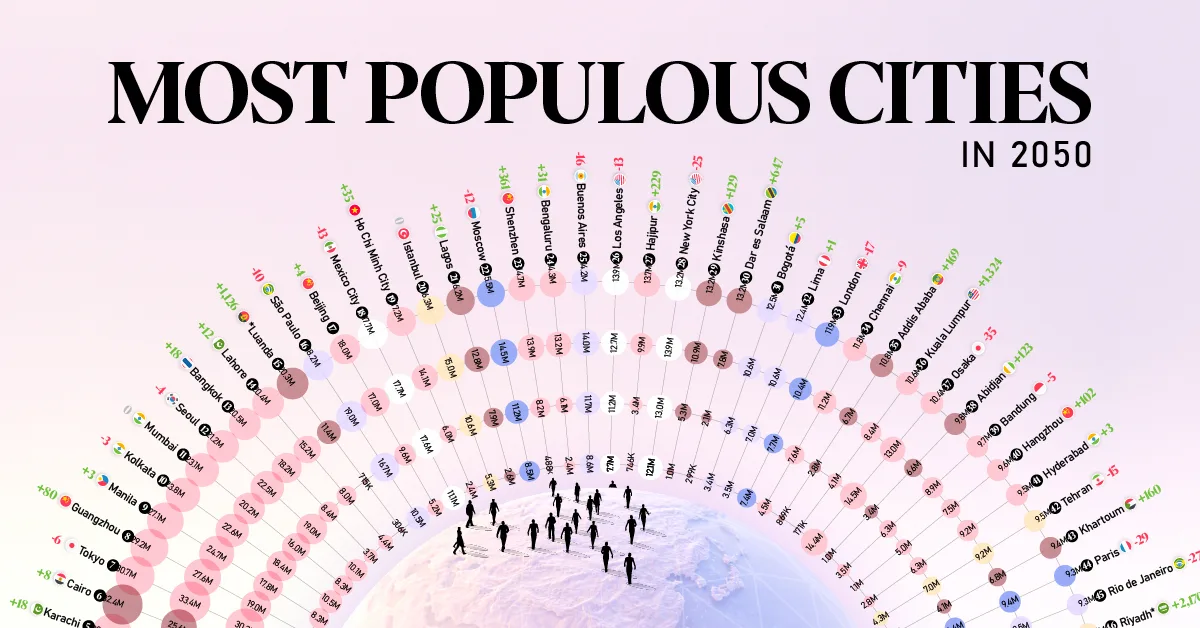
This visualization tracks how the world’s 50 largest cities have risen, stagnated, or fallen in rank across four points in time—1975, 2000, 2025, and 2050—using data from the UN World Urbanization Prospects 2025.
How the World’s Largest Cities Have Risen and Fallen
In 1975, Tokyo and Osaka were the world’s two largest cities, followed by New York, Jakarta, and Mexico City.
By 2000, Asian megacities like Shanghai, Beijing, and New Delhi climbed the rankings as population growth accelerated across Asia. Fast forward to 2025, and the shift has become more pronounced, with many of the world’s largest cities now located in South and East Asia. As urbanization continues, this shift is projected to continue through 2050.
The table below shows the world’s 50 largest cities in 2050, along with their population sizes in 1975, 2000, and 2025:
| 2050 Population Rank | City | Country | 1975 Population | 2000 Population | 2025 Population | 2050 Population |
|---|---|---|---|---|---|---|
| 1 | Dhaka |  Bangladesh Bangladesh |
5,037,174 | 17,434,596 | 36,585,479 | 52,123,000 |
| 2 | Jakarta |  Indonesia Indonesia |
11,696,369 | 25,591,966 | 41,913,860 | 51,784,000 |
| 3 | Shanghai |  China China |
4,542,787 | 14,034,558 | 29,558,908 | 34,912,000 |
| 4 | New Delhi |  India India |
6,091,891 | 17,969,092 | 30,222,405 | 33,891,000 |
| 5 | Karachi |  Pakistan Pakistan |
4,626,701 | 10,799,503 | 21,422,590 | 32,593,000 |
| 6 | Cairo |  Egypt Egypt |
7,440,914 | 15,676,619 | 25,566,102 | 32,366,000 |
| 7 | Tokyo |  Japan Japan |
24,281,618 | 30,302,560 | 33,412,512 | 30,658,000 |
| 8 | Guangzhou | China |
1,644,240 | 18,970,258 | 27,563,372 | 29,243,000 |
| 9 | Manila |  Philippines Philippines |
8,329,012 | 17,799,064 | 24,735,305 | 27,120,000 |
| 10 | Kolkata | India |
10,527,605 | 18,355,286 | 22,549,738 | 23,768,000 |
| 11 | Mumbai | India |
8,338,773 | 15,952,862 | 20,203,056 | 23,059,000 |
| 12 | Seoul |  Republic of Korea Republic of Korea |
10,079,046 | 18,962,544 | 22,490,482 | 21,225,000 |
| 13 | Bangkok |  Thailand Thailand |
3,650,772 | 8,377,066 | 18,180,280 | 20,462,000 |
| 14 | Lahore | Pakistan |
4,402,766 | 7,978,805 | 15,156,430 | 20,388,000 |
| 15 | Luanda |  Angola Angola |
306,000 | 714,643 | 11,370,127 | 20,286,000 |
| 16 | São Paulo |  Brazil Brazil |
10,536,121 | 16,702,008 | 18,949,790 | 18,217,000 |
| 17 | Beijing | China |
5,154,971 | 9,635,380 | 17,013,303 | 18,004,000 |
| 18 | Mexico City |  Mexico Mexico |
11,119,402 | 17,598,162 | 17,734,212 | 17,679,000 |
| 19 | Ho Chi Minh City |  Vietnam Vietnam |
2,384,034 | 6,006,090 | 14,052,713 | 17,201,000 |
| 20 | Istanbul |  Türkiye Türkiye |
5,305,193 | 10,633,602 | 15,014,763 | 16,303,000 |
| 21 | Lagos |  Nigeria Nigeria |
2,612,450 | 7,908,961 | 12,791,699 | 16,180,000 |
| 22 | Moscow |  Russian Federation Russian Federation |
8,520,842 | 11,194,627 | 14,524,753 | 15,522,000 |
| 23 | Shenzhen | China |
487,944 | 8,180,960 | 13,878,396 | 14,661,000 |
| 24 | Bengaluru | India |
2,369,541 | 6,051,928 | 13,187,098 | 14,258,000 |
| 25 | Buenos Aires |  Argentina Argentina |
8,560,900 | 11,711,634 | 14,017,736 | 14,236,000 |
| 26 | Los Angeles |  United States United States |
7,717,837 | 11,195,626 | 12,740,420 | 13,862,000 |
| 27 | Hajipur | India |
745,962 | 3,363,805 | 9,941,510 | 13,695,000 |
| 28 | New York City | United States |
12,076,416 | 13,044,483 | 13,920,148 | 13,225,000 |
| 29 | Kinshasa |  DR Congo DR Congo |
1,035,622 | 5,328,174 | 10,943,641 | 13,211,000 |
| 30 | Dar es Salaam |  Tanzania Tanzania |
299,151 | 2,071,645 | 7,795,114 | 13,160,000 |
| 31 | Bogotá |  Colombia Colombia |
3,389,750 | 6,340,840 | 10,624,315 | 12,478,000 |
| 32 | Lima |  Peru Peru |
3,519,785 | 6,991,685 | 10,580,241 | 12,358,000 |
| 33 | London |  United Kingdom United Kingdom |
7,369,842 | 7,654,553 | 10,416,420 | 11,869,000 |
| 34 | Chennai | India |
4,484,115 | 7,612,508 | 11,153,205 | 11,757,000 |
| 35 | Addis Ababa |  Ethiopia Ethiopia |
868,901 | 2,791,724 | 6,705,705 | 10,783,000 |
| 36 | Kuala Lumpur |  Malaysia Malaysia |
170,777 | 4,143,915 | 8,443,731 | 10,627,000 |
| 37 | Osaka | Japan |
14,448,054 | 14,487,830 | 12,964,145 | 10,449,000 |
| 38 | Abidjan |  Côte d’Ivoire Côte d’Ivoire |
1,024,745 | 3,441,806 | 6,621,711 | 9,775,000 |
| 39 | Bandung | Indonesia |
3,475,759 | 6,333,411 | 8,909,104 | 9,747,000 |
| 40 | Hangzhou | China |
1,113,616 | 4,964,897 | 7,500,208 | 9,625,000 |
| 41 | Hyderabad | India |
2,810,479 | 6,340,661 | 9,190,795 | 9,546,000 |
| 42 | Tehran |  Iran Iran |
4,265,101 | 6,999,195 | 9,174,964 | 9,499,000 |
| 43 | Khartoum |  Sudan Sudan |
870,553 | 4,135,102 | 6,809,355 | 9,444,000 |
| 44 | Paris |  France France |
7,423,859 | 8,385,156 | 9,381,921 | 9,326,000 |
| 45 | Rio de Janeiro | Brazil |
5,880,669 | 8,416,754 | 9,500,336 | 9,300,000 |
| 46 | Riyadh |  Saudi Arabia Saudi Arabia |
126,000 | 2,557,269 | 6,916,417 | 9,153,000 |
| 47 | Alexandria | Egypt |
2,647,675 | 4,477,718 | 7,266,957 | 9,023,000 |
| 48 | Johannesburg |  South Africa South Africa |
1,180,560 | 2,767,803 | 7,077,175 | 8,916,000 |
| 49 | Onitsha | Nigeria |
756,883 | 2,353,086 | 5,627,706 | 8,681,000 |
| 50 | Yaoundé |  Cameroon Cameroon |
455,219 | 1,578,631 | 5,106,087 | 8,661,000 |
Looking ahead to 2050, Dhaka is projected to be the world’s most populous city with over 52 million residents, followed closely by Jakarta. Asian cities are projected to remain population hubs, with Shanghai, New Delhi, and Karachi rounding out the top five, and the Asian continent accounting for 24 of the 50 largest cities.
Meanwhile, Africa emerges as the fastest-growing urban region in the world, accounting for 13 of the 50 largest cities. Cities such as Lagos, Kinshasa, Cairo, and Dar es Salaam are projected to see explosive population growth over the coming decades, driven by high fertility rates and urbanization.
Overall, the number of megacities, those with over 10 million inhabitants, is projected to increase to 37, up from 33 megacities in 2025.
Slower Growth in Developed Economies
While cities in emerging markets surge, many historically large cities in Europe, Japan, and North America are projected to grow relatively slowly, or even plateau.
For example, Osaka’s population is projected to decline by 2.5 million, or 20%, and New York’s by 5%. Other large metros including Tokyo, Paris, and Seoul, are expected to hit similar population plateaus.
However, despite slow growth, these cities are likely to remain global economic powerhouses, supported by long histories of commercial and economic activity.
Learn More on the Voronoi App
If you enjoyed this infographic, explore more insights on Voronoi, including The Countries Set to Double Their Population the Fastest.