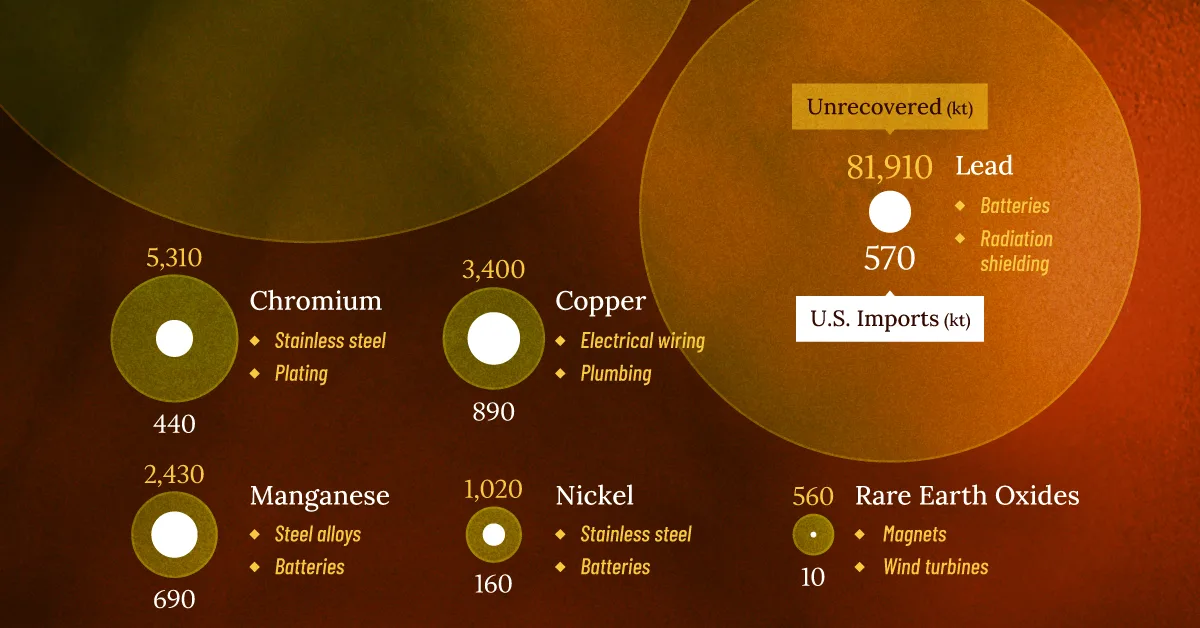
 See more visuals like this on the Voronoi app.
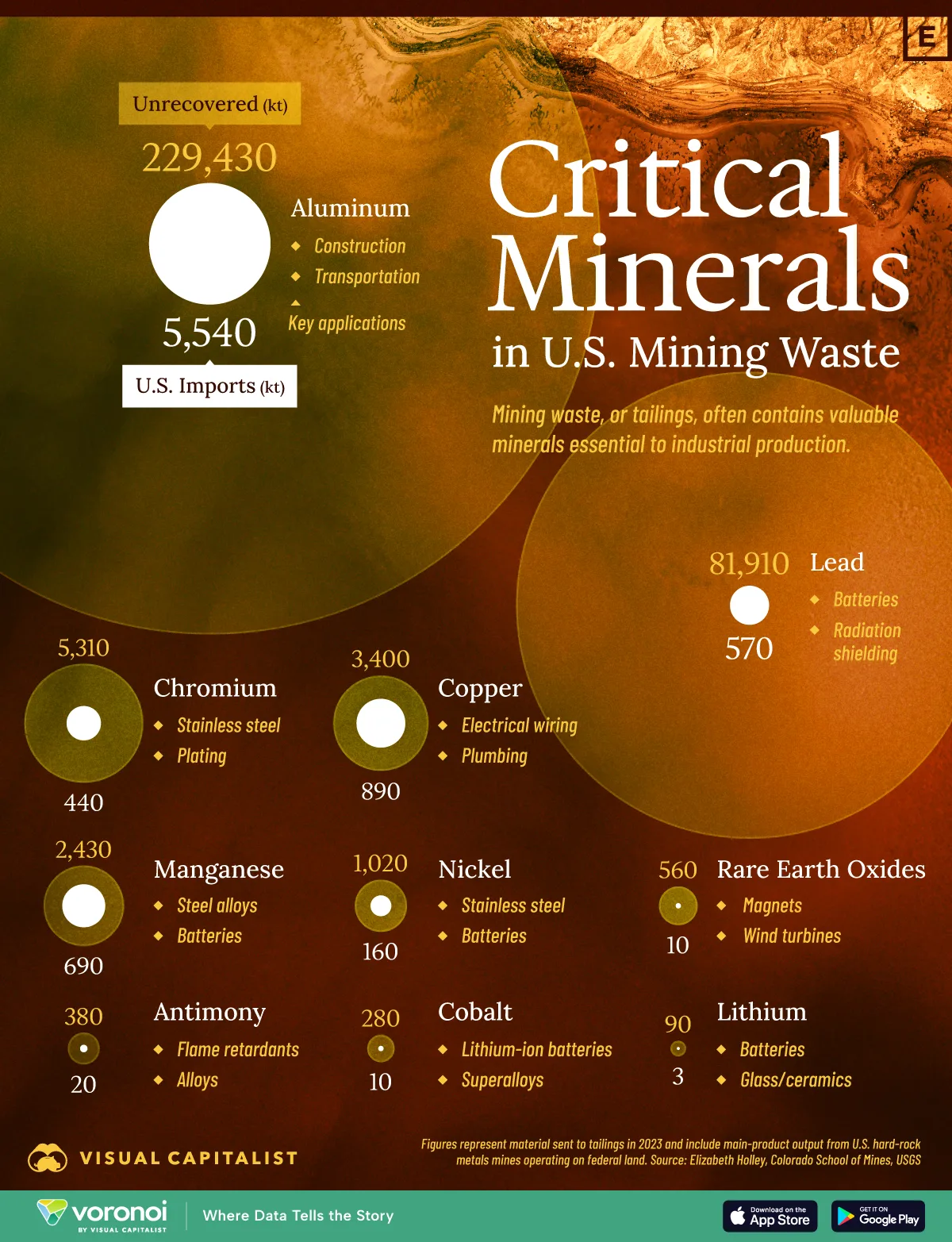
Critical Minerals Lost to U.S. Mining Waste, by Tonnage
See visuals like this from many other data creators on our Voronoi app. Download it for free on iOS or Android and discover incredible data-driven charts from a variety of trusted sources.
Key Takeaways
- Hundreds of millions of tonnes of critical minerals were sent to U.S. mine tailings in 2023.
- Aluminum and lead alone account for over 300 million tonnes of unrecovered material.
- Reprocessing mining waste could strengthen domestic supply chains for energy, defense, and advanced manufacturing.
The U.S. is often described as highly dependent on foreign sources for critical minerals. Yet every year, vast quantities of these same materials are sent to mine tailings as waste.
This visualization ranks critical minerals by the amount discarded into U.S. mining waste in 2023, highlighting where the largest volumes of potential supply remain unrecovered.
The data for this visualization comes from analysis by Professor Elizabeth Holley of the Colorado School of Mines and includes main-product output from U.S. hard-rock metals mines operating on federal land.
Where the Largest Volumes Are Being Lost
Aluminum stands out by a wide margin, with an estimated 229 million tonnes sent to tailings in 2023. That is more than 40 times the volume imported that year.
Lead follows with more than 81 million tonnes unrecovered, despite its importance for batteries and radiation shielding.
| Element | Unrecovered 2023 (kt) | U.S. Imports 2023 (kt) | Applications |
|---|---|---|---|
| Aluminum | 229,430 | 5,540 | Construction, Transportation |
| Lead | 81,910 | 570 | Batteries, Radiation shielding |
| Chromium | 5,310 | 440 | Stainless steel, Plating |
| Copper | 3,400 | 890 | Wiring, Plumbing |
| Manganese | 2,430 | 690 | Steel alloys, Batteries |
| Nickel | 1,020 | 160 | Stainless steel, Batteries |
| Rare Earth Oxides | 560 | 10 | Magnets, Wind turbines |
| Antimony | 380 | 20 | Flame retardants, Alloys |
| Cobalt | 280 | 10 | Lithium-ion batteries, Superalloys |
| Lithium | 90 | 3 | Batteries, Glass/ceramics |
Critical for Clean Energy and Industry
Several minerals essential to clean energy technologies also appear prominently. Copper, nickel, lithium, cobalt, and rare earth oxides are all present in mining waste at volumes far exceeding current import levels. These materials are critical for electric vehicles, grid infrastructure, wind turbines, and battery storage.
Recovering even a fraction of what is discarded could ease supply constraints and reduce exposure to geopolitical risks.
“The challenge lies in recovery,” Professor Holley told the Colorado School of Mines’ Mines Newsroom.
“It’s like getting salt out of bread dough—we need much more research, development, and policy support to make the recovery of these critical minerals economically feasible.”
Reprocessing tailings could offer a dual benefit. Economically, it could strengthen domestic supply chains and reduce reliance on imports from a small number of foreign producers, particularly China.
Environmentally, it could lower the need for new mines, which often face long permitting timelines and local opposition.
Learn More on the Voronoi App
If you enjoyed today’s post, check out Every Mineral Deemed Critical to U.S. Security in 2025 on Voronoi, the new app from Visual Capitalist.
- Source: https://www.visualcapitalist.com/ranked-the-critical-minerals-lost-to-u-s-mining-waste-by-tonnage/