
Misleading certifier logo on the front panel of products falsely implies full organic certification
THE STORY: A QUICK OVERVIEW
• A formal complaint filed with the USDA alleges that Quality Assurance International (QAI) has created a certification mark that functions as a marketing claim strongly implying products labeled “Made with organic ingredients” are certified organic, in violation of federal regulations for labeling organic food.
• The QAI seal implies full organic certification — misleading consumers — even though “Made with organic ingredients” products are not certified organic and may contain up to 30% nonorganic ingredients.
• Nowhere does the primary display panel disclose the 70% organic minimum requirement or the proportion of nonorganic ingredients, despite premium pricing.
• The certification mark constitutes more than the currently permitted seal, logo, or identification of the certifier, which undermines consumer confidence and provides unfair market advantage to companies using misleading marketing claims.
LA FARGE, WIS. — OrganicEye, a prominent organic industry watchdog, has filed a formal legal complaint alleging that Amy’s Kitchen, LLC, certified by Quality Assurance International (QAI), in an effort to deceive the public, is using a modified and misleading certifier seal on the front panel of products that do not qualify for full organic certification.
Amy’s Kitchen markets a wide range of frozen ready-to-heat meals, burritos and wraps, pizza, snacks, and canned soups. Most of their products are labeled and sold in accordance with federal regulation Section 205.304, which governs packaged products labeled “Made with organic,” rather than qualifying for full organic status. OrganicEye asserts that these products bear a USDA accredited certifier’s promotional message on the principal display panel that goes well beyond what is permitted under the regulations.
“It is our contention that the image and wording used on the QAI seal constitute more than the permitted simple seal, logo, or identification of the certifier,” said Mark A. Kastel, executive director at OrganicEye. “This certification mark functions as a marketing claim that strongly implies the product itself is certified organic, which it is not.”
The QAI marketing message is particularly confusing because it includes the phrase “Certified Organic,” even though products labeled “Made with organic ingredients” are not certified organic. While these products are made with 70% or more organic ingredients, they can contain a substantial proportion (up to 30%) of non-organic ingredients and, as such, do not qualify to be identified as “organic” or to include the USDA organic seal.
In the example of Amy’s pizza, the certified organic ingredients listed include flour, tomato puree, olive oil, honey, basil, garlic, and cane sugar. However, key ingredients such as mozzarella and parmesan cheeses — likely the most expensive components — are not organic, nor are the safflower/sunflower oil, yeast, or spices used in the product.
“There is no reason that Amy’s can’t produce food made with all certified organic ingredients and thus qualify for organic labeling,” Kastel added.
This issue is particularly significant given the high level of consumer trust placed in organic certification. Recent surveys by the Organic Trade Association show that shoppers of all ages rank USDA Organic certification and Non-GMO Project verification as the most trusted food labels, with nearly half of respondents rating their trust in these certifications the highest. The implication that products “Made with organic ingredients” are certified organic adds perceived high value to items that do not qualify for the USDA Organic seal and, OrganicEye contends, places companies that use all organic ingredients at a competitive disadvantage.
Nowhere on the principal display panel, information panel, or elsewhere on the packaging are consumers clearly informed that products “Made with organic ingredients” are required to contain only a minimum of 70% organic ingredients. Consumers have no way of knowing the proportion of nonorganic ingredients in the products they are purchasing for premium prices.
“Consumers are willing to pay a premium for products they believe are organic and ‘free from’ toxic agrichemicals, hormones, antibiotics, synthetic dyes, and unnecessary additives,” said Kastel. “But they may be unknowingly paying higher prices for products that are as much as 30% nonorganic.”
OrganicEye is urging the USDA’s National Organic Program to address what it views as willfully misleading labeling practices and to ensure that certifier seals and marketing language do not create marketplace confusion and undermine consumer confidence in the organic label.
They have also created an online petition that organic consumers/eaters can use to contact Amy’s CEO, Andy Berliner, asking that the company discontinue their disingenuous labeling and transition the 68% of products they produce that do not qualify for organic labeling to all-organic ingredients.
“For companies like Amy’s, selling both certified organic products and those labeled ‘Made with organic ingredients,’ their marketing amounts to an organic ‘shell game,’” said OrganicEye’s Kastel.
-30-
More:
Companies like Organic Valley and Nature’s Path that sell only certified organic products bearing the USDA seal on the front of their product packaging have built brands that are widely trusted by shoppers nationwide.
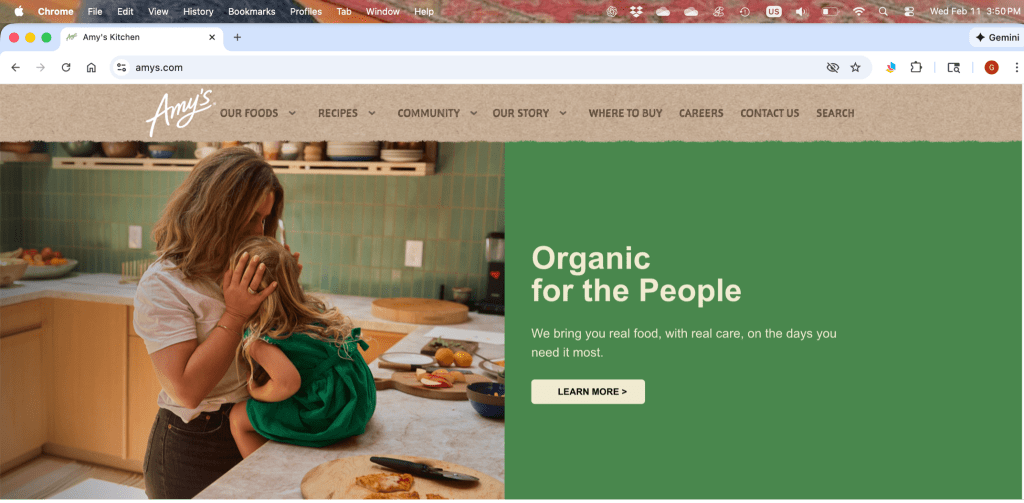
“When a company like Amy’s opens their website with a page where the first word is ‘Organic,’ it is clearly implying their brand is organic,” OrganicEye’s Kastel observed.
Amy’s Kitchen, launched in 1988, did not begin to sell organic products — their organic soup line — until 1999, well after the Organic Foods Production Act of 1990 established the USDA National Organic Program.
“Amy’s customers likely recognize the value of the word ’Organic‘ on their packaging,” said Kastel. “When a brand mixes certified organic SKUs (stock keeping units) with others that do not qualify for organic certification, the disclaimer “Made with [organic ingredients]” provides a smoke screen that can confuse shoppers into believing that nearly all Amy’s products are certified organic — even though the majority of their products can contain up to 30% non-organic ingredients.”
The post Organic Industry Watchdog Accuses Major Certifier and Food Marketer of Consumer Deception appeared first on OrganicEye.


