
Data centers, electrification, and manufacturing facilities are driving a surge in US electricity demand. Following years of only needing to maintain electricity levels, utilities and regulators now need to find an additional 270 GW of power in the next decade. This is due to an expected increase of 150 GW of national peak demand and an estimated retiring of 120 GW of existing power generation.
Thankfully, there are cost-effective solutions that can be deployed quickly to strengthen the grid and make up 95 percent of the difference. Below we list five solutions with the percentage of demand each can reduce.
Energy efficiency: The fastest, lowest-cost resource (20 percent)
Improving energy efficiency helps make the most of every electron, reducing costs while also improving comfort and resilience in homes and other buildings. Creating energy efficiency programs for new loads and expanding existing programs aligned with system needs can unlock over 50 GW of electricity for the grid.
Energy efficiency has traditionally meant replacing older technologies or appliances with newer versions that perform better with the same amount of energy or less. Looking at energy efficiency from a systems perspective, not just a product-focused approach, it becomes evident that many efficiency opportunities are interconnected across the buildings, transportation, and industry sectors, creating multilayered opportunities for greater efficiency and cost savings.
Virtual power plants: Fast, flexible capacity without new infrastructure (22 percent)
Virtual power plant (VPP) programs coordinate distributed energy resources like smart thermostats, home batteries, and electric vehicles to provide grid services. By 2030, 60 GW of VPPs could be deployed.
VPPs are unique in their flexibility, cost-effectiveness, and speed — programs can be created and launched in under six months. VPPs can allow utilities to more efficiently use existing, underutilized grid infrastructure, which often results in a lower cost capacity for incremental demand. They are also highly modular and can be scaled up or down on short notice, making them a useful solution for managing the risk associated with uncertain demand forecasts — meaning no stranded assets.
Advanced transmission technologies: An efficiency upgrade for the grid (30 percent)
Advanced transmission technologies (ATTs), including grid enhancing technologies (GETs) and advanced conductors, are essentially an efficiency upgrade for the grid: they can help existing infrastructure transport more electricity, which relieves congestion, lowers customer costs, and improves reliability.
GETs and advanced conductors can unlock over 80 GW of incremental peak capacity by reducing transmission and interconnection constraints. ATTs are also less expensive than new transmission and can be installed in a shorter time than it takes to site, permit, and build new lines. Modernizing the grid with ATTs can help quickly get more out of the existing grid, but ATT uptake has been slow despite successful small-scale deployments in the United States.
Clean repowering: Using existing grid connections to get clean energy on the grid faster and cheaper (5 percent)
Clean repowering is an elegant and efficient solution that builds new clean energy resources where grid connections already exist to circumvent the lengthy interconnection queues that have emerged as the primary barrier to launching new energy resources. It can take up to 15 years or more to plan, permit, and build transmission lines in the United States, leaving energy projects languishing in limbo as they wait to connect to the grid.
Although some planned retirements have been delayed, the US Energy Information Administration predicts that coal generating capacity will decline by 13 GW over the next two years.
Building new renewable energy and storage where fossil generation is retiring or alongside exiting fossil plants could speed up the deployment of energy resources while reducing system costs because we don’t have to build as much new infrastructure.
Power Couples: Powering new large loads without straining the grid (19 percent)
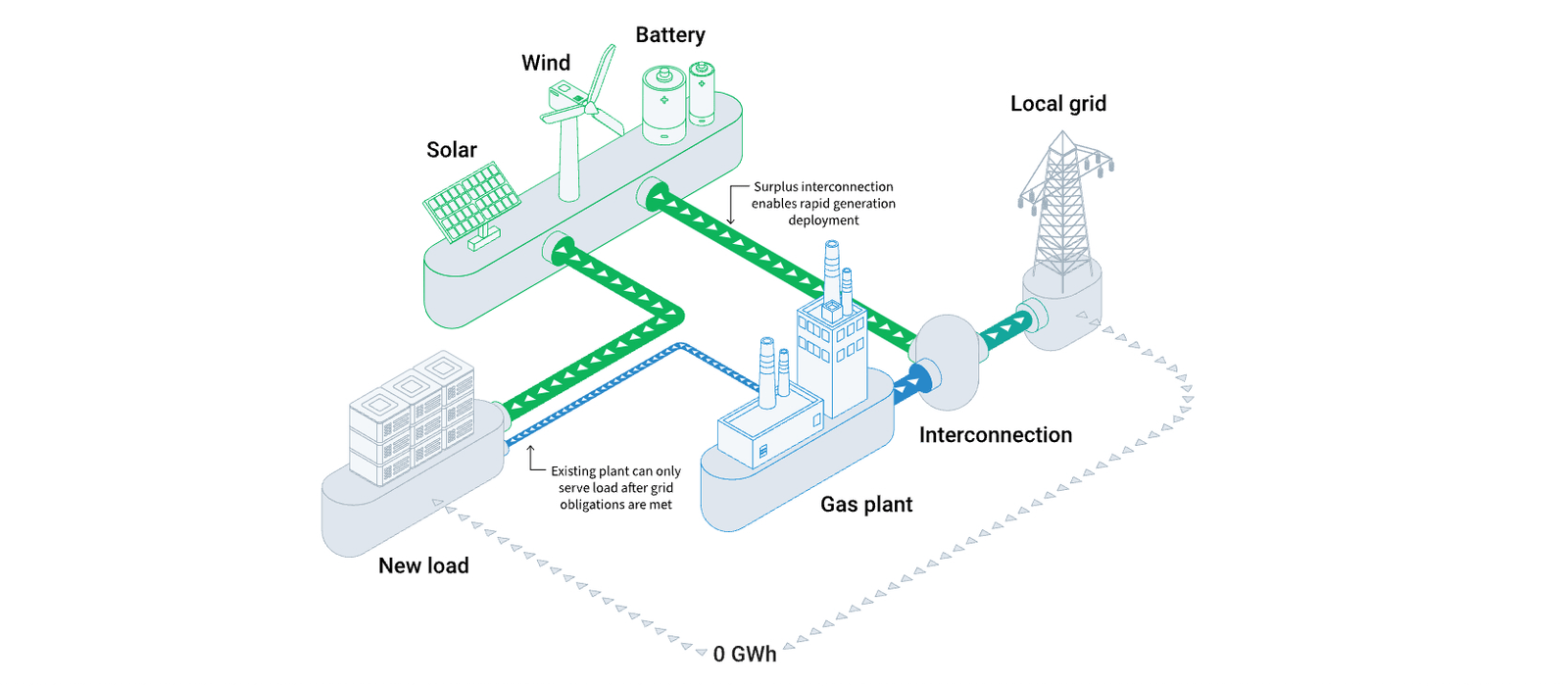
Powering new large electricity loads with wind, solar, and battery systems built near existing, underutilized generators with approved interconnections — a strategy we call “Power Couples” — can deploy the energy needed for data centers and other consumers without putting additional strain on the grid or raising prices for other ratepayers.
These new clean energy resources are sized to meet the demand of the new load and can send surplus energy to the grid.
As of 2025, there are more than 30 GW of opportunity to deploy Power Couples under $100 per megawatt-hour (MWh), and over 50 GW of opportunity under $200/MWh.
Power couple co-located at site of existing natural gas generator
We can meet demand growth with solutions available now
Proven solutions exist to provide utilities and regulators with options to support economic growth in the near term without risking massive investments in infrastructure that could be stranded if the data center, manufacturing, and electrification booms don’t pan out as expected.
These existing technologies can be quickly implemented to get the most out of our energy infrastructure, strengthen our existing grid, and prepare the system for the deployment of future energy generation resources.
The post Fast, Efficient Solutions to Meet Electricity Demand Growth appeared first on RMI.


