
 See more visualizations like this on the Voronoi app.
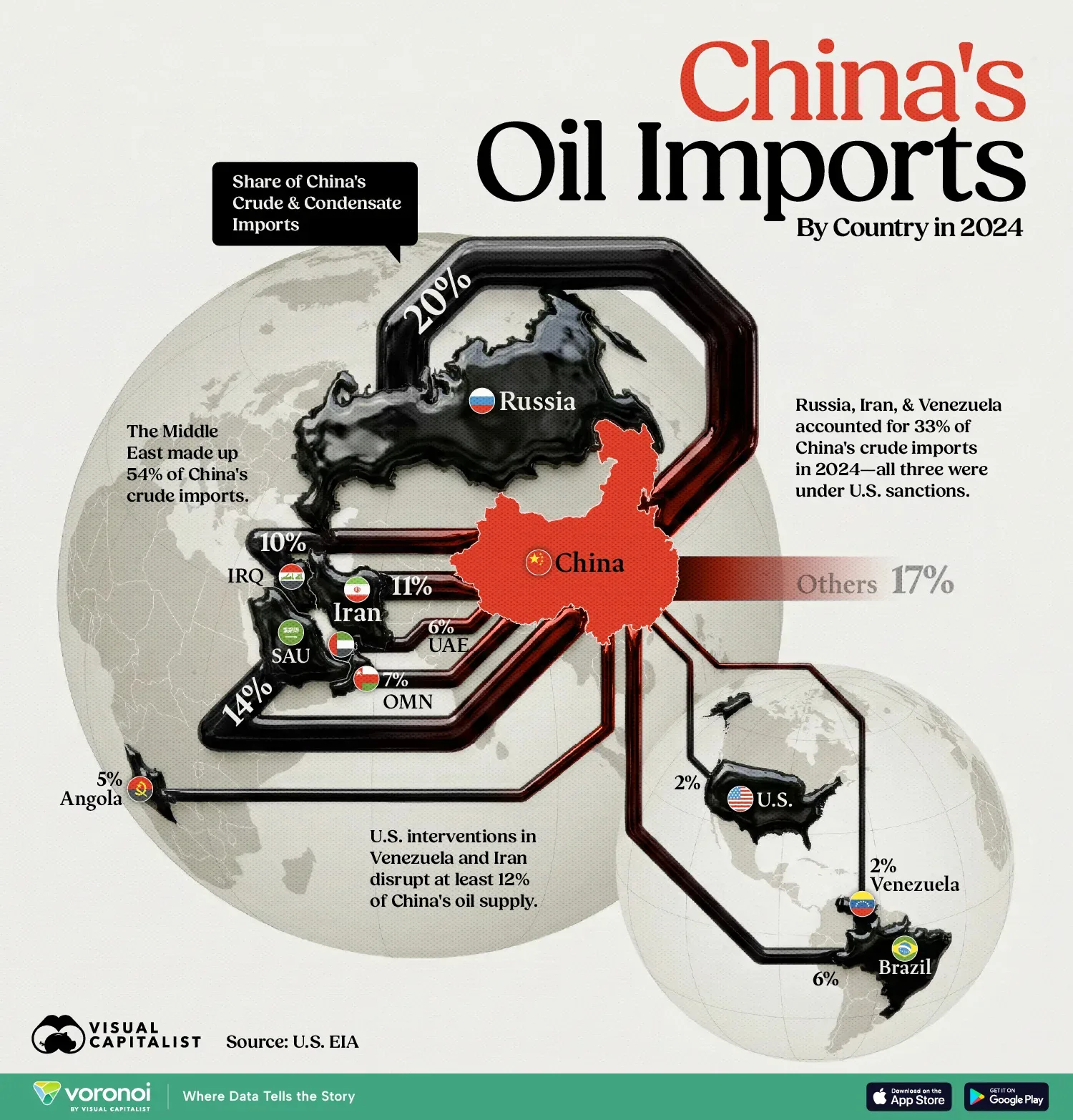
Mapped: Where China Gets Its Oil
See visuals like this from many other data creators on our Voronoi app. Download it for free on iOS or Android and discover incredible data-driven charts from a variety of trusted sources.
Key Takeaways
- Over half of China’s imports of crude oil came from the Middle East in 2024.
- The effective closure of the Strait of Hormuz thus poses a risk to China’s energy security.
- Sanctioned countries — Russia, Iran, and Venezuela — accounted for 33% of China’s crude import mix that year.
China is the world’s largest crude oil importer, bringing in roughly 11 million barrels per day to fuel its economy. But that dependence creates a vulnerability: a large share of its supply comes from the Middle East.
The Strait of Hormuz, a critical trade route between Oman and Iran, has been disrupted as shipping companies reroute or stockpile cargo following U.S.-Israel strikes on Iran on Feb. 28, 2026.
The world’s largest oil tankers pass through the strait due to its depth and width, carrying 20.7 million barrels of oil every day in 2024. A large portion of that was headed for Asia, and China specifically.
The map, which is based on data from the U.S. EIA, shows where China imported its crude and condensate from in 2024.
China’s Oil Imports by Country
Dive into the data, which tracks import-source dependence rather than total Chinese primary energy dependence, below:
| Country | Share of China’s Crude Oil and Condensate Imports in 2024 |
|---|---|
 Russia Russia |
20% |
 Saudi Arabia Saudi Arabia |
14% |
 Iran Iran |
11% |
 Iraq Iraq |
10% |
 Oman Oman |
7% |
 United Arab Emirates United Arab Emirates |
6% |
 Brazil Brazil |
6% |
 Angola Angola |
5% |
 United States United States |
2% |
 Venezuela Venezuela |
2% |
 Other Other |
17% |
Russia was China’s largest supplier in 2024, accounting for about 20% of crude and condensate imports. Saudi Arabia followed at 14%, while Iran supplied 11%.
Other Middle Eastern producers—including Iraq, Oman, and the United Arab Emirates—also contribute significant shares.
Taken together, the Middle East made up 54% of crude and condensate imports, highlighting a concentration that leaves China exposed to sudden changes in energy flows through the region.
Brazil and Angola are key diversifiers, representing 6% and 5% of China’s imports.
China’s Supply Chain is Linked to Sanctions
Energy security was already on the Chinese agenda, leading it to bolster domestic production of renewables and even coal.
Russia, Iran, and Venezuela accounted for 33% of China’s crude import mix in 2024, highlighting how countries facing global sanctions have banded together.
Russia has strengthened its relationship with Asia since Europe began weaning itself off Russian gas in support of Ukraine. It moves a lot of its energy by pipe, meaning it avoids maritime corridors that can quickly become chokepoints and thus offer China an import source that is less exposed to geopolitical vulnerabilities.
Learn More on the Voronoi App
To learn more about China’s trading partners, check out this graphic which charts the country’s top relationships.


