Beyond the Atmosphere: Exploring Space and Humanity’s Future
Key Takeaways
- Commercial firms have become the leaders in exploring space by conducting 70% of global spacecraft launches in 2024.
- Launch costs have fallen dramatically and may decline another 95%, making exploring space more accessible than ever.
- The space economy is projected to exceed $1 trillion by 2032.
Exploring space, that final frontier, has become a unifying goal as nations collaborate to extend beyond Earth. A new wave of commercial players and national space programmes are expanding access and reshaping exploration and governance alike
In partnership with Dubai Future Forum, the world’s largest gathering of futurists taking place every November in Dubai, this graphic shows how exploration, investment, and innovation are converging to transform our understanding of space.
It’s one of four dimensions—Ocean, Mind, Space, and Land—within the Dubai Future Forum’s larger theme, Exploring the Unknown.
The data comes from these sources:
- World Population Review
- Citigroup
- BryceTech
- Government and Commercial Space Organization Websites
- Space Foundation
- The Global 50 Report by Dubai Future Foundation.
Global Citizens, Galactic Pathways
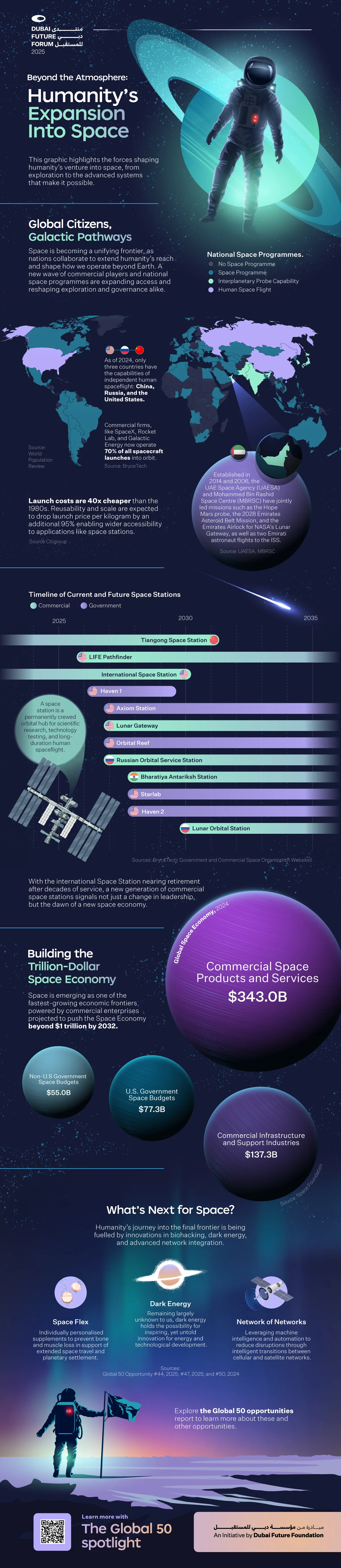
As of 2024, only three countries have the capabilities of independent human spaceflight: China, Russia, and the United states.
However, the number of countries with interplanetary probe capabilities has grown to eight, including the UAE Space Agency (UAESA) which successfully launched the Mars Hope Probe in 2020.
To see how this breaks down, here is a table of National Space Programmes around the world:
| Country | Human Space Flight | Interplanetary Probe Capability | Space Programme Acronym |
|---|---|---|---|
| United States | Yes | Yes | NASA, USSF |
| China | Yes | Yes | CNSA |
| Russia | Yes | Yes | ROSCOSMOS |
| India | Yes | ISRO | |
| Pakistan | Yes | SUPARCO | |
| Japan | Yes | JAXA | |
| South Korea | Yes | KARI, KASI | |
| United Arab Emirates | Yes | UAESA | |
| Brazil | AEB | ||
| Iran | ISA | ||
| United Kingdom | UKSA | ||
| France | CNES | ||
| Italy | ASI | ||
| Argentina | CONAE | ||
| Canada | CSA/ASC | ||
| Ukraine | SSAU | ||
| Poland | POLSA | ||
| Australia | ASA and NSP | ||
| Sweden | SNSA | ||
| Israel | ISA | ||
| New Zealand | NZSA | ||
| Indonesia | LAPAN | ||
| Nigeria | NASRDA | ||
| Bangladesh | SPARRSO | ||
| Ethiopia | ESSTI | ||
| Mexico | AEM | ||
| Egypt | EgSA, NARSS, EASRT-RSC | ||
| Philippines | PhilSA | ||
| Vietnam | TTVTVN or VNSC, VAST-VNSC | ||
| Turkey | TUA | ||
| Germany | DLR | ||
| Thailand | GISTDA | ||
| South Africa | SANSA | ||
| Kenya | KSA | ||
| Colombia | CCE | ||
| Spain | AEE | ||
| Algeria | ASAL | ||
| Angola | GGPEN | ||
| Morocco | CRTS | ||
| Malaysia | MYSA | ||
| Ghana | GSSTI | ||
| Peru | CONIDA | ||
| Saudi Arabia | SSA | ||
| Venezuela | ABAE | ||
| North Korea | NATA | ||
| Taiwan | TASA | ||
| Kazakhstan | KazCosmos | ||
| Chile | CSA | ||
| Romania | ASR, ROSA | ||
| Netherlands | SRON | ||
| Rwanda | RSA | ||
| Tunisia | CNCT | ||
| Azerbaijan | Azercosmos | ||
| Greece | HSC | ||
| Hungary | HSO | ||
| Austria | ASAL | ||
| Switzerland | SSO | ||
| Turkmenistan | TNSA | ||
| Paraguay | AEP | ||
| Bulgaria | SRI-BAS, STIL-BAS | ||
| Denmark | DNSC, DTU Space | ||
| Singapore | CRISP | ||
| Norway | NRS NSC |
||
| Mongolia | NRSC | ||
| Lithuania | LSA | ||
| Bahrain | BSA | ||
| Uzbekistan | Uzbekspace agency | ||
| Syria | SSA | ||
| Bolivia | ABE | ||
| Belgium | BIRA, IASB, BISA | ||
| Portugal | PTSPACE | ||
| Belarus | BSA | ||
| El Salvador | ESAI | ||
| Costa Rica | AEC | ||
| Luxembourg | LSA |
Even as the number of national programmes continues to grow, commercial firms now operate 70% of all spacecraft launches into orbit.
As a result, launch costs are 40x cheaper than the 1980s and are expected to fall by an additional 95% in the future.
Space Stations of the Future
With the International Space Station (ISS) nearing retirement after decades of service, the future looks far more commercial.
Here is a table that shows the expected timelines for announced space stations:
| Name | Flag | Entity | Program | Launch Date |
|---|---|---|---|---|
| International Space Station | US | NASA, RosCosmos, ESA, CSA, JAXA | Government | 1998 |
| Tiangong Space Station | China | CMSA | Government | 2021 |
| Haven-1 | US | Vast | Commercial | 2026 |
| Axiom Station | US | Axiom Space | Commercial | 2027 |
| Lunar Gateway | US | Government | 2027 | |
| Orbital Reef | US | Blue Origin, Sierra Space | Commercial | 2027 |
| Russian Orbital Service Station | Russia | Roscosmos | Government | 2027 |
| Bharatiya Antariksh Station | India | ISRO | Government | 2028 |
| Starlab | US | NanoRacks, Voyager Space, Airbus, MDA Space, Mitsubishi | Commercial | 2029 |
| Haven-2 | US | Vast | Commercial | 2028 |
| Lunar Orbital Station | Russia | Roscosmos | Government | 2028 |
| Artificial Gravity Station | US | Vast | Commercial | 2035 |
The new generation of space stations signals not just a change in leadership, but the dawn of a new space economy.
The Trillion-Dollar Space Economy
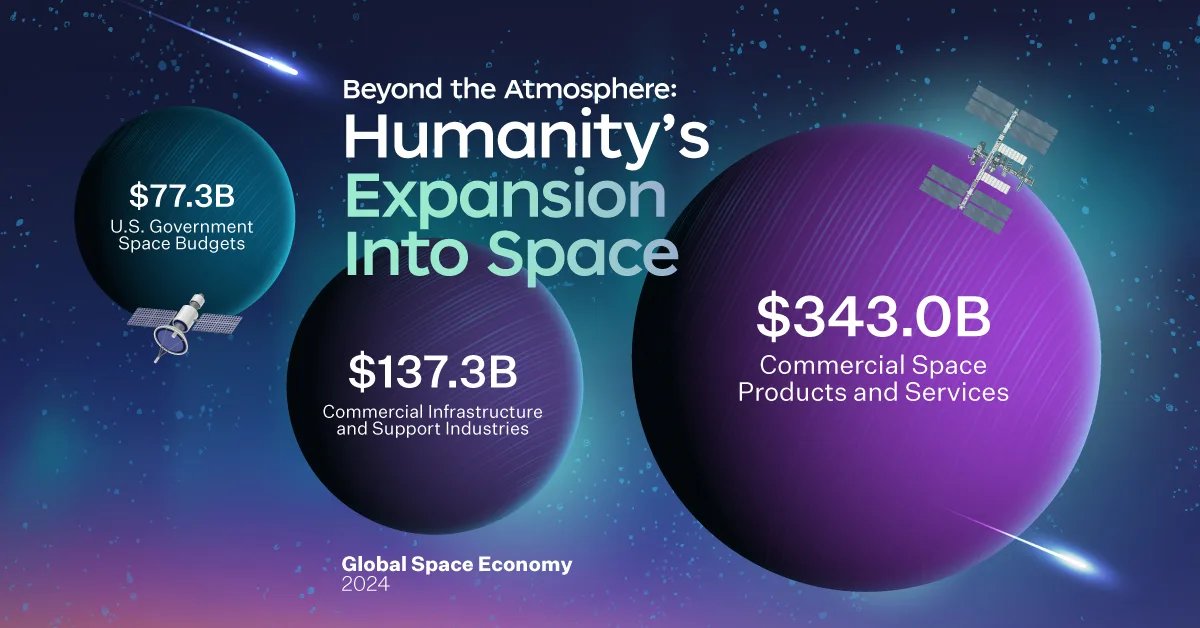
Space is emerging as one of the fastest growing economic frontiers. By 2032, commercial enterprises will push the value of the space economy beyond $1 trillion by 2032
For a clearer comparison, here is a table comparing commercial to government space budgets in 2024:
| Sector | Value ($ Billions) |
|---|---|
| Commercial Space Products and Services | 343 |
| Commercial Infrastructure and Support Industries | 137 |
| U.S. Government Space Budgets | 77 |
| Non-U.S Government Space Budgets | 55 |
| Global Space Economy, 2024 | $613 Billion |
Commercial budgets currently far exceed government, with commercial space products and services ($343 billion) leading the way.
Looking Ahead: The Future of Space
The future of space is being fueled by innovations in biohacking, dark energy, and advanced network integration.
To continue exploring the space and its biggest emerging opportunities shaping the future, read the Dubai Future Foundation’s Global 50 report.

Learn more about the Dubai Future Forum.
-

 Technology1 week ago
Visualized: Exploring the Future of the Mind
Exploring the Mind: opportunities that could shape the future through discovery, investment, and innovation with the Dubai Future Foundation.
-
 Technology2 weeks ago
Visualized: Exploring the Ocean’s Future
Explore ocean opportunities that could shape the future through discovery, investment, and innovation with the Dubai Future Foundation.