
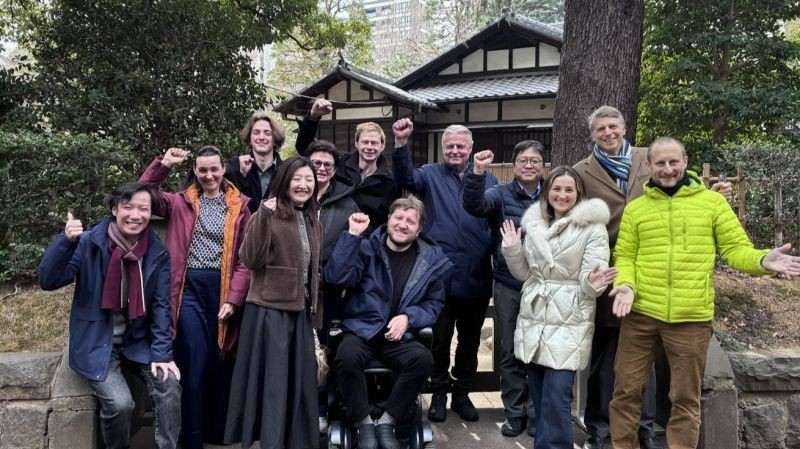
Urban researchers from a Future Earth Urban Knowledge-Action Network (Urban KAN) project between Japan, Sweden, and Poland gathered in Tokyo from 9–11 February to launch the new Driving Urban Transitions project “Enhancing Urban Resilience to Disasters and Conflicts through Nature-Based Infrastructure.” The three-year collaboration brings together The University of Tokyo (JST), the Stockholm Resilience Centre (FORMAS), and the Social-Ecological Systems Analysis Lab at the University of Lodz (NCBR) to explore how nature-based solutions (NbS) can strengthen urban resilience across Europe and Asia.
The kickoff meeting was attended by members of the Future Earth Urban KAN leadership and Secretariat, including Kensuke Fukushi, Urban KAN co-chair; Thomas Elmqvist, member of the Urban KAN Advisory Group; Marcin Jarzebski, Urban KAN member and Future Earth Science Officer; and Giles Bruno Sioen, Urban KAN member and Future Earth Co-Lead for Research & Innovation. Their participation underscored the project’s strong alignment with Future Earth’s strategic priorities on sustainability, resilience, and actionable urban knowledge.
The meeting focused on aligning the consortium’s vision, refining work packages, and establishing a shared roadmap for research and collaboration. Participants exchanged knowledge on urban green infrastructure, disaster risk reduction, civic ecology, and post-conflict recovery, while also initiating joint tasks and strengthening partnerships that will underpin the project’s success. The Tokyo kickoff marked an important first step in building a transnational research partnership dedicated to advancing nature-based infrastructure for resilient, equitable, and sustainable urban recovery.
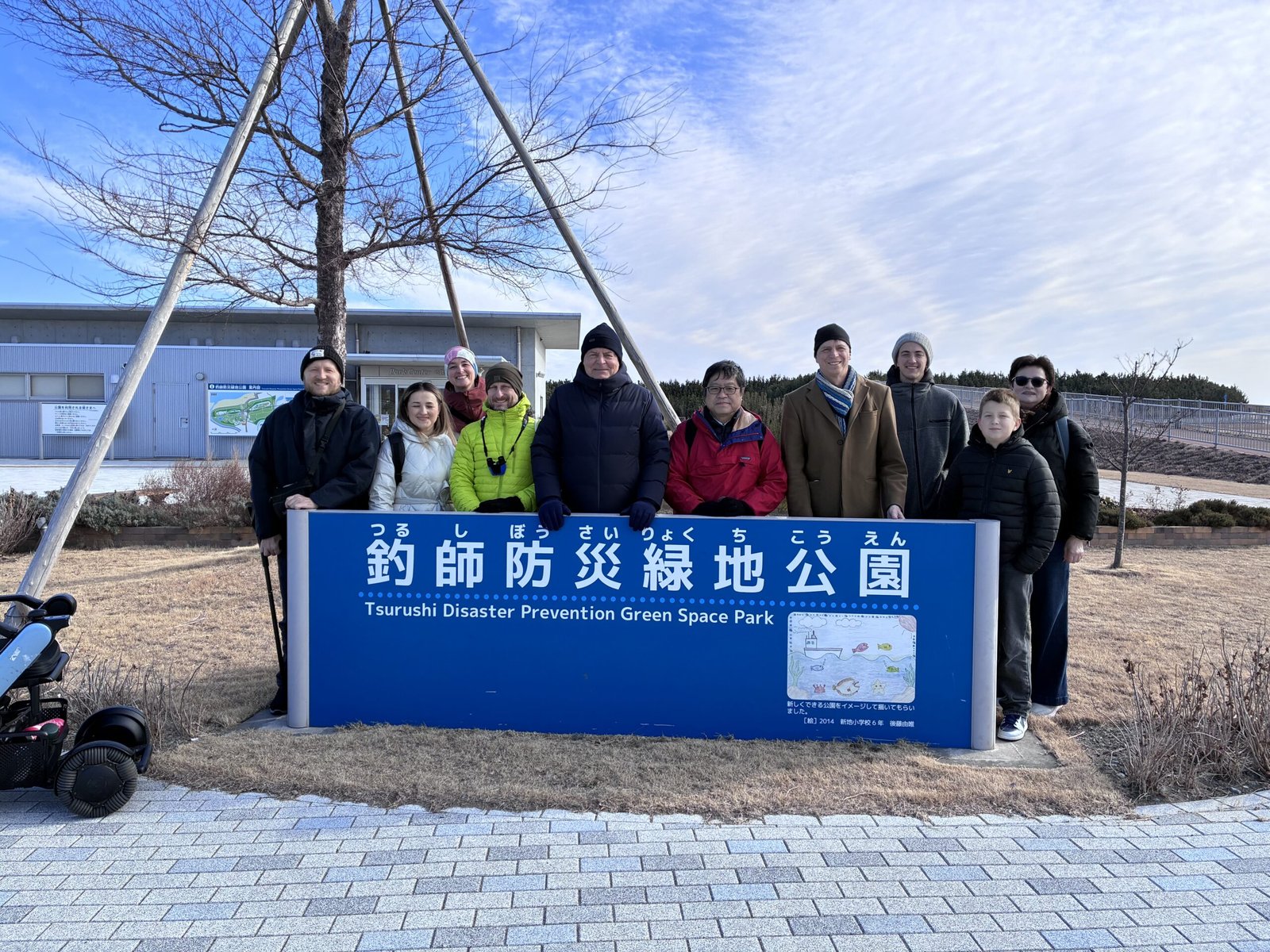
In addition to the Tokyo kickoff discussions, participants conducted a field visit in coastal Tohoku, primarily in Shinchi (Fukushima) and neighboring municipalities in Fukushima and Miyagi Prefectures. The visit examined post-disaster reconstruction and community-led recovery, with a focus on the integration of nature-based and hybrid infrastructure for resilience. Sites included memorial facilities, reconstructed coastal parks with evacuation functions, and compact-city–style public housing, offering concrete insights into how disaster recovery, demographic change, and sustainability transitions intersect in practice. The field visit directly informs the project’s work on green and resilient infrastructure under conditions of population aging and decline.

The project responds to the growing convergence of climate change, biodiversity loss, disasters, and geopolitical instability. Urban areas are increasingly on the frontlines of these crises, requiring approaches that move beyond rebuilding physical infrastructure toward long-term, nature-positive recovery. By integrating ecological restoration with social cohesion and community wellbeing, the project aims to contribute to sustainable and inclusive urban futures.
Research will focus on analyzing post-disaster and post-conflict recovery processes in various countries to accelerate recovery in Ukrainian cities. Five key objectives guide the work: understanding the role of green infrastructure in preparedness and recovery; examining civic ecology practices as pathways for healing and reintegration; identifying diverse nature-based responses to crises; exploring green infrastructure design across urban–rural gradients; and developing strategies to integrate these insights into long-term recovery policy.
A strong emphasis will be placed on multigenerational perspectives, including the role of children and youth, as well as the reintegration of returnees and veterans in post-conflict settings. Collaboration with municipalities, NGOs, and global networks such as Future Earth and ICLEI will help ensure the project’s findings translate into real-world impact.
Taken together, the kickoff meeting in Tokyo and the field visit in coastal Tohoku provided a shared reference point for participants to reflect on how nature-based and hybrid infrastructure approaches are being explored in diverse urban recovery contexts. Anchored within the Future Earth Urban Knowledge-Action Network, the project brings together international perspectives on disaster recovery, demographic change, and sustainability transitions, contributing to ongoing dialogue on the role of nature-based infrastructure in building more resilient and inclusive urban futures.
For further information on the project within the Driving Urban Transitions partnership, please see: https://dutpartnership.eu/projects/resilient-urban-nbi


